
Have you ever checked the weather and seen 72°F, then looked at another website and found 22°C? You may have wondered why the numbers are so different when they seem to describe almost the same weather.
This is where many English learners get confused.
Fahrenheit and Celsius are two different temperature scales. They measure the same thing, but they use different numbers. For example, water freezes at 32°F on the Fahrenheit scale and at 0°C on the Celsius scale.
That can look strange at first, especially when you are learning English and also trying to understand weather, cooking, travel, or science.
This topic is important because temperature words appear everywhere in daily English. You may hear someone say, “It’s 95 degrees today,” see “Bake at 350°F” in a recipe, or read “The temperature is 20°C” in a weather report.
The good news is that the difference is easy to understand once you know how each scale works.
You will also learn how to convert Fahrenheit to Celsius, how to convert Celsius to Fahrenheit, how people use these scales in everyday conversation, and how to avoid common mistakes.
By the end, numbers such as 50°F, 68°F, 100°F, 10°C, and 30°C will make much more sense.
What Does “Fahrenheit” Mean?
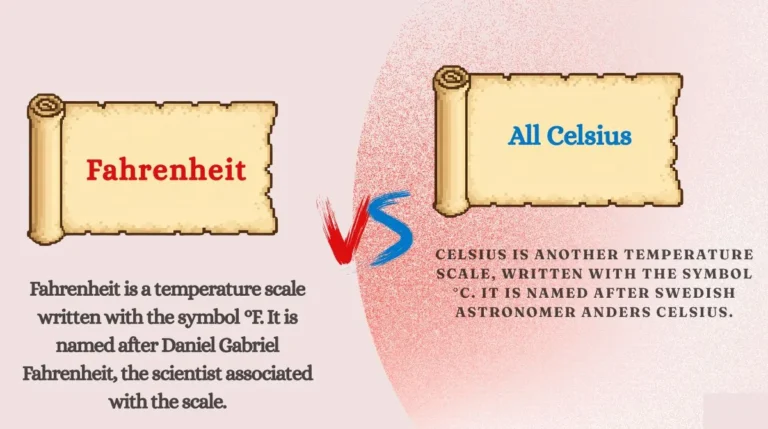
Fahrenheit is a temperature scale written with the symbol °F. It is named after Daniel Gabriel Fahrenheit, the scientist associated with the scale.
When people use Fahrenheit, they describe how hot or cold something is using Fahrenheit degrees. The scale is especially common in the United States, where it is widely used for weather, cooking, and everyday temperature discussions.
For example, an American weather report may say:
“It will be 85°F this afternoon.”
That means the temperature will be 85 degrees Fahrenheit.
When do we use Fahrenheit?
Fahrenheit is commonly used when talking about:
- Weather in the United States
- Body temperature in some everyday American contexts
- Oven temperatures in many American recipes
- Hot and cold temperatures in homes, cars, and workplaces
- Other everyday temperature measurements in the United States
A useful point for English learners is that people often simply say “degrees” when the scale is already clear.
For example:
“It’s 90 degrees today.”
In an American conversation, this often means 90°F.
However, when there could be confusion, it is better to say the full scale:
“It’s 90 degrees Fahrenheit today.”
Language and usage rule
Fahrenheit is normally used as an adjective or as part of the temperature expression.
You can say:
- “The temperature is 70 degrees Fahrenheit.”
- “The oven is set to 350°F.”
- “Today will be 80 degrees Fahrenheit.”
- “The water reached 100°F.”
It is also common to write the number and symbol together:
70°F
In standard writing, the degree symbol is placed after the number and before the scale letter.
Examples of Fahrenheit
- It is 75°F outside today.
- The forecast says the temperature will reach 90°F.
- Set the oven to 350°F.
- The water was about 100°F.
- It was only 40°F this morning.
- The temperature dropped to 32°F overnight.
- I usually feel comfortable at around 70°F.
- The thermometer showed 98.6°F.
Common learner confusion about Fahrenheit
One common mistake is thinking that Fahrenheit and Celsius use the same number system.
They do not.
For example:
- 50°F is about 10°C
- 68°F is about 20°C
- 86°F is about 30°C
- 104°F is about 40°C
So, 86°F does not mean 86°C. The scales are different.
Another common problem is forgetting that the letter F means Fahrenheit. If you see °F, think Fahrenheit.
What Does “Celsius” Mean?
Celsius is another temperature scale, written with the symbol °C. It is named after Swedish astronomer Anders Celsius.
Celsius is the temperature scale used in most countries around the world. It is especially common in Europe, Asia, Africa, Australia, and many other regions.
For many learners, Celsius feels easier because the numbers are closely connected to the familiar freezing and boiling points of water.
Under standard atmospheric pressure:
- Water freezes at 0°C
- Water boils at 100°C
This is why the Celsius scale is often easy to remember.
For example:
“It is 25°C today.”
This means the weather is around 25 degrees Celsius, which is roughly 77°F.
When do we use Celsius?
Celsius is commonly used for:
- Weather reports in most countries
- Science and education
- Cooking in many parts of the world
- Room and outdoor temperatures
- General temperature measurements
A weather report might say:
“The temperature will reach 30°C this afternoon.”
In ordinary speech, people may simply say:
“It’s 30 degrees.”
The exact meaning depends on the country and context.
Language and usage rule
Just like Fahrenheit, Celsius can be used with a number and the word “degrees.”
Examples include:
- “The temperature is 20 degrees Celsius.”
- “It’s 35°C outside.”
- “The water is 50°C.”
- “Keep the oven at 180°C.”
Remember that Celsius describes the scale. It is not the same as saying just “temperature.”
Examples of Celsius
- It is 25°C outside.
- The temperature dropped to 5°C last night.
- Water freezes at 0°C.
- Water boils at 100°C at standard atmospheric pressure.
- The oven should be set to 180°C.
- Tomorrow may reach 35°C.
- The room feels comfortable at about 22°C.
- The thermometer showed 38°C.
Common learner confusion about Celsius
Some learners think Celsius always means cold because they are used to low numbers such as 0°C or 10°C. That is not true.
A temperature of:
- 0°C is freezing
- 10°C is cool
- 20°C is mild
- 30°C is hot for many people
- 40°C is very hot
So, when you see Celsius, do not judge the weather by the number alone. Learn the usual temperature ranges too.
Difference Between Fahrenheit and Celsius
The biggest difference is simple: they are two different scales used to measure temperature.
They describe the same physical condition, but the numbers are different.
For example, a warm day might be:
86°F = 30°C
The temperature has not changed. Only the way it is measured has changed.
Fahrenheit vs Celsius comparison table
| Feature | Fahrenheit | Celsius |
|---|---|---|
| Symbol | °F | °C |
| Name | Fahrenheit | Celsius |
| Freezing point of water | 32°F | 0°C |
| Boiling point of water | 212°F | 100°C |
| Common in | United States | Most countries |
| Scale between freezing and boiling | 180 degrees | 100 degrees |
| Common weather example | 75°F | 24°C |
| Common oven example | 350°F | 180°C |
Usage difference
The main difference is regional usage.
If you are reading an American weather forecast, you are likely to see Fahrenheit:
“High: 92°F”
If you are reading a weather report from many other countries, you are more likely to see Celsius:
“High: 33°C”
Neither scale is “more correct.” They are simply different ways to express temperature.
Grammar and language logic
Although the topic is really about temperature measurement rather than grammar, English learners often make language mistakes when using these terms.
Compare:
The temperature is 30°C.
and:
The temperature is 86°F.
Both sentences have the same grammar pattern:
The temperature + is + number + scale
You can also use:
It + is + number + degrees + scale
For example:
“It is 20 degrees Celsius.”
or:
“It is 68 degrees Fahrenheit.”
You can ask:
“What is the temperature?”
You can also ask:
“How many degrees is it?”
When the country or conversation already makes the scale obvious, speakers may leave out “Fahrenheit” or “Celsius.”
Sentence-structure difference
The numbers change, but the sentence structure usually does not.
Compare these:
“It’s 25°C today.”
“It’s 77°F today.”
The grammar stays the same.
Here are some other useful patterns:
The temperature is + number + scale.
The temperature is 18°C.
It is + number + degrees + scale.
It is 64 degrees Fahrenheit.
The temperature reached + number + scale.
The temperature reached 40°C.
The oven is set to + number + scale.
The oven is set to 350°F.
Meaning comparison
The real challenge is remembering what the numbers feel like.
For quick reference:
| Fahrenheit | Celsius | General feeling |
|---|---|---|
| 14°F | -10°C | Extremely cold |
| 32°F | 0°C | Freezing point of water |
| 50°F | 10°C | Cool |
| 59°F | 15°C | Mild/cool |
| 68°F | 20°C | Comfortable |
| 77°F | 25°C | Warm |
| 86°F | 30°C | Hot |
| 95°F | 35°C | Very hot |
| 104°F | 40°C | Extremely hot |
These descriptions are general because people experience temperatures differently. Humidity, wind, sunlight, clothing, and activity can also affect how hot or cold a temperature feels.
How to Convert Fahrenheit to Celsius
The Fahrenheit-to-Celsius formula is:
°C = (°F − 32) × 5/9
You first subtract 32 from the Fahrenheit number. Then multiply the result by 5/9.
Example: Convert 68°F to Celsius
Start with:
68 − 32 = 36
Then:
36 × 5/9 = 20
So:
68°F = 20°C
Another example: Convert 86°F
86 − 32 = 54
Then:
54 × 5/9 = 30
So:
86°F = 30°C
This is a very useful conversion because 86°F is a common warm-weather temperature.
How to Convert Celsius to Fahrenheit
The Fahrenheit formula is:
°F = (°C × 9/5) + 32
First multiply the Celsius temperature by 9/5. Then add 32.
Example: Convert 20°C to Fahrenheit
20 × 9/5 = 36
Then:
36 + 32 = 68
So:
20°C = 68°F
Another example: Convert 30°C
30 × 9/5 = 54
Then:
54 + 32 = 86
So:
30°C = 86°F
The formulas may look difficult at first, but after using them a few times, they become much easier.
Grammar Rules You Must Remember
Rule 1: Use the correct symbol
Use:
- °F for Fahrenheit
- °C for Celsius
Examples:
The temperature is 75°F.
The temperature is 24°C.
Do not switch the letters. The number may be correct, but the sentence will mean something completely different if the wrong scale is used.
Rule 2: “Degrees” is used with both scales
You can say:
“It is 70 degrees Fahrenheit.”
or:
“It is 21 degrees Celsius.”
The word degrees works with both systems.
In written form, the symbol replaces the word:
70°F
21°C
In technical, scientific, or formal writing, giving the number and scale clearly is usually safest.
Rule 3: Do not add the wrong scale to a number
A Fahrenheit number cannot simply be called Celsius.
For example:
Wrong: It is 100°C when the thermometer shows 100°F.
Correct: It is 100°F.
These are very different temperatures.
In fact, 100°F is about 37.8°C, while 100°C is the boiling point of water under standard atmospheric pressure.
That is a huge difference.
Rule 4: Learn common temperature equivalents
You do not always need a calculator.
Memorize a few common pairs:
32°F = 0°C
50°F = 10°C
68°F = 20°C
86°F = 30°C
104°F = 40°C
Once you remember these, you can estimate many temperatures more quickly.
Common Mistakes Students Make
Temperature mistakes usually happen because learners try to treat Fahrenheit and Celsius as if they were identical.
Mistake 1: Thinking 80°F means 80°C
This is probably the most common mistake.
80°F is about 26.7°C, while 80°C is extremely hot.
So when someone says:
“It is 80 degrees today.”
You need to know the local system before deciding what that means.
Mistake 2: Forgetting the 32 in the conversion formula
Some learners try to convert Fahrenheit by simply multiplying or dividing.
For example, they may think:
68°F ÷ 2 = 34°C
That is wrong.
The correct formula is:
(68 − 32) × 5/9 = 20°C
The 32 is an important part of the Fahrenheit-to-Celsius conversion.
Mistake 3: Mixing up weather temperatures
A learner might read:
“Today’s high is 35°F”
and think it is very hot because 35 is close to 35°C.
It is not.
35°F is about 1.7°C, so it is quite cold.
Mistake 4: Confusing oven temperatures
Recipes can cause problems when you switch between countries.
For example:
350°F is about 177°C.
It is often rounded to 180°C in practical cooking.
So following the wrong scale can make a recipe fail because the oven temperature can be far too high or too low.
Mistake 5: Using the wrong question
Some learners ask:
“How Celsius is it?”
That is not natural English.
Better choices are:
“What’s the temperature?”
“How many degrees is it?”
“What’s the temperature in Celsius?”
“What is that in Fahrenheit?”
Easy correction tip
Whenever you see a temperature, look for the letter first.
F = Fahrenheit
C = Celsius
Then think about the likely temperature range.
This small habit prevents many mistakes.
Easy Trick to Remember the Difference
Here is a simple memory trick:
C = Celsius = Common Around the World
You can think of C as Common internationally. Most countries use Celsius for everyday temperatures.
F = Fahrenheit = Familiar in the USA
Think of F as Fahrenheit in the USA.
This is not a perfect language rule, but it is a useful memory trick for learners.
Another helpful trick is to remember just five pairs:
32°F = 0°C
50°F = 10°C
68°F = 20°C
86°F = 30°C
104°F = 40°C
Notice something interesting: every time Celsius increases by 10 degrees, Fahrenheit increases by 18 degrees.
The difference between the two scales is not a fixed number, so you cannot always just add or subtract the same amount.
For quick estimates, you may hear people use rough shortcuts. For example, some use:
Fahrenheit ≈ Celsius × 2 + 30
This can give a rough idea, but it is not exact.
For accurate conversion, use the real formulas.
Daily Life Examples
Understanding temperature becomes easier when you see it in natural conversations.
Example 1: Talking about the weather
A: How hot is it today?
B: It’s about 90°F.
A: Wow, that’s hot!
Here, Fahrenheit is natural in an American setting.
Example 2: A Celsius weather report
A: What’s the temperature outside?
B: It’s 28°C.
A: That sounds pretty warm.
Example 3: Asking for a conversion
A: It’s 30°C here. What is that in Fahrenheit?
B: It’s 86°F.
This is a common question when people from different countries are talking.
Example 4: Visiting another country
A: The weather app says 72°F.
B: I’m used to Celsius. What is that?
A: It’s about 22°C.
Example 5: Talking about cold weather
A: It’s only 32°F this morning.
B: So that’s 0°C?
A: Exactly.
Example 6: Cooking
A: What temperature should I use for the oven?
B: Set it to 350°F.
A: Is that about 180°C?
B: Yes, roughly.
Example 7: Talking about a hot day
A: What was the temperature yesterday?
B: It reached 40°C.
A: That is about 104°F, right?
B: Yes.
Example 8: Asking someone about the temperature
A: How many degrees is it outside?
B: Around 20 degrees Celsius.
A: That sounds pleasant.
Example 9: Understanding American English
A: It’s 100 degrees today.
B: Fahrenheit or Celsius?
A: Fahrenheit.
This shows why asking for the scale can be important.
Example 10: Comparing temperatures
A: Which is warmer, 50°F or 20°C?
B: 20°C. It is about 68°F.
These simple conversations are good practice because they show how people really use temperature expressions.
Practice Section
Choose the correct answer.
1. Water freezes at:
A. 0°F
B. 0°C
C. 100°F
2. 68°F is approximately:
A. 10°C
B. 20°C
C. 40°C
3. Which symbol represents Fahrenheit?
A. °C
B. °F
C. °K
4. Which formula converts Celsius to Fahrenheit?
A. (C − 32) × 5/9
B. C × 9/5 + 32
C. C ÷ 2
5. 30°C is approximately:
A. 54°F
B. 68°F
C. 86°F
Answers
1. B — 0°C
2. B — 20°C
3. B — °F
4. B — C × 9/5 + 32
5. C — 86°F
Try to answer the questions without looking at the explanations above. Then check your answers. That small amount of practice can help the conversions stick in your memory.
FAQs About Fahrenheit vs Celsius
What is the difference between Fahrenheit and Celsius?
Fahrenheit and Celsius are two different temperature scales. They measure the same physical temperature but use different numbers.
For example, water freezes at 32°F and 0°C. Likewise, 68°F is equal to 20°C. The main difference is the scale used to express the temperature.
Is Fahrenheit higher or lower than Celsius?
Neither scale is simply higher or lower. The numbers are based on different scales.
For the same temperature, the Fahrenheit number is often larger than the Celsius number when the temperature is above about -40°. For example, 30°C is 86°F.
The two scales meet at -40 degrees, so -40°C = -40°F.
What is 100°F in Celsius?
100°F is approximately 37.8°C.
This is close to normal human body temperature, although actual body temperature can vary by person and measurement method.
The conversion is:
(100 − 32) × 5/9 = 37.8°C
What is 20°C in Fahrenheit?
20°C equals 68°F.
This is a useful temperature to remember because 20°C often feels mild or comfortable, depending on humidity, wind, clothing, and personal preference.
The formula is:
(20 × 9/5) + 32 = 68°F
Is Celsius used more than Fahrenheit?
Celsius is used in most countries for everyday temperature measurements, while Fahrenheit remains widely used in the United States.
Some countries or situations may use both scales, especially when communicating with international audiences. The important thing is to identify which scale is being used.
Why does the United States use Fahrenheit?
The United States continues to use Fahrenheit in many everyday settings, including weather reports, cooking, and household temperature discussions.
Most other countries use Celsius for these purposes. This difference is mainly a matter of historical and regional usage rather than one scale being scientifically better for ordinary temperature measurement.
Conclusion
Understanding Fahrenheit vs Celsius becomes much easier when you stop thinking of them as competing numbers and start thinking of them as two different measuring systems for the same temperature.
Fahrenheit uses °F, while Celsius uses °C. Water freezes at 32°F or 0°C, and water boils at 212°F or 100°C under standard atmospheric pressure. Celsius is common in most countries, while Fahrenheit is especially common in the United States.
For everyday English, learn a few useful pairs such as 68°F = 20°C, 86°F = 30°C, and 104°F = 40°C. These will help you understand weather reports, conversations, recipes, and travel information much faster.
The best way to remember the difference is to practice. Read temperatures aloud, try a few conversions, and notice which scale is used in the English you hear. After a little practice, Fahrenheit and Celsius will stop looking confusing and start feeling natural.

Evan Rellmont is a writer who turns thoughtful ideas into meaningful words, creating stories and reflections that connect, inspire, and leave a lasting impression.