
English learners often get confused by can and could because the two words are closely related.
Both are modal verbs, both can talk about ability or possibility, and both can appear in questions. Yet they are not always interchangeable.
For example, “Can you help me?” and “Could you help me?” are both correct. The first is a normal request, while the second usually sounds softer and more polite.
Then there is past ability: “I can swim” talks about an ability I have now, while “I could swim when I was six” talks about an ability I had in the past.
The tricky part is that could does not always mean past. It can be used for present or future possibilities, polite requests, permission questions, and suggestions. Can, meanwhile, is often used for present ability, permission, offers, requests, and general possibilities.
These two little words appear in everyday English all the time. You hear them at home, at school, at work, in shops, and in casual conversations.
Understanding them will help you speak more naturally and avoid common grammar mistakes.
By the end, you will know when to choose can, when to choose could, and how their meanings change with context.
What Does “Can” Mean?
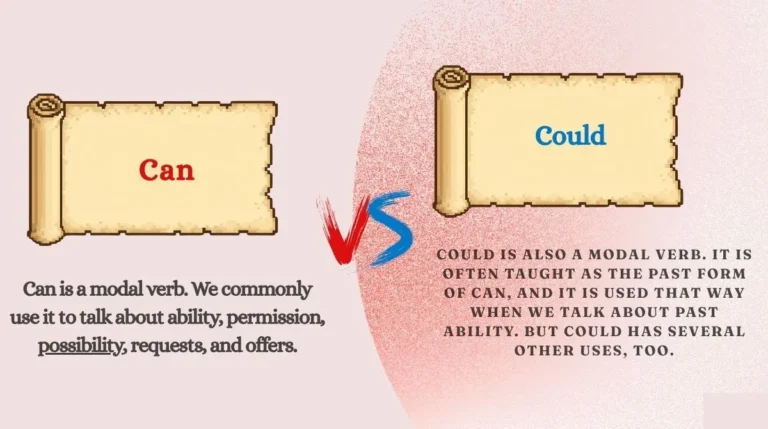
Can is a modal verb. We commonly use it to talk about ability, permission, possibility, requests, and offers.
The most common use is ability. When someone says “I can drive,” they mean driving is a skill they have. It does not necessarily mean they are driving at that moment.
We also use can for permission. For example, “You can use my phone” means the speaker gives permission. In everyday English, “Can I use your phone?” is also a normal way to ask for permission.
Another use is general possibility. Compare “It can be very hot here in July.” This does not mean it is hot at this exact moment. It means hot weather is a normal or possible condition in that place.
Grammar rule for can
After can, use the base form of the verb:
- can go
- can speak
- can help
- can drive
- can understand
Do not add to or -s after can.
✅ She can swim.
❌ She can to swim.
❌ She can swims.
Questions are formed directly with can:
✅ Can you help me?
❌ Do you can help me?
The negative form is can’t in normal speech and cannot in writing.
Examples of can
- I can speak English and Urdu.
- My brother can fix computers.
- Can you open the window, please?
- Can I borrow your pen?
- You can sit here.
- We can meet after work.
- This road can be dangerous at night.
- I can hear someone outside.
Common learner confusion with can
A common mistake is thinking can only means “be able to.” In fact, its meaning changes with the sentence.
- I can swim. → ability
- Can I swim here? → permission
- Can you help me? → request
- Can I carry that for you? → offer
- It can be noisy here. → general possibility
So, always look at the purpose of the sentence rather than learning one fixed translation for can.
What Does “Could” Mean?
Could is also a modal verb. It is often taught as the past form of can, and it is used that way when we talk about past ability. But could has several other uses, too.
For example, “When I was ten, I could run very fast” describes a general ability in the past. But “It could rain tonight” does not talk about the past at all. It shows an uncertain future possibility.
We also use could to make requests sound more polite:
Could you help me?
And we use it when asking permission:
Could I leave a little early today?
In these examples, could is not a past form in meaning. It simply makes the request softer.
Could is also common when making suggestions:
You could try restarting the computer.
This means “Here is one possible idea.” It is not an order.
Grammar rule for could
Like can, could is followed by the base form of the verb:
- could go
- could help
- could study
- could wait
- could be
Do not use to or -s after could.
✅ He could help.
❌ He could to help.
❌ He could helps.
For negatives, use couldn’t or could not.
✅ I couldn’t understand him.
❌ I didn’t could understand him.
For questions, place could before the subject:
✅ Could you help me?
❌ Do you could help me?
Examples of could
- When I was younger, I could climb trees easily.
- Could you close the door, please?
- Could I ask you something?
- We could order pizza tonight.
- It could rain later.
- She could be at home now.
- You could try again tomorrow.
- I couldn’t understand the instructions.
Common learner confusion with could
The biggest problem is thinking could always means past.
It can have several meanings:
- Past ability: I could swim when I was six.
- Present possibility: He could be busy right now.
- Future possibility: We could visit them next week.
- Polite request: Could you help me?
- Suggestion: You could talk to your teacher.
The context tells you what could means.
Difference Between Can and Could (Detailed)
The easiest way to understand can vs could is to compare their main uses.
| Use | Can | Could |
|---|---|---|
| Present ability | I can drive. | Usually not the normal choice |
| General past ability | Usually not used | I could drive at 18. |
| General possibility | It can be expensive. | It could be expensive. |
| Uncertain possibility | Less common for this meaning | It could rain tonight. |
| Asking permission | Can I come in? | Could I come in? |
| Giving permission | You can go. | Normally not used to give actual permission |
| Request | Can you help me? | Could you help me? |
| Suggestion | Less common | You could try again. |
| Offer | Can I help? | I could help, if you like. |
Can for present ability
Use can when someone has an ability now.
- I can cook.
- She can drive.
- We can solve this problem.
If the person still has the skill, can is normally the natural choice.
Could for past ability
Use could for a general ability someone had in the past.
- When I was a child, I could run for hours.
- My grandfather could speak three languages.
- She could play the piano at age eight.
There is an important detail here. For one specific successful action in the past, English often prefers was/were able to or managed to instead of affirmative could.
✅ I was able to find my keys yesterday.
✅ She managed to finish the project on time.
This is because could commonly describes general ability or possibility, while was able to focuses on a particular successful event.
Can for general possibility
Can often describes something that is possible in general.
- Winters can be very cold here.
- Driving in heavy rain can be dangerous.
- People can make mistakes.
- This machine can become noisy after long use.
The idea is not always “this will happen.” It means the situation is possible or sometimes happens.
Could for uncertain possibility
Could often means that something is possible, but the speaker is not certain.
- Sara could be at home.
- It could rain tonight.
- This could be the answer.
- They could arrive late.
Here, could presents one possible situation rather than a definite fact.
Could for polite requests
Both words can be used to ask someone to do something.
- Can you pass the salt?
- Could you pass the salt?
Both are correct. Could normally sounds more polite or less direct.
That does not mean can is rude. Can you help me? is perfectly natural with friends, family, classmates, and coworkers. Could you help me? simply gives the request a softer tone.
Could for polite permission
You can also use both forms when asking for permission.
- Can I leave early today?
- Could I leave early today?
The second version is usually more polite or formal. However, when you give permission, the normal reply is:
“Yes, you can.”
Not:
“Yes, you could.”
Cambridge specifically notes that could is used to ask for permission, while can is normally used to give it.
Sentence structure
Both verbs follow a very simple pattern:
Subject + can/could + base verb
- She can dance.
- She could dance.
For questions:
Can/Could + subject + base verb?
- Can you swim?
- Could you swim as a child?
For negatives:
Subject + can’t + base verb
- I can’t drive.
Subject + couldn’t + base verb
- I couldn’t drive when I was younger.
Once you remember this pattern, many sentence-building mistakes disappear.
Grammar Rules You Must Remember
Rule 1: Use the base verb after can and could
Never add to, -s, or another tense ending directly after these modal verbs.
✅ She can sing.
✅ He could help.
❌ She can sings.
❌ He could helped.
Remember:
can/could + verb 1
The main verb stays in its simple form.
Rule 2: Use can for present ability and could for general past ability
When you talk about something a person is able to do now, use can:
I can swim.
For a general ability in the past, use could:
I could swim when I was five.
A time expression such as when I was five, when I was young, or back then often makes the past meaning clear.
Rule 3: Could can make a request softer
Compare:
- Can you send me the file?
- Could you send me the file?
Both are grammatically correct. Could usually sounds less direct and more polite, especially in formal or unfamiliar situations.
Rule 4: Use could for suggestions and uncertain possibilities
When you are offering an idea, could is very useful:
- We could take the train.
- You could ask your teacher.
- You could try again.
It is also common for possibilities that are not certain:
- The package could arrive tomorrow.
- He could be busy.
- It could snow tonight.
By contrast, can is often used for general possibilities:
- The road can be dangerous at night.
- It can get very cold here in winter.
Common Mistakes Students Make
Many mistakes happen because learners translate directly from their first language. Another problem is that students memorize could = past can and then use it in every past sentence.
Mistake 1: Adding “to”
❌ She can to speak English.
✅ She can speak English.
❌ We could to meet tomorrow.
✅ We could meet tomorrow.
After a modal verb, do not add to.
Mistake 2: Adding “s”
❌ He can drives.
✅ He can drive.
❌ She could speaks French.
✅ She could speak French.
The modal verb is followed by the base verb.
Mistake 3: Using do, does, or did
❌ Did you could swim?
✅ Could you swim?
❌ I didn’t could understand.
✅ I couldn’t understand.
Modal verbs form questions and negatives without do/does/did.
Mistake 4: Using could to give permission
A learner may think this is correct:
❌ “Could I borrow your book?”
❌ “Yes, you could.”
A more natural answer is:
✅ “Yes, you can.”
The question uses could for politeness, while the answer uses can for permission.
Mistake 5: Thinking could always means past
In “Could you help me?”, could refers to a present request.
In “It could rain tonight,” it refers to a future possibility.
In “I could swim when I was six,” it refers to past ability.
So, do not translate could automatically. First ask what the speaker is trying to express.
Mistake 6: Using could for a specific past success
❌ I could find my wallet after an hour.
✅ I was able to find my wallet after an hour.
For a particular successful event, was/were able to or managed to is often clearer. Could remains very natural for general past ability.
Easy Trick to Remember the Difference
Here is a simple memory trick:
Can = able now, allowed now, or generally possible
Could = able before, maybe, more polite, or one possible idea
Think of the two words like this:
CAN → direct and present
COULD → past ability, softer request, or less certain possibility
Look at these pairs:
I can help you.
I am able to help you.
I could help you.
Helping you is one possible option.
Another pair:
Can I use your phone?
A normal permission question.
Could I use your phone?
A softer and more polite permission question.
And one more:
It can get cold here.
Cold weather is a general possibility.
It could get cold tonight.
Tonight being cold is one possible situation.
When you are unsure, ask yourself one question:
What is the purpose of this sentence?
Is it about ability, permission, possibility, politeness, or a suggestion?
That one question will usually guide you to the right word.
Daily Life Examples
These short conversations show how can and could work in real-life English.
1. Asking a friend for help
Ali: Can you carry this box?
Hamza: Sure, I can help.
Because the situation is casual, can sounds natural.
2. Asking a teacher
Student: Could you explain this question again, please?
Teacher: Of course.
Could makes the request softer.
3. Asking for permission
Sara: Can I use your charger?
Mina: Yes, you can.
This is a very common everyday use of can.
4. Asking politely
Customer: Could I have a glass of water, please?
Waiter: Certainly.
The customer chooses could for a more polite request.
5. Talking about a skill
John: Can you cook?
David: Yes, I can make several dishes.
This is about present ability.
6. Talking about childhood ability
Mother: Could you ride a bicycle when you were six?
Son: Yes, I could.
Here, could refers to past ability.
7. Talking about possibility
Aisha: Where is Omar?
Nida: He could be in the library.
The speaker is guessing, so could shows uncertainty.
8. Making a suggestion
Tom: I do not know how to fix my laptop.
Sam: You could restart it first.
This gives one possible solution.
9. General possibility
Ahmed: Is this road dangerous?
Bilal: It can be dangerous when it is very foggy.
Here, can describes a general situation.
10. Making an offer
Shop assistant: Can I help you find your size?
Customer: Yes, please.
Can I help? is a very common way to offer assistance.
Practice Section
Choose can or could to complete each sentence.
- When I was seven, I ___ swim very well.
- ___ you please send me the address?
- We ___ go out for dinner tonight.
- My sister ___ speak Spanish now.
- It ___ be difficult to park here on weekends.
Answers
- could — This describes past ability.
- could — This is a polite request.
- could — This is a possible suggestion or plan.
- can — This is present ability.
- can — This describes a general possibility.
FAQs
What is the difference between can and could?
Can commonly talks about present ability, permission, offers, requests, and general possibility. Could commonly talks about past ability, uncertain possibility, polite requests, and suggestions. Context decides the exact meaning.
Can we use could for present situations?
Yes. Could can describe a present or future possibility, such as “She could be at home” or “It could rain tonight.” It is also used now for polite requests such as “Could you help me?”
Is could more polite than can?
Usually, yes, when you are making a request or asking for permission. Could you help me? normally sounds softer than Can you help me? Still, can is completely normal and polite in many everyday conversations.
Can can be used to give permission?
Yes. We normally use can to give permission: “Yes, you can go.” We commonly use could to ask for permission, but not to give it. So the natural exchange is “Could I leave?” — “Yes, you can.”
Can can be used for future ability?
Yes. In sentences such as “I can meet you tomorrow,” can can express ability or availability in the future. English often uses can for a future arrangement when the speaker is able to do it.
What is the difference between could and was able to?
Could is very common for general ability in the past, such as “She could swim at age five.” For one particular successful action, English often prefers was/were able to or managed to, such as “She was able to find the missing key.”
Conclusion
Learning can vs could becomes much easier when you stop thinking of could as only the past form of can. It can certainly describe past ability, but it also has several important everyday uses. We use it for uncertain possibilities, polite requests, permission questions, and suggestions.
Use can for present ability, permission, offers, and many general possibilities. Use could for general past ability, softer requests, suggestions, and possibilities that are less certain. Also remember the basic grammar rule: both words are followed by the base form of the verb.
The best way to master these words is to notice them in real conversations and practice making your own sentences. Try using one new example each day. After a little practice, choosing between can and could will start to feel natural rather than confusing.

Evan Rellmont is a writer who turns thoughtful ideas into meaningful words, creating stories and reflections that connect, inspire, and leave a lasting impression.