
Many English learners know the verb hang, but they often become confused when they need to talk about its past tense or past participle.
Should you say hanged or hung? Both words are correct, but they are normally used in different situations.
The confusion happens because English has one verb with two past forms. In most everyday situations, we use hung when something is suspended, placed on a wall, or attached from above.
For example, we say, “She hung the picture on the wall.” However, when talking about a person being put to death by hanging, the traditional and standard form is hanged.
For example, “The prisoner was hanged.”
This small difference matters because choosing the wrong form can change the meaning of your sentence. It is especially useful when you are writing stories, history assignments, news-style sentences, or simply trying to improve your grammar.
The good news is that the rule is quite easy once you see the difference clearly. Hung is generally used for ordinary acts of suspending or attaching something, while hanged is used for execution by hanging.
You will also see hung in many common expressions, such as “hung a picture” or “hung the curtains.”
By the end, the difference should feel much more natural, and you will know exactly which form to choose.
What Does “Hanged” Mean?
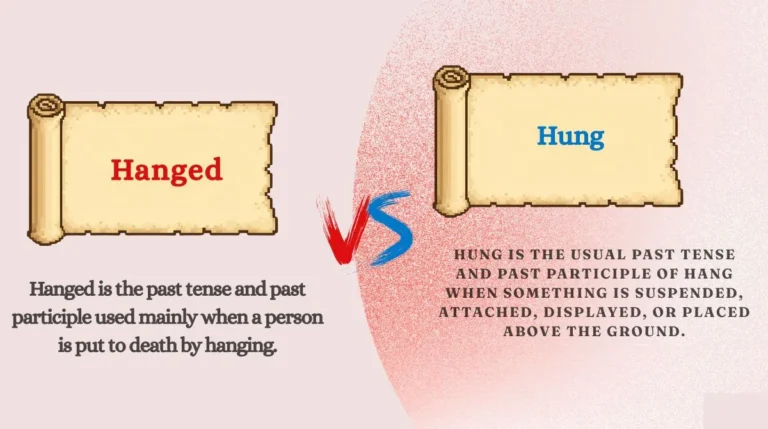
Hanged is the past tense and past participle used mainly when a person is put to death by hanging.
This is a special use of the verb hang. In standard modern English, when the sentence describes an execution, hanged is the preferred form.
For example:
- The prisoner was hanged for his crime.
- The historical figure was hanged in the nineteenth century.
- The man was sentenced to be hanged.
- Several people were hanged during that period.
- The records say that the prisoner was hanged at dawn.
- He was hanged after being found guilty.
- The book describes how the rebel was hanged.
- In the old story, the villain was hanged by order of the king.
The grammar is important here. Hanged is normally used when hang means “execute by hanging.”
The Basic Grammar Rule
The verb forms in this special meaning are:
hang → hanged → hanged
For example:
- Present: The authorities may hang the prisoner.
- Past: The authorities hanged the prisoner.
- Past participle: The prisoner was hanged.
This is different from the ordinary form of hang, which follows another pattern:
hang → hung → hung
That is the form you will use for things that are suspended or attached.
Why Do Learners Get Confused?
A common reason is that students learn irregular verbs such as sing–sang–sung, ring–rang–rung, and write–wrote–written. They expect every verb to follow one simple pattern.
With hang, things are a little unusual because both hung and hanged exist.
A learner may see “The picture was hung” and then assume that “The prisoner was hung” must also be correct. Although hung can appear in informal or historical usage, standard modern English normally makes the distinction clear: use hanged for execution.
So, when the subject is a person and the sentence is about an execution, hanged is the safe standard choice.
What Does “Hung” Mean?
Hung is the usual past tense and past participle of hang when something is suspended, attached, displayed, or placed above the ground.
It is extremely common in everyday English.
For example:
- She hung the painting in the living room.
- We hung the curtains yesterday.
- He hung his coat by the door.
- They hung decorations around the room.
- I hung the calendar on the wall.
- The children hung their bags on the hooks.
- She hung the wet clothes outside.
- He hung a mirror in the hallway.
In all these sentences, hung describes an ordinary action. Nothing is being executed.
The Basic Grammar Rule
For ordinary uses of hang, the verb forms are:
hang → hung → hung
Examples:
Present:
I hang my coat here.
Past:
I hung my coat here yesterday.
Past participle:
I have hung my coat here before.
You can also use hung without a direct object when something simply remains in a suspended position:
- The picture hung above the sofa.
- Her coat was hanging by the door.
- The lamp hung from the ceiling.
Common Uses of “Hung”
The word hung is used for many normal situations.
You can hang a picture, poster, curtain, mirror, coat, light, flag, decoration, calendar, or sign.
You can also talk about something that is physically suspended:
- The lamp hung from the ceiling.
- A flag hung outside the building.
The word also appears in everyday expressions. For example, someone can say:
- “I hung up the phone.”
- “She hung up her jacket.”
- “We hung the decorations before the party.”
Notice that these are all ordinary meanings of the verb.
A Note About “Hung Up”
Hung up is another very common expression.
It can mean putting something down or ending a telephone call:
- She hung up the phone.
- He hung up before I could answer.
In informal English, hung up can also describe being unable to stop thinking about something:
- He is still hung up on that old problem.
These uses have nothing to do with execution, so hung is correct.
Difference Between Hanged and Hung
The central difference is based on meaning.
Hanged is normally used when a person is executed by hanging.
Hung is normally used when an object is suspended, attached, displayed, or placed somewhere by hanging.
The easiest way to understand the distinction is to ask one simple question:
Is the sentence talking about an execution?
If yes, use hanged.
If no, hung will usually be the correct past form.
| Word | Main use | Example |
|---|---|---|
| Hanged | Execution by hanging | The prisoner was hanged. |
| Hung | Suspending or attaching something | She hung the picture. |
| Hung | Something remained suspended | The lamp hung from the ceiling. |
| Hanged | Historical or legal execution | He was hanged by order of the court. |
| Hung | Putting up decorations | We hung balloons around the room. |
| Hung | Attaching clothing | He hung his coat on the hook. |
| Hung | Ending a phone call with “hang up” | She hung up the phone. |
Usage Difference
Consider these two sentences:
The man was hanged.
This means the man was executed by hanging.
The man was hung from a rope.
Depending on context, this can simply describe a person being suspended, but it does not express the standard execution meaning as clearly. In formal standard English, hanged is preferred when an execution is intended.
Now compare two objects:
The picture was hung on the wall.
The curtains were hung in the bedroom.
Here, hanged would be incorrect because these sentences describe ordinary hanging.
Grammar Logic
The difference is not simply about whether the subject is a person or an object.
The real issue is what the verb means in the sentence.
For example:
- The sailor hung the flag.
- The flag was hung outside the building.
The object is a flag, so this is ordinary suspension.
But:
- The prisoner was hanged.
The verb refers to execution, so hanged is used.
This is why memorizing only “person = hanged” and “thing = hung” is not enough. That shortcut can cause problems in more complicated sentences.
Sentence Structure Difference
Both words can appear in several grammatical structures.
With hanged:
Subject + was/were + hanged
- The prisoner was hanged.
Subject + had been + hanged
- The prisoner had been hanged before the officials arrived.
With hung:
Subject + hung + object
- She hung the picture.
Subject + was/were + hung
- The picture was hung above the fireplace.
Subject + had + hung + object
- They had hung the decorations before the guests arrived.
The grammar pattern can look almost identical, so meaning is what tells you which form to choose.
Grammar Rules You Must Remember
Rule 1: Use “Hanged” for Execution
When hang means that a person was put to death by hanging, use hanged.
Examples:
- The prisoner was hanged after the trial.
- The historical record says he was hanged in 1840.
- The criminal was sentenced to be hanged.
Think of hanged as the special past form connected with execution.
Rule 2: Use “Hung” for Ordinary Hanging
When you place, suspend, or attach something, use hung in the past tense.
Examples:
- I hung the painting yesterday.
- She hung her coat near the entrance.
- We hung the lights across the room.
- They hung a sign above the door.
Nothing is being executed, so hung is correct.
Rule 3: The Present Form Is “Hang” for Both Meanings
In the present tense, the base form is simply hang.
For ordinary use:
- I hang my clothes here.
For the execution meaning:
- The sentence says the criminal would be hanged.
The difference becomes especially important in the past tense and past participle.
Remember:
Ordinary meaning: hang → hung → hung
Execution meaning: hang → hanged → hanged
Rule 4: “Hanging” Is Usually the Same for Both Meanings
The -ing form is hanging.
For example:
- She is hanging a picture.
- The picture is hanging on the wall.
- The historical account describes a man being hanged.
When you need the past form for execution, use hanged, not hung, in standard English.
The form hanging itself does not change to show this distinction.
Common Mistakes Students Make
The most common mistake is treating hung as the only past form of hang.
Students often learn:
hang → hung → hung
and then use hung everywhere.
That works for ordinary situations, but it misses the special execution form.
Mistake 1: Using “Hung” for an Execution
Wrong: The prisoner was hung for his crime.
Preferred standard form: The prisoner was hanged for his crime.
Why? Because the sentence describes an execution.
Mistake 2: Using “Hanged” for an Object
Wrong: She hanged the picture on the wall.
Correct: She hung the picture on the wall.
The picture was simply placed on the wall.
Mistake 3: Thinking Every Person Requires “Hanged”
This is another useful warning.
Wrong: He hanged his coat on the hook.
Correct: He hung his coat on the hook.
The subject is a person, but the action is ordinary hanging, not execution.
So the meaning of the verb matters more than the subject alone.
Mistake 4: Forgetting That “Hung” Is Very Common
Because hanged is a memorable word, some learners start using it too often.
For example:
Incorrect: We hanged the Christmas decorations.
Correct: We hung the Christmas decorations.
A simple way to check your sentence is to replace the verb mentally with “put up” or “suspended.”
If that meaning fits, hung is usually right.
Mistake 5: Confusing Past Tense and Past Participle
Some learners also struggle with sentences using has, have, had, was, or were.
For ordinary hanging:
- She hung the picture.
- She has hung the picture.
For execution:
- He was hanged.
- He had been hanged.
The helping verb does not change the basic distinction. You still choose the form according to the meaning of hang.
Easy Trick to Remember the Difference
Here is an easy classroom trick:
“Hanged has the extra D because death is involved.”
It is not a formal grammar rule, of course. It is simply a memory trick.
Think:
Hanged → death → execution
Hung → things → everyday hanging
So:
- A picture is hung.
- A coat is hung.
- Curtains are hung.
- Decorations are hung.
- A prisoner is hanged when the sentence describes execution.
Another useful trick is to think about what is happening in the scene.
Imagine decorating a bedroom. You put a picture on the wall. You hung it.
Now imagine a history lesson about an old execution. The prisoner was hanged.
Different situation, different past form.
A Very Simple Question to Ask Yourself
Before writing the sentence, ask:
“Am I talking about hanging something up, or executing someone?”
If you mean hanging something up, choose hung.
If you mean executing someone, choose hanged.
That one question solves most problems.
Daily Life Examples
These examples show how the two forms work in natural English.
Example 1
A: Did you put up the new painting?
B: Yes, I hung it above the sofa.
The painting was attached to the wall, so hung is correct.
Example 2
A: Where is your jacket?
B: I hung it behind the door.
Again, this is an everyday action.
Example 3
A: Why are there so many decorations in the hall?
B: We hung them for the school event.
The decorations were simply put up.
Example 4
A: What happened to the historical prisoner?
B: According to the records, he was hanged after the trial.
This describes an execution, so hanged is the standard form.
Example 5
A: Have you hung the curtains yet?
B: Not yet. I’ll do it this afternoon.
The curtains are being installed, so use hung.
Example 6
A: Why is that lamp so low?
B: It is hanging from the ceiling.
The present participle hanging is used here.
Example 7
A: Did Sara hang the new calendar?
B: Yes, she hung it next to the desk.
The past tense is hung because this is ordinary hanging.
Example 8
A: What does the old book say about the king’s enemy?
B: It says that the man was hanged.
The context is an execution, so hanged is used.
Example 9
A: Why did you hang up the phone?
B: I thought the call had ended.
The expression is hang up → hung up in the past.
Example 10
A: Who hung the sign outside?
B: The manager did it this morning.
The sign was attached to a building, so hung is correct.
These everyday examples show why context is so important. You do not choose between hanged and hung simply by looking at the subject. You choose based on the meaning of hang.
Practice Section
Choose the correct word: hanged or hung.
1. She ______ the picture above her desk yesterday.
2. The prisoner was ______ after being convicted.
3. We ______ the decorations before the party started.
4. The old records say that the man was ______ in the town square.
5. He ______ his jacket on the chair.
Answers
1. hung — The picture was placed on the wall.
2. hanged — The sentence refers to execution.
3. hung — Decorations are ordinary objects.
4. hanged — The historical sentence describes an execution.
5. hung — The jacket was simply suspended or placed on a support.
A useful practice method is to create two mental groups:
Hung: pictures, clothes, curtains, flags, signs, decorations
Hanged: prisoners, convicted people, execution, death by hanging
Once you connect each form with its meaning, the difference becomes much easier.
FAQs
What is the difference between hanged and hung?
Hanged is normally used when a person is executed by hanging. Hung is normally used for ordinary actions such as suspending a picture, coat, curtain, or decoration.
For example, “The prisoner was hanged,” but “She hung the picture.”
Can we use “hung” for a person?
Hung can appear in contexts where a person is physically suspended rather than specifically described as being executed. However, when the intended meaning is execution, standard modern English uses hanged.
So, for an execution, “He was hanged” is the normal choice.
Is “hanged” formal or informal?
Hanged is neither simply formal nor informal. It is a standard grammatical form used for the specific meaning of execution by hanging.
You may find hung in some historical texts or informal writing, but hanged is the conventional form when referring to execution.
Why is it “hanged” but “hung” in English?
English uses two past forms of hang because the verb developed different patterns for different meanings.
For ordinary suspension, we usually use hung. For execution, standard English traditionally uses hanged.
That makes hang an unusual verb, but the distinction is fairly consistent.
Is it “was hanged” or “was hung”?
If you mean that someone was executed by hanging, use was hanged.
If you mean that something was suspended or attached, use was hung.
Examples: “The prisoner was hanged.” “The picture was hung on the wall.”
What is the past tense of “hang”?
There are two common past forms:
Hung is used for ordinary meanings of hang: “She hung the coat.”
Hanged is used for execution: “The prisoner was hanged.”
So, the correct answer depends on the meaning of the verb.
Conclusion
The difference between hanged and hung may seem strange at first, but the rule is actually simple. For everyday actions involving suspension, use hung: “She hung the picture,” “He hung his coat,” or “We hung the decorations.”
When hang means putting a person to death by hanging, the standard form is hanged: “The prisoner was hanged.”
The most important point is to focus on the meaning of the sentence, not just on whether the subject is a person or a thing. A person can hang a coat, and a coat can be hung. The special word hanged is connected with execution.
Keep this simple pair in mind: ordinary hanging = hung; execution = hanged. After you see these forms in enough sentences, choosing the right one will become automatic. A little practice with real examples can make this unusual English verb much easier to remember.

Evan Rellmont is a writer who turns thoughtful ideas into meaningful words, creating stories and reflections that connect, inspire, and leave a lasting impression.