
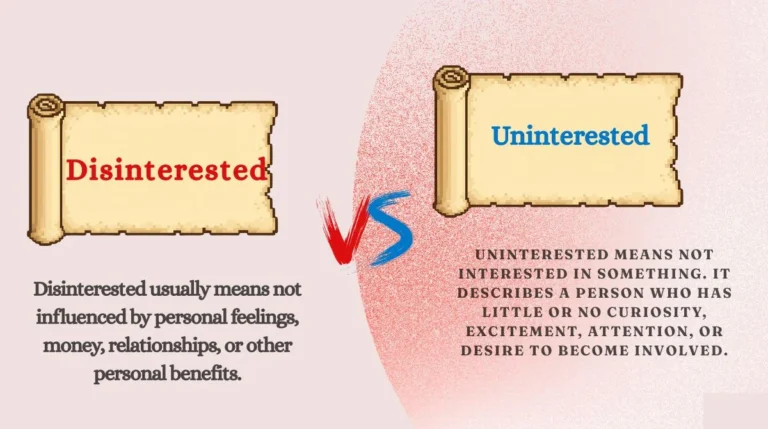
Disinterested vs uninterested is a common English confusion because the two words look almost the same.
Both contain the word interested, so many learners naturally think that they have exactly the same meaning. However, in careful English, they usually express two different ideas.
The easiest way to remember the difference is this: uninterested means not interested, while disinterested traditionally means free from personal interest or bias.
For example, a student who does not care about football is uninterested in football.
A judge who has no personal connection to either side of a case can be described as disinterested, meaning impartial or unbiased.
There is one extra detail that makes this pair tricky. Several major dictionaries also record disinterested with the meaning “not interested.” Cambridge notes that this use exists but says many people consider it incorrect, while Oxford describes it as an informal use.
So, what should an English learner do? In most situations, use uninterested when you mean that someone does not care about or want to know about something.
Use disinterested when you mean neutral, fair, or not personally involved.
Once you understand that small difference, these two words become much easier to use correctly.
What Does “Disinterested” Mean?
Disinterested usually means not influenced by personal feelings, money, relationships, or other personal benefits. In simple words, a disinterested person has no personal stake in the result, so that person can judge a situation fairly.
For example, imagine two students have an argument. Their teacher knows neither student personally and has nothing to gain from the decision. The teacher can listen to both sides and give a disinterested opinion. Here, the meaning is not “the teacher does not care.” It means the teacher is impartial.
Cambridge defines disinterested as having no personal involvement or personal advantage and therefore being free to act fairly. Oxford similarly connects it with being impartial, objective, or unbiased.
When Should You Use “Disinterested”?
Use disinterested when you are talking about a person, opinion, decision, observer, expert, or judgment that is free from personal interest.
It often appears in situations involving fairness, advice, decisions, disputes, investigations, or professional judgment.
For example:
- We need a disinterested judge to review the complaint fairly.
- The committee asked for a disinterested opinion from an outside expert.
- A disinterested observer watched the discussion without taking sides.
- The referee must remain disinterested during the match.
- She gave me disinterested advice because she had nothing to gain.
- The report was written by a disinterested researcher with no connection to the company.
- We should ask a disinterested third party to settle the disagreement.
- His position as a disinterested mediator helped both groups trust the process.
Grammar Rule for “Disinterested”
Disinterested is an adjective. It describes a person, group, opinion, action, or judgment.
Common patterns include:
disinterested + noun
- a disinterested observer
- a disinterested opinion
- a disinterested party
- a disinterested judge
You can also use it after linking verbs such as be, seem, appear, and remain.
- The mediator remained disinterested.
- She seemed disinterested in the dispute.
Be careful with the word’s meaning. In traditional careful usage, disinterested does not simply mean that someone is bored or does not care. It points to a lack of personal stake or bias.
A Common Learner Confusion
Consider this sentence:
Sarah is disinterested in cooking.
A reader might understand it as “Sarah is not interested in cooking.” This meaning is now found in dictionaries, but it can still sound confusing or unacceptable to people who prefer the traditional distinction. Cambridge specifically notes that the “not interested” use is sometimes found but is considered incorrect by many speakers.
For clear writing, especially in school, exams, business writing, and formal English, uninterested is the safer choice when you mean “not interested.”
What Does “Uninterested” Mean?
Uninterested means not interested in something. It describes a person who has little or no curiosity, excitement, attention, or desire to become involved.
This is the word you normally need when someone does not care about a subject, activity, event, hobby, or conversation.
Cambridge directly defines uninterested as “not interested” and also describes it as not being excited or not wanting to become involved.
Imagine your friend asks, “Do you want to watch the cricket match tonight?”
You say:
“No, I’m uninterested in cricket.”
You are saying that cricket does not interest you. You are not making a statement about fairness or neutrality.
When Should You Use “Uninterested”?
Use uninterested when you mean:
- not interested
- not curious
- not excited
- not wanting to take part
- not paying much attention because something does not interest you
For example:
- My brother is uninterested in politics.
- The children looked uninterested in the long speech.
- She is uninterested in buying a new phone right now.
- Tom seemed uninterested in the movie.
- The student became uninterested in the lesson after an hour.
- I am completely uninterested in celebrity news.
- They were uninterested in joining the club.
- He sounded uninterested in the conversation.
Grammar Rule for “Uninterested”
Uninterested is also an adjective.
A very common structure is:
be + uninterested + in + noun
- I am uninterested in sports.
- She is uninterested in the offer.
- They were uninterested in the discussion.
You can also use it with a verb ending in -ing:
- He is uninterested in learning French.
- She is uninterested in joining the group.
- They are uninterested in watching another movie.
The preposition in is important in these structures.
Another Common Confusion
Do not confuse uninterested with uninteresting.
These words describe different things.
Uninterested describes a person or group that lacks interest.
The students were uninterested in the lecture.
Uninteresting describes something that does not create interest.
The lecture was uninteresting.
The students may be uninterested because the lecture is uninteresting, but the two words do not mean exactly the same thing.
Difference Between Disinterested and Uninterested
The main difference is about personal interest.
Uninterested means a person does not have interest in something.
Disinterested traditionally means a person has no personal stake or bias, so they can remain fair and impartial.
Here is a simple comparison:
| Word | Main meaning | Focus | Example |
|---|---|---|---|
| Disinterested | Impartial; free from personal interest | Fairness and lack of personal stake | We need a disinterested judge. |
| Uninterested | Not interested | Lack of curiosity or concern | He is uninterested in football. |
Usage Difference
Think about two people.
The first person says:
“I don’t care about fashion.”
That person is uninterested in fashion.
The second person says:
“I can judge this fashion competition fairly because none of the contestants is my friend.”
That person is disinterested.
The first sentence is about lack of interest. The second is about lack of personal involvement.
Grammar Logic
The prefixes can make learners think that dis- and un- work in exactly the same way. English does not always work that neatly.
In uninterested, the meaning is straightforward: the person is not interested.
With disinterested, the traditional meaning developed around being free from self-interest or personal advantage. Modern dictionaries also record the “not interested” sense, which is one reason the distinction causes confusion today.
That means you may see disinterested used in two ways in real English. Still, when you are writing carefully and want your meaning to be immediately clear, keeping the two words separate is very helpful.
Sentence Structure Difference
Both adjectives can appear after be and before nouns.
Uninterested:
Ali was uninterested in the lecture.
Structure:
subject + be + uninterested + in + object
Disinterested:
Ali was a disinterested observer.
Structure:
subject + be + a + disinterested + noun
You can also say:
Ali remained disinterested during the argument.
Here, disinterested means he had no personal stake and did not favor one side.
Meaning Comparison
Compare these two sentences:
The lawyer was uninterested in the case.
This suggests that the lawyer did not find the case interesting or did not want to be involved.
The lawyer was disinterested in the case.
In careful usage, this suggests the lawyer had no personal interest or advantage connected to the case and could therefore approach it objectively.
That difference can be very important.
Imagine a company choosing a supplier. One employee owns part of one supplier’s business. Another employee has no connection to any supplier.
The first employee is personally interested in the outcome. The second employee may be disinterested because there is no personal benefit involved.
If someone simply does not care which supplier is chosen, however, saying they are uninterested may communicate the idea more clearly.
Grammar Rules You Must Remember
Rule 1: Use “Uninterested” for “Not Interested”
When your meaning is simply “not interested,” use uninterested.
I am uninterested in horror movies.
The sentence says that horror movies do not attract your attention or curiosity.
Another example:
She is uninterested in learning German.
She does not want to spend time learning it.
Rule 2: Use “Disinterested” for Impartiality
When someone has no personal advantage, connection, or bias, disinterested is the traditional and clear choice.
We need a disinterested person to settle the argument.
The person should not have a reason to support either side.
Another example:
The manager asked for a disinterested review of the complaint.
The review should be fair and independent.
Rule 3: Use “Uninterested in,” Not “Uninterested on”
The usual preposition after uninterested is in.
Correct:
He is uninterested in sports.
Incorrect:
He is uninterested on sports.
Correct:
They were uninterested in joining the meeting.
This is a useful pattern to memorize: uninterested in + noun/gerund.
Rule 4: Remember That “Disinterested” Can Have Two Senses
Modern dictionaries recognize that disinterested is sometimes used to mean “not interested,” even though many style-conscious speakers prefer uninterested for that meaning. Oxford labels the “not interested” sense informal, while Cambridge notes that many people consider it incorrect.
So you may encounter:
He was disinterested in the lecture.
Some speakers use this to mean “He was not interested in the lecture.”
For your own writing, especially when clarity matters, it is usually better to write:
He was uninterested in the lecture.
That removes doubt about what you mean.
Common Mistakes Students Make
Many learners make mistakes with these words because the difference is small on the page but important in meaning.
Mistake 1: Using “Disinterested” for Every Meaning of “Not Interested”
Wrong or unclear:
I am disinterested in basketball because I find it boring.
A traditional reader may understand this as “I have no personal stake in basketball,” which is probably not what the speaker means.
Better:
I am uninterested in basketball because I find it boring.
Here, the intended meaning is completely clear.
Mistake 2: Thinking “Disinterested” Means “Unfriendly”
Disinterested does not automatically mean cold, rude, careless, or unfriendly.
The doctor gave a disinterested opinion.
This does not mean the doctor was rude. It means the opinion was free from personal involvement or advantage.
Mistake 3: Confusing “Uninterested” and “Uninteresting”
Wrong idea:
The book was uninterested.
A book cannot normally have human interest or curiosity in the same way a person does.
Better:
The book was uninteresting.
Or:
I was uninterested in the book.
A simple rule helps:
People can be uninterested. Things can be uninteresting.
Mistake 4: Forgetting the Preposition “In”
Wrong:
She is uninterested science.
Correct:
She is uninterested in science.
Wrong:
He is uninterested to join the team.
Better:
He is uninterested in joining the team.
Why Do These Mistakes Happen?
The main reason is that dis- and un- often suggest a negative meaning in English. Learners naturally expect disinterested to mean exactly the same thing as not interested.
There is also a historical reason. Dictionaries record that disinterested has developed more than one sense, and both meanings can still appear in English. Dictionary.com and the American Heritage Dictionary both discuss this long history of overlap.
Easy Correction Tip
Ask yourself one question:
“Does this person not care, or is this person fair and unbiased?”
If the answer is does not care, choose uninterested.
If the answer is fair and unbiased because there is no personal stake, choose disinterested.
Easy Trick to Remember the Difference
Here is a simple classroom trick:
UNINTERESTED = NO INTEREST
The word uninterested is the one to choose when someone says:
“That does not interest me.”
Think:
UN + interested = not interested
For example:
I am uninterested in football.
That means football does not interest me.
DISINTERESTED = NO PERSONAL STAKE
For disinterested, think about a person standing outside a disagreement.
They are not supporting one side because they will benefit from the result. They can look at the situation fairly.
For example:
The company hired a disinterested expert to investigate the complaint.
The expert has no personal connection with the people involved.
One quick memory sentence is:
Uninterested means “I don’t care about it.” Disinterested means “I have nothing personal to gain from it.”
This is not a perfect explanation of every use you will see in the wild, but it is an excellent guide for clear everyday and formal English.
Another useful trick is to connect disinterested with dispassionate, impartial, and unbiased.
Connect uninterested with bored, indifferent, or not interested.
Once those groups become familiar, choosing the right word becomes much easier.
Daily Life Examples
Real conversations are one of the best ways to learn confusing words. Here are some simple examples.
1. Talking About Hobbies
A: Do you play tennis?
B: No. I’m completely uninterested in tennis.
Here, the person simply has no interest in the sport.
2. Choosing a Judge
A: Who should decide between the two teams?
B: Ask Sara. She is disinterested and has no connection to either team.
Sara can make a fair decision because she has nothing personal at stake.
3. At School
Teacher: Why didn’t you finish the reading?
Student: I was uninterested in the story.
The student did not find the story engaging.
4. A Family Argument
Brother: You agree with me because I’m your brother!
Sister: No, I can be disinterested here. I don’t want anything from either side.
The idea is that she has no personal advantage in the argument.
5. Talking About Movies
A: Did you enjoy that movie?
B: Not really. I was uninterested from the beginning.
The movie failed to hold the person’s attention.
6. Professional Advice
Client: Can your friend recommend a company for us?
Manager: I’d rather ask an outside consultant for a disinterested opinion.
The outside consultant is less likely to have a personal or financial connection.
7. Shopping
A: Are you buying those shoes?
B: No, I’m uninterested in them. They are too expensive.
The person does not want the shoes.
8. A Sports Referee
Coach: Can we trust the referee to judge fairly?
Captain: The referee has no connection to either team, so he should be disinterested.
Here, the word is about neutrality and fairness.
9. A Long Meeting
A: How was the meeting?
B: Honestly, I was uninterested after the first hour.
The speaker lost interest.
10. Solving a Dispute
A: We cannot agree on who is right.
B: Let’s ask a disinterested third party to help us.
The third party can look at the issue without a personal stake.
Practice Section
Choose the correct word: disinterested or uninterested.
1. Maria was ______ in watching another three-hour documentary.
2. The company needed a ______ person to investigate the complaint.
3. I am ______ in collecting stamps.
4. The judge must be ______ and should not benefit from the decision.
5. The children became ______ in the lecture because it was too long.
Answers
1. uninterested
Maria does not want to watch the documentary.
2. disinterested
The person should have no personal connection or advantage.
3. uninterested
The meaning is simply “not interested.”
4. disinterested
The judge needs to be impartial and free from personal interest.
5. uninterested
The children lost interest in the lecture.
A useful extra challenge is to replace each adjective with a clearer phrase. For example, uninterested can often be replaced with not interested, while disinterested can often be replaced with impartial or unbiased.
FAQs
1. What is the difference between disinterested and uninterested?
Uninterested normally means not interested in something.
Disinterested traditionally means impartial or free from personal interest.
Because disinterested is also sometimes used to mean “not interested,” the context matters. For clear writing, keep the traditional distinction.
2. Can “disinterested” mean “not interested”?
Yes. Major dictionaries record this meaning. However, some dictionaries and style traditions warn that many readers prefer uninterested for “not interested.” Cambridge notes this disagreement, and Oxford labels the “not interested” sense informal.
3. Is “uninterested” correct in formal English?
Yes. Uninterested is a standard adjective meaning “not interested.” It is appropriate in both everyday and formal English when that is your intended meaning. Cambridge lists it directly as meaning “not interested.”
4. Is “disinterested” a formal word?
It is often used in formal situations involving fairness, judgment, advice, mediation, or impartiality. For example, a disinterested observer means an observer with no personal stake in the matter.
5. Which word should I use when I mean “not interested”?
Use uninterested. It is the clearest choice and avoids the possible confusion surrounding the second sense of disinterested.
For example:
I am uninterested in politics.
This clearly means that politics does not interest you.
6. What is the difference between uninterested and uninteresting?
Uninterested describes someone who lacks interest.
The students were uninterested.
Uninteresting describes something that fails to create interest.
The lesson was uninteresting.
So a lesson can be uninteresting, and because of that, the students may become uninterested.
Conclusion
The difference between disinterested vs uninterested becomes simple when you focus on the kind of “interest” involved.
Use uninterested when a person is not interested, excited, curious, or involved in something. It is the natural choice for sentences such as, “I am uninterested in sports.”
Use disinterested when you mean impartial, unbiased, or free from personal advantage. A disinterested judge, observer, or adviser does not have a personal stake in the outcome.
There is a little overlap because disinterested is also used to mean “not interested,” and major dictionaries recognize that usage. Still, keeping the traditional difference in your own writing makes your meaning clearer and helps you avoid criticism in formal English.
A good habit is to remember: uninterested = no interest; disinterested = no personal stake. Use these words in your own sentences, and the difference will soon feel natural.

Evan Rellmont is a writer who turns thoughtful ideas into meaningful words, creating stories and reflections that connect, inspire, and leave a lasting impression.