
Have you ever written “excell” when you wanted to write “excel”? You are not alone.
Many English learners make this mistake because the word excelled has two l’s, so it feels natural to think that the basic form should also be spelled with two l’s.
There is another reason for the confusion: excel and excell sound almost exactly the same when spoken.
The good news is that the answer is simple. In standard modern English, excel is the correct spelling when you mean “to do something extremely well” or “to be very good at something.” Major English dictionaries list excel as the standard verb, while excell is generally treated as a misspelling.
This small spelling difference matters in schoolwork, emails, résumés, applications, and professional writing.
It also matters when you are talking about Microsoft Excel, the spreadsheet program.
By the end of this guide, you will know exactly when to use excel, why excell is incorrect, how the word changes to excelled and excelling, and how to avoid this mistake in your everyday English.
What Does “Excell” Mean?
Is “Excell” a correct English word?
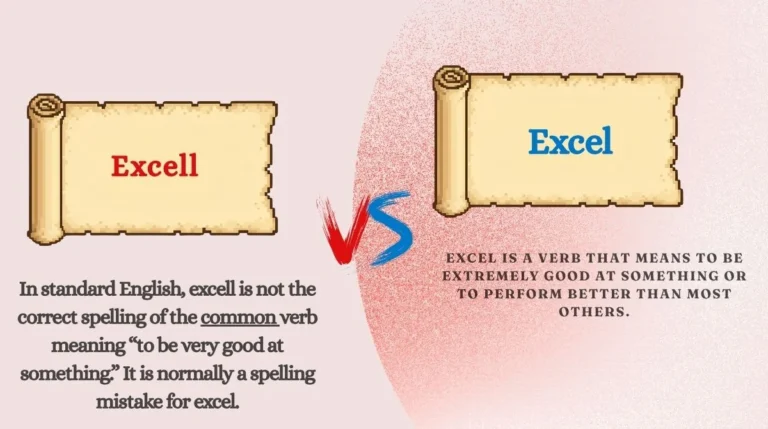
In standard English, excell is not the correct spelling of the common verb meaning “to be very good at something.” It is normally a spelling mistake for excel. Wiktionary identifies excell as a misspelling of excel, while major dictionaries such as Cambridge and Oxford give the standard verb as excel.
So, when you want to describe someone who is excellent at a skill, subject, sport, or activity, write excel, not excell.
For example:
- ❌ She excells at mathematics.
- ✅ She excels at mathematics.
The extra l does not belong in the base form.
Why do people write “excell”?
This mistake is easy to understand. English learners often notice that the word changes from excel to excelled and excelling. Both of those forms contain two l’s:
- excel → excelled
- excel → excelling
Because of this, some learners assume that the original word must be excell. It is not.
The base word has only one l:
excel
When certain endings are added, the final l is doubled:
excelled
excelling
That spelling change is one of the biggest reasons learners remember the wrong base form.
Examples of the wrong spelling
Here are some sentences where excell should be changed to excel:
- ❌ I want to excell in science.
- ❌ She excells at drawing.
- ❌ He hopes to excell in his new job.
- ❌ Our team excells at solving difficult problems.
- ❌ Maria wants to excell in English.
- ❌ They worked hard to excell in the competition.
- ❌ Good students often excells in subjects they enjoy.
- ❌ He is trying to excell at public speaking.
Every one of these uses should have excel instead.
Common learner confusion
A common question is:
“If excelled has two l’s, why doesn’t excell have two l’s?”
The answer is that English spelling sometimes changes when suffixes are added. The spelling of a base word does not always tell you exactly how its past or -ing form will look.
Think of it this way:
excel → excelled → excelling
Not:
excell → excellled → excelling
The second pattern is incorrect.
There is also a difference between the spelling of the word and its pronunciation. Excel is pronounced approximately ik-SEL, with the stress on the final syllable. Oxford lists the pronunciation as /ɪkˈsel/.
So, if you are writing the verb, remember the short base form: excel.
What Does “Excel” Mean?
Simple definition of excel
Excel is a verb that means to be extremely good at something or to perform better than most others. Cambridge defines it as being extremely good at something, while Oxford explains that it means being very good at doing something.
For example:
She excels at mathematics.
This means she is very good at mathematics.
You can use excel to talk about many areas of life:
- school subjects
- sports
- music
- work
- business
- communication
- art
- technology
- cooking
- leadership
When do we use “excel”?
We normally use excel when we want to show that someone or something performs at a very high level.
Common structures include:
excel at + noun
He excels at football.
excel at + verb-ing
She excels at solving problems.
excel in + noun
He excels in science.
Both excel at and excel in are standard patterns. Cambridge gives examples such as excel in languages and excel at badminton, and Oxford also lists both structures.
We can also use excel without naming a specific area when the context is already clear:
She studied hard and began to excel.
This means she started performing extremely well.
Examples of “excel”
- She excels at mathematics.
- Ahmed excels in science.
- My brother excels at football.
- Our teacher excels at explaining difficult ideas.
- The young player excels in competitive sports.
- Sara excels at speaking English.
- He has always excelled in creative writing.
- The company excels at customer service.
Notice that excel usually talks about strong performance. It is a positive word.
Verb forms of “excel”
This is an important part of the spelling puzzle.
The main forms are:
| Verb form | Correct spelling | Example |
|---|---|---|
| Base form | excel | I want to excel. |
| He/She/It | excels | She excels at math. |
| Past simple | excelled | He excelled in school. |
| Past participle | excelled | She has excelled this year. |
| -ing form | excelling | They are excelling in class. |
Oxford lists these forms as excel, excels, excelled, excelled, excelling.
This table gives you the key spelling lesson:
The base form is excel with one l.
The double l appears in excelled and excelling.
“Excel yourself”
There is also an expression, especially common in British English:
excel yourself
It means to do something extremely well, especially better than you normally do. Cambridge and Oxford both give this usage.
For example:
You really excelled yourself with this project.
This suggests that the person did an unusually excellent job.
Difference Between Excell and Excel
The main difference is actually very easy:
Excel is correct. Excell is incorrect when you mean the verb “to be very good at something.”
| Point | Excell | Excel |
|---|---|---|
| Standard English spelling | ❌ No | ✅ Yes |
| Meaning “to be very good at” | ❌ Incorrect | ✅ Correct |
| Dictionary verb | ❌ Not the standard form | ✅ Yes |
| Base form | ❌ Excell | ✅ Excel |
| Past form | — | Excelled |
| -ing form | — | Excelling |
| Example | ❌ She excells at music. | ✅ She excels at music. |
Usage difference
There is no normal usage situation in which you should choose excell instead of excel for this meaning.
You might see excell online, in social media posts, informal messages, or learner writing, but seeing a spelling does not make it standard English.
For formal writing, always use excel.
Grammar logic
Excel is a verb. It describes an action or ability.
Nadia excels at art.
Here:
- Nadia = subject
- excels = verb
- at art = information about the area in which she is very good
Because Nadia is third-person singular, the present simple form becomes excels.
Compare:
I excel at art.
You excel at art.
They excel at art.
She excels at art.
Only he, she, it takes -s in the simple present.
Sentence structure
Here are three common sentence patterns:
Subject + excel + at + noun
Tom excels at chess.
Subject + excel + in + noun
Tom excels in mathematics.
Subject + excel + at + verb-ing
Tom excels at solving puzzles.
This makes the word useful in everyday English, academic writing, and professional communication.
Meaning comparison
There is no real meaning difference between excell and excel because excell is not the standard spelling of this verb.
The real choice is:
excel = correct
excell = misspelling
That is the most important point to remember.
Grammar Rules You Must Remember
Rule 1: Use “excel” as the base verb
When you are using the basic form of the verb, spell it with one l.
✅ I want to excel in English.
✅ They hope to excel at work.
✅ She wants to excel in her studies.
Do not write:
❌ I want to excell in English.
The correct base word is always excel.
Rule 2: Use “excels” with he, she, or it
In the simple present, add -s when the subject is he, she, or it.
He excels at football.
She excels in science.
This company excels at customer support.
Do not add another l to the base word before adding -s.
❌ He excells at football.
✅ He excels at football.
Rule 3: Double the “l” in “excelled” and “excelling”
This is the spelling rule that causes most confusion.
The correct forms are:
excelled
excelling
For example:
She excelled in school.
They are excelling in the competition.
The double l belongs to these forms. It does not mean the base word is excell.
Rule 4: Use “excel at” or “excel in”
When you name the area or activity, at and in are common choices.
He excels at tennis.
She excels in mathematics.
You can also use:
She excels at writing.
The preposition can depend on the expression and context, but both excel at and excel in are established English patterns.
A useful learning habit is to remember common combinations rather than trying to translate directly from your first language.
Common Mistakes Students Make
Mistake 1: Writing “excell” as the base form
This is the most common problem.
❌ I want to excell at English.
✅ I want to excel at English.
Correction tip: When the word stands alone as the basic verb, use only one l.
Mistake 2: Writing “excells”
Students sometimes think third-person singular needs another l.
❌ She excells at singing.
✅ She excels at singing.
The correct form is simply:
excel + s = excels
There is no need to create excells.
Mistake 3: Thinking “excelled” proves the base word is “excell”
This is a very understandable mistake.
A learner may see:
He excelled in school.
Then think:
The word has two l’s, so the base must be excell.
But the correct word family is:
excel → excelled → excelling
A similar spelling change happens in other English words when endings are added. The safest habit is to learn the whole word family.
Mistake 4: Confusing the verb with Microsoft Excel
Excel can also be a proper name: Microsoft Excel, the spreadsheet software.
So these are different uses of the same spelling:
She excels at mathematics.
Here, excel is a verb.
I entered the numbers into Excel.
Here, Excel is the name of software.
Microsoft describes Excel as spreadsheet software and uses Excel as the product name.
Do not write:
❌ Microsoft Excell
Write:
✅ Microsoft Excel
Mistake 5: Using “excel” when you simply mean “pass”
Excel has a stronger meaning than simply passing a test.
I passed the exam.
This tells us you were successful.
I excelled in the exam.
This suggests you performed exceptionally well.
So excel is connected with very high performance.
Easy Trick to Remember the Difference
Here is a simple memory trick:
“Excel has one L until you add an ending.”
Think of the word as a small ladder:
EXCEL → base form
EXCELS → present with he/she/it
EXCELLED → past
EXCELLING → -ing form
The important thing is that the extra l appears when you change the word into certain forms.
You can also remember:
Excel = excellent performance
The words look related for a reason. When someone excels, that person performs at a high level.
So when you think:
“very good”
think:
EXCEL
not:
EXCELL
Another quick memory line is:
One L to excel; two Ls when excel becomes excelling or excelled.
It is not a perfect spelling rule for every English verb, but it is a very useful reminder for this particular word.
Daily Life Examples
You are likely to meet excel in school, work, sports, and normal conversation.
1. Talking about school
A: How is your daughter doing in school?
B: She really excels in mathematics.
Here, excels means she performs very well.
2. Talking about sports
Our captain excels at football.
This means the captain is especially good at football.
3. Talking about a coworker
Ali excels at solving problems.
This tells us that problem-solving is one of Ali’s strongest skills.
4. Talking about a student
Maria has always excelled in science.
This means Maria has performed very well in science over time.
5. Talking about a new skill
I am learning public speaking because I want to excel at it.
The speaker wants to become extremely good at the skill.
6. Talking about a team
Our team excels at defending.
The team is especially strong when defending.
7. Talking about work
She excels in customer service.
This means she is highly skilled at working with customers.
8. Talking about personal improvement
He worked hard and excelled in his new role.
The past form shows that he performed extremely well.
9. Talking about Microsoft Excel
Can you send me the report in Excel?
Here, Excel is the name of the spreadsheet program, not the verb.
10. Comparing normal and exceptional performance
Everyone did well, but Sarah really excelled.
The sentence means Sarah performed especially well compared with the others.
These examples show why learning this word is useful. It appears in both everyday conversation and more formal situations.
Practice Section
Choose the correct option in each sentence.
1. She wants to ___ in mathematics.
A. excell
B. excel
2. He ___ at basketball.
A. excels
B. excells
3. They ___ in their final exams last year.
A. excelled
B. exceld
4. She is ___ at solving difficult problems.
A. excelling
B. excelling
5. Please save the document in ___ format.
A. Excel
B. Excell
Answers
1. B — excel
The base form has one l.
2. A — excels
Use excels with he, she, or it.
3. A — excelled
The past form has two l’s.
4. A — excelling
The -ing form is spelled excelling.
5. A — Excel
Microsoft Excel is spelled with one l.
FAQs
What is the difference between Excell and Excel?
Excel is the correct spelling of the verb meaning “to be extremely good at something.” Excell is normally a misspelling of that word. Use excel in school, business, formal writing, and everyday English.
Is “excell” a correct English word?
Not as the standard spelling of the common verb excel. Major English dictionary sources list excel as the correct verb. Some dictionaries or word-reference sites may show excell only to identify it as a misspelling.
Why does “excelled” have two Ls?
The past form is excelled, and the -ing form is excelling. The extra l appears when these endings are added. The base form remains excel, with only one l.
Can we use “excel” in questions?
Yes. You can use excel naturally in questions.
For example:
What subjects do you excel in?
What sports does he excel at?
How can I excel in my studies?
These questions ask about areas where someone performs very well.
Is “excel” formal or informal?
Excel is a normal standard English word. It works in everyday conversation, academic writing, professional communication, and formal documents. For example, you can say “She excels at music” in a casual conversation or in a school report.
Is Microsoft Excel related to the verb “excel”?
The name Excel is related to the idea of being excellent or superior, but in modern use Microsoft Excel is the name of spreadsheet software. Microsoft officially uses Excel as the product name.
Is it correct to say “excel at” and “excel in”?
Yes. Both structures are common.
He excels at tennis.
She excels in science.
You can also use excel at + -ing:
He excels at solving puzzles.
Cambridge and Oxford both document excel at and excel in as standard patterns.
What is the past tense of excel?
The past tense is excelled.
She excelled in school.
The past participle is also excelled:
He has excelled in his career.
The -ing form is excelling:
They are excelling in their studies.
Conclusion
The spelling choice is much easier once you remember the basic rule: excel is the correct word, while excell is normally a spelling mistake when you mean “to be very good at something.”
Use excel as the base verb:
I want to excel in English.
Use excels with he, she, and it:
She excels at science.
Use excelled for the past:
He excelled in school.
And use excelling for the -ing form:
They are excelling in their studies.
The extra l in excelled and excelling is probably the main reason learners get confused. Do not let those forms trick you into spelling the base word as excell.
One final reminder is worth keeping in mind: Excel can also be the name of Microsoft’s spreadsheet software. Whether you are talking about outstanding performance or a spreadsheet, the correct spelling uses one l in the basic word: excel.
A little practice will make this spelling automatic. Write a few sentences using excel, excels, excelled, and excelling, and the difference will soon feel natural.

Evan Rellmont is a writer who turns thoughtful ideas into meaningful words, creating stories and reflections that connect, inspire, and leave a lasting impression.