
Have you ever seen the word foolproof and wondered whether it should actually be written as fullproof? You are not alone.
This is a common spelling confusion, especially for English learners who hear the word before they see it in writing.
The confusion makes sense at first. The word foolproof contains “fool,” which means a person who may make a silly mistake, and “proof,” which means protected against something.
Because full is a very common English word, some people naturally write fullproof instead.
However, there is an important difference: foolproof is the standard and correct spelling when you mean something that is very easy to use, understand, or operate and is unlikely to fail because of a simple mistake.
Fullproof is not the standard spelling of this adjective.
You may hear expressions such as “a foolproof plan,” “a foolproof method,” or “a foolproof way to remember something.” These are common in everyday English, education, work, technology, and conversation.
Understanding this word will help you avoid a very common spelling mistake. It will also help you understand why English sometimes combines words in ways that do not seem obvious at first.
By the end, you will know exactly when to use foolproof, why fullproof is usually incorrect, how the word works grammatically, and how to remember the correct spelling without checking a dictionary every time.
What Does “Foolproof” Mean?
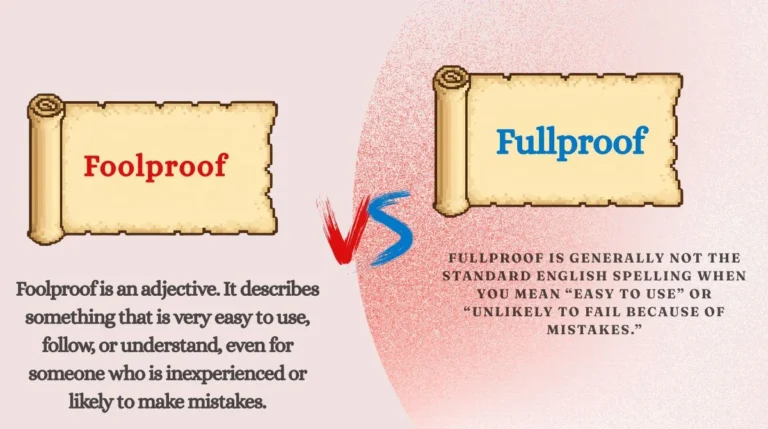
Foolproof is an adjective. It describes something that is very easy to use, follow, or understand, even for someone who is inexperienced or likely to make mistakes.
In simple words, something is foolproof when it is designed so that a person can use it correctly without much difficulty.
For example:
This camera has a foolproof system.
This means the system is so simple that even someone with little experience is unlikely to use it incorrectly.
The word is often used for plans, systems, instructions, methods, machines, ideas, procedures, and solutions.
When Do We Use “Foolproof”?
We normally use foolproof when talking about something that is designed to prevent mistakes or make mistakes difficult.
You might hear it in everyday conversation:
- “I need a foolproof recipe.”
- “She created a foolproof plan.”
- “Is there a foolproof way to fix this?”
- “The instructions are almost foolproof.”
- “We need a foolproof system for organizing the files.”
It does not necessarily mean that something can never go wrong. In real life, very few things are completely impossible to fail. The word often suggests that something is extremely simple, reliable, or hard to misuse.
The Grammar Rule for “Foolproof”
Because foolproof is an adjective, it usually comes before a noun or after a linking verb.
For example:
Before a noun:
- a foolproof method
- a foolproof plan
- a foolproof system
- a foolproof recipe
After a linking verb:
- The method is foolproof.
- Her plan seems foolproof.
- This device is almost foolproof.
The word does not normally function as a noun by itself in standard everyday usage.
Examples of “Foolproof”
Here are some simple examples:
- This recipe is foolproof, even for beginners.
- We need a foolproof way to remember these grammar rules.
- The company designed a foolproof safety system.
- Her plan sounded foolproof at first.
- This app has a foolproof setup process.
- He gave me a foolproof method for organizing my notes.
- Is there a foolproof way to solve this problem?
- The instructions are simple enough to be almost foolproof.
Notice how the word describes a thing, method, plan, or system. That is why it is an adjective.
Why Do People Get “Foolproof” Wrong?
The biggest problem is pronunciation and word familiarity.
When people hear foolproof, they may think it sounds like full proof. Since full is a real English word, fullproof may seem reasonable.
But spelling is not always based on how a word sounds.
The correct adjective is:
foolproof ✅
Not:
fullproof ❌
There is also a meaningful idea behind the word. It comes from the concept of something being “proof against fools,” meaning it is designed so that ordinary mistakes or careless use are unlikely to cause failure.
That does not mean the word is insulting someone. In modern English, foolproof is simply a common adjective used to describe something very easy or reliable.
What Does “Fullproof” Mean?
Fullproof is generally not the standard English spelling when you mean “easy to use” or “unlikely to fail because of mistakes.”
This is the key point to remember.
Many people write fullproof because they confuse it with foolproof. However, standard English uses foolproof for the adjective meaning simple, reliable, or difficult to misuse.
For example:
Correct:
We need a foolproof plan.
Incorrect in this meaning:
We need a fullproof plan.
The second version is a spelling error.
Is “Fullproof” Ever Correct?
In normal modern English, fullproof is not the standard form of the adjective you are looking for.
Sometimes learners may think of the phrase full proof, written as two separate words. That can have a completely different meaning when “full” modifies “proof.”
For example:
The lawyer asked for full proof of ownership.
Here, full is an adjective and proof is a noun. The phrase means complete or sufficient evidence. It is not the same thing as foolproof.
This is an important distinction:
foolproof = very difficult to use incorrectly
full proof = complete proof or complete evidence, depending on context
So you should not replace foolproof with fullproof.
Example of “Full Proof” as Separate Words
Consider this sentence:
The inspector wanted full proof that the machine had been tested.
Here, full describes the noun proof. The speaker is talking about complete evidence.
This is grammatically different from:
The machine has a foolproof safety system.
In the second sentence, foolproof is one adjective describing safety system.
Common Learner Confusion
Many English learners see words such as:
- full-time
- full-length
- full-size
- full-proof
and assume fullproof should work in the same way.
But the adjective you normally need for “safe from mistakes” is not based on full. It is based on fool + proof.
That is why learning the actual meaning helps with the spelling.
Difference Between Foolproof and Fullproof
The main difference is simple: foolproof is the correct standard adjective, while fullproof is generally a misspelling when used with that meaning.
Here is an easy comparison:
| Word | Standard spelling? | Meaning | Example |
|---|---|---|---|
| Foolproof | ✅ Yes | Very easy to use or unlikely to fail because of simple mistakes | This is a foolproof method. |
| Fullproof | ❌ Usually no | Not the standard spelling for this meaning | Avoid “fullproof” when you mean foolproof. |
| Full proof | ✅ In a different context | Complete or sufficient proof/evidence | We need full proof of the claim. |
Usage Difference
The word foolproof is used when you are describing the quality of something.
For example:
She created a foolproof system.
You are saying that the system is very easy to use or unlikely to produce mistakes.
By contrast, full proof is about the amount or completeness of proof.
For example:
The judge wanted full proof before making a decision.
Here, full means complete. The two words are not forming the adjective foolproof.
Grammar Logic
There is another useful grammatical difference.
Foolproof works as one adjective:
a foolproof method
The entire word describes the noun method.
But full proof has two separate words:
full proof
Here, full is an adjective and proof is a noun.
This small difference changes both the spelling and the meaning.
Sentence Structure Difference
Compare these sentences:
We need a foolproof system.
Here:
- foolproof = adjective
- system = noun
Now compare:
We need full proof of the results.
Here:
- full = adjective
- proof = noun
- of the results = phrase explaining what the proof concerns
The sentence structures are different because the words are doing different jobs.
Meaning Comparison
Think about the meanings this way:
Foolproof answers:
“How easy or reliable is it?”
Full proof answers:
“How complete is the evidence?”
That simple question can help you choose the right expression.
Grammar Rules You Must Remember
Rule 1: Use “foolproof” as the adjective for something difficult to misuse.
When a system, plan, method, or device is very easy to use, choose foolproof.
Example:
This online form is foolproof.
You mean that people are unlikely to make mistakes while using it.
Another example:
We need a foolproof procedure for new employees.
The procedure should be clear and easy to follow.
Rule 2: “Foolproof” is normally written as one word.
Do not split it into two words when you are using the adjective.
✅ a foolproof plan
❌ a fool proof plan
✅ The system is foolproof.
The one-word form is the standard spelling.
Rule 3: Do not use “fullproof” as a replacement for “foolproof.”
This is one of the most important spelling rules.
✅ She found a foolproof solution.
❌ She found a fullproof solution.
The wrong version happens because full and fool sound similar in some accents or are easy to confuse while typing.
Rule 4: “Full proof” can be written separately when you literally mean complete proof.
This is a different construction.
For example:
The scientist asked for full proof of the result.
Here, full modifies proof, so the phrase has nothing to do with the adjective foolproof.
The context tells you which form is appropriate.
Common Mistakes Students Make
Spelling mistakes often happen because English contains many words that sound alike or look similar.
The foolproof/fullproof confusion is a good example.
Mistake 1: Writing “fullproof” instead of “foolproof”
Wrong:
This is a fullproof method.
Correct:
This is a foolproof method.
Easy correction tip
Remember that the first part is fool, not full.
Think:
fool + proof = foolproof
The idea is that the method is so simple that even a person who makes mistakes can follow it successfully.
Mistake 2: Writing “fool proof” as two words
Wrong:
We need a fool proof system.
Correct:
We need a foolproof system.
The adjective is normally written as one word.
English has many compound words that combine two smaller words into one:
- waterproof
- fireproof
- childproof
- soundproof
- foolproof
Seeing these related words can help you remember the pattern.
Mistake 3: Thinking “fullproof” means “completely proven”
Some learners assume that fullproof means something has been completely proved.
That is not the usual meaning of foolproof.
For example:
This plan is foolproof.
This does not mean:
This plan has been fully proven.
It means the plan is very easy, reliable, or difficult to mess up.
If you want to talk about complete evidence, use an expression such as:
full proof
or, depending on the context:
complete proof
sufficient proof
conclusive proof
Mistake 4: Using the word for absolutely everything
Although foolproof is useful, it can sound too strong in some situations.
For example:
This business strategy is foolproof.
That sentence suggests the strategy is extremely reliable and very unlikely to fail.
But almost any real plan can have weaknesses.
Sometimes a softer word is better:
This is a reliable strategy.
Or:
This is a simple strategy.
Good writing is not only about correct spelling. It is also about choosing the right level of meaning.
Easy Trick to Remember the Difference
Here is the easiest memory trick:
Think “fool + proof.”
Imagine a person who has little experience using a machine.
If the machine is foolproof, that person can probably operate it correctly.
So remember:
FOOL + PROOF = easy to use
Not:
FULL + PROOF
You can also connect foolproof with other words ending in -proof:
- waterproof = protected from water
- fireproof = resistant to fire
- childproof = designed to stop children from using something incorrectly
- soundproof = designed to block sound
- foolproof = designed to prevent simple mistakes or misuse
Once you notice this family of words, the spelling becomes easier.
A Classroom Memory Sentence
Try remembering this sentence:
A foolproof plan is so simple that even a fool can follow it.
The sentence is a little playful, but it makes the spelling much easier to remember.
Of course, foolproof does not mean that the person using something is actually a fool. It is a traditional expression describing the design or simplicity of something.
Daily Life Examples
The word foolproof appears in many everyday situations. Here are some natural examples you might hear at home, at school, at work, or in casual conversation.
1. Cooking
“Can you give me a foolproof recipe for chocolate cake?”
The speaker wants a recipe that is easy to follow and has a low chance of going wrong.
2. Technology
“This phone setup is pretty much foolproof.”
The setup process is so simple that even a beginner can manage it.
3. Studying
“Do you know a foolproof way to remember vocabulary?”
The student wants a very reliable study method.
4. Work
“We need a foolproof system for checking customer orders.”
The company wants a system that reduces mistakes.
5. Travel
“Is there a foolproof way to avoid missing the train?”
The speaker wants a very reliable method.
6. Everyday Instructions
“Don’t worry. The instructions are foolproof.”
The instructions are easy enough for almost anyone to understand.
7. Cleaning
“This is my foolproof way to remove stains.”
The person believes the method works reliably.
8. School
“Our teacher gave us a foolproof trick for remembering the formulas.”
The trick is simple and helpful.
9. Business
“There is no foolproof plan for every situation.”
This sentence gives a useful warning: even a very good plan cannot guarantee success in every case.
10. Conversation
“I need a foolproof solution because I keep making the same mistake.”
Here, the speaker wants something that prevents repeated errors.
Practice Section
Choose the correct option in each sentence: foolproof, fullproof, or full proof.
1. This is a ______ method for beginners.
A. foolproof
B. fullproof
2. We need ______ of the payment before closing the case.
A. foolproof
B. full proof
3. She designed a ______ system for organizing the documents.
A. foolproof
B. fullproof
4. Is there a ______ way to install this program?
A. foolproof
B. fullproof
5. The lawyer asked for ______ that the contract had been signed.
A. foolproof
B. full proof
Answers
1. A — foolproof
The word describes the method.
2. B — full proof
Here, full describes the noun proof, meaning complete evidence.
3. A — foolproof
The system is designed to reduce mistakes.
4. A — foolproof
The adjective describes the way or method.
5. B — full proof
The speaker is talking about complete evidence, not an easy-to-use system.
FAQs About Foolproof and Fullproof
1. What is the difference between foolproof and fullproof?
Foolproof is the standard spelling of the adjective meaning very easy to use, understand, or follow and unlikely to fail because of simple mistakes. Fullproof is generally a misspelling when used with this meaning. Full proof, as two words, can have a different meaning related to complete proof or evidence.
2. Is “foolproof” one word or two words?
Foolproof is normally written as one word when it is used as an adjective. For example: “This is a foolproof plan.” Writing “fool proof” is not the standard spelling for this adjective.
3. Is “fullproof” a correct English word?
Fullproof is not the standard spelling for the adjective meaning “difficult to use incorrectly.” In that situation, use foolproof. You may see the phrase full proof as two separate words in a different grammatical context, but it does not mean the same thing.
4. Can I use “foolproof” in a question?
Yes. Foolproof can easily be used in questions.
For example:
“Is there a foolproof way to solve this problem?”
It is especially common when someone is looking for a simple and reliable method.
5. Is “foolproof” formal or informal?
Foolproof is a normal English adjective that can be used in both everyday and reasonably formal writing. It is common in conversation, instructions, business writing, educational material, and technical descriptions. However, in very formal writing, words such as reliable, robust, or highly effective may sometimes be more precise.
6. Does foolproof mean something can never fail?
Not necessarily. Foolproof is often used to mean that something is extremely simple or unlikely to fail because of ordinary mistakes. It does not guarantee that every possible problem is impossible. A “foolproof” plan can still fail because of unusual circumstances, technical problems, or events outside someone’s control.
Conclusion
The correct word for something that is very easy to use, understand, or follow is foolproof. It is normally written as one word, and the spelling comes from fool + proof, not full + proof.
For example, you can say “a foolproof method,” “a foolproof plan,” or “a foolproof system.” These expressions describe something designed to reduce mistakes or make incorrect use unlikely.
Fullproof is usually a spelling mistake when used in this sense. However, full proof can appear as two separate words when full describes the noun proof, meaning complete or sufficient evidence.
The easiest way to remember the difference is to focus on the meaning. When you are talking about something that is hard to mess up, use foolproof.
English has many confusing spellings, but once you connect a word with its meaning, it becomes much easier to remember. The next time you need this adjective, trust the simple rule: fool + proof = foolproof.

Evan Rellmont is a writer who turns thoughtful ideas into meaningful words, creating stories and reflections that connect, inspire, and leave a lasting impression.