
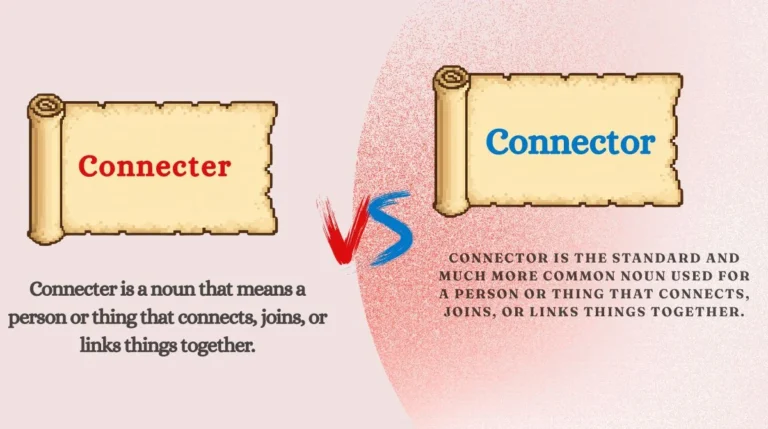
Choosing between connecter and connector can be confusing.
Both spellings look natural because they come from the verb connect, and English often forms nouns by adding -er. That makes connecter seem perfectly logical.
However, there is an important difference in modern usage. Connector is the usual and preferred spelling, while connecter is a real English word but is much less common.
Merriam-Webster lists connector as the noun and gives connecter as a less common form. Collins and Dictionary.com also recognize connecter as a variation of connector.
This small spelling choice matters when you are writing an essay, email, school assignment, website, product description, or technical document.
You may understand both forms, but using the more common form helps your writing sound natural and familiar to English readers.
There is also another reason learners get confused. The word can be used in several different ways.
A connector can be a physical part, such as a cable connector. It can also describe something that joins two ideas, systems, people, or parts. In grammar, words that link ideas are also sometimes called connectors.
The good news is that the rule is simple: use “connector” in normal modern English.
You may see connecter in dictionaries or occasional writing, but it is not the spelling most readers expect.
What Does “Connecter” Mean?
Connecter is a noun that means a person or thing that connects, joins, or links things together.
The word is formed from connect + -er, so its structure is easy to understand. An -er ending often creates a noun for a person or thing that performs an action. For example, teach becomes teacher, and drive becomes driver.
That pattern makes connecter seem natural.
And, in fact, dictionaries do recognize it. Merriam-Webster lists connecter as a less-common form of connector, while Collins defines connecter by referring readers to connector. Dictionary.com likewise describes it as a variation of connector.
So it would be incorrect to say that connecter is completely impossible or never a word.
The real problem is usage. Most modern writers use connector, especially in everyday English, technical English, and professional writing.
When Can “Connecter” Be Used?
You may come across connecter when someone is describing a person, object, or part that creates a connection.
For example:
- The device has a small connecter inside the case.
- She was a natural connecter who introduced people to each other.
- This part works as a connecter between the two systems.
- The engineer replaced the damaged connecter.
- The bridge became an important connecter between the two communities.
- He is a good connecter and enjoys bringing people together.
- The cable needs a special connecter for this machine.
- The organization acts as a connecter between local businesses.
These examples are understandable, and the noun has a recognizable meaning.
However, a modern reader is much more likely to expect connector in these sentences.
A Common Learner Problem
Students often think:
connect + er = connecter
The logic is reasonable, but English does not always form nouns in exactly the way learners expect.
English has many words ending in -er, but different nouns become established through long-term usage. Sometimes the expected form exists, but another form becomes much more common.
That is what happened with connector.
So do not decide a spelling only by looking at the verb. Check which noun form English speakers normally use.
“Connecter” Is Not the Best Choice for Most Writing
Even though the word is recognized, it is usually better to write connector.
For example, instead of:
The connecter is broken.
write:
The connector is broken.
Instead of:
She is a great connecter of people.
write:
She is a great connector of people.
The second versions sound more natural to most modern English readers.
What Does “Connector” Mean?
Connector is the standard and much more common noun used for a person or thing that connects, joins, or links things together.
Merriam-Webster gives connector as the noun form of connect and notes connecter as the less common alternative.
Cambridge also gives connector as a noun for a device or part that makes it possible to connect electrical equipment. It also uses the word for objects that join pipes or tubes.
The meaning can be physical or figurative.
Physical Meaning
A connector can be a part that joins two things.
For example:
- a USB connector
- an HDMI connector
- an electrical connector
- a cable connector
- a pipe connector
- a network connector
Cambridge specifically describes a connector as a device or part that allows electrical equipment to be connected, and it also includes objects that join pipes or tubes.
Figurative Meaning
The word can also describe a person or thing that brings separate people, ideas, or systems together.
For example:
- She is a connector between the two teams.
- The internet is a powerful connector of people.
- This paragraph acts as a connector between two ideas.
- He works as a connector between local companies and investors.
In these examples, the object is not necessarily a physical plug or part. The idea is still the same: something is creating a link.
Example Sentences With “Connector”
- I need a new connector for this cable.
- The charger has the wrong connector for my phone.
- This connector joins the two pipes.
- The engineer checked every electrical connector.
- She became a connector between the two departments.
- The final paragraph is a useful connector between the two sections.
- The computer requires a special connector.
- He is a natural connector who enjoys introducing people.
These examples show why connector is useful in both everyday and technical English.
Difference Between Connecter and Connector
The main difference is frequency and preference, not basic meaning.
Both words can refer to a person or thing that connects something. The major dictionary evidence supports this: Merriam-Webster treats connecter as a less common form of connector, while Collins and Dictionary.com also recognize the relationship between the two words.
Comparison Table
| Feature | Connecter | Connector |
|---|---|---|
| Part of speech | Noun | Noun |
| Basic meaning | A person or thing that connects | A person or thing that connects |
| Dictionary status | Recognized alternative | Standard/common form |
| Modern usage | Much less common | Much more common |
| Technical writing | Usually avoid | Preferred |
| Academic writing | Usually avoid | Preferred |
| Everyday English | Uncommon | Normal |
| Professional writing | Less natural | Natural |
| Best choice for learners | No | Yes |
1. Usage Difference
The biggest difference is how often the words are used.
Connector is the form most readers expect.
Connecter is recognized, but it appears much less often.
That means the safest choice is simple:
Use connector.
2. Meaning Difference
There is generally no major meaning difference between the two spellings.
For example:
The connector joins the two cables.
and
The connecter joins the two cables.
Both can be understood as referring to something that joins the cables.
The difference is that the first sentence uses the normal modern form.
3. Grammar Difference
Both words are nouns.
They can work as:
- subjects
- objects
- complements
- nouns after adjectives
- nouns in compound expressions
For example:
The connector is damaged.
Here, connector is the subject.
I bought a new connector.
Here, connector is the object.
This device is a useful connector.
Here, connector is a subject complement.
The same grammatical roles are possible with connecter, but because that form is uncommon, connector is the much better choice.
4. Sentence Structure
The sentence structure does not change simply because one spelling is used.
Compare:
The connector connects the two devices.
and:
The connecter connects the two devices.
The grammar is the same.
The difference is word choice and spelling preference.
5. Technical Usage
This is where the difference becomes especially clear.
In electronics, computing, electrical engineering, plumbing, and similar areas, connector is the normal term.
For example:
Check the USB connector.
The cable connector is loose.
The pipe connector needs to be replaced.
Cambridge’s definition strongly reflects this technical use, describing connector as a device or part used to connect electrical equipment and as an object that joins pipes or tubes.
Using connecter in such writing may not make the sentence impossible to understand, but it can look unusual or distracting.
Grammar Rules You Must Remember
Rule 1: Use “Connector” as the Normal Noun
When you need a noun for something or someone that connects things, connector should normally be your first choice.
Correct:
The connector is damaged.
Less common:
The connecter is damaged.
The first sentence is the natural choice in modern English.
Rule 2: “Connecter” Is Recognized, but It Is Uncommon
Do not treat connecter as a completely fake word.
Merriam-Webster explicitly lists connector as the noun and connecter as a less-common form. Collins and Dictionary.com also recognize connecter.
So the more accurate rule is:
Connecter exists, but connector is preferred.
This is an important distinction for learners.
Rule 3: Use “Connector” in Formal and Professional Writing
For school assignments, reports, resumes, business emails, technical manuals, and website content, choose connector.
For example:
The connector between the two systems must be checked.
This sounds natural and professional.
Using the less common form may make the reader pause because they are more familiar with connector.
Rule 4: Do Not Confuse the Noun With the Verb
Remember these forms:
- connect — verb
- connected — adjective/past participle
- connecting — present participle
- connection — noun
- connector — noun for a person or thing that connects
Examples:
Please connect the printer.
The printer is connected to the computer.
The connecting cable is too short.
The connection is unstable.
The connector is damaged.
These are different forms of the same word family, and each has its own grammatical job.
Common Mistakes Students Make
Learners often make this mistake because connecter looks like a perfectly regular noun.
English has many words formed with -er, so students naturally apply the same pattern.
For example:
- teach → teacher
- work → worker
- drive → driver
- run → runner
- paint → painter
So they assume:
connect → connecter
But the commonly established noun is connector.
Mistake 1: Calling “connecter” the only correct spelling
Wrong idea:
“Connecter is the correct spelling and connector is wrong.”
That is not accurate.
Dictionary evidence shows that both forms are recognized, but connector is the usual form and connecter is less common.
Mistake 2: Saying “connecter” is not a word at all
This is also too strong.
Connecter is a recognized English noun. Merriam-Webster lists it as less common, and Collins gives it as an entry referring to connector.
A better explanation is:
Connecter is a real but uncommon variant.
Mistake 3: Using “connecter” in technical writing
A student might write:
The connecter of the cable is damaged.
A more natural sentence is:
The connector of the cable is damaged.
Or even better:
The cable connector is damaged.
The familiar technical term makes the sentence clearer.
Mistake 4: Assuming spelling always follows a simple rule
English spelling is full of patterns, but those patterns are not perfect.
You can often predict a word from its root, but established usage matters too.
That is why connector should be learned as a vocabulary item rather than guessed every time.
Easy Correction Tip
When you see connecter, ask yourself:
“Would a normal English reader expect connector here?”
In most modern situations, the answer is yes.
So write:
connector
Easy Trick to Remember the Difference
Here is the easiest memory trick:
CONNECT + OR = CONNECTOR
Think of the word as:
connect + or → connector
You do not need to use this as a universal English spelling rule. It is simply a helpful way to remember the preferred form.
You can also connect the word with other familiar words ending in -or, such as:
- actor
- editor
- operator
- director
- creator
- translator
But remember that English uses several noun-forming endings, so these examples are only memory helpers.
A Second Memory Trick
Think:
A connector connects.
The word has connect inside it:
conNECTor
When you look at the word, the meaning becomes easy to remember.
Imagine plugging your phone charger into a device. The small part that makes the connection is a connector.
That real-life image can help the spelling stay in your memory.
Daily Life Examples of Connector
The word connector appears in many real-life situations.
1. Phone Charger
My charger has the wrong connector for this phone.
This is a common technology use.
2. Computer
The computer connector is loose.
Here, connector means a physical part used to join equipment.
3. Cable
Please check the connector before replacing the whole cable.
The connector may be damaged even when the rest of the cable works.
4. Plumbing
The plumber replaced the pipe connector.
A connector can join two pipes or tubes.
5. Electrical Work
The electrician checked the electrical connectors.
This is another standard technical use.
6. People
Sara is a great connector because she knows everyone in the office.
Here, the word is used figuratively for a person who brings people together.
7. Business
The company acts as a connector between small businesses and large suppliers.
The company creates a useful link between two groups.
8. Writing
The word “however” can act as a connector between two ideas.
In language learning, terms such as connector, linking word, and transition word can be used for words or expressions that help ideas relate to one another.
9. Networking
He is an important connector in the local business community.
This describes someone who helps different people meet or work together.
10. General Conversation
This road is an important connector between the two towns.
The word can describe something that links places.
Practice Section
Choose the better word in each sentence: connecter or connector.
1.
The phone needs a new ______.
2.
This part is used as a pipe ______.
3.
She is a natural ______ who introduces people to each other.
4.
The computer’s ______ is damaged.
5.
The engineer replaced the old cable ______.
Answers
1. Connector
The phone needs a new connector.
2. Connector
This part is used as a pipe connector.
3. Connector
She is a natural connector who introduces people to each other.
4. Connector
The computer’s connector is damaged.
5. Connector
The engineer replaced the old cable connector.
You might notice that connecter could be understood in these sentences, but connector is the normal choice.
FAQs About Connecter vs Connector
What is the difference between connecter and connector?
Both words can refer to a person or thing that connects or joins things together. The main difference is how commonly they are used. Connector is the standard and much more common form, while connecter is recognized as a less-common variant.
Is connecter a correct English word?
Yes. Connecter is a recognized English word, so calling it completely wrong is not accurate. Merriam-Webster lists connecter as a less-common form of connector, and Dictionary.com describes it as a variation of connector.
Is connector the preferred spelling?
Yes. Connector is the form you should normally use in modern English. It is widely used in everyday language, professional writing, technology, engineering, and other fields. Cambridge, for example, uses connector for electrical and pipe-related meanings.
Can I use connecter in an essay?
It is better to use connector in an essay. Although connecter is recognized, it is less common and may look unusual to your reader. For school, university, and professional writing, connector is the safer and more natural choice.
Is connector a noun or a verb?
Connector is a noun. It names a person or thing that connects. The verb is connect. For example: “Please connect the cable,” but “The connector is damaged.” The related noun connection describes the link or relationship itself.
Why does connecter look correct?
It looks correct because English often forms nouns with -er, such as teach → teacher and drive → driver. Since connect is a verb, connecter seems like a logical formation. However, established English usage favors connector, and dictionaries recognize connecter as a less-common alternative.
Conclusion
The choice between connecter and connector is easier once you understand that both forms are recognized, but they are not equally common.
Connector is the standard and preferred spelling in modern English. It can describe a physical part that joins things, such as a cable, USB, electrical, or pipe connector. It can also describe a person or thing that brings people, ideas, systems, or places together. Cambridge and Merriam-Webster both document these uses.
Connecter is not simply a made-up spelling. It is a real but much less common variant. Merriam-Webster explicitly marks it as less common, while Collins and Dictionary.com also recognize it.
For everyday English, schoolwork, websites, business communication, and technical writing, remember one simple rule:
When in doubt, use “connector.”
A little practice will make the choice automatic. The next time you need the noun form of connect, write connector and you will almost always be making the natural choice.

Evan Rellmont is a writer who turns thoughtful ideas into meaningful words, creating stories and reflections that connect, inspire, and leave a lasting impression.