
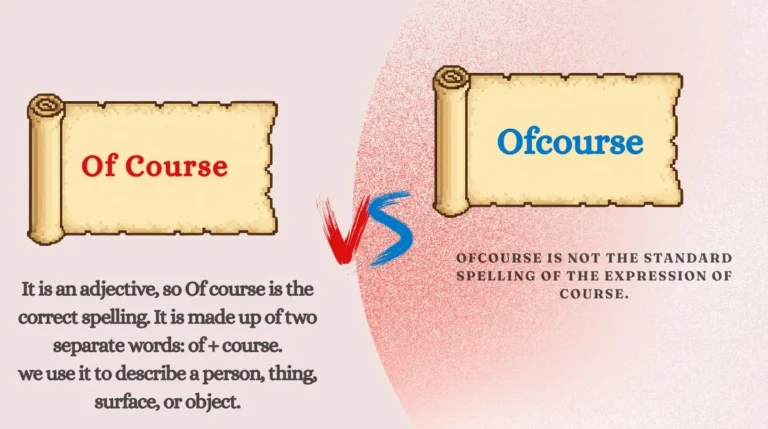
Many English learners are unsure whether to write “of course” or “ofcourse.” The two forms look almost the same, and when you hear them in everyday speech, there is no space that you can hear.
That can make the spelling confusing, especially for students who are still building their English vocabulary.
The good news is very simple: “of course” is the correct form. “Ofcourse” is not standard English. The two words should be written separately when they are used to mean “certainly,” “yes,” or “naturally.”
This small spelling difference matters because of course is very common in English. You will see it in emails, text messages, school writing, conversations, books, and online communication.
It can be used to agree with someone, answer a question, show that something is obvious, or politely confirm that you are willing to do something.
There is one more thing that makes this expression interesting. Although it contains the words of and course, its meaning often has very little to do with an actual course, class, or path.
In many sentences, it works as a common expression called an idiomatic phrase.
By the end of this guide, you will know the correct spelling, understand its meaning, learn how to use it naturally, avoid common mistakes, and feel confident using of course in both spoken and written English.
What Does “Of Course” Mean?
Of course is the correct spelling. It is made up of two separate words: of + course.
In everyday English, of course commonly means:
- certainly
- naturally
- yes
- without doubt
- as expected
It is often used when the speaker thinks the answer is clear, expected, or obvious.
For example, imagine your friend asks:
“Can you help me with my homework?”
You might say:
“Of course!”
Here, of course means “Yes, certainly” or “Yes, I am happy to help.”
The phrase can also show that something is expected.
“Of course, Sarah won the competition. She had practiced for months.”
In this sentence, the speaker feels that Sarah’s success was not surprising.
When Should You Use “Of Course”?
You can use of course in many everyday situations.
One common use is to give a positive answer.
“Can I borrow your pen?”
“Of course.”
It can also be used to agree with a statement.
“We need to leave early.”
“Of course. The train is at 7 a.m.”
Another use is to introduce information that seems natural or obvious.
“Of course, learning a new language takes time.”
You may also use it when giving permission.
“May I sit here?”
“Of course.”
It is especially common in friendly conversations, customer service, emails, and casual writing.
Grammar Rule for “Of Course”
When of course is used as a phrase meaning “certainly” or “naturally,” it usually works as an adverbial expression. It can appear at different points in a sentence.
At the beginning:
“Of course, you can come with us.”
In the middle:
“You can, of course, come with us.”
At the end:
“You can come with us, of course.”
The meaning is similar, but the position can slightly change the feeling or emphasis.
When it appears at the beginning or in the middle as an aside, a comma is commonly used.
Examples of “Of Course”
- Of course, I remember your name.
- Can I use your phone? Of course!
- She is, of course, very good at English.
- Of course we should help him.
- “Will you join us?” “Of course I will.”
- He was nervous, of course, because it was his first speech.
- Of course, you need to study if you want to improve.
- “Do you want some tea?” “Of course.”
A Common Learner Confusion
Many learners spell this phrase as ofcourse because they hear it as one sound.
English has many expressions that are made of two separate words, but speakers say them quickly. As a result, learners may think the words have joined together.
However, the correct written form remains:
✅ of course
Not:
❌ ofcourse
This is similar to other common phrases that need a space, such as at least, a lot, and in fact.
What Does “Ofcourse” Mean?
Ofcourse is not the standard spelling of the expression of course.
You may sometimes see ofcourse in social media posts, comments, informal messages, or writing created by English learners. However, it is generally considered a spelling error when the intended meaning is “certainly” or “naturally.”
It is important to understand that this does not mean the phrase has a different meaning when someone writes it as one word. Usually, the writer simply made a spelling mistake.
For example:
❌ Ofcourse I will help you.
The writer almost certainly means:
✅ Of course I will help you.
Why Do People Write “Ofcourse”?
There are several simple reasons.
First, people often pronounce the phrase quickly. In natural speech, of course can sound almost like one connected unit.
Second, English has many compound words, so learners may assume that two frequently used words eventually become one word.
Third, people often type quickly on phones. Informal online writing contains many spelling mistakes, and repeated exposure to those mistakes can make them look correct.
Finally, some learners may have learned the phrase by sound rather than by reading it.
Is “Ofcourse” Ever Correct?
For normal modern English writing, you should treat ofcourse as incorrect when you mean “certainly” or “naturally.”
For school assignments, essays, websites, emails, professional writing, and formal communication, always use:
of course
The important habit is to remember that the phrase has two separate words.
Examples
Here are some incorrect examples and their corrections:
❌ Ofcourse, I agree with you.
✅ Of course, I agree with you.
❌ She will come, ofcourse.
✅ She will come, of course.
❌ Ofcourse you can ask a question.
✅ Of course you can ask a question.
❌ I knew it was true ofcourse.
✅ I knew it was true, of course.
❌ “Can I leave early?” “Ofcourse.”
✅ “Can I leave early?” “Of course.”
The meaning has not changed. Only the spelling has been corrected.
Difference Between “Of Course” and “Ofcourse” (Detailed)
The biggest difference is very easy to remember: one is correct standard spelling, and the other is not.
| Point | Of Course | Ofcourse |
|---|---|---|
| Spelling | Correct | Incorrect |
| Number of words | Two | One |
| Standard English | Yes | No |
| Meaning | Certainly, naturally, yes | Usually intended to mean “of course” |
| Formal writing | Appropriate | Avoid |
| Informal texting | Appropriate | Still incorrect, even if commonly typed |
| Example | Of course I can help. | Ofcourse I can help. |
Usage Difference
There is no real meaning difference between the two forms in ordinary writing because ofcourse is not accepted as the standard spelling of this expression.
The correct expression is always of course.
Compare:
Of course, I understand.
This is correct and natural.
Now compare:
Ofcourse, I understand.
The reader can understand what you mean, but the spelling is wrong.
Grammar Logic
The phrase contains two words that retain their separate forms.
Of is a preposition.
Course is a noun.
Together, of course developed into a fixed expression that can work adverbially in a sentence.
It is similar to other expressions where separate words work together as one unit of meaning.
For instance:
- in fact
- at once
- by chance
- of course
- at first
You would not normally combine these into one word.
Sentence Structure
Of course can stand alone:
“Are you coming?”
“Of course!”
It can also appear before a clause:
Of course, I will call you later.
It can appear inside a clause:
You are, of course, welcome here.
And it can come at the end:
She knew the answer, of course.
The spelling does not change in any of these positions.
Meaning Comparison
When of course expresses agreement or certainty, it can mean:
- certainly
- definitely
- naturally
- obviously
- yes
But context matters.
Compare:
“Can I come with you?”
“Of course.”
Here it means yes or certainly.
Now:
“Of course, water is important for the body.”
Here it expresses something considered obvious or natural.
Another example:
“He was tired, of course, after working all day.”
Here it means naturally or as expected.
Grammar Rules You Must Remember
Rule 1: Always Write “Of Course” as Two Words
When you mean “certainly” or “naturally,” write the expression as two separate words.
✅ Of course, I will help you.
Not:
❌ Ofcourse, I will help you.
This is the most important rule.
Rule 2: Use Commas When “Of Course” Is an Introductory or Parenthetical Expression
A comma is often used when the phrase is added as a comment.
Of course, she was happy.
You can also place it in the middle:
She was, of course, happy.
When it comes at the end, a comma may also be used:
She was happy, of course.
The exact punctuation can depend on the sentence, but these comma patterns are very common.
Rule 3: “Of Course” Can Answer a Question by Itself
You do not always need a complete sentence after it.
“Can you help me?”
“Of course.”
“Are you going to the party?”
“Of course!”
This is completely natural in conversation.
Rule 4: Do Not Treat “Ofcourse” as an Alternative Spelling
A common mistake is to think that of course is formal while ofcourse is informal.
That is not the right way to think about it.
The difference is not simply a matter of style. Of course is the standard spelling. Ofcourse should normally be corrected.
For example:
✅ “Of course, I can explain that.”
❌ “Ofcourse, I can explain that.”
Whether you are writing a school answer or sending a short text message, of course is the safe choice.
Common Mistakes Students Make
The most common mistake is joining the two words together.
Mistake 1: Writing “Ofcourse”
❌ Ofcourse I know the answer.
Correct:
✅ Of course I know the answer.
Why does this happen? Because learners often hear the phrase as one sound in fast speech.
Correction tip: When writing it, mentally say “of + course.” The space between the two words becomes easier to remember.
Mistake 2: Using “Of Course” Without Understanding the Meaning
Some students use of course simply because they have seen native speakers use it often.
For example:
“I went to the shop, of course, and bought milk.”
This may be grammatically possible, but the phrase should have a reason for being there. It should add a sense of certainty, naturalness, or expected information.
Do not add it to every sentence.
Mistake 3: Adding Too Many Commas
Students sometimes write:
❌ Of course, I, will, help you.
That is incorrect.
The natural sentence is:
✅ Of course, I will help you.
The comma after of course is enough in this example.
Mistake 4: Thinking It Always Means “Obviously”
Sometimes of course means “certainly,” but it can also simply be a polite way of saying yes.
“Could you open the window?”
“Of course.”
Here, the speaker is not saying that opening the window is obvious. They are simply agreeing politely.
Mistake 5: Confusing Spelling With Pronunciation
In speech, words often connect. Native speakers may pronounce of course quickly, and the phrase may sound like one smooth unit.
Writing is different.
You hear connected speech, but you write the words separately.
Easy Trick to Remember the Difference
Here is a simple trick:
Think: “Of + Course = Two Words”
Imagine that course is a path.
A person walks of course? Not literally in this modern expression, but the important point is that the phrase visibly contains two separate words.
Whenever you are unsure, pause for one second and ask yourself:
“Is it of + course?”
The answer is yes.
So write:
OF COURSE
not:
OFCOURSE
Another useful memory trick is to compare it with the phrase of course not.
You naturally see the words as separate:
Of course not!
Now remove not:
Of course!
The space stays there.
You can also remember this classroom rule:
If “of course” means “certainly,” keep the space.
That one small habit can prevent the spelling mistake.
Daily Life Examples
Of course is extremely common in real conversations. Here are some natural examples you may hear or use every day.
1. Asking for Help
A: Can you help me with this bag?
B: Of course.
This is a friendly way to say yes.
2. Asking for Permission
A: Can I sit here?
B: Of course. There is plenty of space.
Here, the phrase gives permission.
3. Offering Something
A: Would you like some water?
B: Of course, thank you.
It shows agreement.
4. Talking About a Friend
Of course, Ali was excited about the trip.
The speaker thinks Ali’s excitement was natural or expected.
5. In the Classroom
Teacher: Do you understand this rule?
Student: Of course, but I have one question.
The student is saying yes while adding another point.
6. Talking to a Customer
Customer: Can I change my reservation?
Staff member: Of course. Let me check the details.
This sounds polite and helpful.
7. In a Family Conversation
Mother: Will you be home for dinner?
Son: Of course.
The answer shows certainty or willingness.
8. Talking About Practice
Of course, you will make mistakes when learning a new language.
Here, the phrase shows that mistakes are expected.
9. In an Email
Of course, I would be happy to send you the information.
This can sound polite and professional.
10. Showing Natural Results
She practiced every day, so of course her English improved.
The phrase shows that the result was expected.
These examples show something important: of course is not limited to one type of sentence. It can express agreement, certainty, permission, expectation, or a natural result.
Practice Section
Choose the correct option in each sentence.
1.
__________, I can help you with that.
A. Ofcourse
B. Of course
2.
She was tired, __________, after the long journey.
A. of course
B. ofcourse
3.
“Can I borrow your notebook?” “__________.”
A. Ofcourse
B. Of course
4.
__________ you are nervous before your first interview.
A. Of course
B. Ofcourse
5.
I knew, __________, that he would arrive late.
A. Ofcourse
B. of course
Answers
1. B — Of course
The correct spelling uses two words.
2. A — of course
The phrase is used as an added comment and is correctly written separately.
3. B — Of course
It can be used by itself as a complete conversational response.
4. A — Of course
It means that nervousness is natural or expected.
5. B — of course
The expression remains two separate words even when placed in the middle of a sentence.
A useful practice habit is to write five original sentences with of course. The more you use the correct form, the more natural the spelling will feel.
FAQs
1. What is the difference between “of course” and “ofcourse”?
Of course is the correct standard spelling, while ofcourse is generally a spelling error. The phrase of course means “certainly,” “naturally,” or “yes.” Always use the two-word form in standard English writing.
2. Can we use “of course” in questions?
Yes, you can use of course in questions, although the exact meaning depends on the sentence.
For example:
Of course, why would I say no?
It can also appear in a question when the speaker expects agreement, although tone and context are important.
3. Is “of course” formal or informal?
Of course can be used in both informal and formal situations. You can use it in conversations, emails, school writing, and professional communication. However, in very formal writing, writers sometimes choose a more precise word such as certainly or naturally, depending on the context.
4. Is “ofcourse” an English word?
No, ofcourse is not the standard spelling of this expression. You may see it online because people make spelling mistakes or type quickly. Seeing it often does not make it the correct spelling.
5. Is it “of course” or “ofcourse” in a sentence?
Use of course.
For example:
Of course, I understand.
The two words should not normally be joined into one word.
6. What does “of course” mean in everyday English?
In everyday English, of course can mean yes, certainly, naturally, or as expected. Its exact meaning depends on the situation.
For example:
“Can you help me?”
“Of course!”
Here, it means certainly or yes.
Conclusion
The spelling question between of course and ofcourse has a very simple answer: of course is correct. The expression should be written as two separate words.
It is a common English phrase used to show agreement, certainty, permission, or something that seems natural or expected. You can use it alone in conversation, at the beginning of a sentence, in the middle, or at the end.
The biggest reason learners make this mistake is pronunciation. In fast spoken English, of course may sound like one connected expression. But when you write it, keep the space between of and course.
Remember the easy rule: Of + Course = two words.
Once you get used to seeing and writing the correct form, the mistake becomes much easier to avoid. So the next time you need to say “certainly” or “yes,” feel free to write:
Of course!

Evan Rellmont is a writer who turns thoughtful ideas into meaningful words, creating stories and reflections that connect, inspire, and leave a lasting impression.