
Have you ever typed “shiney” and then wondered whether it should actually be “shiny”? You are not alone.
This is a very common spelling problem for English learners because the word shine already ends in e. When people want to turn it into an adjective, it feels natural to keep the e and add y.
However, standard English uses shiny, not shiney, when we are describing something that reflects light or looks bright and glossy.
Major dictionaries such as Oxford, Cambridge, and Merriam-Webster list shiny as the standard adjective.
This small spelling difference matters more than it may seem. You might need the word when talking about shoes, cars, hair, clothes, tables, phones, jewelry, or other objects.
You may also see it in school assignments, emails, product descriptions, and everyday conversations.
The good news is that the rule is easy once you understand where the confusion comes from.
By the end of this guide, you will know which spelling is correct, what shiny means, why shiney causes problems, how to use the word naturally, and how to remember the correct spelling without thinking twice.
What Does “Shiny” Mean?
Shiny is the correct spelling.
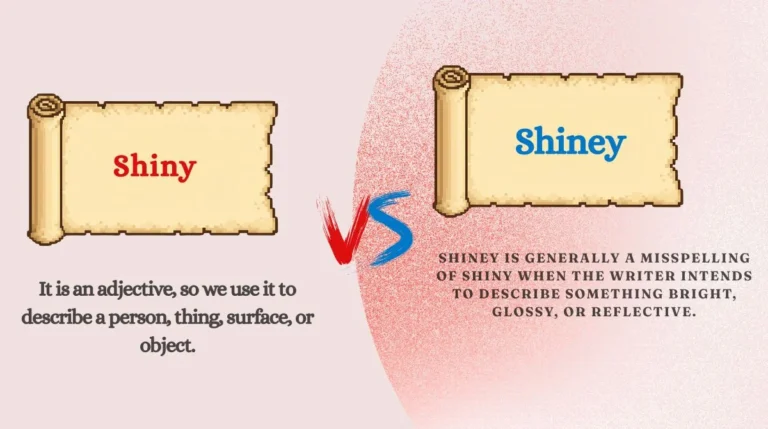
It is an adjective, so we use it to describe a person, thing, surface, or object. It usually means bright, smooth, glossy, or reflecting light. Cambridge defines shiny as something that is bright because it reflects light, while Oxford describes it as something smooth and bright that reflects light.
For example:
The car has a shiny black surface.
Here, shiny describes the surface of the car.
You can use this word for many everyday things. A pair of shoes can be shiny. Hair can be shiny. A table can have a shiny surface. A new phone can have a shiny screen.
When should you use “shiny”?
Use shiny when you want to say that something:
- reflects light
- looks glossy
- has a smooth, bright appearance
- appears polished
- looks bright and attractive
The word can describe both natural and artificial surfaces.
For example, hair may naturally look shiny. Shoes can become shiny after polishing. A metal spoon may look shiny because it reflects light.
Grammar rule for “shiny”
Shiny is an adjective.
It commonly comes:
Before a noun
She bought a shiny dress.
He wore shiny black shoes.
Or after a linking verb such as be, look, seem, or appear:
The floor looks shiny.
Her hair is shiny.
The new table seems shiny.
It can also be used in comparisons.
This car is shinier than the old one.
That metal is the shiniest part of the machine.
Merriam-Webster gives the comparative and superlative forms as shinier and shiniest.
Examples of “shiny”
- She bought a pair of shiny black shoes.
- The new car looks very shiny.
- His hair was clean and shiny.
- I cleaned the table until it became shiny.
- The children were excited by the shiny toy.
- She wore a shiny silver necklace.
- The kitchen floor has a shiny surface.
- I love the shiny finish on this phone.
These examples show how flexible the word is. It can describe many kinds of surfaces and objects.
What does “shiny” suggest?
The exact meaning can depend on the context.
A shiny car usually means the car has a bright, polished-looking surface.
Shiny shoes often suggest that the shoes have been polished.
Shiny hair means the hair reflects light and looks glossy.
A shiny new phone can mean both physically glossy and, in a broader informal sense, very new and attractive. Oxford specifically lists the expression shiny new for something very new and attractive.
So, the word does not always mean exactly the same thing in every sentence. The central idea, however, is brightness or a polished-looking appearance.
Common learner confusion
The biggest confusion is simple:
shine + y = shiny
Many learners write:
shiney
because they see the word shine and simply add y.
But English spelling does not always work by keeping the whole base word unchanged. In this case, the final e is dropped before the y is added.
So remember:
shine → shiny
not:
shine → shiney
That one small change is the key to getting the spelling right.
What Does “Shiney” Mean?
Shiney is generally a misspelling of shiny when the writer intends to describe something bright, glossy, or reflective.
In standard English, you should not use shiney for this meaning. Major learner and general dictionaries list shiny as the adjective. Oxford and Cambridge both give shiny as the standard form.
This means that these sentences should use shiny:
The shoes are shiny.
She has shiny hair.
We bought a shiny new table.
Writing shiney instead would be a spelling mistake in normal school, academic, professional, and standard online writing.
Why do people write “shiney”?
There is a very understandable reason.
The base verb is:
shine
When learners see shine, they often think:
shine + y = shiney
That looks logical at first glance.
English spelling, however, often changes the final e when a suffix is added. Here, the final e is removed:
shine → shiny
This is why the correct adjective has only one e, and that e belongs to the original spelling position before the y is added.
Should you ever write “shiney”?
For ordinary English writing, the answer is no.
Avoid shiney in:
- school assignments
- exams
- resumes
- emails
- blog posts
- product descriptions
- business writing
- formal documents
When you mean “bright or reflective,” choose shiny.
Examples of incorrect usage
Incorrect: She has shiney hair.
Correct: She has shiny hair.
Incorrect: I bought shiney shoes.
Correct: I bought shiny shoes.
Incorrect: The floor is very shiney.
Correct: The floor is very shiny.
The meaning is usually easy to understand, but the spelling is still incorrect.
A useful point for learners
Do not confuse shiney with the verb shine.
Shine is a real English word.
The stars shine at night.
The sun is shining.
But when you need the adjective describing something bright or reflective, the standard form is:
shiny
That distinction is important:
- shine = verb or noun
- shiny = adjective
- shining = adjective or present participle
- shiney = nonstandard spelling when intended as the adjective shiny
Merriam-Webster lists shine as both a verb and a noun, while shiny is an adjective.
Difference Between Shiny and Shiney
The main difference is not a difference in meaning. It is a difference between a standard spelling and a common misspelling.
| Word | Correct? | Part of Speech | Meaning | Example |
|---|---|---|---|---|
| shiny | Yes | Adjective | Bright, glossy, or reflective | She has shiny hair. |
| shiney | No, in standard usage | — | Usually intended to mean “shiny” | Avoid this spelling. |
1. Usage difference
Shiny is used in normal English whenever something looks bright because of light reflection or has a glossy appearance. Cambridge, Oxford, and Merriam-Webster all recognize it as a standard English adjective.
Shiney, on the other hand, should generally be treated as an incorrect spelling when you are writing standard English.
So if you are writing:
The new car is ___.
The correct answer is:
shiny
2. Grammar difference
There is no real grammar contrast between the two forms because shiney is not the standard adjective.
The useful grammar contrast is:
shine → verb/noun
shiny → adjective
shining → participle/adjective
For example:
The sun shines brightly.
The car is shiny.
The sun is shining.
Each word has a different job.
3. Meaning difference
When learners search for shiny or shiney, they sometimes expect each spelling to have a different meaning.
It does not work that way in standard English.
Shiny means something that is bright, glossy, smooth, or reflective.
Shiney, when written by mistake, normally intends the same meaning.
Therefore, it is not like pairs such as peace/piece where the two spellings create different words. Here, one is the correct spelling and the other is the spelling error.
4. Sentence structure
Because shiny is an adjective, you can use it in common adjective patterns.
Before a noun:
a shiny car
shiny shoes
shiny hair
After a linking verb:
The car looks shiny.
Her shoes are shiny.
The floor became shiny after cleaning.
Comparative form:
This surface is shinier.
Superlative form:
That is the shiniest object in the room.
These forms are standard and widely recognized.
Grammar Rules You Must Remember
Rule 1: Use “shiny” as the adjective
When you are describing something that reflects light or looks glossy, use shiny.
The table is shiny.
She has shiny black hair.
Do not use shiney in standard English for this meaning.
Rule 2: The base word “shine” loses its final “e”
The spelling becomes:
shine → shiny
The important detail is that the final e is not kept.
This is why:
shiny ✅
is correct, while:
shiney ❌
is not the standard spelling.
A similar pattern appears in other English adjectives such as smoky, icy, and slimy. These examples are useful because they show that the written form can change when an adjective is formed.
Rule 3: “Shiny” is an adjective, not a verb
Use shiny to describe something.
The floor is shiny.
Do not use it as the main action word.
For the action, use shine or shining depending on the sentence:
The sun shines brightly.
The sun is shining.
Her shoes are shiny.
This simple distinction helps prevent many grammar mistakes.
Rule 4: Use “shinier” and “shiniest” for comparison
When comparing two things, use shinier.
My new shoes are shinier than my old ones.
When one thing has the highest degree, use shiniest.
That is the shiniest car in the parking lot.
Oxford and Merriam-Webster both list shinier and shiniest as the comparative and superlative forms.
Common Mistakes Students Make
The easiest way to understand spelling mistakes is to look at the reason behind them.
Mistake 1: Keeping the “e” from “shine”
Many students think:
shine + y = shiney
But standard spelling gives:
shine → shiny
Wrong:
The floor is shiney.
Correct:
The floor is shiny.
Mistake 2: Confusing “shiny” and “shining”
These words are related, but they do not always work in the same sentence.
Shiny usually describes an object’s appearance or surface:
She has shiny hair.
Shining usually focuses more on something giving off or reflecting light, or it can describe something metaphorically excellent or impressive. Cambridge lists both the bright-light sense and an “excellent” sense of shining.
Compare:
Her shoes are shiny.
The stars are shining.
The shoes have a glossy appearance. The stars are actively giving or reflecting light.
Mistake 3: Thinking “shiney” is an alternative spelling
English has some words with different accepted spellings in British and American English.
That can make learners believe every spelling difference is acceptable.
But shiny is the standard spelling in both major varieties. Oxford provides the word in both British and American dictionaries, and Cambridge also lists it.
So this is not a British-versus-American spelling issue.
Mistake 4: Using “shiny” when “shine” is needed
Consider:
The sun ___ through the window.
The correct word is:
The sun shines through the window.
Not:
The sun shiny through the window.
Why? Because shiny is an adjective, while shines is a verb.
A useful check is to ask:
Am I describing something, or am I talking about an action?
If you are describing, shiny may be the right choice.
If you are talking about the action, you may need shine.
Mistake 5: Spelling from pronunciation
Some learners hear:
shiny
and try to write what they hear.
Because the e in shine is not pronounced in the adjective, the spelling can feel less obvious.
Reading the word often is the best solution.
Try remembering these together:
shine
shiny
shining
Seeing the family of words helps your brain recognize the correct spelling.
Easy Trick to Remember the Difference
Here is a simple memory trick:
Drop the E, add the Y
Start with:
SHINE
Remove the final E:
SHIN
Add Y:
SHINY
So:
SHINE → SHINY
A very easy phrase to remember is:
“Shine drops E before Y.”
You can write it in your notes like this:
shine – e + y = shiny
Another helpful trick is to connect the spelling with a familiar phrase:
shiny shoes
The phrase is very common. Think about a pair of polished shoes reflecting light.
Not:
shiney shoes
but:
shiny shoes
Real-life memory
Imagine cleaning a pair of black shoes.
First, you shine the shoes.
Then the shoes become shiny.
That gives you a useful pair:
shine = the action
shiny = the result or appearance
For example:
I shine my shoes.
My shoes are shiny.
This is not the only way the words are used, but it is a very helpful beginner-friendly connection.
Daily Life Examples
The word shiny appears in ordinary conversation more often than many learners realize.
1. Talking about shoes
A: Why are your shoes so shiny?
B: I polished them this morning.
2. Talking about a new car
A: Is that your new car?
B: Yes. It looks really shiny in the sunlight.
3. Talking about hair
A: Your hair looks great today.
B: Thanks! I used a new shampoo. It makes my hair shiny.
4. Talking about a kitchen table
A: Did you clean the table?
B: Yes. Look how shiny it is now.
5. Talking about jewelry
A: Your necklace is beautiful.
B: Thank you. It is nice and shiny.
6. Talking about a phone
A: I like the back of your phone.
B: Me too, although the shiny surface gets fingerprints easily.
7. Talking about a floor
A: The floor looks different.
B: We polished it, so now it is very shiny.
8. Talking about a new toy
A: Which toy does your son like best?
B: The shiny red car. He carries it everywhere.
9. Talking about clothes
A: Why didn’t you wear that shirt?
B: It is too shiny for a normal day.
10. Talking about something attractive and new
A: They bought a shiny new computer for the office.
B: Nice! That should make the work easier.
These examples show that shiny is a useful everyday adjective, not just a word found in grammar exercises.
Practice Section
Choose the correct option in each sentence.
1. Her shoes are very ______ after polishing.
A. shiney
B. shiny
2. The new car has a ______ black finish.
A. shiny
B. shiney
3. My hair looks ______ today.
A. shiney
B. shiny
4. This table is ______ than the old one.
A. shinyer
B. shinier
5. That is the ______ object in the room.
A. shiniest
B. shineyest
Answers
- B — shiny
- A — shiny
- B — shiny
- B — shinier
- A — shiniest
Notice that the same spelling idea continues in the comparative forms:
shiny → shinier → shiniest
The word does not become shineyer or shineyest.
FAQs
What is the difference between shiny and shiney?
Shiny is the correct standard spelling. It is an adjective meaning bright, smooth, glossy, or reflective. Shiney is generally a misspelling used when the writer means shiny. Major dictionaries list shiny as the standard form.
Is shiney a correct English word?
Not as the standard adjective meaning “bright” or “reflective.” In normal English writing, use shiny. This is especially important in schoolwork, professional writing, websites, and formal communication.
Why is shiny spelled without the e?
The adjective is formed from shine, but the final e is dropped before y is added:
shine → shiny
This is why shiny is correct rather than shiney.
Is shiny a noun, verb, or adjective?
Shiny is an adjective.
It describes something:
a shiny car
shiny shoes
shiny hair
The related word shine can be a verb or noun, depending on the sentence. Merriam-Webster lists both noun and verb uses for shine.
What is the comparative form of shiny?
The comparative form is shinier:
This car is shinier than mine.
The superlative form is shiniest:
That is the shiniest car here.
Oxford and Merriam-Webster both list these forms.
Is shiny formal or informal?
Shiny is a normal, standard English adjective. It can be used in casual conversation, school writing, professional descriptions, and formal writing when appropriate. The expression shiny new can also be used in a more informal or expressive way to describe something new and attractive.
Conclusion
When you are choosing between shiny or shiney, the answer is clear: shiny is the correct standard spelling.
Use shiny as an adjective when something is bright, smooth, glossy, polished, or reflects light. You can talk about shiny shoes, shiny hair, a shiny car, a shiny floor, or a shiny metal surface. Oxford, Cambridge, and Merriam-Webster all recognize shiny as the standard word.
The spelling becomes much easier when you remember one simple rule:
shine → shiny
Drop the final e and add y.
Also remember that shine and shiny have different grammar jobs. Shine can be a verb or noun, while shiny is an adjective. So you can say, “The sun shines,” but “The car is shiny.”
The next time you are unsure, do not write shiney. Think of shiny shoes, shiny hair, or a shiny car. A little practice will make the correct spelling feel completely natural.

Evan Rellmont is a writer who turns thoughtful ideas into meaningful words, creating stories and reflections that connect, inspire, and leave a lasting impression.