
Have you ever written catalogue and wondered whether you should have written catalog instead? Or perhaps you saw one spelling in a British book and the other on an American website and thought, “Which one is actually correct?”
This is a common problem for English learners because both catalogue and catalog are correct English words. The main difference is not their meaning. It is the variety of English being used.
Catalogue is the usual spelling in British English, while catalog is the usual spelling in American English. Cambridge Dictionary also lists catalog as the US spelling of catalogue.
The word can be used for a list of products, books, artworks, or other items.
It can also be a verb meaning to record or arrange things in a list.
So, once you understand the spelling difference, the word becomes much easier to use.
The good news is that you do not need to memorize two different meanings.
In most cases, you simply need to choose the spelling that matches the type of English you are writing.
By the end of this guide, you will know when to use catalogue, when to use catalog, how the two spellings work as nouns and verbs, which spelling is common in different countries, and how to avoid mistakes in everyday writing.
What Does “Catalogue” Mean?
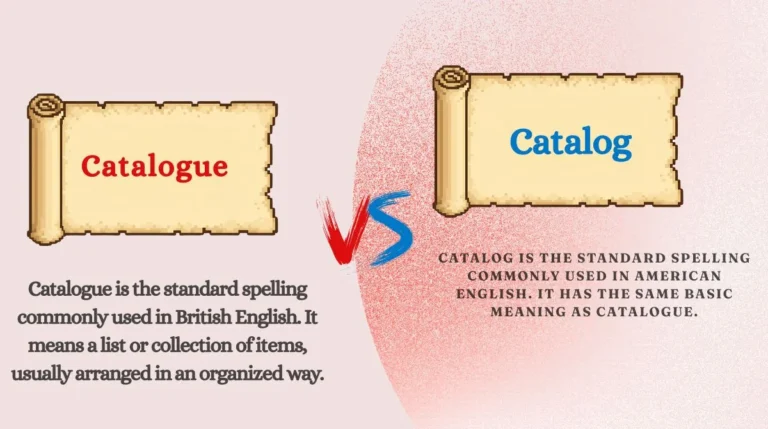
Catalogue is the standard spelling commonly used in British English. It means a list or collection of items, usually arranged in an organized way. It can refer to products for sale, books in a library, works of art, or many other groups of things.
Cambridge Dictionary defines catalogue as a book or list containing items such as goods available from a shop or books and paintings held in a particular place. It also gives catalogue as a verb meaning to record something, especially in a list.
When should you use “catalogue”?
Use catalogue when you are writing in British English or following British spelling conventions.
For example, someone in the UK might write:
- I received a new clothing catalogue.
- The library has a detailed book catalogue.
- The museum published a catalogue of its paintings.
- Please check the product catalogue before ordering.
- The company sends out a seasonal catalogue every year.
- She looked through the furniture catalogue.
- The auction catalogue contains photographs and prices.
- The researchers began to catalogue every species they found.
Notice that the spelling stays the same when the word works as a noun or verb.
Catalogue as a noun
As a noun, catalogue usually means an organized list of things.
It may be a printed book, a digital list, or a record stored online.
For example:
The company printed a new catalogue for its customers.
Here, catalogue is a noun because it names the list of products.
Another example:
I found the book in the university library catalogue.
The word refers to an organized record of books.
Catalogue as a verb
Catalogue can also be a verb. In this form, it means to make a list of things, record them, or organize them.
For example:
The museum is cataloguing its old photographs.
This means the museum is recording and organizing the photographs.
You may also see forms such as catalogued and cataloguing in British English.
Common learner confusion
Many learners think catalogue and catalog have different meanings. Usually, they do not.
The important difference is spelling, not basic meaning.
A learner might write:
The shop sent me a product catalog.
This is perfectly normal in American English.
But in British English, the more traditional spelling is:
The shop sent me a product catalogue.
Both sentences communicate the same idea.
So, do not think of one as “right” and the other as “wrong.” The better question is: Which variety of English am I using?
What Does “Catalog” Mean?
Catalog is the standard spelling commonly used in American English. It has the same basic meaning as catalogue. It can be a list of products, books, records, artworks, or other items.
Cambridge Dictionary specifically labels catalog as the US spelling of catalogue. Its American English entry also gives examples such as a store catalog and a library catalog.
When should you use “catalog”?
Use catalog when you are writing in American English.
For example:
- I ordered the dress from an online catalog.
- The library has an online catalog.
- The company released a new product catalog.
- Please check our summer catalog.
- The museum printed a catalog of the exhibition.
- The store’s catalog includes hundreds of products.
- Students can search the library catalog.
- Scientists cataloged the plants in the area.
Catalog as a noun
As a noun, catalog means an organized list of items.
For example:
The customer received a furniture catalog.
The catalog contains information about the products.
Another example:
I searched the online library catalog for the book.
Here, the word refers to a digital system containing information about available books.
Modern catalogs are not always printed. They may be websites, databases, apps, or searchable online systems.
Catalog as a verb
In American English, catalog can also be used as a verb.
For example:
The scientists cataloged more than 500 plants.
This means they recorded and organized information about the plants.
You may also see:
- cataloged
- cataloging
- catalogs
For example:
The library catalogs new books every month.
Common learner confusion
Some students see catalog and assume that the missing “ue” makes it a shortened or informal form.
That is not the best way to think about it.
Catalog is the normal American spelling. It is not simply a casual shortcut.
For American readers, catalog is a fully standard spelling. For British readers, catalogue is generally the expected form.
Difference Between Catalogue and Catalog
The biggest point to remember is simple: the two words usually have the same meaning, but they belong to different spelling traditions.
| Feature | Catalogue | Catalog |
|---|---|---|
| Main variety | British English | American English |
| Basic meaning | Organized list or record | Organized list or record |
| Noun | Yes | Yes |
| Verb | Yes | Yes |
| Common UK spelling | Yes | Less common |
| Common US spelling | Less common | Yes |
| Example | product catalogue | product catalog |
| Verb example | catalogue books | catalog books |
1. The meaning is basically the same
Whether you write catalogue or catalog, you are normally talking about a list, collection, or organized record.
Compare:
The bookstore published a new catalogue.
and
The bookstore published a new catalog.
The meaning is essentially the same. The spelling reflects the variety of English.
2. British English usually prefers “catalogue”
In British English, the spelling with -ue is standard:
university catalogue
product catalogue
library catalogue
exhibition catalogue
This spelling is also common in other contexts that follow British spelling conventions.
3. American English usually prefers “catalog”
American English normally removes the final -ue:
university catalog
product catalog
library catalog
exhibition catalog
This is the form American readers are most likely to expect.
4. The verb follows the same pattern
The difference does not disappear when the word becomes a verb.
British English:
The librarian catalogued the books.
American English:
The librarian cataloged the books.
You may also notice a difference in the -ing form:
British English:
cataloguing
American English:
cataloging
The same regional spelling pattern appears in these related forms.
5. Sentence structure does not change
This is another important point for learners.
You do not need a special grammar rule for catalogue or catalog.
The word can appear in the same basic sentence patterns.
For example:
The company published a product catalogue.
The company published a product catalog.
The sentence structure is identical.
The only major change is spelling.
Grammar Rules You Must Remember
Rule 1: Use “catalogue” for British English
When your writing follows British English spelling, catalogue is the normal choice.
Example:
I looked through the holiday catalogue.
This is natural British English.
Rule 2: Use “catalog” for American English
When you are writing in American English, use catalog.
Example:
I looked through the holiday catalog.
This is natural American English.
Rule 3: Both spellings can be nouns and verbs
Do not assume that one is a noun and the other is a verb.
Both can be used in both roles.
Noun:
The museum has a catalogue.
Verb:
The museum catalogues its paintings.
American forms:
The museum has a catalog.
The museum catalogs its paintings.
Rule 4: Stay consistent in formal writing
If you choose one variety of English, try to keep your spelling consistent.
For example, a document written in British English may use:
catalogue
colour
centre
organise
A document written in American English may use:
catalog
color
center
organize
Mixing varieties is not always a serious error, but consistency makes your writing look more polished and professional.
Common Mistakes Students Make
Learners often make mistakes with this word because they see both spellings online. That creates understandable confusion.
Mistake 1: Thinking “catalogue” is always correct
A student may learn British English and conclude that catalog is wrong.
That is not true.
Wrong idea:
“Catalog” is an incorrect spelling.
Better understanding:
“Catalog” is the standard American spelling.
Cambridge Dictionary clearly identifies catalog as the US spelling of catalogue.
Mistake 2: Thinking “catalog” is always correct
The opposite mistake happens too.
An American learner may see catalog everywhere and assume that catalogue is a spelling error.
Again, that is not correct.
Catalogue is the usual British form.
Mistake 3: Changing the meaning
Some learners think the words describe different things.
For example, they may imagine that a catalogue is a printed book while a catalog must be an online list.
That distinction is not a grammar rule.
Either spelling can refer to printed or digital lists.
For example:
I searched the online catalogue.
and
I searched the online catalog.
Both are possible, depending on the variety of English being used.
Mistake 4: Mixing forms in the same document
A writer might use catalogue in one paragraph and catalog in another without any reason.
This can make the writing look inconsistent.
For example:
Our product catalogue is available online.
Visit our product catalog for more information.
If the whole document is intended to use British English, choose catalogue throughout.
Mistake 5: Forgetting the verb spelling
Students sometimes learn the noun but forget that the verb changes too.
British:
She catalogued the documents.
American:
She cataloged the documents.
A useful habit is to learn the word family together rather than memorizing only one form.
Easy Trick to Remember the Difference
Here is a simple classroom trick:
British English = Catalogue
American English = Catalog
Think of the extra -ue as the British version.
You can memorize it like this:
UK → catalogue
US → catalog
Another easy trick is to connect it with other British-American spelling differences.
British English often keeps extra letters:
colour
favourite
centre
catalogue
American English often uses shorter spellings:
color
favorite
center
catalog
This does not mean that American English is “better” or that British English is “more correct.” They are simply different standard varieties of English.
A real-life memory trick
Imagine you are shopping online.
If the website is written in British English, you may see:
View our latest catalogue.
If it is written in American English, you may see:
View our latest catalog.
The product list is the same kind of thing. Only the spelling changes.
That is the key.
Daily Life Examples
Here are some natural examples that you might hear or read in everyday English.
Example 1: Shopping
British English:
Have you seen the new clothing catalogue?
American English:
Have you seen the new clothing catalog?
Both ask about a list of clothes offered by a company.
Example 2: Library
British English:
You can find the book in the library catalogue.
American English:
You can find the book in the library catalog.
This is especially common in schools, colleges, and universities.
Example 3: Online shopping
I checked the company’s online catalogue before buying anything.
An American writer would normally spell the key word as catalog.
Example 4: A museum
The museum published a catalogue of its new exhibition.
The catalogue gives information about the artworks.
Example 5: Business
Please send me your latest product catalogue.
The customer wants a list of products, often with descriptions and prices.
Example 6: Science
Researchers are cataloguing the plants found in the region.
Here, the verb means they are making an organized record.
Example 7: School
Our teacher asked us to search the library catalogue.
The students need to find books.
Example 8: A conversation between friends
“Where did you find that jacket?”
“I saw it in an online catalog.”
This is a natural American-style example.
Example 9: Collecting information
The team is cataloguing old photographs.
The group is recording and organizing them.
Example 10: Digital systems
The website has a searchable catalog of available courses.
A catalog does not need to be a paper book. It can be a digital list or database.
Practice Section
Choose the correct option according to the variety of English mentioned.
1. British English
The university library has a large book (catalog / catalogue).
2. American English
I found the product in the store (catalogue / catalog).
3. British English
The museum is (cataloging / cataloguing) its old photographs.
4. American English
The librarian (catalogued / cataloged) the new books.
5. General meaning
Both (catalogue / catalog) can mean an organized list of items.
Answers
1. catalogue
British English normally uses catalogue.
2. catalog
American English normally uses catalog.
3. cataloguing
The British spelling keeps the -ue form.
4. cataloged
American English normally uses cataloged.
5. Both
The two spellings have essentially the same meaning.
FAQs About Catalogue or Catalog
What is the difference between catalogue and catalog?
The main difference is regional spelling. Catalogue is the usual British English spelling, while catalog is the usual American English spelling. They generally have the same meaning and can both be used as nouns and verbs.
Is catalogue British or American?
Catalogue is primarily associated with British English. American English normally uses catalog instead. The meaning remains the same, so the spelling choice mainly depends on which variety of English you are following.
Is catalog a correct English word?
Yes. Catalog is a fully correct English word and is the standard American spelling. It can be used as both a noun and a verb. Cambridge Dictionary lists it as the US spelling of catalogue.
Is catalogue more formal than catalog?
No. Neither spelling is automatically more formal. The difference is mainly regional. A British company can use catalogue in formal writing, while an American company can use catalog in equally formal writing.
Can catalogue be used as a verb?
Yes. Catalogue can be a verb meaning to record, organize, or list things. For example: “The museum is cataloguing its paintings.” American English normally writes the same verb as cataloging.
Which spelling should I use in my writing?
Use the spelling that matches your audience and the variety of English required by your school, workplace, or website. For British English, choose catalogue. For American English, choose catalog. Most importantly, stay consistent throughout the same piece of writing.
Conclusion
The difference between catalogue and catalog is much easier than it first appears. They are not two completely different words. In most situations, they have the same meaning and can both work as nouns or verbs.
The main difference is regional spelling. Catalogue is the standard form in British English, while catalog is the standard form in American English.
So, when you see the two forms, do not worry that one must be wrong. First think about your audience. Are you writing for British English readers or American English readers?
Remember the simple rule:
UK → catalogue
US → catalog
Once this small difference becomes familiar, you will be able to use the word confidently in emails, school assignments, websites, business writing, and everyday English.
Good English is not about memorizing every spelling difference at once. It is about noticing patterns and using them naturally. Keep practicing, and these regional differences will soon feel much easier.

Evan Rellmont is a writer who turns thoughtful ideas into meaningful words, creating stories and reflections that connect, inspire, and leave a lasting impression.