
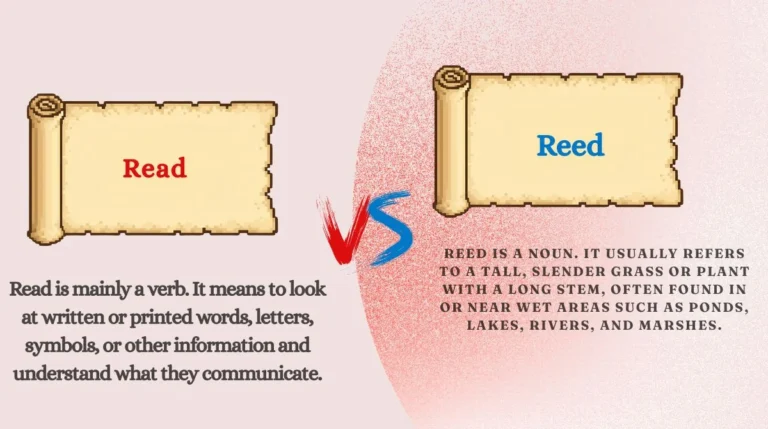
English has many words that sound exactly the same but have completely different meanings and spellings. Read and reed are a good example.
They are pronounced the same in their present-tense form, but they do not mean the same thing at all. This can make writing especially confusing for English learners.
The word read is very common. We use it when we talk about looking at written words and understanding their meaning.
We read books, emails, messages, signs, instructions, newspapers, and many other things. The word can also be used in different tenses, which creates another small challenge because the spelling stays the same while the pronunciation can change.
The word reed, on the other hand, is a noun.
It can refer to a tall, thin plant that often grows in wet places. It can also mean a thin vibrating piece used in some musical instruments, such as a clarinet.
Once you see the meaning clearly, the difference becomes much easier.
By the end of this guide, you will know when to use read and when to use reed, how their pronunciations work, the common mistakes students make, and a simple trick that can help you remember the correct spelling.
What Does “Read” Mean?
Read is mainly a verb. It means to look at written or printed words, letters, symbols, or other information and understand what they communicate. It can also mean to say written words aloud or to learn information from something that has been written.
For example, when you open a book and understand the words on the page, you read the book. When you look at a text message and understand what your friend wrote, you read the message.
The word is extremely common in everyday English. Students read textbooks. Workers read emails. Children read stories. Drivers read road signs. People read menus before ordering food.
When Do We Use “Read”?
We use read when talking about written information or the action of understanding it.
Here are some common situations:
- Reading a book or novel
- Reading a newspaper
- Reading an email
- Reading a message
- Reading instructions
- Reading a sign
- Reading a report
- Reading information online
We can also use read in a wider sense. For example, a person can “read” a situation or someone’s emotions. In that use, it means to understand or interpret something. Merriam-Webster also lists meanings connected with interpreting signs, information, and even numerical displays.
Grammar Rule for “Read”
The most important thing to remember is that read is a verb in its most common use.
It can appear in different forms:
Present: read
Past: read
Past participle: read
-ing form: reading
Third-person singular: reads
One tricky point is pronunciation.
In the present tense, read is pronounced /riːd/, like reed.
In the simple past, read is pronounced /red/, like the color red. The spelling does not change, but the pronunciation does.
Examples of “Read”
- I read a book every night before bed.
- Please read the instructions carefully.
- She likes to read mystery stories.
- Did you read my message?
- We read the news every morning.
- He reads the newspaper on the train.
- The teacher asked us to read the next chapter.
- I read your email yesterday.
Notice the last sentence carefully. Read is spelled the same, but because the sentence refers to yesterday, it is the past form and is pronounced /red/.
Common Learner Confusion with “Read”
Many students hear read and reed pronounced the same and assume they can use either spelling.
That is not correct.
For example:
❌ I reed a book every evening.
✅ I read a book every evening.
The first sentence is incorrect because the action of looking at written words requires the verb read.
Another common problem happens with the past tense:
✅ I read that book last week.
Here, the word is still spelled read, but it sounds like red.
So remember:
read = the verb
reed = a different word
What Does “Reed” Mean?
Reed is a noun. It usually refers to a tall, slender grass or plant with a long stem, often found in or near wet areas such as ponds, lakes, rivers, and marshes.
The word also has a musical meaning. A reed can be a thin, flexible piece attached to certain musical instruments. When air passes over it, the reed vibrates and helps create sound. Clarinet and saxophone players, for example, use reeds.
Unlike read, reed is normally a thing or object, not an action.
When Do We Use “Reed”?
Use reed when you are talking about:
- A tall grass-like plant
- A group of such plants
- A natural plant growing near water
- A part of some musical instruments
The word may appear less often than read in everyday beginner English, but it is still useful, especially when reading about nature, music, gardening, geography, or science.
Grammar Rule for “Reed”
Reed is a countable noun.
You can say:
- a reed
- one reed
- two reeds
- many reeds
- the reeds
For example:
A reed was growing beside the pond.
Several reeds moved in the wind.
The plural form is simply reeds. Merriam-Webster lists both the plant meaning and the musical-instrument meaning under the noun reed.
Examples of “Reed”
- Tall reeds grew around the edge of the lake.
- A bird was hiding among the reeds.
- The wind moved the reeds beside the river.
- She saw a group of reeds near the pond.
- The musician replaced the old reed on his instrument.
- A clarinet player must choose the right reed.
- The wetland was filled with green reeds.
- We walked past a patch of reeds near the water.
In each example, reed refers to a thing, not the act of reading.
Common Learner Confusion with “Reed”
The biggest problem is pronunciation.
Reed is pronounced /riːd/, the same way as the present-tense verb read. Cambridge gives the pronunciation of reed as /riːd/ in both British and American English.
So when you hear the sound /riːd/, you cannot always know the spelling immediately. You must use the meaning and the sentence to decide.
For example:
I read every day.
Here, the word is an action, so the spelling is read.
The reeds are growing near the river.
Here, the word means plants, so the spelling is reeds.
Difference Between Read and Reed
The easiest way to understand the difference is to look at their meanings, grammar, and sentence roles.
| Feature | Read | Reed |
|---|---|---|
| Part of speech | Usually a verb | Usually a noun |
| Main meaning | To look at and understand written words | A tall plant or a thin musical strip |
| Pronunciation | Present: /riːd/ | /riːd/ |
| Past-tense pronunciation of “read” | /red/ | Not applicable |
| Example | I read books. | The reeds grow near water. |
| Refers to an action? | Yes | No |
| Refers to a thing? | Sometimes as a noun | Yes |
Usage Difference
The biggest difference is simple:
Read = an action involving written information
Reed = a plant or musical object
Think about these two sentences:
I read the book.
The speaker is doing something. The person is looking at written words and understanding them.
The reed is beside the pond.
The speaker is naming a thing.
That basic difference will help you choose the right spelling in most situations.
Grammar Logic
Another useful clue is grammar.
If the word fits naturally after a subject and describes an action, you probably need read.
She read the letter.
They read the instructions.
We read every evening.
Here, read acts as a verb.
If the word has a determiner or adjective before it and names an object or thing, you probably need reed.
A reed grew near the pond.
The tall reeds bent in the wind.
The musician changed the reed.
Here, reed acts as a noun.
Sentence Structure Difference
Look at these structures:
Subject + read + object
- I read books.
- She read the note.
- We read the article.
Now compare:
Determiner/adjective + reed + extra information
- A reed grew beside the lake.
- The tall reeds moved in the wind.
- He replaced the broken reed.
This is a very useful grammar clue.
Meaning Comparison
Here is the simplest mental picture:
read → words, books, messages, information
reed → plant, pond, wetland, instrument
When you connect each word to a picture, the spelling becomes easier to remember.
Grammar Rules You Must Remember
Rule #1: Use “read” for the action of understanding written words.
When someone looks at text and understands it, use read.
✅ She read the letter.
✅ Please read this message.
❌ She reed the letter.
The action always takes the spelling read.
Rule #2: Use “reed” for the plant.
When you are talking about the tall, thin plant found in wet places, use reed.
✅ The pond is surrounded by reeds.
✅ A reed grew near the river.
❌ A read grew near the river.
A plant is a noun, so reed is the correct choice.
Rule #3: Use “reed” for a part of some musical instruments.
A reed can also be the thin, vibrating part used in instruments such as clarinets and saxophones.
✅ The saxophone player changed the reed.
✅ This reed produces a better sound.
Here, the word is a musical object, not a reading action.
Rule #4: Remember that “read” changes pronunciation in the past tense.
This rule is especially important for learners.
Present:
I read books.
Pronunciation: /riːd/
Past:
I read that book yesterday.
Pronunciation: /red/
The spelling remains read, but the sound changes.
This is one reason English learners sometimes find the word unusual.
Common Mistakes Students Make
Students often make mistakes with these words because English spelling does not always match pronunciation.
Mistake 1: Using “reed” for the verb
❌ I reed books every day.
✅ I read books every day.
Why does this happen? Because read sounds like reed when it is used in the present tense.
Correction tip: Ask yourself, “Am I doing an action with written words?”
If yes, use read.
Mistake 2: Using “read” for the plant
❌ We saw many read near the river.
✅ We saw many reeds near the river.
The missing s also matters here. Since there are many plants, you need the plural noun reeds.
Mistake 3: Confusing the past pronunciation
Some learners think the past tense should be written differently because it sounds like red.
❌ I red the book yesterday.
✅ I read the book yesterday.
This is a spelling mistake caused by pronunciation. The correct spelling is still read.
Mistake 4: Choosing a spelling only from sound
This is the biggest lesson.
English has many homophones and near-homophones. A sound alone does not always tell you the spelling.
When you hear /riːd/, ask:
What does the word mean?
Is it an action with written words?
→ read
Is it a plant or musical part?
→ reed
Mistake 5: Forgetting the plural “reeds”
When talking about more than one plant, use reeds.
✅ The reeds were moving in the wind.
Not:
❌ The reed were moving in the wind.
A plural noun needs the plural form.
Easy Trick to Remember the Difference
Here is a simple memory trick:
“Read” needs words. “Reed” grows or plays.
Think of read and imagine a book.
Read → book → words → information
Then think of reed and imagine a pond.
Reed → pond → plant
There is also a second image:
Reed → music → clarinet or saxophone
So when you see the two spellings, create one of these mental pictures.
READ = something you do
REED = something you see or use
This trick works because it connects each spelling to a clear meaning instead of asking you to memorize two spellings without context.
Another useful trick is to notice the extra e in reed. The spelling reed looks long and thin, almost like a tall plant. It is not a grammar rule, of course, but it can be a helpful memory image.
Most importantly, do not try to solve the problem by pronunciation alone. Both read in the present tense and reed are pronounced /riːd/.
Daily Life Examples
Here are some natural examples similar to the English you may hear or use every day.
Example 1: Talking about a book
A: What are you doing?
B: I’m reading a book.
The action is reading, so we use read.
Example 2: Talking about a message
A: Did you read my text?
B: Yes, I saw it this morning.
Again, read is the action of looking at written information.
Example 3: Talking about homework
Teacher: Please read pages ten and eleven tonight.
Student: Okay, I’ll do that.
The student is being asked to perform an action.
Example 4: Talking about a pond
A: What are those tall plants?
B: They’re reeds.
Here, reeds names plants.
Example 5: Talking about nature
A: Why are there so many reeds around the lake?
B: They grow well in wet areas.
The word refers to plants growing near water.
Example 6: Talking about music
A: Why did the musician stop playing?
B: He needed to replace the reed.
The word refers to a part of the instrument.
Example 7: Talking about yesterday
A: Did you finish the novel?
B: Yes, I read it last night.
The spelling is still read, but here it is pronounced /red/.
Example 8: Talking about signs
A: Did you read the sign outside?
B: Yes. It says the shop closes at six.
This is a very normal everyday use of read.
Example 9: Talking about a wetland
A: What is moving in the wind?
B: The reeds are moving.
They are plants, so reeds is the correct spelling.
Example 10: Talking about reading habits
A: Do you read before sleeping?
B: Yes, I usually read for about twenty minutes.
This is one of the most common uses of the verb.
Practice Section
Choose read or reed in each sentence.
1. I like to ______ before going to bed.
a) read
b) reed
2. The ______ beside the pond are very tall.
a) read
b) reeds
3. Did you ______ the email I sent you?
a) read
b) reed
4. The musician bought a new ______ for his instrument.
a) read
b) reed
5. I ______ that story yesterday.
a) read
b) reed
Answers
1. read — It is an action involving written words.
2. reeds — These are plants.
3. read — The person is looking at an email.
4. reed — It is a musical-instrument part.
5. read — This is the past form of the verb, pronounced /red/.
Frequently Asked Questions
What is the difference between read and reed?
Read is usually a verb meaning to look at and understand written words or information. Reed is a noun referring mainly to a tall plant or a thin vibrating part used in some musical instruments.
Although present-tense read and reed sound the same, their meanings and spellings are different.
Are read and reed pronounced the same?
In their most common forms, yes. Present-tense read is pronounced /riːd/, and reed is also pronounced /riːd/.
However, the past tense of read is pronounced /red/. This is one of the unusual features of English spelling and pronunciation.
Can “reed” be used as a verb?
The common use of reed is as a noun. Merriam-Webster also records a verb form reed, but it is much less common in ordinary English than the noun. For beginners, the important use to remember is the noun referring to a plant or musical component.
Is “read” a noun or a verb?
Read is most commonly used as a verb, but it can also be used as a noun in some contexts. For example, “a good read” means something enjoyable to read. Merriam-Webster lists noun, verb, and adjective uses of the word.
For beginner grammar, however, the verb is the most important use.
Why does read have two pronunciations?
The spelling read is used for both present and past forms, but the pronunciation changes.
Present: read /riːd/
Past: read /red/
This means you need to use the tense and context to understand which pronunciation is intended.
Is reed only the name of a plant?
No. Reed can also refer to a thin vibrating piece used in certain musical instruments. It may be made from natural cane or other materials, depending on the instrument.
So when you see the word in a music-related sentence, it may not refer to a plant at all.
Conclusion
The difference between read and reed is actually simple once you focus on meaning instead of sound. Read is mainly a verb connected with books, messages, signs, instructions, and other written information. Reed is a noun that usually refers to a tall plant found in wet places or to a vibrating part used in certain musical instruments.
The confusing part is pronunciation. Present-tense read and reed sound the same: /riːd/. The past tense of read, however, is pronounced /red/.
A good way to remember the difference is this: read is something you do, while a reed is something you see or use. Keep that idea in mind, and these two words will become much easier to use correctly.
The best way to master confusing words is regular practice. Read sentences, notice the context, and pay attention to how each word is used. With time, choosing the correct spelling will feel natural.

Evan Rellmont is a writer who turns thoughtful ideas into meaningful words, creating stories and reflections that connect, inspire, and leave a lasting impression.