
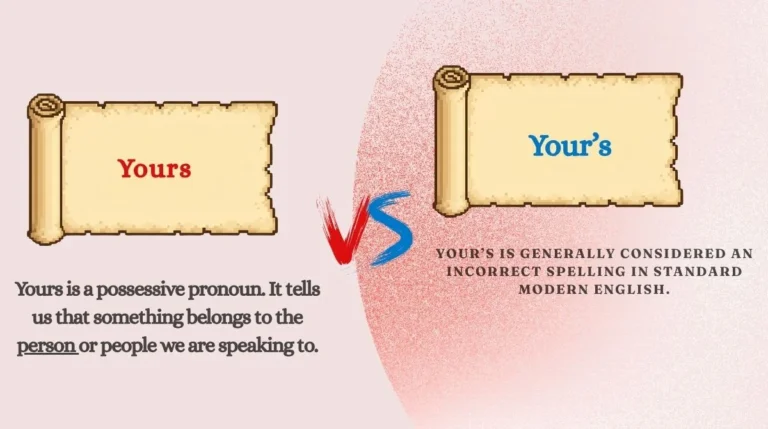
Have you ever stopped while writing an email, message, or school assignment and wondered whether the correct word is “yours” or “your’s”?
You are not alone. This is a very common mistake, especially for English learners.
At first glance, your’s may look correct because we often use apostrophes to show possession in English.
For example, we write John’s book or Sarah’s phone. So it is easy to think that your’s should follow the same rule.
However, English has a small but important exception here. The correct spelling is yours, without an apostrophe. Your’s is not correct in standard modern English.
This difference matters because these words appear often in everyday communication. You may see yours in emails, letters, conversations, formal writing, and phrases such as “Yours sincerely” or “Is this book yours?”
The good news is that the rule is actually quite simple once you understand how your and yours work.
By the end of this guide, you will know the difference between your and yours, understand why your’s is incorrect, learn the grammar rule behind possessive pronouns, and see how these words are used in natural English. You will also get practical examples, common mistakes, memory tricks, and a short practice exercise.
What Does “Yours” Mean?
Yours is a possessive pronoun. It tells us that something belongs to the person or people we are speaking to.
For example:
- Is this pen yours?
- That blue jacket is yours.
- I found a wallet. Is it yours?
- The final decision is yours.
In each sentence, yours shows ownership.
The important point is that yours can stand alone. It replaces a noun or noun phrase that has already been mentioned or is understood from the context.
When Do We Use “Yours”?
We use yours when we want to say that something belongs to you or you and another person.
Look at this simple example:
This is your bag.
Here, your comes before the noun bag.
Now imagine that the listener already knows which bag you mean:
This bag is yours.
We use yours because we do not need to repeat the noun after it.
Compare:
- This is your phone.
- This phone is yours.
The meaning is almost the same, but the grammar is different.
Your goes before a noun.
Yours can stand by itself.
The Grammar Rule for “Yours”
The key rule is:
Yours is a possessive pronoun and is normally used without a noun immediately after it.
For example:
- This seat is yours.
- The red car is yours.
- The choice is yours.
We do not normally say:
- This is yours car. ❌
- That is yours book. ❌
Instead, we say:
- This is your car. ✅
- That is your book. ✅
The difference between your and yours becomes much easier when you remember where the noun appears.
Examples of “Yours”
Here are several natural examples:
- Is this notebook yours?
- That umbrella is yours.
- I think this key is yours.
- The choice is yours.
- Which seat is yours?
- This room is yours for the weekend.
- The responsibility is yours.
- I left your package on the table, but that blue box is yours.
These examples all show ownership.
“Yours” in Letters and Emails
You may also see yours at the end of a letter or email.
For example:
Yours sincerely,
Ali
Or:
Yours faithfully,
Maria
Here, yours is part of a traditional closing. It does not mean that the person owns something such as a book or a phone. Instead, it is a conventional expression used when ending certain letters.
In less formal emails and messages, people often use:
Best wishes,
Kind regards,
Thanks,
So yours has more than one use, but the same spelling rule applies: no apostrophe.
Common Confusion About “Yours”
Many learners think:
“Yours means something belongs to you, so it should have an apostrophe.”
That idea makes sense at first, but it is not how English possessive pronouns work.
Some possessive forms use apostrophes, such as:
- John’s
- the teacher’s
- the dog’s
But common possessive pronouns are different:
- mine
- yours
- his
- hers
- ours
- theirs
These are written without apostrophes.
What Does “Your’s” Mean?
Your’s is generally considered an incorrect spelling in standard modern English.
It is not the standard possessive pronoun. When you want to say that something belongs to someone, the correct form is yours.
So:
Is this phone your’s? ❌
should be:
Is this phone yours? ✅
Likewise:
The decision is your’s. ❌
should be:
The decision is yours. ✅
Why Do People Write “Your’s”?
The mistake usually happens because learners have seen apostrophes used to show possession.
For example:
- Ahmed’s laptop
- the girl’s bag
- my brother’s car
These expressions use ’s because the noun is showing possession.
This can make your’s seem logical.
However, your is already a special possessive word. When it changes to the independent possessive pronoun, it becomes yours, not your’s.
Think of it as a grammar pattern that you simply need to remember.
Is “Your’s” Ever Correct?
In normal modern English writing, your’s is not the correct spelling of the possessive pronoun.
You should not use it in:
- school assignments
- exams
- business emails
- websites
- formal documents
- academic writing
- everyday standard English
There can be unusual historical, quoted, stylized, or nonstandard examples in old texts or informal writing, but these do not change the standard rule for modern English learners.
For practical writing, the rule is very simple:
Use yours, not your’s.
Examples of Incorrect and Correct Usage
Incorrect:
Is this bag your’s? ❌
Correct:
Is this bag yours? ✅
Incorrect:
The blue pen is your’s. ❌
Correct:
The blue pen is yours. ✅
Incorrect:
I think this seat is your’s. ❌
Correct:
I think this seat is yours. ✅
Incorrect:
That decision is your’s. ❌
Correct:
That decision is yours. ✅
Once you see the pattern several times, the correct form becomes much easier to remember.
Difference Between “Yours” and “Your’s”
The main difference is very easy:
Yours is correct. Your’s is incorrect in standard English.
There is no normal grammar situation in modern standard English where you should choose your’s instead of yours.
| Word | Correct? | Function | Example |
|---|---|---|---|
| yours | ✅ Yes | Possessive pronoun | This book is yours. |
| your’s | ❌ No | Nonstandard spelling | This book is your’s. |
But there is another useful distinction to understand: your and yours.
| Word | Grammar role | Position | Example |
|---|---|---|---|
| your | Possessive determiner | Before a noun | Your phone is ringing. |
| yours | Possessive pronoun | Usually stands alone | This phone is yours. |
| your’s | Incorrect form | Not standard | This phone is your’s. |
Your + Noun
Use your before a noun.
Examples:
- your car
- your house
- your name
- your teacher
- your answer
- your idea
- your friend
- your jacket
Sentence:
Your jacket is on the chair.
The noun jacket comes after your.
Yours Without a Noun
Use yours when the noun is already known or understood.
For example:
My bag is black, but yours is blue.
We do not need to say:
My bag is black, but your bag is blue.
We can simply use yours.
Another example:
Your answer is correct, but mine is longer.
Here, mine replaces my answer.
Grammar Logic Behind the Difference
English often gives us two related possessive forms.
For you:
- Possessive determiner: your
- Possessive pronoun: yours
For comparison:
- I → my → mine
- you → your → yours
- he → his → his
- she → her → hers
- we → our → ours
- they → their → theirs
This is a useful pattern to learn.
Notice that the independent possessive forms do not normally use apostrophes.
That means:
- mine ✅
- yours ✅
- his ✅
- hers ✅
- ours ✅
- theirs ✅
Not:
- mine’s ❌
- your’s ❌
- her’s ❌
- our’s ❌
- their’s ❌
This is one of the most useful rules to remember.
Meaning Comparison
Consider these two sentences:
Your laptop is expensive.
The laptop is yours.
Both sentences tell us who owns the laptop.
The first sentence uses your before the noun.
The second sentence uses yours by itself.
So the difference is mainly grammatical, not about ownership itself.
Grammar Rules You Must Remember
Rule 1: “Yours” Never Needs an Apostrophe
The correct possessive pronoun is yours.
This pen is yours. ✅
Not:
This pen is your’s. ❌
Apostrophes are not added simply because a word shows possession.
That is one of the biggest lessons here.
Rule 2: Use “Your” Before a Noun
When a noun comes immediately after the possessive word, use your.
Examples:
Your book is on the desk.
I like your new shoes.
Where is your phone?
Your answer was correct.
Do not use yours before these nouns.
For example:
Yours phone is ringing. ❌
The correct sentence is:
Your phone is ringing. ✅
Rule 3: Use “Yours” When the Noun Is Not Repeated
When you do not need to repeat the noun, yours can stand alone.
Examples:
This book is yours.
Which desk is yours?
The red bicycle is yours.
My seat is near the window, but yours is by the door.
The noun is understood from the conversation.
Rule 4: Possessive Pronouns Usually Do Not Use Apostrophes
This rule goes beyond yours.
Possessive pronouns include:
- mine
- yours
- his
- hers
- ours
- theirs
They do not normally take apostrophes.
For example:
That bag is hers. ✅
Not:
That bag is her’s. ❌
And:
These seats are ours. ✅
Not:
These seats are our’s. ❌
Learning this wider pattern can help you avoid many similar mistakes.
Common Mistakes Students Make
The biggest reason students write your’s is that they connect apostrophes with possession.
That connection is partly correct, but it does not work for every possessive form.
Mistake 1: Writing “Your’s”
Wrong:
Is this notebook your’s?
Correct:
Is this notebook yours?
Correction tip: When yours means “belonging to you,” remove the apostrophe.
Mistake 2: Using “Yours” Before a Noun
Wrong:
I like yours car.
Correct:
I like your car.
Why?
Because car is the noun, and your must come before the noun.
A simple test is to ask:
“Is a noun directly after the word?”
If yes, you probably need your.
Mistake 3: Confusing “Your” With “You’re”
This is a different mistake, but it is very common.
Your shows possession:
Your phone is ringing.
You’re means you are:
You’re very kind.
Try replacing you’re with you are.
If the sentence still makes sense, you’re may be correct.
For example:
You’re late.
→ You are late. ✅
But:
Your late. ❌
There is no possessive meaning there.
Mistake 4: Confusing “Yours” With “Your’s”
This is usually caused by overusing apostrophes.
Some learners think:
“If something belongs to someone, add ’s.”
That is not a complete rule.
We use apostrophes in some possessive nouns:
James’s bicycle
But possessive pronouns such as yours already have their own forms.
So memorize:
your → yours
Not:
your → your’s
Mistake 5: Confusing “Its” and “It’s”
This pair teaches another important apostrophe lesson.
Its shows possession:
The dog hurt its leg.
It’s means it is or it has:
It’s raining.
This is similar to what happens with yours. An apostrophe can change a word into a contraction, but not every possessive form needs one.
Easy Trick to Remember the Difference
Here is a simple classroom trick:
Your needs a noun. Yours does not.
Say it slowly:
Your + noun
Yours = no noun after it
For example:
your book ✅
your car ✅
your phone ✅
But:
The book is yours. ✅
The car is yours. ✅
The phone is yours. ✅
Now what about your’s?
Just remember:
Yours already knows how to show possession. It does not need an apostrophe.
You can also remember the common family:
mine, yours, his, hers, ours, theirs
None of these needs an apostrophe to show possession.
Imagine a teacher writing this on the board:
your → yours
That is the whole spelling change.
You add s, not ’s.
A Quick Mental Check
Whenever you are about to write your’s, stop for one second and ask:
“Am I trying to say that something belongs to you?”
If the answer is yes, write:
yours
This tiny pause can prevent the mistake.
Daily Life Examples
These forms appear in normal conversations all the time.
Example 1: Talking About a Phone
A: Is this phone yours?
B: Yes, it is mine.
Here, yours stands alone because phone has already been mentioned.
Example 2: Talking About a Seat
A: Is this your seat?
B: No, mine is over there. Is that one yours?
Here, your comes before seat, while yours stands alone.
Example 3: Talking About a Jacket
A: Is this your jacket?
B: No, that black jacket is yours.
The first sentence uses your because jacket follows it.
The second uses yours because the noun does not need to be repeated.
Example 4: Talking About Homework
A: Is this your homework?
B: Yes, it is mine. What about yours?
The meaning of yours is “your homework.”
Example 5: Talking About a Table
A: Which table is yours?
B: The one near the window.
This sounds completely natural in spoken English.
Example 6: Talking About Responsibility
A: Who should make the final decision?
B: The decision is yours.
Here, yours does not refer to a physical object. It can also show that something belongs to someone in a broader sense, such as a choice, duty, or responsibility.
Example 7: Comparing Ideas
A: My idea is simple.
B: Yours is more creative.
Here, yours means “your idea.”
Example 8: Asking About Ownership
A: Is this umbrella yours?
B: No. I think it belongs to Sarah.
This is a very common everyday question.
Example 9: In a Friendly Message
I have your notebook. You left it at my house. Come and get it whenever you can.
You would use your because notebook comes after it.
But you could say:
The blue notebook is yours.
Here, yours replaces your notebook.
Example 10: Ending a Letter
A formal letter may end with:
Yours sincerely,
or
Yours faithfully,
These expressions are traditional letter closings. Again, the spelling is yours, without an apostrophe.
Practice Section
Choose the correct option in each sentence: your, yours, or your’s.
1. Is this notebook ______?
A. your
B. yours
C. your’s
2. I like ______ new backpack.
A. your
B. yours
C. your’s
3. The blue car is ______.
A. your
B. yours
C. your’s
4. Where is ______ phone?
A. your
B. yours
C. your’s
5. My seat is here. Is that one ______?
A. your
B. yours
C. your’s
Answers
1. B — yours
Is this notebook yours?
The noun notebook has already been mentioned, so yours stands alone.
2. A — your
I like your new backpack.
The noun phrase new backpack comes after your.
3. B — yours
The blue car is yours.
There is no noun immediately after yours.
4. A — your
Where is your phone?
The noun phone comes after your.
5. B — yours
Is that one yours?
The word yours means “your seat.”
Remember: your’s is never the correct answer in standard English.
FAQs About Yours or Your’s
What is the difference between yours and your’s?
Yours is the correct possessive pronoun, while your’s is a nonstandard and incorrect spelling in modern standard English. Use yours when something belongs to you. For example: “Is this bag yours?”
Is “your’s” a word?
You may see your’s written in informal messages or mistaken English, but it is not the standard spelling of the possessive pronoun. In normal modern English, write yours without an apostrophe.
Can we use “yours” in questions?
Yes. Yours is very common in questions. For example: “Is this pen yours?” and “Which jacket is yours?” It is especially useful when the noun is already understood.
Is “yours” formal or informal?
Yours is neither only formal nor only informal. It is a normal English word used in everyday speech and writing. It can also appear in formal expressions such as “Yours sincerely” and “Yours faithfully.”
Why doesn’t “yours” have an apostrophe?
Because yours is a possessive pronoun, and standard possessive pronouns do not normally use apostrophes. Compare mine, yours, his, hers, ours, and theirs. The apostrophe is not needed to show possession.
Is it correct to say “yours book”?
No. The correct phrase is “your book.” Use your before a noun. Use yours when the noun is not repeated, such as “This book is yours.”
Conclusion
The difference between yours and your’s is much easier than it first seems. The most important thing to remember is that yours is the correct spelling, while your’s is not standard modern English.
Use your before a noun:
your phone
your house
your idea
Use yours when the noun is already understood or does not need to be repeated:
The phone is yours.
The house is yours.
The idea is yours.
The easiest memory trick is: your + noun, yours without the noun.
Also remember that possessive pronouns such as mine, yours, his, hers, ours, and theirs do not need apostrophes.
Once you start noticing this pattern in conversations, emails, books, and everyday writing, the correct spelling will feel natural. Just skip the apostrophe and write yours.

Evan Rellmont is a writer who turns thoughtful ideas into meaningful words, creating stories and reflections that connect, inspire, and leave a lasting impression.