
English has many words that look simple but are surprisingly easy to spell incorrectly. Accommodation is one of them.
A very common mistake is writing accomodation with only one m. You may see this spelling in emails, school assignments, websites, travel messages, or even business documents.
The confusion usually happens because the word is long, and when we say it aloud, the double letters are not easy to notice.
The correct spelling is accommodation — with two c’s and two m’s. The spelling accomodation is a misspelling, not an alternative English word.
Cambridge specifically warns learners to spell the word with cc and mm.
This small spelling difference matters because accommodation is a useful everyday word. You may use it when talking about a hotel, rented home, student housing, travel, or a place where someone can stay. In British English, it is commonly used as an uncountable noun for a place to live or stay.
In American English, accommodations is also commonly used as a plural noun.
By the end of this guide, you will know which spelling is correct, why the mistake happens, how to remember the double letters, how to use the word naturally, and how accommodation works in real English sentences.
What Does “Accommodation” Mean?
Accommodation is the correct English spelling.
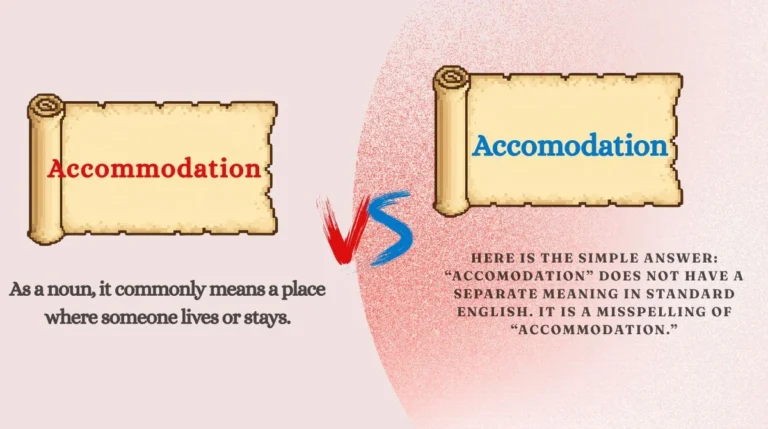
As a noun, it commonly means a place where someone lives or stays.
This could be a house, apartment, hotel, hostel, rented room, student residence, or another place to stay. Oxford lists it as a British English uncountable noun meaning a place to live, work, or stay.
For example:
We found comfortable accommodation near the university.
Here, accommodation means the place where the students will live.
Another important point is grammar. When this meaning is used in British English, accommodation is normally uncountable. That means we generally do not say “an accommodation” when talking about a place to stay. Cambridge gives examples such as “nice accommodation” and “accommodation in San Francisco is very expensive,” and warns against using the article a before it in this sense.
When Do We Use “Accommodation”?
We use the word in many everyday situations.
It is especially common when talking about:
- hotels and holidays
- rented homes
- student housing
- temporary housing
- business travel
- places for guests
- housing for workers
Here are some natural examples:
- The hotel accommodation was clean and comfortable.
- We need to find accommodation before the semester starts.
- The company provided accommodation for its workers.
- Our accommodation was close to the beach.
- She is looking for cheap accommodation in London.
- The price includes flights and accommodation.
- Students can apply for accommodation on campus.
- They were given temporary accommodation after the storm.
Notice something important: in these examples, accommodation refers to a general place or housing arrangement, rather than one specifically counted item.
Accommodation Can Have Other Meanings
The word is not limited to housing.
It can also mean an agreement or arrangement between people or groups with different views. Oxford describes this as a formal meaning connected with reaching an acceptable agreement.
For example:
The two sides reached an accommodation after several meetings.
There is also a more specialized meaning in biology and medicine. Accommodation can describe the process by which the eye changes the shape of its lens to focus clearly on an object. Both Oxford and Cambridge include this meaning in their dictionary entries.
However, for everyday English learners, the meaning you will most often need is a place to stay or live.
Common Learner Confusion
Many learners understand the meaning perfectly but still spell the word incorrectly.
They may write:
I booked a room at a nice hotel accomodation.
The meaning is clear, but the spelling is wrong.
The correct version is:
I booked a room at a nice hotel accommodation.
The key is to remember that the word contains cc and mm:
a c c o m m o d a t i o n
Not:
a c o m m o d a t i o n
And not:
a c c o m o d a t i o n
The double letters are important.
What Does “Accomodation” Mean?
Here is the simple answer: “accomodation” does not have a separate meaning in standard English. It is a misspelling of “accommodation.”
When someone writes accomodation, they usually mean accommodation, but they have left out one of the two m’s.
So these two forms are not two different English words:
❌ accomodation
✅ accommodation
Only the second spelling is correct.
Why Do People Write “Accomodation”?
This mistake is very common because English spelling does not always match pronunciation.
When you say the word, you do not strongly hear:
mm
as two separate sounds.
The pronunciation is roughly:
uh-kom-uh-DAY-shun
Because the word is spoken smoothly, learners often remember only one m when writing it.
There is another reason for the mistake: the related verb is accommodate, which itself has double letters. Learners sometimes remember the sound but forget which letters are doubled.
The correct family looks like this:
- accommodate
- accommodation
- accommodating
- accommodated
Keeping the spelling pattern in mind can help you avoid the mistake.
Is “Accomodation” Ever Correct?
For standard English writing, no.
You should not use accomodation in:
- school assignments
- university work
- professional emails
- websites
- resumes or CVs
- official documents
- travel bookings
- business writing
It may appear online because people make spelling mistakes, but seeing it does not make it correct.
Think of it as the same kind of error as writing “seperate” instead of “separate.” A common mistake can still be a mistake.
Examples of the Incorrect Form
Here are some examples of sentences containing the misspelling:
❌ We need to arrange student accomodation.
❌ The hotel accomodation was expensive.
❌ Free accomodation is provided.
❌ I am looking for accomodation near the office.
In every sentence, replace accomodation with accommodation.
Correct:
✅ We need to arrange student accommodation.
✅ The hotel accommodation was expensive.
✅ Free accommodation is provided.
✅ I am looking for accommodation near the office.
The Main Point to Remember
There is no meaning difference between the two spellings because accomodation is simply incorrect.
The real choice is not:
accommodation vs. accomodation
It is:
correct spelling vs. common misspelling
That makes this one easier than many confusing-word questions. You do not need to decide which word fits the sentence. You simply need to remember the correct spelling.
Difference Between Accommodation and Accomodation
The biggest difference is very simple: one is correct and one is incorrect.
| Feature | Accommodation | Accomodation |
|---|---|---|
| Spelling | ✅ Correct | ❌ Incorrect |
| Meaning | A place to stay, housing, or another formal arrangement | No separate standard meaning |
| Dictionary word | ✅ Yes | ❌ No |
| Double c | ✅ Yes | ❌ No |
| Double m | ✅ Yes | ✅ Yes |
| Suitable for formal writing | ✅ Yes | ❌ No |
| Example | hotel accommodation | hotel accomodation ❌ |
Spelling Difference
Look closely at the middle of the word.
Correct:
accommodation
The word contains:
cc + mm
Incorrect:
accomodation
This version contains:
c + mm
So the missing letter is the second c.
A useful way to break the word apart visually is:
ac + com + modation
Or simply remember:
AC + COM + MODATION
The most important visual pattern is:
ccmm
Meaning Difference
There is actually no real meaning difference.
That is because accomodation is not a standard alternative spelling. It is simply an error.
Some learners ask whether one spelling belongs to British English and the other belongs to American English. That is not the case.
The British/American difference concerns accommodation vs. accommodations, not accommodation vs. accomodation. Cambridge notes that British English commonly uses the uncountable noun accommodation, while American English often uses the plural accommodations for a place to stay.
For example:
British English:
We booked our accommodation for the trip.
American English:
We booked our accommodations for the trip.
Both can be correct depending on the variety of English and context.
But:
We booked our accomodation.
is simply misspelled.
Grammar Difference
There is no grammar rule that allows accomodation.
The grammatical noun is:
accommodation
It can appear in phrases such as:
- hotel accommodation
- student accommodation
- temporary accommodation
- rented accommodation
- holiday accommodation
- affordable accommodation
- accommodation costs
In British English, the word is usually uncountable when it means housing or a place to stay.
Grammar Rules You Must Remember
Rule 1: Always Spell It With Two C’s
The first important spelling rule is:
accommodation = cc
Do not remove one of the c’s.
Correct:
We found suitable accommodation.
Incorrect:
We found suitable acomodation.
Incorrect:
We found suitable accomodation.
A quick visual check can help. When typing the word, pause after a and look for cc.
Rule 2: It Also Has Two M’s
The word does not only have double c. It also has double m.
The central spelling pattern is:
ccmm
So write:
accommodation
not:
accomodation
One missing letter is enough to make the spelling incorrect.
Rule 3: Accommodation Is Usually Uncountable in British English
When the word means a place to live or stay, British English usually treats it as an uncountable noun. Cambridge gives accommodation as an uncountable noun and notes that accommodations is sometimes heard in American English.
So in British English, we usually say:
We need accommodation.
Not:
We need an accommodation.
And:
The accommodation was excellent.
Not:
The accommodation was excellents.
However, American English commonly uses accommodations when talking about places to stay.
Rule 4: Do Not Confuse the Noun With the Verb “Accommodate”
The related verb is:
accommodate
It means to provide enough space, help someone, or make suitable arrangements.
For example:
The hotel can accommodate 200 guests.
From that verb, we get:
accommodate → accommodation
This connection is useful because both words keep the double-letter pattern.
Correct:
The hotel can accommodate large groups.
The hotel provides comfortable accommodation.
Learning related words together is often easier than memorizing one word by itself.
Common Mistakes Students Make
Mistake 1: Leaving Out the Second C
This is probably the most common error.
❌ accomodation
✅ accommodation
The learner remembers the double m but forgets the double c.
Correction tip: Memorize the middle pattern as CCMM.
Mistake 2: Using “An Accommodation” in British English
A learner may say:
I booked an accommodation near the airport.
In standard British usage, when accommodation means a place to stay generally, this is usually incorrect.
A better sentence is:
I booked accommodation near the airport.
You can, however, count a specific kind of place with another noun:
We booked a hotel room.
The problem is not the idea of counting. It is the use of accommodation as an uncountable noun in this meaning.
Mistake 3: Adding “S” Automatically
Some learners write:
Our accommodations were excellent.
This can be correct in American English, particularly when referring to lodging arrangements. Cambridge specifically lists accommodations as a common US plural form.
But if you are writing British English, especially for school or general international English, accommodation is normally the safer choice when referring to housing in general.
Mistake 4: Trusting Pronunciation Too Much
English spelling cannot always be guessed from pronunciation.
You may hear:
accommodation
and feel that there is only one m sound.
That does not mean the spelling contains only one m.
The same thing happens with many English words. Pronunciation helps, but spelling patterns and visual memory are also important.
Easy Trick to Remember the Difference
Here is a simple classroom trick:
Think: “ACCOMMODATION Has Room for Everybody.”
Imagine a hotel with two rooms, two beds, or two spaces.
Then remember:
AC + COM + MODATION
The easiest memory shortcut is:
Accommodation has CC and MM.
You can even turn it into a little sentence:
Accommodation needs two C’s and two M’s.
Whenever you type the word, quickly check:
A C C O M M O D A T I O N
You can also compare it with the verb:
accommodate
Both have the same double-letter idea:
accommodate → accommodation
Another useful trick is to say the letters mentally:
ac — cc — omm — odation
You do not need to pronounce every part this way when speaking. This is only a spelling trick.
A Visual Memory Method
Write these side by side:
ACCOMMODATION ✅
ACCOMODATION ❌
ACCOMMODATION ✅
The correct spelling visually looks more balanced because it contains two pairs of repeated consonants:
CC and MM
That visual pattern becomes easier to recognize after a few repetitions.
Daily Life Examples
The word appears often in travel, education, work, and housing conversations. Here are natural examples you may hear or use in everyday English.
1. Talking About a Hotel
A: Have you booked the hotel yet?
B: Yes. I also booked our accommodation for three nights.
Here, accommodation means the place where the travelers will stay.
2. Student Housing
A: Where are you going to live during university?
B: I’m still looking for student accommodation.
This is very common when discussing university housing.
3. Talking About Cost
Accommodation in the city centre is very expensive.
This sentence talks about housing in general.
4. Travel Planning
Does the tour price include accommodation?
This is a useful question when booking a holiday or tour.
5. Renting a Home
She found affordable accommodation near her workplace.
The word refers to somewhere suitable for her to live.
6. Company Housing
The company provides accommodation for employees who move from other cities.
This means the company gives workers a place to stay.
7. Temporary Housing
The families were offered temporary accommodation.
This could refer to housing provided for a limited period.
8. Asking About a Place to Stay
What was your accommodation like?
This is a natural question after someone returns from a trip or starts at a new university.
9. Booking in Advance
You should arrange your accommodation before you travel.
This is practical advice for a trip.
10. Comparing Options
The second hotel offers better accommodation for families.
The meaning here is the quality or suitability of the place provided for guests.
These examples show why correct spelling matters. You may use this word in emails, booking forms, travel conversations, university applications, and workplace writing.
Practice Section
Choose the correct option in each sentence.
1. We need to arrange our ______ before the trip.
A. accomodation
B. accommodation
2. The university offers student ______.
A. accommodation
B. accomodation
3. The price includes flights and ______.
A. accomodation
B. accommodation
4. She is looking for cheap ______ near her office.
A. accommodation
B. accomodation
5. The hotel provided comfortable ______ for all the guests.
A. accomodation
B. accommodation
Answers
- B — accommodation
- A — accommodation
- B — accommodation
- A — accommodation
- B — accommodation
There is one spelling to learn here: accommodation.
FAQs About Accommodation or Accomodation
What is the difference between accommodation and accomodation?
Accommodation is the correct spelling. Accomodation is a common misspelling and is not a separate standard English word. The correct form contains both double c and double m.
Is “accomodation” a correct spelling?
No. In standard English, the correct spelling is accommodation. If you see accomodation, it is normally a spelling error caused by leaving out one of the two c’s.
Why is accommodation spelled with two C’s and two M’s?
The word has the spelling pattern ccmm. It is related to the verb accommodate, which also contains the double c. Remembering the related word can help you keep the spelling correct.
Is accommodation countable or uncountable?
When it means a place to live or stay, accommodation is usually uncountable in British English. For example, we say “We need accommodation.” American English commonly uses accommodations as a plural noun.
Can I say “an accommodation”?
In British English, not usually when you mean housing or a place to stay in general. It is more natural to say “some accommodation” or simply “accommodation.” You can use a countable phrase such as “a hotel room” when you want to identify one specific place.
Is “accommodation” British or American English?
The word is used in both British and American English, but the grammar can differ. British English commonly uses accommodation as an uncountable noun, while American English often uses accommodations as a plural noun for places to stay.
Conclusion
The spelling question is actually easier once you remember one important pattern.
The correct word is accommodation. It has two c’s and two m’s:
A C C O M M O D A T I O N
The spelling accomodation is incorrect. It is simply a common misspelling of the correct word.
When accommodation means a place to live or stay, it is especially common in travel, education, housing, and work situations. In British English, it is normally uncountable, while American English often uses accommodations as a plural form.
The best way to remember the spelling is:
Accommodation = CC + MM
Try writing the word a few times and use it in simple sentences. Once your eyes become familiar with ccmm, the incorrect form accomodation will start to look wrong immediately.
Spelling improves with small, regular practice. One tricky word at a time, and you will get better.

Evan Rellmont is a writer who turns thoughtful ideas into meaningful words, creating stories and reflections that connect, inspire, and leave a lasting impression.