
“Breathe” and “breath” are two English words that look almost the same, but they do not have the same meaning or pronunciation.
This small difference causes a lot of trouble for English learners, especially when writing emails, school assignments, social media posts, or everyday messages.
The confusion is easy to understand. Both words are connected to air and breathing, and the only spelling difference is the final e. However, one word is a verb, while the other is a noun.
Their sounds are also different, which makes them useful to learn together.
For example, you can say, “I need to breathe slowly,” because breathe describes an action. But you say, “Take a deep breath,” because breath names the air that you take into your lungs.
Knowing this difference can make your English much clearer. It can also help you avoid common spelling and grammar mistakes.
The good news is that the rule is quite simple once you connect each word with its job in a sentence.
By the end, you will know when to use breathe and when to use breath, how to pronounce them, the mistakes to avoid, and a few easy tricks to remember the difference.
What Does “Breathe” Mean?
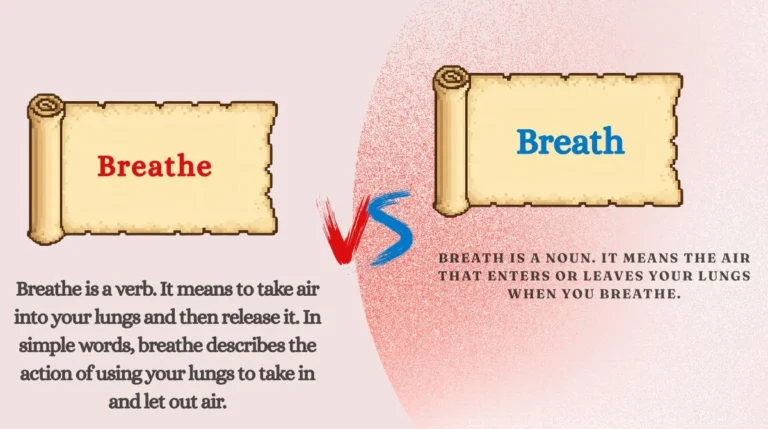
Breathe is a verb. It means to take air into your lungs and then release it. In simple words, breathe describes the action of using your lungs to take in and let out air.
We use this word when talking about the act of breathing, whether someone is doing it normally, slowly, quickly, deeply, or with difficulty.
When do we use “breathe”?
Use breathe when you need a word that describes an action.
For example:
- You breathe every moment, even when you are sleeping.
- Please breathe slowly.
- I find it hard to breathe in this room.
- She went outside to breathe some fresh air.
- He stopped talking so he could breathe.
- Try to breathe deeply before the test.
- The doctor told him to breathe normally.
- I always breathe through my nose when I exercise.
Notice the pattern. In each sentence, breathe tells us what someone is doing.
Grammar rule for “breathe”
Because breathe is a verb, it can change according to tense and subject.
Present:
- I breathe slowly.
- She breathes slowly.
Past:
- He breathed deeply.
Present participle:
- They are breathing fresh air.
So, you can use forms such as breathe, breathes, breathed, and breathing.
Examples with “breathe”
- Breathe in slowly and count to five.
- She went outside to breathe fresh air.
- It was difficult to breathe after running.
- Please breathe normally during the exercise.
- He was breathing heavily after the race.
- The baby is sleeping and breathing quietly.
- She breathed a sigh of relief when she heard the news.
- If you feel nervous, stop and breathe.
Common confusion with “breathe”
Many learners see the word breathe and think its pronunciation should be exactly like breath. That is not correct.
Breathe is usually pronounced with a voiced th sound, like the sound in this.
It sounds like:
breathe = /briːð/
You can think of it as sounding like “breedh.”
This difference becomes especially useful when speaking. If you pronounce breathe like breath, a listener may still understand you from context, but your pronunciation will sound less natural.
What Does “Breath” Mean?
Breath is a noun. It means the air that enters or leaves your lungs when you breathe.
It can also refer to one complete act of taking air in and letting it out.
For example:
- Take a deep breath.
- I could see his breath in the cold air.
- She held her breath underwater.
Here, breath is not an action word. It is the thing or amount of air connected with breathing.
When do we use “breath”?
Use breath when you are talking about air, one inhalation and exhalation, or something related to the air coming from your lungs.
Common expressions include:
- take a deep breath
- hold your breath
- catch your breath
- out of breath
- bad breath
- fresh breath
- a short breath
These expressions are very common in everyday English.
Grammar rule for “breath”
Because breath is a noun, it can be used after words such as a, the, your, my, his, and one.
For example:
- Take a breath.
- Hold your breath.
- I need a quick breath.
- She was out of breath.
The plural form is breaths when you are talking about more than one breath.
Examples with “breath”
- Take a deep breath before you begin.
- He held his breath while swimming underwater.
- She was out of breath after climbing the stairs.
- I could see my breath in the cold morning air.
- Take a slow breath and relax.
- His breath smelled like garlic.
- She took a long breath before answering.
- I needed a moment to catch my breath.
Common confusion with “breath”
The most common mistake is using breath when a verb is needed.
For example:
❌ Please breath slowly.
✅ Please breathe slowly.
Why? Because “please ___ slowly” needs an action. The action is breathe.
Another mistake happens in expressions:
❌ Take a deep breathe.
✅ Take a deep breath.
Here, take is followed by a noun phrase. You are taking a breath, not “a breathe.”
Difference Between Breathe and Breath
The easiest way to understand the difference is to remember their parts of speech.
Breathe = verb = an action
Breath = noun = air or one act of breathing
That single rule solves most problems.
Comparison table
| Feature | Breathe | Breath |
|---|---|---|
| Part of speech | Verb | Noun |
| Basic meaning | To take air in and let it out | Air taken in or released |
| Describes | An action | A thing or act |
| Pronunciation | /briːð/ | /breθ/ |
| Example | Please breathe slowly. | Take a deep breath. |
| Common expressions | breathe deeply, breathe normally | hold your breath, catch your breath |
| Related forms | breathes, breathed, breathing | breaths |
Usage difference
Look at these two sentences:
- Breathe slowly.
- Take a deep breath.
The first sentence tells someone to do something. Therefore, we need the verb breathe.
The second sentence tells someone to take a thing/amount of air. Therefore, we need the noun breath.
Another useful pair is:
- I cannot breathe.
- I cannot catch my breath.
In the first sentence, the speaker is talking about the action. In the second, the speaker is talking about their breath as a noun.
Grammar logic
A quick grammar test can help.
Ask yourself:
“Is this word showing an action?”
If yes, use breathe.
Ask:
“Am I talking about air, one breath, or something I can describe with ‘a,’ ‘the,’ or ‘your’?”
If yes, use breath.
For example:
- Breathe deeply. → Action
- Take a breath. → Noun
- She is breathing quickly. → Action
- His breath was cold. → Noun
Sentence structure difference
Breathe can be followed by words that describe how the action happens:
- Breathe slowly.
- Breathe deeply.
- Breathe normally.
Breath often appears with determiners or adjectives:
- a deep breath
- your last breath
- fresh breath
- bad breath
Compare:
✅ She breathed deeply.
✅ She took a deep breath.
The meaning is related, but the grammar is different.
Grammar Rules You Must Remember
Rule 1: Use “breathe” for an action
When the word tells someone what to do, use breathe.
✅ Breathe slowly.
✅ Try to breathe through your nose.
The verb can also appear in different forms:
- breathe
- breathes
- breathed
- breathing
Example:
She was breathing heavily after the workout.
Rule 2: Use “breath” for the noun
When you are talking about the air or one complete act of breathing, use breath.
✅ Take a deep breath.
✅ He held his breath.
The word can be singular or plural:
- one breath
- three breaths
Example:
She took three deep breaths before going on stage.
Rule 3: “A” usually comes before the noun “breath”
Because breath is a countable noun in many common uses, you can say a breath.
✅ Take a breath.
✅ He took a deep breath.
But you cannot normally use a directly before the verb breathe.
❌ Take a breathe.
✅ Take a breath.
This is one of the best grammar clues to remember the difference.
Rule 4: Watch the pronunciation
The spelling difference is small, but the vowel and final sound are different.
Breath rhymes closely with words such as death and left in many accents.
Breathe has a long ee sound and a voiced final th sound.
So:
- breath → /brɛθ/
- breathe → /briːð/
Try saying these pairs:
breath – breathe
breath – breathe
breath – breathe
The pronunciation can help your spelling and grammar at the same time.
Common Mistakes Students Make
These two words are confusing because they come from the same idea. Learners often remember the meaning but forget which spelling belongs to the noun and which belongs to the verb.
Mistake 1: “Take a deep breathe”
❌ Take a deep breathe.
✅ Take a deep breath.
Why is the first one wrong?
Because take needs a noun here. You take a breath.
Easy tip: Remember the common phrase take a breath.
Mistake 2: “I can’t breath”
❌ I can’t breath.
✅ I can’t breathe.
Here, can’t is followed by a base verb.
You can say:
- I can’t run.
- I can’t sleep.
- I can’t speak.
- I can’t breathe.
You cannot say “I can’t breath” because breath is a noun.
Mistake 3: “She is breath slowly”
❌ She is breath slowly.
✅ She is breathing slowly.
After is/are/am, we often use the -ing form for an action happening now.
The verb is breathe, so the form becomes breathing.
Mistake 4: “Hold your breathe”
❌ Hold your breathe.
✅ Hold your breath.
The expression is hold your breath.
Here, your is followed by a noun:
- your breath
- your voice
- your phone
- your hand
So breath is the correct choice.
Mistake 5: “He was out of breathe”
❌ He was out of breathe.
✅ He was out of breath.
The fixed expression is out of breath.
It means you are breathing very hard, usually after exercise or physical effort.
Example:
I was out of breath after running to the bus stop.
Easy correction method
Whenever you are unsure, stop and ask:
“Do I need an action or a thing?”
Action → breathe
Thing/air → breath
This simple question catches most mistakes.
Easy Trick to Remember the Difference
Here is a very easy memory trick:
Breathe has “E” at the end because it is an action.
Think of the final E in breathe as giving the word extra energy to do something.
breathe = do
breath = thing
Another trick is to connect the words like this:
You breathe. You take a breath.
Say that sentence a few times:
I breathe.
I take a breath.
It gives you both words in their natural grammar.
There is also a useful spelling clue:
Breathe contains the long ee sound, similar to words such as:
- see
- tree
- free
Breath has the shorter vowel sound, like:
- red
- bread
- death
The pronunciation is not a perfect spelling rule for every learner, but it can make the difference easier to remember.
Real-life logic
Imagine you are sitting before an important exam.
You might say:
“I am nervous, so I need to breathe slowly.”
Then you might say:
“I will take a deep breath.”
The first word is an action.
The second word is the breath itself.
That connection is much easier to remember than simply memorizing two spellings.
Daily Life Examples
These examples show how native and fluent English speakers commonly use these words in real situations.
1. Before an exam
Teacher: You look nervous.
Student: I am.
Teacher: Just breathe slowly and read the first question carefully.
Here, breathe is an action.
2. After exercise
Ali: Are you okay?
Sam: Yes. I just need to catch my breath.
The phrase catch my breath is very common after running or physical activity.
3. At the doctor
Doctor: Please breathe in slowly.
Patient: Like this?
Doctor: Yes, now breathe out.
The doctor is asking the patient to perform an action.
4. During swimming
Mia: How long can you hold your breath?
Sara: Maybe thirty seconds.
Here, breath is a noun.
5. On a cold morning
Tom: Look! I can see my breath.
Ben: Yes, it is freezing today.
The cold air makes the moisture in the exhaled air visible.
6. During meditation
Instructor: Close your eyes and breathe deeply.
Student: I already feel calmer.
Again, the word describes an action.
7. After climbing stairs
Nina: Give me a minute. I’m out of breath.
Friend: No problem. Take your time.
Out of breath means breathing hard after physical effort.
8. Before speaking on stage
Teacher: Take a deep breath and relax.
Student: Okay, I think I’m ready.
The student is taking one deep breath.
9. Talking about fresh air
Jack: I love walking near the sea.
Emma: Me too. It’s nice to breathe fresh air.
Here, breathe describes the action of taking in the air.
10. Staying calm
Dad: Don’t panic. Just breathe.
Son: Okay. I feel a little better now.
This is a very natural use in spoken English.
Practice Section
Choose the correct word: breathe or breath.
1. Take a deep ______ before you answer.
2. I find it difficult to ______ in this crowded room.
3. She was out of ______ after running.
4. Please ______ slowly and relax.
5. He held his ______ underwater.
Answers
1. breath
“Take a deep breath” is the correct expression.
2. breathe
“Difficult to” is followed by a base verb, so we need breathe.
3. breath
The fixed expression is out of breath.
4. breathe
“Please” is followed by a verb in this sentence.
5. breath
The natural phrase is hold your breath.
Quick score guide
If you got all five correct, you have a strong understanding of the basic rule.
If you missed one or two, do not worry. Go back to the simple idea:
breathe = verb
breath = noun
FAQs
What is the difference between breathe and breath?
Breathe is a verb that means to take air into and release air from your lungs.
Breath is a noun that refers to the air you take in or release, or one act of breathing.
For example: “I need to breathe” but “Take a deep breath.”
Can we use “breathe” in questions?
Yes. Breathe is a verb, so it can be used in many kinds of questions.
Examples:
- Can you breathe normally?
- Why are you breathing so fast?
- Are you able to breathe through your nose?
The form changes depending on the tense and sentence structure.
Is “breath” a noun or a verb?
Breath is a noun.
It can refer to air coming into or leaving the lungs, or to one complete act of breathing.
For example:
- Take a breath.
- Hold your breath.
- I was out of breath.
Why do breathe and breath sound different?
They have different vowel sounds and different final th sounds.
Breath is commonly pronounced /brɛθ/, while breathe is pronounced /briːð/.
In breath, the final sound is unvoiced. In breathe, it is voiced.
Is “take a breathe” correct English?
No. The correct phrase is take a breath.
Breath is the noun needed after “take.”
Correct:
Take a deep breath.
Incorrect:
Take a deep breathe.
Is “out of breath” a common expression?
Yes. Out of breath is a very common expression in everyday English.
It means that someone is breathing hard, usually because they have run, climbed stairs, exercised, or done another physical activity.
Example:
I was out of breath after chasing the bus.
Conclusion
The difference between breathe and breath may look tiny, but it is an important part of clear English.
The easiest rule is simple: breathe is a verb, while breath is a noun. You breathe when you perform the action. You take, hold, catch, or lose your breath.
Remember these two sentences:
I need to breathe.
I need to take a breath.
Once you understand that pattern, many confusing sentences become easy.
Pay attention to common expressions such as take a deep breath, hold your breath, catch your breath, and out of breath. Hearing and using these phrases in real conversations will help the correct spelling feel natural.
Do not worry if you mix the two words sometimes. Even simple English words can be confusing when their spellings are so similar. A little practice will make the difference much easier to remember.
Keep using them in short sentences, and soon you will know exactly when to breathe and when to take a breath.

Evan Rellmont is a writer who turns thoughtful ideas into meaningful words, creating stories and reflections that connect, inspire, and leave a lasting impression.