
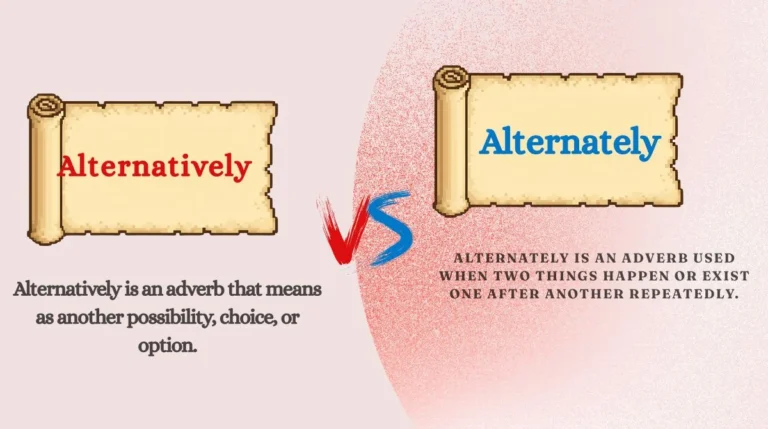
English has many words that look almost identical but do very different jobs. Alternatively and alternately are a perfect example.
They have the same beginning, sound similar, and both come from the word alternative, so it is easy to mix them up.
The difference becomes much clearer when you focus on the idea behind each word. Alternatively is used when you want to present another choice, option, or possibility.
Alternately, on the other hand, is used when two things happen one after another repeatedly.
Cambridge Grammar explains this distinction directly: alternately means “first one thing, then another thing and then the first thing again,” while alternatively introduces another possible choice.
This small difference matters because using the wrong word can change the meaning of your sentence. Compare these two ideas:
Alternatively, we can take the bus.
This gives another choice.
The lights flashed alternately.
The lights switched from one to the other repeatedly.
The first sentence is about options. The second is about repetition or switching.
Once you understand that basic idea, these words become much easier. You will also see why alternatively is common in advice, instructions, and conversations, while alternately often describes actions, feelings, sounds, or things that take turns.
What Does “Alternatively” Mean?
Alternatively is an adverb that means as another possibility, choice, or option. In simple English, it often means “instead,” “as another choice,” or “another option is…”. Cambridge Dictionary defines it as a word used to suggest another possibility.
You normally use it when someone has one idea, plan, method, or choice and you want to give a different one.
For example:
We could eat at home. Alternatively, we could go to a restaurant.
The first option is eating at home. The second option is going to a restaurant. Alternatively introduces the second choice.
When should you use “alternatively”?
Use alternatively when you are:
- giving another choice
- suggesting a different plan
- offering another method
- explaining a second possibility
- replacing one option with another
It is especially common in written English, instructions, formal explanations, advice, and clear discussions.
Grammar rule for “alternatively”
Because alternatively is an adverb, it can appear in several positions in a sentence. A very common pattern is:
Alternatively, + clause
For example:
Alternatively, you can send the form by email.
It can also come after or:
You can call us, or alternatively, you can send a message.
The word often connects two possible actions or choices.
Examples of “alternatively”
- Alternatively, you can take the train.
- We could stay home; alternatively, we could visit my parents.
- You can pay online or, alternatively, pay in cash.
- Alternatively, try restarting the computer.
- She could study medicine. Alternatively, she could choose biology.
- We can meet on Friday or alternatively on Saturday.
- If the first method does not work, alternatively, try this one.
- You could walk to the office; alternatively, you could take a taxi.
Notice something important in all these examples: there is a choice.
You are not describing something that switches back and forth. You are presenting one possibility and then another.
Common confusion with “alternatively”
Many learners see the word alternate inside alternately and assume that both words mean almost the same thing. They do not.
Consider:
Alternatively, we can leave now.
This means:
Another choice is to leave now.
But:
The two singers performed alternately.
This means:
One singer performed, then the other, then the first again.
A useful question is:
Am I giving another choice?
If the answer is yes, alternatively is usually the right word.
What Does “Alternately” Mean?
Alternately is an adverb used when two things happen or exist one after another repeatedly. In simple words, one thing happens, then the other, and then the first happens again.
Cambridge Dictionary describes this meaning as two things happening or existing “one after the other repeatedly.” Cambridge Grammar gives the same basic idea: first one thing, then another, and then the first again.
For example:
The two children carried the box alternately.
This means one child carried it, then the other child carried it, and then the first child took a turn again.
Here, there is no second option being offered. Instead, there is a repeated change between two things.
When should you use “alternately”?
Use alternately when:
- two people take turns
- two things happen repeatedly
- one condition changes to another and back again
- two people or things replace each other in sequence
- something happens in a repeating pattern
It is often used with words such as between, and, or descriptions showing two changing states.
Grammar rule for “alternately”
A common structure is:
A + happens + alternately + with B
or:
A and B + happen alternately
You may also see:
alternately + adjective + and + adjective
For example:
She was alternately happy and worried.
Her emotional state moved between happiness and worry.
Examples of “alternately”
- The players spoke alternately.
- The lights flashed red and blue alternately.
- She was alternately excited and nervous.
- The twins answered the teacher alternately.
- Rain and sunshine appeared alternately throughout the day.
- The two teams took the field alternately.
- He looked alternately at his phone and the clock.
- The machine makes two different sounds alternately.
In each example, something is switching, taking turns, or changing repeatedly.
Common confusion with “alternately”
The biggest mistake is using alternately when you simply mean “another option.”
For example:
❌ Alternately, you can call me tomorrow.
In standard usage, especially in careful English, this should be:
✅ Alternatively, you can call me tomorrow.
The second sentence gives another possible choice. Nothing is switching back and forth.
Difference Between Alternatively and Alternately (Detailed)
The two words are closely related, but their jobs are different.
| Word | Main meaning | Main idea | Typical use |
|---|---|---|---|
| Alternatively | another choice or possibility | Option | Suggestions, choices, plans |
| Alternately | one thing, then another repeatedly | Switching or taking turns | Actions, feelings, sounds, conditions |
1. Usage difference
Alternatively introduces a different possibility.
You can drive. Alternatively, you can take the bus.
There are two options.
Alternately describes repeated change between two things.
The speakers played music alternately.
The speakers take turns.
That is the central difference.
2. Grammar logic
The meaning of alternatively is connected to the noun alternative, which refers to something different that can be chosen instead. Cambridge defines an alternative as something different that offers a possibility of choice.
So when you use alternatively, think:
alternative → another choice
The meaning of alternately is connected to the verb alternate, meaning to happen or exist one after another repeatedly.
So when you use alternately, think:
alternate → take turns / switch
3. Sentence structure difference
Alternatively often introduces a second clause:
Alternatively, we could stay here.
It can also appear in a sentence containing two options:
You can email the report or, alternatively, print it.
Alternately usually describes how an action or state happens:
They spoke alternately.
Or:
She was alternately cheerful and serious.
The word describes a pattern, not a choice.
4. Meaning comparison
Look at these pairs:
Alternatively, we can walk home.
Another possibility is walking home.
They walked home alternately.
They took turns walking.
Another pair:
Alternatively, choose the blue shirt.
The blue shirt is another option.
The lights blinked alternately.
One light blinked, then the other, repeatedly.
The difference is much easier to see once you ask whether the sentence is about choice or sequence.
Grammar Rules You Must Remember
Rule 1: Use “alternatively” for another choice
When you offer another option, use alternatively.
Alternatively, you can use a pencil.
The speaker is giving a different option.
A quick replacement test is useful:
Alternatively = instead / another option
If instead fits naturally, alternatively is probably the correct word.
Rule 2: Use “alternately” for repeated switching
When two things take turns or repeatedly replace each other, use alternately.
The two dancers moved alternately.
One dancer moves, then the other, and the pattern continues.
Think:
alternately = one, then the other, then the first again
Rule 3: Do not use “alternately” simply to mean “or”
This is one of the most common learner mistakes.
❌ Alternatively, you can take the bus or walk.
This sentence can actually use alternatively because the writer is presenting choices.
✅ Alternatively, you can take the bus.
The idea is “another option.”
Cambridge Grammar specifically contrasts these uses and gives alternatively for another choice rather than alternately.
Rule 4: Look for a repeated pattern with “alternately”
Words like between, take turns, one after another, and changing states can signal the correct choice.
The baby was alternately laughing and crying.
The players answered alternately.
The weather changed alternately between rain and sunshine.
The key idea is not choice. It is repeated movement from one thing to another.
Common Mistakes Students Make
These words are confusing because they look so similar. Their spellings differ by only a few letters, and both are connected to alternate/alternative. But similar-looking words can still have different meanings.
Mistake 1: Using “alternately” for another option
❌ Alternately, you can take the train.
✅ Alternatively, you can take the train.
Why?
Because the speaker is giving an additional choice, not describing repeated switching.
Mistake 2: Using “alternatively” for taking turns
❌ The two students answered the questions alternatively.
✅ The two students answered the questions alternately.
Here, the students are taking turns. One answers, then the other.
Mistake 3: Thinking “alternate” and “alternative” are always interchangeable
They are related, but they do not always have the same grammar or meaning.
Alternative usually deals with another choice or a different possibility.
Alternate is commonly associated with taking turns, repeated changes, or every other item.
Cambridge notes an important related distinction: alternate can describe repeated sequence, while alternative refers to another choice.
Mistake 4: Choosing by spelling instead of meaning
Some learners try to remember only:
“Which spelling looks right?”
That approach is not very reliable.
Instead, ask:
Is the sentence offering another choice?
Use alternatively.
Are two things taking turns or switching repeatedly?
Use alternately.
This meaning-based method is much easier and more useful.
Easy Trick to Remember the Difference
Here is a simple memory trick that works well for beginners.
Remember: “Alternatively = Alternative choice”
Notice the word alternative inside alternatively.
An alternative is another option.
So:
Alternatively = another choice
Example:
We can go by bus. Alternatively, we can take a taxi.
There are two choices.
Now remember:
“Alternately = Alternate turns”
Think about two people taking turns.
Ali talks. Sara talks. Ali talks. Sara talks.
They are acting alternately.
So:
Alternately = one, then the other
That gives you an easy two-word rule:
Alternatively = choice
Alternately = turns
You can also use a simple classroom test.
Imagine your sentence is:
“You can do X. ______, you can do Y.”
Does “another option” make sense?
Yes? Choose alternatively.
Now imagine:
“X happens, then Y happens, then X happens again.”
That is alternately.
This trick works because it focuses on the meaning rather than the spelling.
Daily Life Examples
These words appear naturally in everyday English, especially when people discuss plans, directions, schedules, and repeated actions.
1. Choosing a way to travel
“Should we drive?”
“We can. Alternatively, we can take the train.”
The second sentence gives another option.
2. Choosing food
“You can have tea. Alternatively, I can make you coffee.”
Again, there are two choices.
3. Giving instructions
“You can complete the form online. Alternatively, you can print it and bring it to the office.”
The speaker is presenting another method.
4. Taking turns
“The two children read the story alternately.”
One child reads, then the other.
5. Describing changing emotions
“She felt alternately excited and nervous before the exam.”
Her feelings moved between two states.
6. Describing flashing lights
“The warning lights blinked red and yellow alternately.”
The colors appeared one after another repeatedly.
7. Discussing weekend plans
“We could visit Grandma. Alternatively, we could stay home and watch a movie.”
This is clearly about options.
8. Talking about exercise
“The runners breathed quickly and slowly alternately.”
The pattern changes repeatedly.
9. Talking about work
“You can work from home. Alternatively, you can come to the office.”
The speaker is giving another choice.
10. Talking about conversation
“The two friends spoke alternately during the interview.”
They took turns speaking.
Notice how natural the distinction feels once you connect each word with its main idea.
Practice Section
Choose the correct word: alternatively or alternately.
1. You can call me later. __________, send me a text message.
2. The two singers performed __________.
3. We could eat outside. __________, we could order pizza.
4. The machine switches __________ between two sounds.
5. She was __________ happy and worried during the trip.
Answers
1. Alternatively
There is another communication option: sending a text.
2. Alternately
The singers took turns performing.
3. Alternatively
The speaker is giving another choice.
4. Alternately
The machine repeatedly switches from one sound to another.
5. Alternately
Her emotional state moved between happiness and worry.
A good habit is to explain the reason, not just memorize the answer. Ask yourself whether the sentence describes a choice or a repeated sequence.
FAQs
What is the difference between alternatively and alternately?
Alternatively means “as another choice or possibility.” Alternately means that two things happen one after another repeatedly. In simple terms, alternatively = another option, while alternately = taking turns or switching.
Can we use alternatively in questions?
Yes. It can appear in questions when you are asking about another possible choice.
For example:
“Alternatively, could we meet on Monday?”
It can also appear in a question such as:
“What could we do alternatively?”
The exact structure depends on the sentence, but the meaning still relates to another option.
Is alternatively formal or informal?
Alternatively is used in both everyday and formal English. It is especially common in writing, instructions, business communication, and explanations. In casual speech, people may often use simpler expressions such as “instead,” “or,” or “another option is.” Cambridge also lists instead as a synonym in this sense.
Is alternately the same as alternatively?
No. They are not interchangeable in careful standard usage.
Alternatively, we can leave now.
This means leaving now is another option.
They left the room alternately.
This suggests they left one after another, taking turns.
The first is about choice; the second is about sequence.
Can “alternately” describe people’s feelings?
Yes. It can describe two feelings or conditions that change from one to another.
For example:
He was alternately confident and nervous.
This means he moved repeatedly between the two emotional states. Cambridge gives similar examples involving changing moods and conditions.
What is an easy synonym for alternatively?
Useful synonyms include instead, another possibility is, and as another option.
For example:
Alternatively, we can walk.
can be understood as:
Instead, we can walk.
However, not every synonym will fit every sentence perfectly, so always check the context.
Conclusion
The difference between alternatively and alternately becomes simple when you stop focusing on their spelling and focus on their meaning.
Use alternatively when you are giving another choice, option, or possibility. It often means “instead” or “another option is.” For example:
Alternatively, you can take the train.
Use alternately when two things take turns, switch, or happen one after another repeatedly.
The two players answered alternately.
The easiest rule to remember is this:
Alternatively = choice.
Alternately = turns.
When you see either word, ask yourself one quick question: Am I offering another option, or am I describing something that switches back and forth? That question will usually give you the right answer.
With a little practice, these two commonly confused adverbs will stop being confusing. Try noticing them in books, websites, conversations, and everyday instructions. The more you see them in real sentences, the more natural the difference will feel.

Evan Rellmont is a writer who turns thoughtful ideas into meaningful words, creating stories and reflections that connect, inspire, and leave a lasting impression.