
Have you ever written a sentence about an injured foot and suddenly wondered whether you should use heel or heal? You are not alone.
These two words are a common problem for English learners because they sound exactly the same when spoken. However, their meanings are completely different.
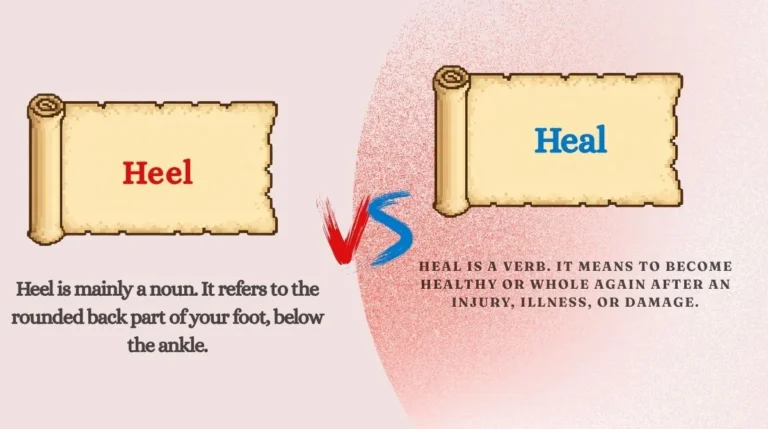
Heel is usually a noun related to the foot or a shoe. Heal is a verb that means to become healthy again or to make an injury better.
Cambridge and Oxford both list heel and heal as homophones, meaning they have the same pronunciation but different meanings and spellings.
This small spelling difference matters in everyday English.
You might talk about a sore heel, a pair of high heels, or pain at the back of your foot. On another day, you may say that a cut needs time to heal or that someone needs time to heal emotionally.
The good news is that the difference is easy to learn once you connect each word with its job. Heel names a body part or a part of a shoe, while heal describes recovery or repair.
By the end of this guide, you will know exactly when to use each word, how they behave in sentences, which mistakes to avoid, and a simple trick that can help you remember the spelling.
What Does “Heel” Mean?
Heel is mainly a noun. It refers to the rounded back part of your foot, below the ankle. It can also mean the part of a shoe that supports or raises the back of your foot. Cambridge defines it as the rounded back part of the foot and also the raised part at the back of a shoe.
So, when you are talking about a foot, shoe, sock, or something connected with the back part of the foot, heel is usually the correct word.
When should you use “heel”?
Use heel when you are naming something. In most everyday situations, it works as a noun.
For example:
- My heel hurts after walking all day.
- She stepped on the back of my heel.
- These shoes have a very high heel.
- I have a small cut on my heel.
- The new shoes rubbed against my heel.
- He lifted his heels while stretching.
- Her left heel is sore today.
- The shoe has a thick heel.
Notice something important: in all of these sentences, heel refers to a thing or a body part. It is not describing an action of recovery.
The word can also have a few less common meanings. For example, a heel can refer to the end or lower part of something. Merriam-Webster also records meanings such as the crusty end of a loaf of bread and the back or lower part of certain objects.
There is also an informal meaning of heel for a person who behaves badly or unfairly. This meaning is less common in everyday beginner English, so the body-part meaning is the most important one to learn first.
“Heel” in common expressions
You will often see heel in expressions connected with feet, shoes, and movement.
For example:
- high heels — shoes with raised heels
- at someone’s heels — very close behind someone
- on the heels of — coming immediately after something
- drag your heels — delay doing something
- take to your heels — run away
You do not need to memorize all of these at once. Start with the basic meaning: heel = the back part of the foot or shoe.
Common learner confusion with “heel”
The biggest problem is pronunciation. Heel sounds like heal, so listening alone may not tell you which spelling is correct.
Imagine someone says:
“My heel hurts.”
You hear the sound /hiːl/, but you must use the surrounding meaning to choose the spelling.
Ask yourself:
Are we talking about a foot or shoe?
If the answer is yes, use heel.
A useful example is:
My heel hurts, so I hope it will heal soon.
Here, both words appear in the same sentence. The first one names the body part. The second one describes recovery.
What Does “Heal” Mean?
Heal is a verb. It means to become healthy or whole again after an injury, illness, or damage. It can also mean to repair emotional pain or improve a damaged relationship or situation. Cambridge defines it as becoming or making something well again, especially after an injury.
Merriam-Webster also explains that heal can mean making something free from injury or helping a damaged condition return to a sound state.
When should you use “heal”?
Use heal when you are talking about recovery, repair, or getting better.
For example:
- The cut will heal soon.
- My ankle is starting to heal.
- Give the wound time to heal.
- The doctor said the bone should heal normally.
- Her injury took several weeks to heal.
- Small cuts usually heal quickly.
- His broken bone is slowly healing.
- Time can help people heal emotionally.
Here, heal describes an action or process. That is why it is normally used as a verb.
Different forms of “heal”
Because heal is a verb, it can change form depending on the sentence.
The basic forms are:
- heal
- heals
- healed
- healing
Examples:
- I hope it will heal quickly.
- The wound heals slowly.
- The injury healed after several weeks.
- The cut is healing now.
Oxford lists these verb forms as part of its learner dictionary entry for heal.
You can also use heal with an object:
The medicine helped heal the wound.
Or without an object:
The wound will heal naturally.
This distinction is useful because English verbs can sometimes work with or without an object.
“Heal” can describe emotional recovery
Many learners think heal is only used for physical injuries. That is not true.
English speakers also use it for emotional pain, broken relationships, and difficult situations.
For example:
- She needed time to heal after the loss.
- Their friendship slowly healed.
- The experience left an emotional wound that took years to heal.
- Talking openly helped the family heal.
- Time may help him heal from the experience.
Cambridge specifically notes that heal can be used when a painful emotion or bad situation improves or comes to an end.
This gives the word a wider meaning: something damaged does not always have to be physical.
Common learner confusion with “heal”
The most common error is writing heel when the sentence needs a verb.
For example:
Wrong: The cut will heel soon.
Correct: The cut will heal soon.
Why? Because the sentence is talking about recovery, not a foot.
Try asking:
Is the sentence about getting better or repairing something?
If yes, heal is probably the word you need.
Difference Between Heel and Heal
The easiest way to understand the difference is to look at their grammar and meaning together.
| Word | Part of speech | Main meaning | Example |
|---|---|---|---|
| heel | Noun | The back part of the foot or a shoe | My heel hurts. |
| heal | Verb | To become healthy or make something better | My injury will heal. |
The spelling is different, but the pronunciation is the same. That makes these words homophones. Oxford specifically groups heal, heel, and he’ll as homophones.
Usage difference
The biggest difference is simple:
Heel = a thing or body part
Heal = an action or process
Compare these:
My heel is injured.
Here, heel is a noun. It names the body part.
My heel will heal soon.
Here, heal is a verb. It describes what happens to the injured heel.
This is why learning the grammar role is so helpful. You do not always need to think about spelling alone. Look at the sentence and ask what job the word is doing.
Grammar logic
A noun can be the subject or object of a sentence:
Her heel hurts.
The doctor examined her heel.
A verb shows an action, process, or state:
Her heel will heal.
The wound is healing.
The cut healed quickly.
This grammar difference makes the choice much easier.
Sentence structure difference
With heel, common sentence patterns include:
my/your/his/her + heel
Her heel is sore.
the + heel + of + noun
The heel of my shoe is broken.
With heal, common patterns include:
subject + heal
The wound will heal.
subject + heal + object
The medicine may heal the wound.
subject + be + healing
The injury is healing.
Seeing the structure is often more useful than memorizing isolated definitions.
Meaning comparison
These two words can even appear side by side:
His heel was badly injured, but it is beginning to heal.
This sentence gives you the entire lesson in one line.
Heel tells you what was injured.
Heal tells you what is happening to it.
Grammar Rules You Must Remember
Rule 1: Use “heel” for the back part of the foot.
When you are naming the body part below the ankle at the back of the foot, use heel. Cambridge identifies this as the rounded back part of the foot.
Example:
I have pain in my heel.
Rule 2: Use “heel” for the back part of a shoe.
A shoe also has a heel.
Example:
The heel of my shoe broke.
You may also talk about high heels, shoe heels, and heel height.
Rule 3: Use “heal” for recovery.
When something gets better after an injury or damage, use heal.
Example:
The wound needs time to heal.
This is the key verb meaning recorded by major learner dictionaries.
Rule 4: “Heal” can also describe emotional or social recovery.
English uses this word beyond physical injuries.
Example:
It took time for the family to heal after the difficult experience.
You can also say that a relationship or disagreement is healing.
Common Mistakes Students Make
These words are easy to confuse because there is no difference in pronunciation.
Mistake 1: Using “heel” as a verb
Wrong: The cut will heel in a few days.
Correct: The cut will heal in a few days.
The first sentence sounds understandable when spoken, but the spelling is wrong because the sentence needs a verb.
Mistake 2: Using “heal” for the foot
Wrong: My heal hurts.
Correct: My heel hurts.
The sentence is naming a body part, so heel is needed.
Mistake 3: Confusing the two in the same sentence
Consider this sentence:
My heel is injured, but I expect it to heal soon.
Students sometimes write:
My heal is injured, but I expect it to heel soon.
This reverses the two words. The easiest correction is to remember that the body part is heel, while the recovery process is heal.
Mistake 4: Choosing by sound
A learner may think:
“They sound the same, so either spelling should work.”
Unfortunately, English does not work that way. Homophones often have completely different meanings.
For example, right and write sound alike, but they are not interchangeable. Heel and heal work the same way.
Easy correction tip
Before writing the word, pause for one second and ask:
Am I naming something, or describing recovery?
Naming a body part or shoe part → heel
Describing recovery or repair → heal
That simple question can prevent most mistakes.
Easy Trick to Remember the Difference
Here is a very simple memory trick:
Heel has two E’s like your two feet.
Think:
HEEl → feet
This is not a grammar rule, but it is a useful memory aid for spelling.
Now connect heal with health:
HEAL → HEALTH
Both words begin with HEA-, which can remind you of becoming healthy again.
So remember:
Heel = foot
Heal = health
Another helpful trick is to create one sentence in your mind:
My heel will heal.
The first word names the body part.
The second word describes what will happen to it.
Say that sentence a few times. It is short, natural, and easy to remember.
Daily Life Examples
These everyday examples show how native speakers use the two words naturally.
Example 1
A: Why are you walking so slowly?
B: My heel hurts.
Example 2
A: Are you going to wear those shoes?
B: No. The heel is broken.
Example 3
A: How is your injury now?
B: It is slowly healing.
Example 4
A: Should I cover this small cut?
B: Yes, and give it time to heal.
Example 5
A: Why did you stop running?
B: I hurt my heel during practice.
Example 6
A: Can you walk normally yet?
B: Not yet. My heel still hurts.
Example 7
A: Is the wound serious?
B: The doctor says it should heal.
Example 8
A: Why are you not wearing your new shoes?
B: The heel is rubbing against my foot.
Example 9
A: Do you think the friendship can recover?
B: Yes, but it may take time to heal.
Example 10
A: Your cut looks much better.
B: Yes, thankfully, it has almost healed.
Notice how natural the words become when you focus on the meaning. Heel appears around the foot, shoes, and body. Heal appears around injuries, recovery, emotions, and repair.
Practice Section
Choose the correct word: heel or heal.
1. My right _____ hurts after the long walk.
2. The doctor said the wound will _____ naturally.
3. This shoe has a very high _____.
4. Give your injury some time to _____.
5. She hurt her _____ while running.
Answers
1. heel
The sentence names a part of the foot.
2. heal
The sentence describes recovery.
3. heel
A shoe has a heel.
4. heal
The injury needs to get better.
5. heel
Again, this is the body part.
Here is another quick test. Read each sentence and identify the reason for the spelling:
My heel is painful.
Heel = body part.
My heel needs time to heal.
Heal = recovery.
The heel of my shoe is loose.
Heel = shoe part.
The damaged skin should heal soon.
Heal = become healthy again.
Once you see the meaning behind each sentence, the spelling choice becomes much more automatic.
FAQs
What is the difference between heel and heal?
Heel is usually a noun for the back part of the foot or the raised part of a shoe. Heal is a verb meaning to become healthy again or to make an injury better. They sound the same but have different meanings and spellings.
Are heel and heal pronounced the same?
Yes. Both are pronounced /hiːl/ in standard English. That makes them homophones. Their spelling and meaning are different even though their pronunciation is the same.
Can heal be used for emotional pain?
Yes. Heal can describe emotional recovery as well as physical recovery. For example, you can say, “She needs time to heal,” meaning she needs time to recover emotionally. Cambridge also gives examples of heal being used for painful emotions and difficult situations.
Is heel always related to the foot?
Not always. The most common meaning is the back part of the foot or shoe, but heel has other meanings too. For example, it can describe a lower or back part of something, and it can also have an informal meaning referring to a bad or unfair person.
Can “heal” be used in the past tense?
Yes. The past tense and past participle are healed.
For example:
The wound healed quickly.
You can also use healing for the -ing form:
The injury is healing well.
Oxford lists healed and healing among the standard forms of the verb.
How can I remember heel vs heal easily?
Connect heel with the foot and heal with health. You can also remember this sentence: “My heel will heal.” The first word names the foot part, and the second describes recovery. This is a quick way to keep the spellings separate.
Conclusion
The difference between heel and heal is small in spelling but important in meaning. Because both words sound the same, even strong English learners sometimes mix them up.
Remember the main idea:
Heel is a noun. It usually means the back part of the foot or the raised part of a shoe.
Heal is a verb. It means to become healthy again, recover from an injury, or help something damaged become better.
The easiest memory trick is:
Heel = foot
Heal = health
You can also remember the sentence “My heel will heal.” It shows exactly how the two words can work together.
When you are unsure, do not listen only to the sound. Look at the meaning and grammar of the sentence. Ask yourself whether you are naming a body part or talking about recovery.
With a little practice, these two homophones will stop being confusing. Soon, choosing between heel and heal will feel completely natural.

Evan Rellmont is a writer who turns thoughtful ideas into meaningful words, creating stories and reflections that connect, inspire, and leave a lasting impression.