
Have you ever written a sentence like, “I lended my friend some money,” and then wondered whether lended is actually correct? You are not alone.
Many English learners make this mistake because regular verbs usually form their past tense by adding -ed.
For example, work becomes worked, clean becomes cleaned, and help becomes helped. So, it feels natural to think that lend should become lended.
English, however, has many irregular verbs that do not follow this simple pattern. Lend is one of them. Its past tense and past participle are both lent.
This small difference is important because lend is a very common word in everyday English.
We use it when talking about giving someone money, a book, a pen, a phone charger, a car, or almost anything else for a short time with the expectation that it will be returned.
Once you understand the basic rule, the confusion becomes much easier. You will know when to use lend, lent, and lent as a past participle, and you will also understand why lended is usually not the correct choice in standard English.
Whether you are a student, beginner, or non-native English speaker, learning this verb correctly will help you sound more natural in both speaking and writing.
What Does “Lended” Mean?
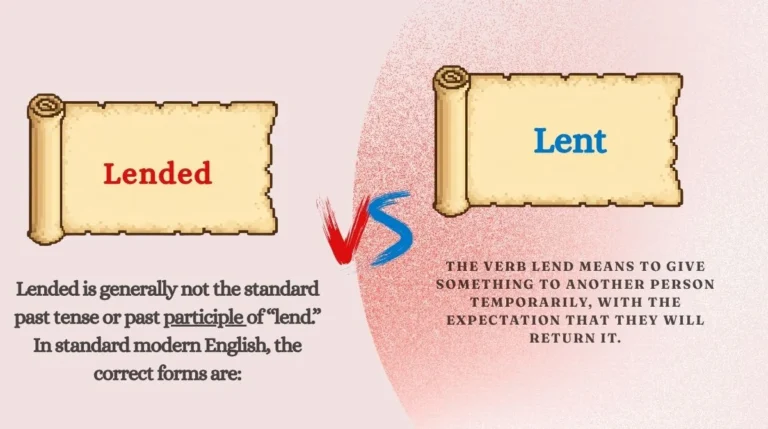
Lended is generally not the standard past tense or past participle of “lend.” In standard modern English, the correct forms are:
- lend — present/base form
- lent — past tense
- lent — past participle
The word lended may sometimes appear in informal, regional, historical, or nonstandard English, but it is not the form you should normally use in school, professional writing, exams, or standard spoken English.
The reason learners use lended is easy to understand. They know that many English verbs add -ed to make the past tense. But lend is an irregular verb, so its form changes.
When Should You Avoid “Lended”?
When you mean that someone gave something temporarily in the past, use lent, not lended.
For example:
- Incorrect: I lended him my pen.
- Correct: I lent him my pen.
- Incorrect: She lended me some money.
- Correct: She lent me some money.
- Incorrect: We lended our car to our neighbor.
- Correct: We lent our car to our neighbor.
The key point is simple: do not treat “lend” like a regular verb.
Examples of the Incorrect Form
You may hear or see sentences like these:
- He lended me his notebook.
- I lended her my umbrella.
- They lended us some money.
- Sarah lended her brother a bicycle.
- My friend lended me his charger.
- We lended our house to a relative.
- She lended me a jacket.
- The teacher lended me a book.
In standard English, these sentences should use lent instead.
Why Do Learners Say “Lended”?
The pattern is easy to explain.
Learners often think:
lend + ed = lended
That rule works with many regular verbs:
- call → called
- open → opened
- wash → washed
- jump → jumped
But English has many common irregular verbs:
- go → went
- buy → bought
- teach → taught
- send → sent
- lend → lent
So, lend has to be memorized as an irregular verb.
What Does “Lent” Mean?
Lent is the correct past tense and past participle of lend.
The verb lend means to give something to another person temporarily, with the expectation that they will return it.
For example:
I lent my brother my laptop.
This means I gave my laptop to my brother for a period of time, but I expect him to give it back.
The Three Main Forms
It helps to learn the verb as a small family:
| Form | Verb | Example |
|---|---|---|
| Base form | lend | I lend my books to friends. |
| Past tense | lent | I lent him my book yesterday. |
| Past participle | lent | I have lent him my book before. |
Notice that the past tense and past participle are the same:
lend → lent → lent
When Do We Use “Lent”?
Use lent when the action happened in the past.
For example:
- I lent Maria my dictionary.
- He lent me his bike yesterday.
- She lent her friend some money.
- We lent our neighbor a ladder.
- They lent us their car for the weekend.
- My brother lent me his headphones.
- The teacher lent me a grammar book.
- I lent my umbrella to Tom.
In each sentence, the lending happened in the past.
“Lent” as a Past Participle
Lent is also used with helping verbs such as have, has, and had.
Examples:
- I have lent him my notes.
- She has lent me her book.
- We had lent them our car before.
- He has never lent me money.
Here, lent is not simply standing as an ordinary past tense. It is the past participle form used in a perfect tense.
A Common Learner Confusion
Some learners know that lent is the past form but become unsure when they see:
I have lent her my book.
They may wonder why lent appears after have.
The answer is simple: lent is both the simple past form and the past participle form of lend.
That is similar to other irregular verbs such as:
- send → sent → sent
- buy → bought → bought
- keep → kept → kept
Difference Between Lended and Lent (Detailed)
The biggest difference is that lent is the standard correct form, while lended is generally not used in standard English.
| Word | Status | Verb Form | Standard English? | Example |
|---|---|---|---|---|
| lended | Nonstandard form | Attempted past/past participle | ❌ Usually no | I lended him money. |
| lent | Correct form | Past tense and past participle | ✅ Yes | I lent him money. |
Usage Difference
The word lend is an irregular verb. Because of this, its past form is not made by simply adding -ed.
The correct pattern is:
lend → lent
Not:
lend → lended
This is one reason irregular verbs can be difficult for learners. You cannot always guess their past forms from the spelling of the base verb.
Grammar Logic
Think of lend as a verb with three main forms:
Present: lend
Past: lent
Past participle: lent
Consider these examples:
I lend him money sometimes.
Present tense.
I lent him money yesterday.
Simple past.
I have lent him money before.
Present perfect.
The form changes according to the tense, but lended does not belong in the standard pattern.
Sentence Structure
The verb lend often follows this useful structure:
Subject + lend + person + thing
Examples:
I lent Sarah my pen.
He lent me his car.
They lent us some money.
You can also use:
Subject + lend + thing + to + person
Examples:
I lent my pen to Sarah.
He lent his car to me.
They lent some money to us.
Both structures are correct.
Meaning Comparison
There is no standard English meaning that makes lended different from lent. In most situations where someone writes lended, they mean the same thing as lent.
So this is not a case where two words have different meanings. It is mainly a matter of correct verb form.
Grammar Rules You Must Remember
Rule 1: Use “Lend” for the Present
Use lend when talking about something that happens now, regularly, or generally.
Examples:
I often lend my books to classmates.
Can you lend me a pen?
I never lend money to strangers.
The base form is also used after do, does, can, will, should, and other modal or helping verbs.
For example:
Will you lend me your phone?
Not:
Will you lent me your phone?
After will, use the base form lend.
Rule 2: Use “Lent” for the Simple Past
When the lending happened in the past, use lent.
Examples:
I lent him my jacket yesterday.
She lent me $20 last week.
We lent our neighbors a ladder.
Remember:
Yesterday → lent
Last week → lent
Two days ago → lent
Do not add -ed to the verb.
Rule 3: “Lent” Is Also the Past Participle
After have, has, or had, use lent.
Examples:
I have lent him my car before.
She has lent me her notes.
They had lent us some chairs.
This is a useful pattern:
have/has/had + lent
Not:
have/has/had + lended
For example:
- Incorrect: I have lended him my book.
- Correct: I have lent him my book.
Rule 4: Do Not Add “-ed” Just Because the Verb Looks Regular
English has many verbs that look as though they should take -ed, but they do not.
Compare:
- lend → lent
- send → sent
- spend → spent
- build → built
- keep → kept
- feel → felt
The safest approach is to learn irregular verbs in groups and practice them in real sentences.
Common Mistakes Students Make
Mistake 1: Adding “-ed”
This is the most common problem.
Wrong:
I lended him my pen.
Correct:
I lent him my pen.
The learner is following the regular verb rule, but lend is irregular.
Mistake 2: Using “Lent” After “Will”
Some students remember lent but use it everywhere.
Wrong:
I will lent you my book.
Correct:
I will lend you my book.
After will, use the base verb.
The same rule applies to can, may, should, must, and similar modal verbs.
For example:
Can you lend me your notes?
Not:
Can you lent me your notes?
Mistake 3: Confusing “Lend” and “Borrow”
This is a different but very common mistake.
Lend means you give something temporarily to someone.
Borrow means you receive something temporarily from someone.
Compare:
I lent Ali my book.
I gave the book to Ali.
Ali borrowed my book.
Ali received the book from me.
This simple difference can save you from many mistakes.
Mistake 4: Using “Lended” in Formal Writing
Even if people understand what you mean, lended can make your writing look grammatically incorrect.
For school assignments, exams, work emails, and professional communication, always choose lent when talking about the past.
Easy Correction Tip
Whenever you want to use the past of lend, stop and ask:
“Did the action happen in the past?”
If yes, use:
lent
A quick mental check can prevent the mistake.
Easy Trick to Remember the Difference
Here is a simple memory trick:
Think: “Send and Lend”
These two verbs look similar and follow the same kind of irregular pattern:
send → sent
lend → lent
So when you remember send → sent, attach lend → lent to it.
You can also remember this short line:
I lend today, I lent yesterday.
For example:
I lend my books to friends.
But:
I lent my book to Ahmed yesterday.
Another useful trick is to remember the three forms together:
lend – lent – lent
Say them aloud a few times:
lend, lent, lent
lend, lent, lent
This makes the irregular form easier to remember when you are speaking or writing quickly.
Daily Life Examples
The verb appears in everyday situations more often than you may think. Here are some natural examples you might hear in real conversations.
1. Borrowing a Pen
A: Can you lend me a pen?
B: Sure. Here you go.
Here, lend is used because the speaker is asking someone to give them a pen temporarily.
2. Talking About Yesterday
I lent my friend my charger yesterday.
The action happened in the past, so lent is correct.
3. Lending Money
My brother lent me some money when I needed it.
The money was given temporarily, so lent is the correct past form.
4. Asking for a Book
Could you lend me that book for a few days?
This is a polite request. Because the request is about now or the future, use lend.
5. Talking About Experience
I have lent my car to my cousin several times.
The present perfect uses have + lent.
6. A School Situation
The teacher lent me a dictionary during the test.
The lending happened in the past, so lent is needed.
7. At Home
Can you lend me your phone charger?
Again, lend is used for a present request.
8. Talking About Last Week
Sarah lent me her umbrella last Friday.
The phrase last Friday clearly places the action in the past.
9. Lending Something Valuable
My uncle lent us his car for the weekend.
The car was given temporarily.
10. A Friendly Request
A: I forgot my notebook. Can you lend me yours?
B: Yes, but please give it back after class.
This is a natural everyday use of lend.
Practice Section
Choose the correct word: lend, lent, or lended.
1.
Yesterday, I ______ my friend my calculator.
2.
Can you ______ me your notebook?
3.
She has ______ me her bicycle before.
4.
We ______ our neighbor some chairs last weekend.
5.
I will ______ you my umbrella.
Answers
1. lent
The word yesterday shows that the action happened in the past.
2. lend
This is a request about the present or near future.
3. lent
After has, we need the past participle. The correct form is lent.
4. lent
Last weekend indicates the past.
5. lend
After will, use the base form.
Notice that lended is not needed in any of these standard English sentences.
FAQs About Lended or Lent
What is the difference between lended and lent?
Lent is the correct standard English past tense and past participle of lend. Lended is generally considered nonstandard and should not normally be used in formal or standard English.
For example, say “I lent him my book,” not “I lended him my book.”
Can we use “lend” in questions?
Yes. Lend is very common in questions, especially when asking someone to give you something temporarily.
Examples include:
Can you lend me a pen?
Could you lend me some money?
Will you lend me your car?
Because these questions refer to a request, the base form lend is usually used.
Is “lended” ever used in English?
You may occasionally find lended in nonstandard, regional, historical, or learner English. However, it is not the normal form in standard modern English.
For everyday writing, schoolwork, exams, and professional communication, use lent.
Is “lent” the past tense of “lend”?
Yes. Lent is the simple past form of lend.
Example:
I lend him books.
Present.
I lent him a book yesterday.
Past.
The same word lent is also used as the past participle.
Is “lend” the same as “borrow”?
No. The two words describe opposite sides of the same action.
When you lend, you give something to another person temporarily.
When you borrow, you take or receive something temporarily.
For example:
I lent John my book.
John borrowed my book.
How do you use “lent” in a sentence?
Use lent when talking about a past lending action or after have, has, or had.
Examples:
I lent her my jacket yesterday.
She has lent me her notes.
They had lent us their car before.
The main form to remember is:
lend → lent → lent
Conclusion
The difference between lended and lent becomes simple once you remember that lend is an irregular verb. You should not add -ed to make its past form.
The correct forms are:
lend → lent → lent
Use lend for the present and for requests or after modal verbs such as can and will. Use lent for the simple past and as the past participle after have, has, and had.
For example:
Can you lend me your pen?
I lent him my pen yesterday.
I have lent him my pen before.
The form lended may appear in some nonstandard varieties of English, but it is not the normal choice for standard English. When you are writing an essay, taking an exam, speaking carefully, or communicating professionally, choose lent.
One small habit can make this much easier: memorize the verb as lend, lent, lent, and practice it in complete sentences. Once you use it a few times, the correct form will start to feel natural.

Evan Rellmont is a writer who turns thoughtful ideas into meaningful words, creating stories and reflections that connect, inspire, and leave a lasting impression.