
Have you ever typed “priviledge” and then wondered whether it was correct? You are not alone.
This is one of those English spelling mistakes that feels completely natural because of the way the word sounds when we say it.
The correct spelling is privilege. The spelling priviledge is incorrect in standard English.
This confusion usually happens because the ending of the word sounds a little different from the way it is written.
When people hear privilege, they may expect the spelling to contain “d” before the final “ge.” However, English spelling does not always match pronunciation perfectly.
The word is also very common. We use it when talking about special rights, advantages, opportunities, social position, education, work, family life, and even polite situations.
For example, you can say, “It was a privilege to meet you,” or “Good education should not be a privilege for only a few people.”
The good news is that there is a simple answer: privilege is correct; priviledge is not. Once you learn the spelling pattern, it becomes much easier to remember.
By the end of this guide, you will know exactly what privilege means, why priviledge is wrong, how to use the correct word in sentences, and how to avoid this spelling mistake in your writing.
What Does “Privilege” Mean?
Privilege is the correct spelling.
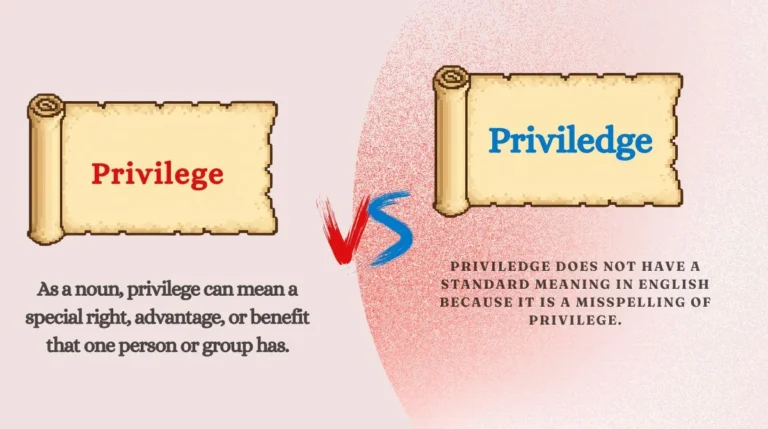
As a noun, privilege can mean a special right, advantage, or benefit that one person or group has. It may exist because of a person’s position, wealth, status, membership, or another special condition. Cambridge defines it as an advantage that only one person or group has, often because of their position or wealth.
For example, if members of a club are allowed to use a private room that other people cannot enter, that special access is a privilege.
The word can also have a softer meaning. Sometimes privilege means a special honor or enjoyable opportunity.
For instance:
It was a privilege to meet your family.
Here, the speaker is not talking about social power or special rights. The speaker means that meeting the family was a special and valued experience.
When Do We Use “Privilege”?
We use privilege in several common situations.
You may use it when talking about special rights:
Employees have the privilege of using the company library.
You can also use it to talk about advantages:
Wealth can give people certain privileges.
It is also common in polite or formal expressions:
It was a privilege to work with you.
Another common use appears in discussions about society:
Some people grow up with privileges that others do not have.
The word can also be used as a verb, although this is less common in everyday conversation. As a verb, privilege means to give someone or something special importance, rights, or advantages. Oxford lists this as a formal use.
Grammar Rule for “Privilege”
Privilege is usually a noun.
Common patterns include:
- a privilege
- the privilege of + noun or -ing form
- have the privilege of + -ing
- privileges
- privileged as an adjective
Examples:
- It is a privilege to work with such a talented team.
- She had the privilege of studying abroad.
- Parking here is a privilege, not a right.
- The club offers several privileges to its members.
- He understood the privileges that came with his position.
- I felt privileged to be invited to the event.
- Everyone deserves equal opportunities, not just a few privileges.
- The school gave senior students the privilege of using the new laboratory.
Notice something important: the spelling is always privilege in the noun form.
Common Learner Confusion
Many learners accidentally write:
priviledge ❌
They may think the word follows a pattern such as knowledge or another word containing a d sound or letter near the ending.
But English spelling does not work that way here.
The correct form is:
privilege ✅
It is also helpful to notice the pronunciation. Cambridge gives the pronunciation as /ˈprɪv.ə.lɪdʒ/ in both UK and US English.
The final sound is similar to the “j” sound in judge. That sound can make the spelling feel less obvious, especially for learners who spell words based mainly on how they hear them.
What Does “Priviledge” Mean?
Priviledge does not have a standard meaning in English because it is a misspelling of privilege.
When someone writes priviledge, they almost always mean privilege.
So, if you see:
It was a great priviledge to meet you.
The sentence should be:
It was a great privilege to meet you.
The problem is not the meaning. The problem is the spelling.
Is “Priviledge” Ever Correct?
No. In standard English writing, priviledge is not the correct spelling.
Major learner and general English dictionaries list privilege, not priviledge, as the standard word. Cambridge gives privilege as the noun and provides its pronunciation and meanings, while Oxford and Merriam-Webster also list privilege as the standard form.
That means you should not use priviledge in:
- school assignments
- essays
- emails
- websites
- business writing
- exams
- formal documents
- social media posts when you want correct English
Examples of the Wrong Spelling
Here are some examples where priviledge is incorrect:
- It is a priviledge to work here. ❌
- She had the priviledge of meeting the author. ❌
- Education should be a right, not a priviledge. ❌
- He abused his priviledge. ❌
- The job comes with many priviledges. ❌
- I feel priviledged to be part of this team. ❌
Every one of these sentences needs the same correction.
The Correct Forms
The correct spelling is:
privilege
And related forms include:
privileges
privileged
These words keep the same basic spelling pattern.
For example:
- She enjoys several privileges at work.
- I feel privileged to have this opportunity.
Oxford lists privileged as an adjective meaning having special rights or advantages, and it can also describe someone who has a special opportunity or feels honored.
Difference Between Privilege and Priviledge
The biggest difference is very simple:
Privilege is a correct English word. Priviledge is a misspelling.
There is no normal grammatical situation where you should choose priviledge instead of privilege.
| Point | Privilege | Priviledge |
|---|---|---|
| Correct spelling | ✅ Yes | ❌ No |
| Standard English word | ✅ Yes | ❌ No |
| Has a dictionary meaning | ✅ Yes | ❌ No |
| Can be used as a noun | ✅ Yes | ❌ No |
| Can be used as a verb | ✅ Yes | ❌ No |
| Related adjective | Privileged | Not correct |
| Plural form | Privileges | Not correct |
| Suitable for formal writing | ✅ Yes | ❌ No |
Usage Difference
There is no real meaning difference between these two forms because only one is a standard word.
A student might think:
“Maybe priviledge is another spelling of privilege.”
It is not.
Think of it in the same way as other common spelling mistakes. If someone writes definately instead of definitely, the first form does not become a second accepted word. It is simply incorrect.
The same idea applies here.
Grammar Logic
Privilege can function as a noun and, in formal contexts, as a verb.
As a noun:
His wealth gave him many privileges.
As a verb:
The policy may privilege one group over another.
Merriam-Webster lists both noun and verb uses, while Oxford describes the verb as formal.
Priviledge, however, has no such grammatical role.
Sentence Structure Difference
Correct:
It is a privilege to be here.
Incorrect:
It is a priviledge to be here.
Correct:
She was privileged to meet the president.
Incorrect:
She was priviledged to meet the president.
Correct:
The membership includes several privileges.
Incorrect:
The membership includes several priviledges.
The main lesson is simple: once you learn the base word privilege, its related forms become easier to spell correctly.
Grammar Rules You Must Remember
Rule 1: Always Spell the Main Word “Privilege”
The correct spelling contains “lege” at the end:
privilege
It does not contain “ledge.”
Correct:
privilege ✅
Incorrect:
priviledge ❌
A useful visual check is to look at the final part of the word. The correct word ends in -lege.
Rule 2: The Plural Is “Privileges”
When you are talking about more than one special right or advantage, add -s:
privileges
Example:
Senior employees receive several privileges.
Do not insert d:
priviledges ❌
This mistake usually comes from the same spelling confusion as priviledge.
Rule 3: The Adjective Is “Privileged”
When describing someone who has special advantages or a special opportunity, use:
privileged
Example:
She comes from a privileged background.
Oxford uses privileged for someone who has special rights or advantages. It can also mean having a special opportunity that makes someone feel honored.
Do not write:
priviledged ❌
The correct spelling is:
privileged ✅
Rule 4: After “the privilege of,” Use a Noun or -ing Form
A very common sentence pattern is:
the privilege of + noun
or
the privilege of + verb-ing
Examples:
I had the privilege of meeting her.
He enjoyed the privilege of working from home.
They appreciated the privilege of living in such a peaceful area.
This structure appears often in polite and formal English, especially when someone wants to show that an opportunity was special.
Common Mistakes Students Make
The biggest mistake is adding d before ge because the word may sound as if there is an extra consonant in it.
Mistake 1: Writing “Priviledge”
Wrong:
It was a great priviledge to meet you.
Correct:
It was a great privilege to meet you.
Correction tip: Remember privilege = no d.
Mistake 2: Writing “Priviledges”
Wrong:
Rich people may have more priviledges.
Correct:
Rich people may have more privileges.
The plural simply adds s to the correct base word.
Mistake 3: Writing “Priviledged”
Wrong:
I feel priviledged to be here.
Correct:
I feel privileged to be here.
The adjective is formed from privilege with -d, but the spelling remains privilege + d = privileged. The extra d does not belong inside the original word.
Mistake 4: Spelling by Sound
Sometimes students hear the ending and try to create the spelling from pronunciation.
That can be risky.
English has many words whose pronunciation does not tell you every letter. Privilege is one of them. Cambridge records the word as /ˈprɪv.ə.lɪdʒ/, so the ending sounds like “lij”, but the written form is -lege.
Mistake 5: Assuming a Misspelling Has a Separate Meaning
A learner may search for a difference between privilege and priviledge as though they are two English words.
They are not.
There is no special meaning attached to priviledge. It is simply a spelling error.
Easy Trick to Remember the Difference
Here is an easy classroom trick:
PRIVI + LEGE = PRIVILEGE
Break the word into two parts:
privi + lege
The ending is LEGE, not LEDGE.
You can make a small memory sentence:
Privilege has no D.
That one sentence can save you from the most common spelling mistake.
Another trick is to connect it with the related word:
privilege → privileged
When you see the correct spelling in both forms, the pattern becomes easier to remember.
You can also remember this:
No D in privilege. D comes later in privileged.
Compare:
privilege ✅
privileged ✅
The d belongs to the ending -d in privileged. It is not part of the base spelling.
A final visual trick is to write these side by side:
PRIVILEGE ✅
PRIVILEDGE ❌
The correct version is shorter by one letter, and there is no d before ge.
Daily Life Examples
The word privilege appears in everyday English much more often than many learners realize.
Example 1: At Work
A: Did you enjoy working with the new manager?
B: Yes. It was a privilege to learn from her.
Here, privilege means a special and valued opportunity.
Example 2: At School
Being able to attend a good school is a privilege that should not be taken for granted.
Here, the word refers to an advantage or opportunity.
Example 3: Meeting Someone
It was a privilege to meet your parents.
This is a polite and respectful expression.
Example 4: Talking About Rights
Having access to clean water should be a basic right, not a privilege.
Here, privilege means something available only to some people.
Example 5: Membership
Free parking is one of the privileges of premium membership.
The plural refers to several special benefits.
Example 6: Family Background
He grew up in a privileged family.
The adjective describes someone who has more advantages than many other people.
Example 7: A Special Invitation
I felt privileged to be invited to the ceremony.
Here, privileged means honored or fortunate.
Example 8: Work Benefits
Employees have the privilege of using the gym after work.
Notice the useful structure:
the privilege of + -ing
Example 9: Social Discussion
We should recognize that some people have social privileges that others may not have.
This use is common in discussions about society and equality.
Example 10: A Personal Conversation
A: You got to speak with the author personally?
B: I did. It was a real privilege.
This is a natural spoken-English use.
Practice Section
Choose the correct answer in each sentence.
1. It was a great ______ to work with such an experienced teacher.
A. privilege
B. priviledge
2. Club members enjoy several ______.
A. privileges
B. priviledges
3. I feel ______ to be part of this project.
A. privileged
B. priviledged
4. Education should be a right, not a ______.
A. privilege
B. priviledge
5. She had the ______ of studying at a famous university.
A. privilege
B. priviledge
Answers
- A. privilege
- A. privileges
- A. privileged
- A. privilege
- A. privilege
A good way to improve is to say each correct sentence aloud and then write it once from memory.
FAQs
What is the difference between privilege and priviledge?
Privilege is the correct English spelling. Priviledge is a misspelling and is not a standard English word. Use privilege in all normal writing, including school, work, and formal communication.
Is “priviledge” a real word?
No. Priviledge is not the standard spelling of an English word. It is a common spelling mistake for privilege, which means a special right, advantage, benefit, or valued opportunity.
How do you spell privilege correctly?
The correct spelling is:
P-R-I-V-I-L-E-G-E
A useful memory trick is: privilege has no D. The incorrect form priviledge adds a d before ge.
Can “privilege” be used in a sentence?
Yes. For example:
It was a privilege to meet your family.
You can also say:
The job comes with several privileges.
The word is commonly used as both a general noun and in polite expressions.
Is privilege formal or informal?
Privilege is used in both everyday and formal English. In phrases such as “It was a privilege to meet you,” it can sound polite and respectful. The verb privilege is less common in everyday conversation and is described as formal by Oxford.
What is the correct adjective: privileged or priviledged?
The correct adjective is privileged.
Example:
She feels privileged to have this opportunity.
Do not write priviledged. The correct form is built from privilege + d.
Conclusion
The spelling question “privilege or priviledge?” has a clear answer: privilege is correct, and priviledge is incorrect.
The word privilege can mean a special right, advantage, benefit, or opportunity. It is common in everyday speech, polite expressions, school writing, business English, and discussions about society. Cambridge, Oxford, and Merriam-Webster all recognize privilege as the standard form.
The most common mistake is adding a d before the final ge. Try to remember the simple rule:
PRIVILEGE has no D.
The related forms are also important:
privilege
privileges
privileged
Once you remember the base spelling, these forms become much easier.
The best way to make the correct spelling stick is to use it regularly. Write a few sentences, notice the word when you read, and pay attention to the correct form whenever you see it. A small spelling point like this can make your English look much more polished and confident.

Evan Rellmont is a writer who turns thoughtful ideas into meaningful words, creating stories and reflections that connect, inspire, and leave a lasting impression.