
Have you ever wanted to describe someone who asks too many personal questions, keeps checking what other people are doing, or wants to know things that are really none of their business? You may have heard the word nosy or nosey. But which spelling is correct?
This is a common question because both forms appear in English.
You may see one spelling in a dictionary, then notice the other spelling in a book, message, website, or conversation.
That can make learners wonder whether one is a mistake or whether the two words have different meanings.
The good news is simple: nosy and nosey have the same meaning. Both are used to describe a person who is too interested in other people’s private business or activities.
Major dictionaries, including Merriam-Webster, Cambridge, and Oxford, recognize nosey as a variant of nosy.
The main difference is spelling, not meaning. Nosy is generally the more common and standard-looking form, while nosey is also accepted and widely used.
By the end of this guide, you will know exactly when to use each spelling, how to build sentences with the word, how to avoid common mistakes, and how to remember the difference easily.
You will also learn how nosy can sound playful, friendly, or slightly rude depending on the situation.
What Does “Nosy” Mean?
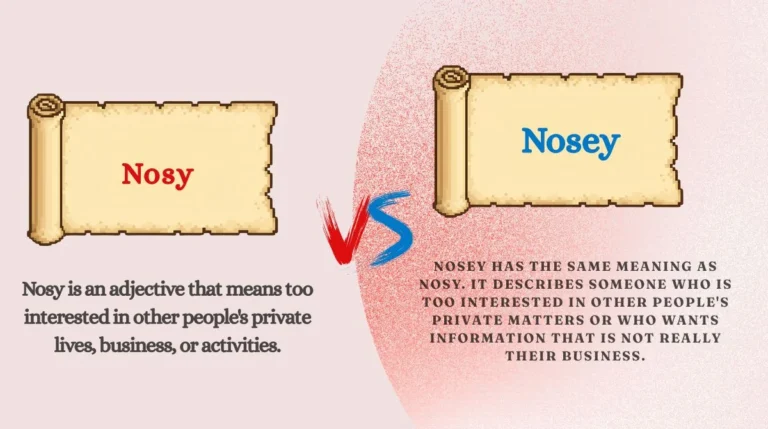
Nosy is an adjective that means too interested in other people’s private lives, business, or activities.
A nosy person wants information that may not concern them. They may ask personal questions, look through someone else’s things, listen to private conversations, or pay too much attention to what other people are doing.
The word usually has a negative or disapproving meaning. Oxford describes it as being too interested in things that do not involve you, especially other people’s affairs. Cambridge gives a similar meaning and labels the adjective as disapproving.
When Should You Use “Nosy”?
Use nosy when you want to describe a person, question, behavior, neighbor, child, friend, coworker, or another person or thing that shows too much interest in private matters.
For example:
- My neighbor is very nosy.
- She asked a nosy question about my salary.
- Don’t be nosy.
- His nosy behavior annoyed everyone.
- The children were being nosy about the surprise party.
The word is especially common in everyday conversation. It is informal, so it is more natural in casual speech than in very formal writing.
Grammar Rule for “Nosy”
Nosy is an adjective.
An adjective describes a person, place, thing, or idea. We commonly place nosy before a noun or after a linking verb such as be, seem, or become.
Before a noun:
- a nosy neighbor
- a nosy child
- a nosy reporter
- a nosy question
After a linking verb:
- She is nosy.
- He became nosy.
- They seem nosy.
You can also form related words such as nosily and nosiness. Merriam-Webster lists nosily as the adverb and nosiness as the noun form.
8 Examples of “Nosy”
- My sister is naturally nosy and always wants to know what I am doing.
- The nosy neighbor asked us why we had a new car.
- That was a very nosy question about my personal life.
- Don’t be nosy; I will tell you when I am ready.
- The children were nosy when they saw a large box in the living room.
- Our coworker can be quite nosy about other people’s relationships.
- He looked nosy when he started reading the note on my desk.
- She is curious about the project, but she is not trying to be nosy.
Notice something important in the last example. Curious and nosy are not always the same. Being curious can be positive, while being nosy usually suggests that someone has gone too far.
Common Learner Confusion About “Nosy”
Some learners think nosy must be related to the word nose in a direct grammar sense, so they become unsure about the spelling.
The connection is easy to understand historically and visually, but modern English treats nosy as one adjective. You do not need to think of it as “a person with a big nose.” Its modern meaning is about prying into other people’s business.
Another confusion is whether nosy needs a hyphen. It does not.
Correct:
- a nosy person
- a nosy neighbor
Incorrect:
- a nose-y person
- a nosy-person
The ordinary adjective is simply written as nosy.
What Does “Nosey” Mean?
Nosey has the same meaning as nosy. It describes someone who is too interested in other people’s private matters or who wants information that is not really their business.
Oxford lists nosey as another spelling of nosy, while Merriam-Webster also gives it as a variant.
So, if you write:
She is nosy.
and:
She is nosey.
both sentences communicate the same basic idea.
When Should You Use “Nosey”?
You can use nosey in normal everyday English when you prefer that spelling or when you are matching a source, style, or audience that uses it.
Examples include:
- My aunt is a little nosey.
- Why are you being so nosey?
- He asked a nosey question.
- The nosey child wanted to open the package.
- Some people think social media makes us more nosey.
The word is informal and can sometimes sound playful. Someone might call a close friend nosey without intending serious criticism.
Grammar Rule for “Nosey”
Just like nosy, nosey is an adjective.
You can place it before a noun:
- a nosey friend
- a nosey neighbor
- a nosey reporter
Or after a linking verb:
- She is nosey.
- He seems nosey.
- They were being nosey.
The spelling nosey does not create a different grammar rule. It is simply an alternative spelling of the same adjective.
8 Examples of “Nosey”
- My little brother is very nosey and keeps asking about my phone.
- She felt that her coworker was being nosey.
- That is a bit of a nosey question.
- The nosey neighbor watched everyone coming into the building.
- I know you are curious, but don’t be so nosey.
- He was too nosey for his own good.
- The children became nosey when they heard their parents whispering.
- Her nosey comments made the conversation uncomfortable.
Common Learner Confusion About “Nosey”
The biggest confusion is simple: learners sometimes assume nosey is wrong because they learned nosy first.
That is not the case. Major English dictionaries recognize both spellings. Cambridge explicitly marks nosey as an alternative spelling, and Oxford lists nosey as another form of nosy.
So you do not need to worry that every use of nosey is a spelling error.
Difference Between Nosy and Nosey
The most important point is this:
There is no real difference in meaning between nosy and nosey.
Both words describe someone who is too interested in other people’s business.
| Feature | Nosy | Nosey |
|---|---|---|
| Meaning | Too interested in other people’s business | Too interested in other people’s business |
| Part of speech | Adjective | Adjective |
| Pronunciation | Same | Same |
| Meaning difference | None | None |
| Usage | Informal | Informal |
| Accepted spelling | Yes | Yes |
| Comparative | nosier | nosier |
| Superlative | nosiest | nosiest |
| Related noun | nosiness | nosiness |
Usage Difference
The only practical difference is spelling preference.
Many dictionaries present nosy as the main spelling and nosey as a variant. Merriam-Webster gives “variants or nosey,” while Oxford presents “also nosey” beside nosy.
For this reason, nosy is usually the safest spelling to choose when you are writing for a general English-learning audience.
That does not make nosey incorrect.
Think of the situation like this:
Nosy = correct
Nosey = also correct
Grammar Logic
Both forms behave in exactly the same way because they are the same adjective.
You can say:
- He is nosy.
- He is nosey.
You can also say:
- a nosy question
- a nosey question
And:
- the nosiest neighbor
- the nosiest neighbor
Interestingly, when the adjective becomes comparative or superlative, standard spelling normally uses nosier and nosiest, not forms such as nosyer or noseyer. Merriam-Webster lists nosier and nosiest for the adjective.
Sentence Structure Difference
There is no sentence-structure difference.
Both can appear in exactly the same positions.
Adjective + noun:
- a nosy child
- a nosey child
Linking verb + adjective:
- She is nosy.
- She is nosey.
Adverb form:
- He looked nosily through the papers.
Because the two spellings have the same grammatical function, changing one spelling to the other does not change the sentence pattern.
Meaning Comparison
Both forms can describe:
A person
- She is nosy.
- She is nosey.
A question
- That was a nosy question.
- That was a nosey question.
Behavior
- His nosy behavior was annoying.
- His nosey behavior was annoying.
A neighbor
- Our nosy neighbor asked about our guests.
- Our nosey neighbor asked about our guests.
The meaning stays the same.
Grammar Rules You Must Remember
Rule #1: Both Spellings Are Correct
You can use nosy or nosey to describe someone who shows too much interest in other people’s business.
Example:
- Don’t be nosy.
- Don’t be nosey.
Both are grammatically correct.
Rule #2: “Nosy” and “Nosey” Are Adjectives
They describe nouns or people.
Example:
- a nosy student
- a nosey student
They can also come after be:
- The student is nosy.
- The student is nosey.
Do not treat them as verbs.
Incorrect:
- He nosies into my business.
Better:
- He is nosy about my business.
Rule #3: “Nosy” Usually Has a Negative Meaning
Someone can be curious in a healthy way. But nosy usually suggests that their curiosity has crossed a line.
Compare:
- She is curious about science.
- She is nosy about her neighbor’s divorce.
The first sentence sounds positive. The second sounds critical because the person is asking about something private.
Rule #4: Use “Nosier” and “Nosiest” for Comparison
When you need the comparative or superlative form, use:
- nosy → nosier → nosiest
Examples:
- My brother is nosier than me.
- That was the nosiest question anyone asked all day.
These forms are commonly given in dictionaries.
Common Mistakes Students Make
One reason this word causes problems is that learners often confuse spelling, meaning, and tone at the same time.
Mistake 1: Thinking “Nosey” Is Wrong
Some students learn nosy first and assume that nosey is a spelling mistake.
That is not true.
Wrong idea:
“Nosey is always incorrect.”
Correct idea:
“Nosy is the main spelling, and nosey is an accepted variant.”
Oxford and Cambridge both recognize nosey, so there is no need to mark every use of it as wrong.
Mistake 2: Using “Nose” Instead of “Nosy”
Learners sometimes write a sentence such as:
She is nose about my life.
That is incorrect.
Nose is a noun or verb, but it is not the adjective you need here.
Correct:
She is nosy about my life.
Or:
She is nosey about my life.
Mistake 3: Assuming “Nosy” Always Means “Curious”
These words are related, but they are not perfect synonyms.
Curious can be positive:
I am curious about how this machine works.
Nosy usually suggests unwanted curiosity:
She is nosy about everyone’s personal problems.
A useful question is:
Is the person simply interested, or are they interfering in private matters?
If the second idea fits, nosy is often the better word.
Mistake 4: Using the Word in Formal Situations
Because nosy and nosey are informal and can sound disapproving, they may not be suitable in every formal situation.
For example, instead of writing:
The employee was nosy.
in a very formal report, you might write:
The employee showed inappropriate interest in private matters.
In normal conversation, however, nosy is perfectly natural.
Mistake 5: Forgetting the Difference Between “Nosy” and “Nose”
The spelling can make the connection look obvious, but remember that nosey is not simply the adjective form of the body part nose.
When you mean “too interested in other people’s business,” use nosy or nosey.
Easy Trick to Remember the Difference
Here is the easiest memory trick:
Think: “No + business”
A nosy person wants to know something that is not their business.
Think:
NOSY = Not Your business
It is not the actual origin or a grammar rule. It is simply a memory trick that can help you remember the meaning.
Now what about the spelling?
Remember: “Nosy” Is the Simple Choice
When you are unsure, write nosy.
Why?
Because major dictionaries commonly use nosy as the main headword and list nosey as a variant.
So a simple classroom rule is:
Use “nosy” when you are unsure. Know that “nosey” is also correct.
That takes away most of the stress.
Another useful trick is to remember that the pronunciation does not change. Both are pronounced roughly like NOH-zee in American English and NOH-zee in British English, although pronunciation symbols differ by dictionary and accent. Cambridge and Oxford provide the same basic pronunciation for the two spellings.
Daily Life Examples
The word appears often in everyday conversations, especially when people talk about neighbors, friends, coworkers, family members, or personal questions.
Example 1: Talking About a Neighbor
A: Why did Mrs. Khan ask where you were last night?
B: She’s just being nosy.
Here, nosy means she is asking about something that does not really concern her.
Example 2: A Personal Question
A: How much money do you make?
B: That’s a little nosy, don’t you think?
This is a polite way to show that the question feels too personal.
Example 3: Talking About a Friend
A: Your friend kept asking about your new relationship.
B: Yes, she’s a bit nosey sometimes.
Here, nosey works just like nosy.
Example 4: Parents and Children
Mom: Why are you looking in your brother’s room?
Child: I just wanted to see what he was doing.
Mom: Don’t be nosy.
This is a very natural everyday use.
Example 5: At Work
A: Did James ask you about your private meeting?
B: Yes. He can be really nosy.
The adjective describes James’s habit of wanting information that is not his business.
Example 6: A Surprise
A: What are you hiding behind your back?
B: Stop being so nosy! You’ll find out later.
Here, the word can sound playful rather than truly angry.
Example 7: Social Media
A: Why does she keep checking everyone’s personal posts?
B: I think she’s just a little nosy.
The word can describe someone’s behavior online as well as offline.
Example 8: Children
A: Why is Ali opening the gift?
B: He’s a nosy little kid.
This can sound affectionate depending on the speaker’s tone.
Example 9: A Group Conversation
A: Are they getting married?
B: I don’t know.
A: Have you asked?
B: No. I don’t want to be nosy.
This shows an important point: you can be curious but choose not to interfere.
Example 10: Friendly Teasing
A: Who were you talking to on the phone?
B: Someone special.
A: Oh, now I’m interested!
B: You’re so nosy!
Here, nosy may be playful because of the friendly relationship.
Practice Section
Choose the better answer in each sentence. Remember that both nosy and nosey are accepted spellings when the meaning is “too interested in other people’s private business.”
1. My neighbor is very ______ and always asks personal questions.
A. noisy
B. nosy
2. Don’t be so ______. I will tell you what happened later.
A. nosy
B. nose
3. She asked a ______ question about his salary.
A. nosey
B. noisy
4. He is ______ about everyone’s relationships.
A. nosy
B. nose
5. That was the ______ question of the day.
A. nosiest
B. nosyer
Answers
1. B — nosy
The person asks too many personal questions, so nosy is correct.
2. A — nosy
The adjective describes someone who is showing too much interest.
3. A — nosey
Nosey is an accepted variant of nosy, so this sentence is correct.
4. A — nosy
The adjective fits after the verb is.
5. A — nosiest
The correct superlative form is nosiest, not nosyer.
FAQs
What is the difference between nosy and nosey?
There is no meaningful difference in modern English. Nosy and nosey are two spellings of the same adjective. Both describe someone who is too interested in other people’s private business.
Is nosy the correct spelling?
Yes. Nosy is a fully correct and widely recognized spelling. It is often presented as the main dictionary form, while nosey is listed as a variant.
Is nosey also correct?
Yes. Nosey is an accepted spelling of the same word. Major dictionaries such as Cambridge and Oxford recognize it as an alternative form of nosy.
Is nosy formal or informal?
Nosy is mainly an informal word. It is very common in everyday conversation, but it can sound too casual or judgmental in highly formal writing. In formal situations, phrases such as “overly interested in private matters” may be more suitable.
Does nosy mean curious?
Not exactly. Curious can describe healthy or positive interest, while nosy usually suggests unwanted interest in another person’s private affairs. Someone can be curious without being nosy, but a nosy person often crosses a social boundary.
What is the plural or comparative form of nosy?
The adjective itself does not need a plural form. For comparison, use nosier and nosiest. For example: “She is nosier than her sister” and “He asked the nosiest question.” Merriam-Webster lists these comparative and superlative forms.
Conclusion
The answer to “Nosy or nosey?” is pleasantly simple: both are correct.
Nosy is the spelling you will often see as the main dictionary form, while nosey is an accepted variant. The meaning does not change. Both words describe someone who is too interested in other people’s private lives, activities, or business.
For everyday English, you can safely use nosy when you want the simplest spelling. At the same time, do not assume that nosey is a spelling mistake when you see it in a book, website, or conversation.
The bigger lesson is to understand the meaning and tone. Nosy is usually informal and slightly negative, while curious can be positive. Knowing that difference will help you choose the right word in real conversations.
So remember: nosy and nosey mean the same thing. When someone asks questions that are really none of their business, you can say, “Don’t be so nosy!” With a little practice, this spelling question will be one less English problem to worry about.

Evan Rellmont is a writer who turns thoughtful ideas into meaningful words, creating stories and reflections that connect, inspire, and leave a lasting impression.