
Have you ever typed a sentence like “What happend yesterday?” and then wondered whether something was wrong? You are not alone.
Happened and happend look almost the same, so this spelling mistake is very common among English learners.
The correct spelling is happened. The word happend is a misspelling and is not the standard spelling used in English.
This may seem like a very small difference, but spelling matters. A single missing letter can make your writing look incorrect, especially in school assignments, emails, messages, essays, and professional communication.
The good news is that this particular mistake is easy to fix once you understand why it happens.
The confusion usually comes from pronunciation. When we say “happened,” the word often sounds like it has only two syllables: “HAP-und.” Because the second e is not strongly pronounced, learners sometimes leave it out when spelling the word.
There is also a useful spelling rule behind this word. Happened comes from the verb happen, and when we add -ed, we keep the final e before adding the ending.
By the end of this guide, you will know why happened is correct, why happend is wrong, how to spell the word easily, and how to use it correctly in everyday English.
What Does “Happened” Mean?
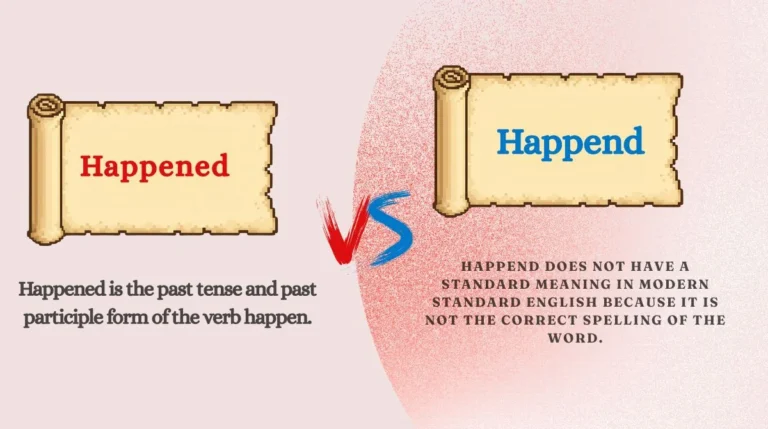
Happened is the past tense and past participle form of the verb happen.
The verb happen means that something takes place or occurs. When we talk about something that took place in the past, we use happened.
For example:
- Something happened at school yesterday.
- What happened after the meeting?
- I don’t know what happened to my phone.
- The accident happened early in the morning.
- She told me what happened last night.
- Nothing unusual happened during the trip.
- A strange thing happened on my way home.
- We were surprised by what happened.
The basic pattern is:
Subject + happened + other information
For example:
The problem happened yesterday.
Here, “happened” tells us that the event took place in the past.
When Should You Use “Happened”?
Use happened when you are talking about an event, situation, or action that already took place.
You will often see it with past-time expressions such as:
- yesterday
- last night
- last week
- two days ago
- earlier
- this morning
- a few minutes ago
- in 2025
For example:
What happened yesterday?
Something strange happened last night.
However, you do not always need a time expression. The past meaning can be clear from the context.
For example:
I saw Sarah at the hospital and asked what happened.
The conversation itself makes it clear that the speaker is asking about something that occurred earlier.
Grammar Rule for “Happened”
The word happened can be used as the simple past form of happen.
- Present: It happens.
- Past: It happened.
It can also be used as a past participle with helping verbs.
For example:
It has happened before.
It had happened before we arrived.
So, happened is a real and correctly spelled English word.
Why Is “Happened” Spelled With “-ened”?
This is where many learners make the mistake.
The base verb is:
happen
When we form the simple past by adding -ed, we get:
happen + ed = happened
Notice that the final e of the base word is still part of the spelling pattern, while the final consonant is doubled:
happen → happened
The correct spelling has two p letters and two e letters before the final d:
h-a-p-p-e-n-e-d
A useful way to see it is:
happen + ed = happened
This can help you remember the spelling instead of trying to spell the word only by sound.
Common Confusion About “Happened”
Many students hear happened and spell it as happend because the pronunciation does not clearly show every letter.
For example, when people speak quickly:
What happened?
The word may sound close to “happənd.”
But English spelling is not always exactly the same as pronunciation. That is why listening alone is not enough to spell this word correctly.
What Does “Happend” Mean?
Happend does not have a standard meaning in modern standard English because it is not the correct spelling of the word.
In most cases, when you see happend, the writer means happened.
For example:
❌ What happend yesterday?
The intended sentence is:
✅ What happened yesterday?
Another example:
❌ I don’t know what happend.
✅ I don’t know what happened.
So, unlike happened, the form happend is not a normal past-tense verb that you should use in standard English writing.
Why Do People Write “Happend”?
There are several reasons.
The first reason is pronunciation. The second e in happened is weak when we speak, so learners may not notice it.
The second reason is the spelling of similar words. Learners may think that adding -d to happen is enough, producing happend.
The third reason is typing quickly. On phones and computers, people often type words based on sound or memory. Since happend looks very close to happened, the mistake can easily slip through.
The fourth reason is simple lack of practice. A student may have seen the word many times but never paid attention to its exact spelling.
Examples Showing the Correct Form
Remember that these sentences need happened, not happend:
- What happened to your car?
- Tell me what happened.
- I don’t know what happened.
- The mistake happened because we were in a hurry.
- Something funny happened at lunch.
- The power cut happened suddenly.
- What happened after the class?
- A lot happened during the weekend.
The Important Point
There is no standard grammar rule that allows happend as the simple past form of happen.
The correct form is always:
happen → happened
So, when writing in standard English, avoid happend.
Difference Between Happened and Happend
The difference is very simple:
Happened is correct.
Happend is incorrect.
The two forms may look almost identical, but only one belongs in standard English.
| Word | Correct? | Meaning | Use |
|---|---|---|---|
| happened | ✅ Yes | Past form of “happen” | Used for something that took place in the past |
| happend | ❌ No | No standard meaning as a verb | Usually a spelling mistake |
Usage Difference
There is actually no real meaning difference between these two forms because happend is not an accepted standard spelling of the past tense.
When someone writes:
What happend?
They normally intend:
What happened?
The problem is spelling, not meaning.
Grammar Logic
The base verb is happen.
The regular past-tense ending is -ed.
Therefore:
happen + ed → happened
This is the form you should learn and remember.
Do not create the past tense as:
happen + d → happend
That spelling does not follow the correct formation of this verb.
Sentence Structure
The word happened is often found in these structures:
What happened?
Something happened.
The accident happened yesterday.
I don’t know what happened.
What happened to him?
It is especially common with the question word what.
For example:
What happened at school?
But remember that happened itself does not only appear in questions. It works in statements, negative structures, and longer sentences too.
For example:
Something unusual happened this morning.
I couldn’t understand what had happened.
Meaning Comparison
The intended meaning of both forms is usually the same because people who write happend generally mean happened.
However, only happened is correct in standard English.
This difference is especially important in formal writing. A spelling mistake may not stop someone from understanding you, but it can make your writing look careless.
Grammar Rules You Must Remember
Rule 1: The Correct Past Form Is “Happened”
The verb happen becomes happened in the simple past.
Present: Something happens every day.
Past: Something happened yesterday.
Do not write:
❌ Something happend yesterday.
Write:
✅ Something happened yesterday.
Rule 2: Keep the “e” Before the “d”
The spelling can be remembered as:
happen + ed = happened
There is an e before the final d.
Look carefully:
happened ✅
happend ❌
That small e is easy to miss, but it is essential.
Rule 3: Do Not Spell Words Only From Their Pronunciation
English has many words whose pronunciation does not clearly show every letter.
Happened is one example.
When spoken naturally, the word can sound like “HAP-ənd,” which may make the middle e easy to forget.
Always remember the written form:
h-a-p-p-e-n-e-d
Rule 4: “Happened” Can Work With Helping Verbs
The word can also appear with helping verbs to create perfect tenses.
For example:
It has happened before.
It had happened before we arrived.
Here, happened stays the same while the helping verb changes.
Notice:
has happened
had happened
Not:
❌ has happend
❌ had happend
The spelling remains happened.
Common Mistakes Students Make
The most common mistake is simply dropping the second e.
Mistake 1: Writing “Happend”
❌ What happend to you?
✅ What happened to you?
The easiest fix is to remember that happen takes -ed to make its regular past form.
Mistake 2: Thinking “Happend” Sounds Better
Some learners write what they hear.
For example, they may pronounce the word quickly and think there is no second e.
But spelling and pronunciation are not always identical in English.
A better habit is to learn the written form as a complete word:
happened
Mistake 3: Forgetting the Double “P”
Another spelling problem is:
❌ hapened
The correct spelling is:
✅ happened
There are two p letters.
Think:
hap + pen + ed
Or simply remember the base word:
happen
Then add -ed.
Mistake 4: Using “Happened” in the Wrong Tense
Although happened is correctly spelled, learners sometimes use it when the sentence needs the present form happen.
For example:
❌ Things happened every day in this office.
This could be correct in a past context, but if you mean a regular present situation, say:
✅ Things happen every day in this office.
The choice depends on the time being discussed.
Compare:
Strange things happen here.
This means they regularly occur now.
Something strange happened here yesterday.
This refers to one past event.
Mistake 5: Confusing “What Happened?” With “What Happens?”
These sentences have different meanings.
What happened?
You are asking about the past.
What happens?
You are asking about what normally occurs or what occurs in a situation.
For example:
What happened at the party last night?
What happens when you press this button?
Understanding the tense helps you choose the correct form.
Easy Trick to Remember the Difference
Here is a very simple memory trick:
Think: “Happen + ED”
Whenever you need the past form, write the base word first:
HAPPEN
Then add:
ED
That gives you:
HAPPENED
Say it in your head as:
HAPPEN + ED = HAPPENED
This is much easier than trying to memorize the spelling letter by letter.
A Second Memory Trick
Look at the ending:
happENED
The word contains ENED at the end.
You can mentally divide it like this:
happ + ened
The important part is to remember that the e does not disappear before d.
A Real-Life Logic Trick
Imagine you are making the past tense of a regular verb.
You have:
walk → walked
play → played
clean → cleaned
And:
happen → happened
So, think of happened as the normal past form of happen, rather than trying to spell it from its sound.
The more you read the correct form, the more natural it will become.
Daily Life Examples
You will hear and use happened in many normal conversations.
Example 1
A: Why are you late?
B: Sorry. Something happened on the way.
Here, happened tells us that an unexpected event took place.
Example 2
A: Why is Tom upset?
B: I don’t know. What happened?
This is one of the most common uses of the word.
Example 3
A: Did you hear about the meeting?
B: Yes. What happened there?
The speaker is asking about a past event.
Example 4
A: You look worried.
B: Something happened at work.
The speaker is talking about something that occurred earlier.
Example 5
A: Where is my cup?
B: I don’t know what happened to it.
The phrase what happened to is very common in everyday English.
Example 6
A: Did anything happen while I was gone?
B: No, everything was fine.
Here, the question asks whether any event occurred.
Example 7
A: Why didn’t Sarah come?
B: Something happened at home.
Again, the word refers to an event in the past.
Example 8
A: What happened yesterday?
B: We had a small problem, but we fixed it.
This is a natural question and answer in daily conversation.
Example 9
A: I can’t believe that happened!
B: I know. It was so unexpected.
The speaker is reacting to a past event.
Example 10
A: Have you heard what happened?
B: No. Tell me.
This example shows happened with the present perfect structure have heard.
Practice Section
Choose the correct word in each sentence.
1. What ______ at the meeting yesterday?
A. happend
B. happened
2. I don’t know what ______ to my bag.
A. happened
B. happend
3. Something strange ______ last night.
A. happend
B. happened
4. Did anything ______ while I was away?
A. happened
B. happend
5. We were shocked by what ______.
A. happend
B. happened
Answers
1. B — happened
The sentence talks about a past event, so happened is correct.
2. A — happened
The correct phrase is what happened to my bag.
3. B — happened
The correct past spelling is happened.
4. A — happened
The sentence uses did, so the main verb should actually be the base form happen:
✅ Did anything happen while I was away?
This is an important grammar point. We do not say did anything happened.
5. B — happened
The correct spelling is happened.
FAQs About Happened or Happend
What is the difference between happened and happend?
Happened is the correct spelling and is the past tense of happen. Happend is a spelling mistake and is not the standard English form. Whenever you mean that something took place in the past, use happened.
Is “happend” a correct English word?
No. Happend is not the standard spelling of the past form of happen. It is usually a typing or spelling error. The correct form is happened, with an e before the final d.
Why do people spell happened as happend?
The mistake usually happens because of pronunciation. When people speak quickly, the middle vowel in happened can sound very weak. As a result, learners may write happend because it seems to match the sound.
How do you spell happened correctly?
The correct spelling is:
H-A-P-P-E-N-E-D
A simple way to remember it is:
happen + ed = happened
Do not remove the e before the final d.
Can I say “What happened?”
Yes. What happened? is completely correct and very common in spoken English. We use it when asking about something that took place in the past.
For example:
What happened at school today?
What happened to your phone?
Is happened formal or informal?
Happened is neither especially formal nor especially informal. It is a normal English verb used in conversations, emails, stories, school writing, news reports, and professional communication.
Is “What happend?” grammatically correct?
No. The sentence has a spelling mistake. The correct sentence is:
✅ What happened?
The grammar idea is fine, but happend must be changed to happened.
What is the present form of happened?
The present form is happen or happens, depending on the subject.
For example:
Things happen.
Something happens every day.
The past form is:
Something happened yesterday.
Should I say “Did what happened?” or “What did happen?”
The normal question is:
✅ What happened?
When did is used as an auxiliary verb, the main verb normally returns to its base form.
For example:
✅ What did happen? — possible when giving special emphasis.
But the most natural everyday question is:
✅ What happened?
Is happened a regular verb?
Yes. Happen is a regular verb, and its past tense is formed with -ed:
happen → happened
The spelling still includes the double p and the e before the final d.
Conclusion
The choice between happened and happend is easy once you remember one simple fact: happened is correct, while happend is a spelling mistake.
The word happened is the past tense and past participle of happen. We use it when something took place or occurred in the past. You will see it in questions such as “What happened?”, as well as sentences like “Something happened yesterday.”
The easiest spelling trick is to start with the base verb:
happen + ed = happened
Do not leave out the e before the final d, and do not forget the double p.
Spelling mistakes like this are normal when learning English. What matters is noticing the mistake and building a better habit. Read the correct form, write it several times, and use it in your own sentences.
The next time you are tempted to write happend, pause for a second and remember: HAPPENED has “ED” at the end. That small habit will help you get the spelling right every time.

Evan Rellmont is a writer who turns thoughtful ideas into meaningful words, creating stories and reflections that connect, inspire, and leave a lasting impression.