
Have you ever written lightening when you meant lightning? Or seen a sentence such as “I saw a bright lightening in the sky” and wondered whether it was correct?
You are not alone. Lightening and lightning look almost the same, and both are connected to the idea of “light.” That small spelling difference, however, changes the meaning completely.
One usually talks about something becoming lighter. The other is the bright flash of electricity you see during a storm.
This confusion is common because the words sound very similar in everyday speech. When people speak quickly, the difference can be hard to hear.
Spelling can also cause trouble because lightening contains the word light, while lightning drops the second “e.”
Understanding the difference is useful in school, work, writing, text messages, and daily conversation. A sentence about a storm needs lightning, while a sentence about hair color, darkness, weight, or mood may need lightening.
Once you learn what each word does, the difference becomes much easier to remember.
You will know which spelling to choose, how each word works grammatically, and why they cannot normally replace each other.
You will also see common mistakes, simple examples, and an easy memory trick that makes this pair much less confusing.
What Does “Lightening” Mean?
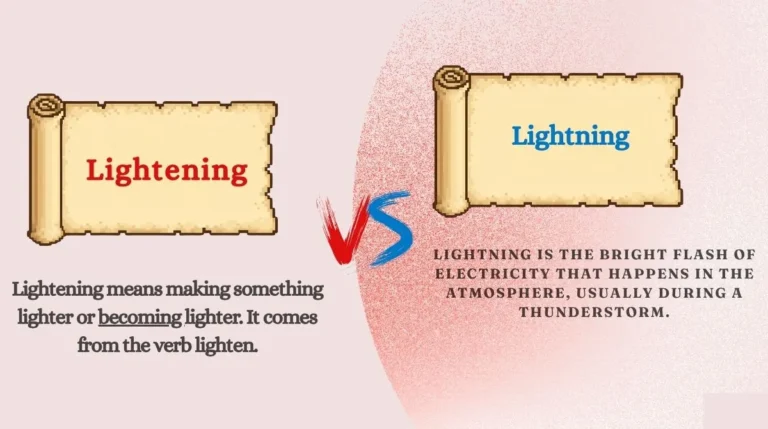
Lightening means making something lighter or becoming lighter. It comes from the verb lighten.
The word lighten has several related meanings. Something can become lighter in color, lighter in weight, less dark, less serious, or less difficult. It can also mean to make someone feel happier or less worried.
For example, if a person’s hair becomes a lighter color, you can say, “She is lightening her hair.” If a dark room becomes brighter, you might say, “The room is lightening up.”
In grammar, lightening is the -ing form of the verb lighten. Depending on the sentence, it can work as a present participle or a gerund.
When Should You Use “Lightening”?
Use lightening when you are talking about an action or change involving something becoming lighter.
It can refer to:
- a lighter color
- less weight
- less darkness
- a less serious mood
- a reduced burden or problem
The exact meaning comes from the context.
For example:
The painter is lightening the walls.
Here, lightening means making the walls a lighter color.
The load is lightening.
Here, it means the load is becoming less heavy.
Her mood is lightening.
Here, it means she is becoming happier or less worried.
Grammar Rule for “Lightening”
The basic form is:
lighten + -ing = lightening
Examples:
- lighten → lightening
- The artist is lightening the background.
- The sky is lightening as the sun rises.
When lightening is used with a helping verb such as is, are, was, or were, it usually describes an action that is happening.
Examples of “Lightening”
Here are some simple examples:
- She is lightening her hair for the summer.
- The designer is lightening the color of the curtains.
- The sky is lightening in the east.
- He is lightening the heavy box by removing some books.
- A little humor is lightening the mood in the room.
- The teacher’s kind words are lightening the student’s worry.
- The darkness is lightening as morning arrives.
- The company is lightening the workload for its employees.
Notice that every example involves some idea of becoming lighter or making something lighter.
A Common Problem With “Lightening”
Many learners choose lightening because it contains the word light and looks as if it should describe the flash in a storm.
That is not correct.
A storm produces lightning, not lightening.
Think about the sentence:
We saw lightning during the storm.
The word refers to the electrical flash in the sky.
But:
The sky is lightening.
This can mean the sky is becoming brighter, usually because dawn is arriving or darkness is fading.
The meanings are completely different even though the spellings are very close.
What Does “Lightning” Mean?
Lightning is the bright flash of electricity that happens in the atmosphere, usually during a thunderstorm.
It is the word you use when you see a sudden bright flash in the sky.
For example:
Lightning lit up the sky.
Here, lightning is the electrical event associated with a storm.
Unlike lightening, lightning is normally a noun in standard everyday English.
It names a thing or natural event rather than an action of making something lighter.
When Should You Use “Lightning”?
Use lightning when you are talking about:
- a thunderstorm
- a flash of electricity in the sky
- dangerous weather
- lightning strikes
- lightning safety
- a bright electrical flash
You might hear phrases such as:
- lightning strike
- lightning storm
- lightning bolt
- lightning flash
- lightning safety
- lightning conductor
All of these refer to the electrical phenomenon.
Grammar Rule for “Lightning”
Because lightning is generally a noun, it can appear as the subject or object of a sentence.
For example:
Lightning struck the tree.
Here, “lightning” is the subject.
We watched the lightning from the window.
Here, “lightning” is the object.
You would not normally say:
The sky is lightning.
That wording changes the expected grammar and meaning. In a sentence about the sky becoming brighter, the correct word is often lightening.
Examples of “Lightning”
Here are eight easy examples:
- Lightning flashed across the sky.
- We stayed inside because of the lightning.
- A bolt of lightning struck a nearby tree.
- The lightning was bright enough to light the whole street.
- I woke up when I saw lightning through the window.
- The storm produced frequent lightning.
- The pilot was warned about heavy lightning in the area.
- We waited for the lightning to stop before leaving.
In all of these sentences, the word refers to the electrical flashes associated with a storm.
A Common Problem With “Lightning”
The most common mistake is adding the extra e:
❌ We watched the lightening during the storm.
✅ We watched the lightning during the storm.
The spelling is important because lightening has a different meaning.
Another common mistake is forgetting that lightning is normally a noun.
For example, learners may write:
❌ The sky is lightning.
When they really mean that the sky is becoming brighter, they should write:
✅ The sky is lightening.
When they mean electrical flashes, they should say:
✅ There is lightning in the sky.
Difference Between Lightening and Lightning
The biggest difference is simple:
Lightening = becoming lighter or making something lighter.
Lightning = a bright electrical flash in the sky during a storm.
The words differ by only one letter, but their meanings are far apart.
| Feature | Lightening | Lightning |
|---|---|---|
| Basic meaning | Making something lighter or becoming lighter | Electrical flash in the atmosphere |
| Root word | Lighten | Lightning is the natural phenomenon |
| Part of speech | Usually verb form; can function as a gerund | Usually noun |
| Common topic | Color, weight, darkness, mood, workload | Storms and electricity |
| Example | She is lightening her hair. | Lightning flashed above us. |
| Connected word | Lighten | Thunderstorm |
| Extra “e” | Yes | No |
| Daily clue | Something becomes lighter | Something flashes in the sky |
Usage Difference
The easiest way to separate them is to ask yourself what you are talking about.
Are you talking about change?
Then lightening may be correct.
Are you talking about a storm flash?
Then lightning is correct.
Compare these two sentences:
The sky is lightening.
This means the sky is becoming brighter.
There is lightning in the sky.
This means electrical flashes are appearing during a storm.
They may both involve the sky and light, but they describe very different things.
Grammar Logic
The grammar gives you another useful clue.
Lightening comes from the verb lighten. It describes an action or process.
For example:
The workers are lightening the load.
The workers are doing something to make the load less heavy.
Lightning, on the other hand, names a natural event:
The lightning was very bright.
It is not describing an action done by someone to make something lighter. It is naming the storm-related electrical phenomenon.
Sentence Structure Difference
Because lightening is an -ing form, it often appears after forms of be:
The room is lightening.
She is lightening the color.
The mood was lightening.
It can also appear in other structures:
Lightening the load made the job easier.
Here, “lightening the load” acts as the subject of the sentence.
Lightning can appear as a normal noun:
Lightning struck the building.
We saw lightning last night.
The sound of thunder followed the lightning.
This difference in sentence structure can help you choose the right word.
Meaning Comparison
A helpful way to think about the pair is:
Lightening changes the level of something.
Lightning is an event in nature.
Color can become lighter.
A bag can become lighter.
A room can become less dark.
A mood can become less serious.
These are examples of lightening.
A flash during a thunderstorm is lightning.
Grammar Rules You Must Remember
Rule 1: Use “lightening” for the verb “lighten”
When something is becoming lighter or someone is making it lighter, use lightening.
Example:
The artist is lightening the background color.
The artist is changing the color so it becomes lighter.
Rule 2: Use “lightning” for electrical flashes in storms
When you mean the bright electrical flash in the sky, use lightning.
Example:
We saw lightning before the rain started.
The sentence is about a storm, so lightning is the correct choice.
Rule 3: “Lightening” can describe more than color
Some learners think lightening only means making a color lighter.
That is too narrow.
It can also relate to weight, darkness, mood, pressure, or a burden.
Example:
The new schedule is lightening the workload.
The workload is becoming easier or less heavy.
Rule 4: Look at the sentence meaning before the spelling
Do not choose the word simply because it contains or does not contain an e.
First, understand the meaning.
Example:
The clouds are lightening.
The clouds are becoming less dark.
But:
Lightning flashed between the clouds.
This sentence describes electrical flashes.
Meaning comes first. Spelling comes second.
Common Mistakes Students Make
Learners often make mistakes with these words because they sound almost identical.
Another reason is that both words are connected in people’s minds with light. One refers to something becoming lighter, while the other creates a flash of light. That connection makes the spelling even easier to mix up.
Mistake 1: Using “lightening” for a storm
❌ We saw lightening during the storm.
✅ We saw lightning during the storm.
A storm gives you a strong clue. If you are talking about flashes in the sky, choose lightning.
Mistake 2: Using “lightning” for a color change
❌ She is lightning her hair.
✅ She is lightening her hair.
Here, “lightening” comes from the verb lighten, meaning to make the hair a lighter color.
Mistake 3: Using “lightning” for a brighter sky
❌ The sky is lightning.
✅ The sky is lightening.
The sentence means the sky is becoming brighter.
Mistake 4: Thinking “lightening” only means color
❌ The only meaning of lightening is changing color.
Not true.
You can talk about lightening a load, lightening a mood, or lightening a dark area.
Easy Correction Tips
When you are unsure, ask yourself a quick question:
“Am I talking about a storm flash?”
If yes, use lightning.
“Am I talking about something becoming lighter?”
If yes, use lightening.
That tiny question can save you from many spelling and grammar mistakes.
Easy Trick to Remember the Difference
Here is a simple memory trick:
Lightning has no “e” because it happens fast!
Think of a flash of lightning as something sudden and quick.
LIGHTNING → storm flash
Now look at:
LIGHTENING → LIGHT + ENING
The extra e can remind you of the verb lighten.
LIGHTENING → making something lighter
For example:
I am lightening the wall color.
One more trick is to picture two different scenes.
Picture number one: a dark stormy sky with a bright flash.
That is lightning.
Picture number two: a painter adding white paint to a dark wall.
That is lightening.
You can also remember these two short phrases:
Lightning = storm
Lightening = lighter
That is usually enough to keep the spellings apart.
Daily Life Examples
These examples show how the two words sound in normal conversation.
1. Talking about a storm
A: Did you hear that?
B: Yes! I saw lightning outside.
Here, the speaker is talking about a storm flash.
2. Talking about hair color
A: Your hair looks different.
B: I’m lightening it a little for summer.
The speaker is changing the hair to a lighter color.
3. Talking about the morning sky
A: Is it getting brighter?
B: Yes, the sky is lightening now.
The sky is becoming brighter as darkness fades.
4. Talking about bad weather
A: Should we go for a walk?
B: Not yet. There’s too much lightning.
The concern is the storm and electrical flashes.
5. Talking about a heavy bag
A: This bag is so heavy.
B: Let’s remove a few things. That will help with lightening the load.
The idea is to make the load less heavy.
6. Talking about a room
A: This room feels very dark.
B: We can try lightening the wall color.
The wall color can be changed to create a lighter appearance.
7. Talking about mood
A: Everyone looks worried.
B: A funny story might help with lightening the mood.
The mood can become more relaxed and cheerful.
8. Watching a storm
A: Look at the sky!
B: Wow, that lightning is incredible.
The speaker is reacting to flashes in the storm.
9. Waiting for better weather
A: Can we leave now?
B: I’d rather wait until the lightning stops.
Again, the word refers to storm electricity.
10. Talking about dawn
A: Is sunrise close?
B: Yes. The sky is lightening already.
The sky is becoming brighter.
These examples show an important point: lightening can describe a gradual change, while lightning usually refers to the sudden flashes you see during storms.
Practice Section
Choose the correct word in each sentence.
1. We saw bright ______ during the thunderstorm.
A. lightening
B. lightning
2. She is ______ her hair for the wedding.
A. lightening
B. lightning
3. The sky is ______ as the sun comes up.
A. lightening
B. lightning
4. A bolt of ______ struck the tree.
A. lightening
B. lightning
5. The joke helped with ______ the mood.
A. lightening
B. lightning
Answers
- B. lightning
- A. lightening
- A. lightening
- B. lightning
- A. lightening
A quick way to check your answers is to look for the meaning. Storm flash? Lightning. Becoming lighter? Lightening.
FAQs About Lightening vs Lightning
What is the difference between lightening and lightning?
Lightening comes from the verb lighten and means making something lighter or becoming lighter. It can describe color, weight, darkness, mood, or a burden.
Lightning is the electrical flash that happens in the atmosphere, usually during a thunderstorm.
Can “lightening” be used in a sentence about the sky?
Yes. Lightening can be used when the sky is becoming brighter or less dark.
For example:
The sky is lightening as morning approaches.
This is different from lightning, which refers to electrical flashes during a storm.
Is “lightning” a noun or a verb?
Lightning is normally used as a noun in standard English. It names the electrical phenomenon in the sky.
For example:
Lightning struck the tree.
It is not the usual verb form of lighten.
Is “lightening” always about color?
No. Lightening has several meanings.
It can describe making something lighter in color or weight. It can also refer to reducing darkness, pressure, seriousness, or a burden.
For example:
The new plan is lightening the workload.
Why do lightening and lightning sound so similar?
They come from closely related spelling and pronunciation patterns, so many speakers pronounce them very similarly. The extra e in lightening may be easy to miss when someone speaks quickly.
That is why understanding the meaning is often more useful than relying only on pronunciation.
How can I remember which spelling to use?
Connect lightning with a storm.
Think:
Lightning = flash in the sky
Connect lightening with the word lighten.
Think:
Lightening = making something lighter
Remembering those two ideas is enough for most everyday sentences.
Conclusion
The difference between lightening vs lightning is small in spelling but big in meaning. Lightening is the -ing form of lighten, so it describes something becoming lighter or someone making something lighter. It can relate to color, weight, darkness, mood, or a burden.
Lightning, however, is the bright electrical flash you see during a thunderstorm. It is normally used as a noun and is closely connected with words such as thunder, storm, bolt, and flash.
When you see these words, do not focus only on how similar they look. Ask yourself what the sentence is talking about. Is something becoming lighter? Choose lightening. Is there an electrical flash in a storm? Choose lightning.
A few simple examples can make this difference stick in your mind. Keep practicing, and soon this confusing pair will feel as easy as any other common English word.

Evan Rellmont is a writer who turns thoughtful ideas into meaningful words, creating stories and reflections that connect, inspire, and leave a lasting impression.