
Load and lode are two English words that often confuse learners because they sound the same, even though they have different spellings and meanings.
When you hear someone say “load,” the sound alone does not tell you which word they mean. You need the context to know how to spell it.
This problem is common because load is a very common everyday word, while lode is much less common. You may see load when people talk about bags, trucks, work, laundry, cars, machines, or computers.
Lode is usually found in mining and geology, where it means a natural vein or deposit of metal ore in rock.
Some dictionaries also record a less common figurative meaning of lode as a rich source or supply.
Knowing the difference is important because a spelling mistake can change the meaning of a sentence. “A heavy load of boxes” is about something being carried. “A gold lode” is about a natural mineral deposit.
After learning these two words, you should be able to recognize which spelling fits the context, understand how each word works in a sentence, and avoid the most common mistakes.
You will also have a simple memory trick you can use whenever these homophones appear in writing.
What Does “Load” Mean?
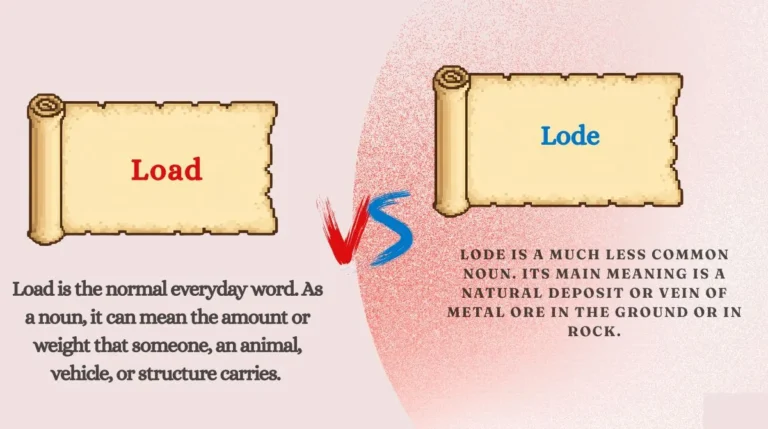
Load is the normal everyday word. As a noun, it can mean the amount or weight that someone, an animal, vehicle, or structure carries. It can also mean an amount of work, a batch of laundry, or a large amount of something in informal expressions such as loads of. As a verb, load means to put things into or onto a vehicle, machine, or other place. It is also used for putting information or a program onto a computer.
Load as a noun
When load is a noun, it often refers to something being carried or the amount being carried.
Examples:
- The truck is carrying a heavy load of sand.
- I lifted the load carefully.
- The elevator has a maximum load of eight people.
- She has a heavy load of work this week.
- I put a load of clothes in the washing machine.
- There were loads of people at the concert.
- We brought one load of firewood inside.
These examples show that load has several everyday uses. It can describe physical weight, work, laundry, or a large amount. This is why the word appears so often in normal conversation.
Load as a verb
As a verb, load means to put something into or onto something.
Examples:
- Please load the boxes into the van.
- They loaded the truck with rice.
- Can you load the dishwasher?
- We loaded our bags into the car.
- The website is taking a long time to load.
- She loaded the file onto her computer.
- The workers are loading the plane.
Two common sentence patterns are:
load + object
“Load the boxes.”
load + object + into/onto + place
“Load the boxes onto the truck.”
You can also say be loaded with:
“The truck was loaded with furniture.”
Common learner confusion about load
Some learners connect load only with heavy objects. In fact, its meaning is much wider. You can have a workload, a course load, a load of laundry, or loads of time in informal English. The main idea is often an amount, a burden, or something that is being put into or onto something.
What Does “Lode” Mean?
Lode is a much less common noun. Its main meaning is a natural deposit or vein of metal ore in the ground or in rock. Cambridge defines it as a layer of metal in its natural form as ore in the ground. Oxford describes it as a line of ore, while the American Heritage Dictionary also gives a figurative sense meaning a rich source or supply.
In simple words, imagine a miner looking through rock for gold or another metal. A lode is a natural line or deposit of ore in that rock.
Examples:
- The miners discovered a rich lode of gold.
- They searched the mountain for a silver lode.
- The old mine was built near a copper lode.
- Geologists examined the rock around the lode.
- The map showed the location of the gold lode.
- They followed the lode through the rock.
The word is strongly connected with mining, minerals, ore, rock, and geology. That makes it much easier to recognize when you know the subject of the sentence.
Lode as a noun
In modern English, lode is normally used as a noun.
“The miners found a lode.”
You would not normally turn it into a verb such as “loded.” If you need a verb meaning “put something into a truck or machine,” the correct word is load, with forms such as loaded, loading, and loads.
A figurative meaning of lode
There is also a figurative use in which lode means a rich source or supply of something.
For example:
“The archive was a lode of useful information.”
This meaning is much less common than the everyday uses of load, so English learners should first remember the mining meaning.
Why lode is easy to miss
The main problem is spelling. You may hear “gold lode” and automatically write “gold load.” But if the sentence is about a natural deposit of ore, lode is the correct spelling.
Difference Between Load and Lode
The central difference is easy:
Load is an everyday word for a burden, amount, quantity, or the action of putting something into or onto something.
Lode is mainly a mining term for a natural vein or deposit of metal ore.
They are pronounced the same in standard English, so they are homophones. Both are listed with /loʊd/ in American English and /ləʊd/ in British English.
Comparison table
| Feature | Load | Lode |
|---|---|---|
| Part of speech | Noun and verb | Mainly noun |
| Main meaning | Weight, burden, amount, or the act of putting something somewhere | A vein or deposit of metal ore |
| Everyday use | Very common | Uncommon |
| Common context | Transport, work, laundry, machines, computers | Mining, geology, minerals |
| Verb form | Yes: load, loaded, loading | No normal modern verb use |
| Example | The truck has a heavy load. | The miners found a gold lode. |
| Pronunciation | /loʊd/ or /ləʊd/ | /loʊd/ or /ləʊd/ |
Usage difference
Use load for carrying, filling, work, laundry, or quantity.
“Please load the bags into the car.”
“I have a heavy workload.”
“We washed two loads of clothes.”
Use lode when the topic is mineral deposits, mining, rock, or ore.
“The miners found a gold lode.”
A useful question is: Am I talking about something being carried or filled, or am I talking about a mineral deposit in rock?
That question usually solves the spelling problem immediately.
Grammar logic
Load can work as both a noun and a verb.
Noun: “The truck has a heavy load.”
Verb: “Workers load the truck every morning.”
Lode is normally a noun:
“The geologist located the lode.”
So if you need an action word meaning “put something into or onto something,” choose load.
Sentence structure difference
Common patterns with load include:
load + noun
“Load the boxes.”
load + noun + into/onto + place
“Load the boxes into the van.”
a load of + noun
“She carried a load of wood.”
With lode, you are more likely to see:
a lode of + mineral
“They found a lode of gold.”
or:
gold/silver/copper + lode
“The mine was near a silver lode.”
Meaning comparison
Compare:
“The workers carried a heavy load.”
“The workers discovered a rich lode.”
The first sentence is about a burden. The second is about a mineral deposit. The sound is identical, but the mental picture is completely different.
Think of load with trucks, bags, work, or machines. Think of lode with mines, rock, and ore.
Grammar Rules You Must Remember
Rule 1: Use “load” for something carried or supported.
When you mean a physical burden, amount of cargo, baggage, or weight, use load.
Example:
“The camel carried a heavy load.”
It can also describe weight supported by a structure:
“The bridge can handle a large load.”
Rule 2: Use “load” as a verb for putting something into or onto something.
This is common with cars, trucks, machines, dishwashers, washing machines, and computers.
Example:
“Please load the boxes onto the truck.”
Rule 3: Use “lode” for a mineral vein or deposit.
When the sentence is about gold, silver, copper, ore, mining, or geology, lode may be the right word.
Example:
“The miners followed the lode through the rock.”
Rule 4: Let the context decide the spelling.
Because load and lode sound the same, pronunciation cannot give you the spelling.
Example:
“They found a gold lode.” ✅
“They found a gold load.” ❌ when the meaning is a natural ore deposit.
But:
“They carried a gold load.” ✅
Here, load means a quantity being carried.
Common Mistakes Students Make
Mistake 1: Using load for a mineral deposit
Incorrect:
“They found a rich gold load.” ❌
Correct:
“They found a rich gold lode.” ✅
The fix is simple: connect lode with ore in rock.
Mistake 2: Using lode for an ordinary burden
Incorrect:
“I carried a heavy lode of books.” ❌
Correct:
“I carried a heavy load of books.” ✅
Books are being carried, so use load.
Mistake 3: Treating lode like a normal verb
Incorrect:
“We loded the truck with boxes.” ❌
Correct:
“We loaded the truck with boxes.” ✅
The verb is load, not lode.
Mistake 4: Writing lodes of for “a lot of”
Incorrect:
“I have lodes of homework.” ❌
Correct:
“I have loads of homework.” ✅
The common informal expression is loads of, meaning “a lot of.”
Easy correction tip
Ask yourself which idea fits the sentence:
carrying / burden / amount / putting into something → load
mining / ore / mineral / vein in rock → lode
This is faster and more reliable than trying to remember the spelling from sound.
Easy Trick to Remember the Difference
Use this picture in your mind:
A truck has a LOAD.
A mine has a LODE.
That is the easiest rule for most learners.
You can also connect load with amount. Both words describe quantity in many common situations. You can have a load of boxes, a load of work, or loads of people.
For lode, think of ore. A lode is something found in rock, especially a deposit of valuable metal ore.
So remember:
LOAD = carry, fill, work, amount
LODE = ore, rock, mine
There is an interesting historical reason the spelling feels confusing. Lode and load are historically related forms, and lode preserved an older sense connected with a way or course. The mining meaning developed from the idea of following a mineral vein through rock.
You do not need to memorize that history to use the words correctly, but it explains why the spellings are so close.
Daily Life Examples
Most everyday sentences will use load, while lode is more likely to appear in a specialized mining or geology context.
- “Can you help me load these bags into the car?”
- “This truck is carrying a very heavy load.”
- “I have a huge load of homework tonight.”
- “Please wait for the page to load.”
- “I put a load of clothes in the washing machine.”
- “There were loads of people at the market today.”
- “The workers finished loading the boxes before noon.”
- “The bridge must support the load safely.”
- “The miners searched the mountain for a silver lode.”
- “The geologist believed the rock contained a valuable copper lode.”
Short conversation
Sara: Can you help me load the boxes?
Ali: Sure. How many are there?
Sara: About ten. The van already has a heavy load.
Ali: Okay. Let’s put the heavier boxes at the bottom.
Later, they discuss mining:
Sara: I read about an old gold mine.
Ali: Did they find anything?
Sara: Yes. They discovered a rich gold lode in the rock.
The conversation shows why context matters. The pronunciation stays the same, but the meaning changes completely.
Practice Section
Choose load or lode.
1. The workers carried a heavy ___ of bricks.
2. The miners discovered a gold ___ beneath the mountain.
3. Please ___ the bags into the car.
4. We have ___s of work to finish today.
5. The geologist studied the mineral ___ carefully.
Answers
1. load — The bricks are being carried.
2. lode — It is a natural gold deposit in rock.
3. load — Here, load is a verb.
4. loads — Loads of means “a lot of” in informal English.
5. lode — The sentence is about a mineral deposit.
Try making three new sentences of your own. Write one with load as a noun, one with load as a verb, and one with lode in a mining context.
FAQs
What is the difference between load and lode?
Load is a common noun and verb connected with burdens, amounts, work, laundry, and putting things into or onto something. Lode is mainly a noun for a natural vein or deposit of metallic ore in rock. They sound alike but have different meanings.
Can we use “load” in questions?
Yes. Load can appear naturally in questions because it works as both a noun and a verb.
For example: “Did you load the boxes?” and “How heavy is the load?” Both are correct.
Can we use “lode” in questions?
Yes, but usually when discussing mining, minerals, or geology.
For example: “Did the miners find a gold lode?” This is grammatical, although lode is uncommon in ordinary conversation.
Is “lode” formal or informal?
Lode is mainly a specialized word used in areas such as mining and geology. It can also appear in figurative or literary writing when something is described as a rich source or supply.
Is “load” only used for heavy things?
No. Load can mean a physical burden, an amount of work, a batch of laundry, computer information, or a large amount in loads of. It has many everyday uses.
Are load and lode homophones?
Yes. They have the same standard pronunciation, while their spellings and meanings are different. This is why the sentence context is so important when you are writing the word you hear.
Conclusion
Load and lode sound the same, but they are used in very different situations. Load is the everyday word for a burden, amount, workload, laundry batch, or the action of putting something into or onto a vehicle, machine, or other place. Lode is a specialized noun that usually means a natural vein or deposit of metal ore in rock.
The easiest memory trick is: a truck has a load, while a mine has a lode. When you hear the word, do not rely on pronunciation alone. Look at the meaning and the surrounding words.
With a little practice, this pair becomes easy. Make a few sentences using both spellings, read them aloud, and check whether the context is about carrying or about mining. Soon, you will choose load and lode naturally and confidently. That small habit will help you avoid spelling mistakes in both school writing and everyday messages.

Evan Rellmont is a writer who turns thoughtful ideas into meaningful words, creating stories and reflections that connect, inspire, and leave a lasting impression.