
Many English learners hesitate when they write occasion because the word does not look exactly the way it sounds.
Some people write ocassion, while others use occasion. The difference is only one letter, but only one spelling is correct in standard English.
The correct spelling is occasion. Ocassion is a common spelling mistake, not a separate English word.
This small spelling problem can appear in school assignments, emails, social media posts, invitations, resumes, and everyday messages.
You may also see the word in common phrases such as special occasion, on occasion, and on this occasion.
The confusion is easy to understand. When we say the word, the two c letters are not strongly noticeable in normal speech.
The word is usually pronounced /əˈkeɪʒən/, so learners may hear something closer to “ocayzhun.”
That makes it tempting to leave out one of the letters when writing it. Cambridge and Oxford both list occasion as the standard spelling and show its common meanings and uses.
The good news is that the rule is simple: occasion is correct; ocassion is incorrect.
What Does “Occasion” Mean?
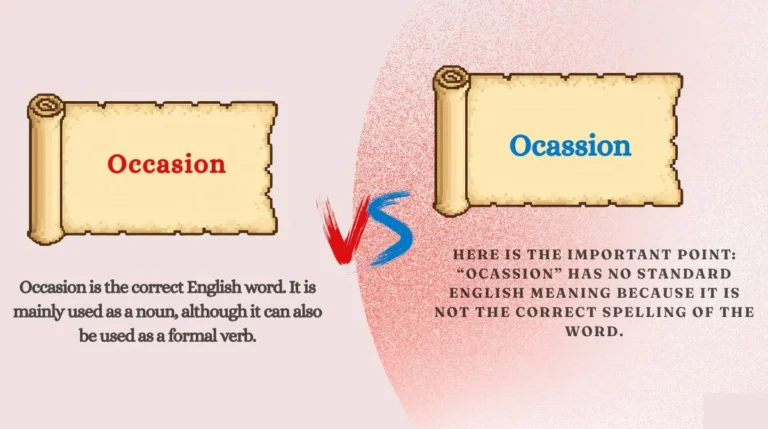
Occasion is the correct English word. It is mainly used as a noun, although it can also be used as a formal verb.
As a noun, occasion can mean a particular time when something happens. It can also mean a special, important, or formal event. For example, a wedding, birthday, graduation, or award ceremony can be called an occasion. Cambridge defines it as a particular time when something happens and also as a special or formal event.
When Do We Use “Occasion”?
We use occasion when talking about:
- A special event
- A particular time
- A specific situation
- A formal or important event
- A time when something happened
- An opportunity or reason in some formal expressions
Here are some everyday examples:
- Her birthday was a very special occasion.
- We have met on several occasions.
- He wore his best suit for the occasion.
- I remember that occasion very clearly.
- The wedding was a joyful occasion.
- On this occasion, we decided to stay home.
- She has helped me on many occasions.
- We only eat at that restaurant on special occasions.
Notice how the meaning changes slightly depending on the sentence. In “a special occasion,” the word refers to an important event. In “on several occasions,” it means several different times.
Grammar Rule for “Occasion”
Occasion is usually a countable noun when it means a particular event or time.
That means we can say:
- an occasion
- two occasions
- several occasions
- many occasions
For example:
It was a memorable occasion.
I have seen her on three occasions.
We can also use common prepositions with it:
- on occasion
- on this occasion
- on that occasion
- on several occasions
- for the occasion
The expression on occasion means sometimes, but not often. Oxford gives this meaning for the idiom and notes that it is used for something that happens from time to time.
Example:
I eat dessert on occasion.
This means I eat dessert sometimes, but not regularly.
Common Learner Confusion About “Occasion”
The biggest problem is spelling.
A learner may think the word should be ocassion because of the way it sounds. But English spelling does not always match pronunciation perfectly.
Another issue is forgetting that occasion has two c’s:
o-c-c-a-s-i-o-n
A useful way to look at it is:
occa + sion
The two c’s belong in the word even though you do not clearly hear both of them.
There is also confusion about pronunciation. The word is pronounced roughly like “uh-KAY-zhun.” The c before a has a /k/ sound, while the s in the middle has a /ʒ/ sound, like the sound in vision.
So, remember:
Correct: occasion
Incorrect: ocassion
What Does “Ocassion” Mean?
Here is the important point: “ocassion” has no standard English meaning because it is not the correct spelling of the word.
It is simply a misspelling of “occasion.”
You may see ocassion in online comments, text messages, informal posts, or learner writing. Seeing a spelling mistake many times can make it look familiar, but familiarity does not make it correct.
Standard dictionaries such as Cambridge, Oxford, and Merriam-Webster use occasion, not ocassion, for this word. Merriam-Webster traces the word back through Middle English and Anglo-French to Latin, while Oxford also gives its historical connection to Latin.
Why Do People Write “Ocassion”?
There are a few simple reasons.
First, pronunciation can hide the spelling. When we speak quickly, we do not clearly separate every letter in a word.
Second, English learners often use sound-based spelling. They hear the word and write what they think they hear.
Third, ocassion looks believable. It contains the familiar ending -sion, and many learners remember only one c.
For example, a student may write:
“It was a very special ocassion.”
The sentence sounds perfectly understandable, but the spelling is wrong.
The correct version is:
“It was a very special occasion.”
Is “Ocassion” Ever Correct?
No. In standard modern English, ocassion is not the accepted spelling.
It should not be used in:
- School writing
- Exams
- Professional emails
- Business documents
- Formal letters
- Resumes
- Articles
- Academic writing
If you see ocassion, read it as a spelling error for occasion.
Difference Between Occasion and Ocassion
The difference is very simple because these two forms are not two different words.
One is correct, and the other is a misspelling.
| Point | Occasion | Ocassion |
|---|---|---|
| Status | Correct English word | Incorrect spelling |
| Number of C’s | Two c’s | One c |
| Meaning | A special event, particular time, etc. | No separate standard meaning |
| Dictionary form | Yes | No |
| Suitable for formal writing | Yes | No |
| Example | It was a special occasion. | Incorrect |
| Correct sentence | We met on several occasions. | Incorrect spelling |
Usage Difference
There is actually no meaning difference between the two forms because ocassion is not an alternative spelling.
You should use occasion whenever you want to express the idea of a particular time or a special event.
For example:
Correct:
The ceremony was a memorable occasion.
Incorrect:
The ceremony was a memorable ocassion.
The second sentence is understandable, but it contains a spelling error.
Grammar Logic
Occasion works as a noun in sentences such as:
This is a special occasion.
Here, occasion is the noun.
It can also occur in fixed expressions:
on occasion
on several occasions
for the occasion
on this occasion
on that occasion
The incorrect form ocassion cannot normally fill these grammar roles in standard English.
Sentence Structure
Here are a few useful patterns:
a/an + occasion
- It was an important occasion.
adjective + occasion
- It was a special occasion.
on + occasion
- We meet on occasion.
on + adjective + occasions
- She visits us on rare occasions.
on + number/quantity + occasions
- He has been late on several occasions.
These patterns are very common in everyday and formal English. Oxford lists structures such as on an occasion, on several occasions, and have occasion to do something among its common uses.
Grammar Rules You Must Remember
Rule 1: Always Spell the Word With Two C’s
The standard spelling is:
occasion
Not:
ocassion
A simple visual check can save you from this mistake.
O C C A S I O N
There are two c’s next to each other.
Example:
The graduation ceremony was a proud occasion.
Rule 2: “Occasion” Is Usually a Countable Noun
When referring to particular events or times, occasion can be singular or plural.
You can say:
- an occasion
- one occasion
- two occasions
- several occasions
- many occasions
Example:
I met him on one occasion.
Example:
I have spoken to her on several occasions.
This is one reason the word appears so often in formal writing. It gives a clear way to refer to separate times when something happened.
Rule 3: Remember the Common Expressions
Some phrases can help you remember the correct spelling naturally.
On occasion = sometimes
Example:
We go out for dinner on occasion.
On this occasion = at this particular time
Example:
On this occasion, everyone agreed with the manager.
For the occasion = especially for a particular event
Example:
She bought a new dress for the occasion.
On several occasions = several different times
Example:
He has called me on several occasions.
When you learn the word through these phrases, its spelling becomes easier to remember. Cambridge lists several of these common uses, including on special occasions, for the occasion, and on that occasion.
Rule 4: Do Not Trust Pronunciation Alone
English spelling often contains letters that are not obvious when a word is spoken.
With occasion, you hear something like:
uh-KAY-zhun
You do not hear a strong pause between the two c’s.
That is why spelling from sound can be risky.
Write the word from memory as:
OCCASION
rather than trying to rebuild it from pronunciation every time.
Common Mistakes Students Make
Spelling mistakes often happen because students write words according to sound. Occasion is a good example.
Mistake 1: Using One C
❌ It was a special ocassion.
✅ It was a special occasion.
The most common mistake is dropping one of the two c’s.
Easy tip: Remember CC in the middle.
Mistake 2: Thinking “Ocassion” Is a British or American Variation
Some learners see different spellings in English and assume that ocassion may be a regional version.
It is not.
British and American English both use:
✅ occasion
The spelling does not change simply because the writer is using British or American English.
Mistake 3: Spelling the Word From Pronunciation
A student may think:
“I hear one c, so I will write one c.”
That approach does not work well with many English words.
Pronunciation tells you how to say a word. Spelling tells you how to write it. The two systems are connected, but they are not always identical.
Mistake 4: Confusing “Occasion” With “Occasional”
Some learners remember occasional correctly but become uncertain about the noun.
Here are the correct forms:
- occasion — noun
- occasional — adjective
- occasionally — adverb
Examples:
This is a special occasion.
He makes occasional visits to the city.
We occasionally eat outside.
The base word is occasion, with two c’s.
Merriam-Webster lists occasionally as an established adverb meaning “from time to time.”
Mistake 5: Adding an Extra Letter in the Wrong Place
Some learners may write things such as:
❌ occassion
❌ ocasian
❌ occation
❌ occassion
These forms can appear when a writer is unsure about the spelling pattern.
The safest version to memorize is:
OCCASION
Easy Trick to Remember the Difference
Here is a classroom trick that works well.
Think:
Occasion has CC before ASION.
Break the word into two simple parts:
OCC + ASION
Then put them together:
OCCASION
You can also make a tiny memory sentence:
“A special occasion needs two C’s.”
Imagine a birthday party. There are two cakes, two candles, or two chairs. The exact image does not matter. The goal is simply to connect occasion with two C’s.
Another useful trick is to compare these two forms visually:
O C C A S I O N ✅
O C A S S I O N ❌
Look at the middle.
In the correct spelling, the C C comes first, and the S comes after them.
A Real-Life Memory Trick
Think about the phrase:
special occasion
You may hear it often at weddings, birthdays, graduations, and celebrations.
Write it several times:
special occasion
special occasion
special occasion
After enough practice, your eyes will begin to recognize the correct form automatically.
That is better than trying to remember a complicated spelling rule.
Daily Life Examples
The word occasion is common in normal conversations. Here are ten examples you may actually hear or use.
1. Talking About a Birthday
A: Why did you buy a new dress?
B: It’s my sister’s birthday, so I need it for the occasion.
Here, occasion means the birthday event.
2. Talking About a Wedding
A: Are you wearing that suit to the wedding?
B: Yes. It’s a special occasion.
The wedding is a special event.
3. Talking About Past Events
A: Have you met the new teacher before?
B: Yes, I’ve spoken to her on several occasions.
Here, occasions means several different times.
4. Talking About Rare Habits
A: Do you eat fast food?
B: Only on occasion.
This means the person does it sometimes, but not often. Cambridge and Oxford both recognize this common use.
5. Talking About a Particular Day
A: Why was everyone so quiet yesterday?
B: It was a serious occasion.
The word refers to the importance of the event.
6. Buying Something Special
A: Why did you buy such an expensive watch?
B: I wanted something nice for special occasions.
The phrase refers to important events when the watch might be worn.
7. Referring to One Specific Time
A: Do you remember when Ali helped us?
B: Yes, I remember that occasion very well.
Here, occasion means a particular time in the past.
8. Talking About Formal Events
A: Why is everyone dressed so formally?
B: Because it’s an important occasion.
The clothing is more formal because the event is important.
9. Talking About a Rare Opportunity
A: Have you ever spoken in front of a large audience?
B: Yes, I had the occasion to speak at a school event.
In formal English, have occasion to do something can mean having a reason or opportunity to do it. Oxford lists this as one of the noun’s established uses.
10. Talking About a Particular Situation
A: Why did you make an exception today?
B: I thought it was appropriate on this occasion.
This means the decision was suitable for that particular situation.
Practice Section
Choose the correct answer: occasion or ocassion.
1. It was a very special ______ for our family.
A. occasion
B. ocassion
2. I have seen him on several ______.
A. occasions
B. ocassions
3. She bought a new dress for the ______.
A. occasion
B. ocassion
4. We go there only ______.
A. on occasion
B. on ocassion
5. The graduation was an important ______.
A. occasion
B. ocassion
Answers
- A — occasion
- A — occasions
- A — occasion
- A — on occasion
- A — occasion
Remember the key spelling pattern:
OCCASION
Two C’s, then A, then SION.
FAQs
What is the difference between occasion and ocassion?
Occasion is the correct English spelling. Ocassion is a misspelling and is not a separate standard English word.
Use occasion for a particular time, a special event, or in phrases such as on occasion.
Is “ocassion” a correct word?
No. Ocassion is not the standard spelling.
When you mean a special event or a particular time, the correct word is occasion, spelled with two c’s.
Why is occasion spelled with two c’s?
The spelling comes from the historical development of the word. English received it through Middle English and Anglo-French from Latin occasio. Modern English keeps the spelling pattern occasion, including the two c’s.
For learners, the easiest approach is simply to memorize CC in the middle.
Can we use “occasion” in a question?
Yes. You can use occasion naturally in questions.
For example:
Was this your first occasion to visit the museum?
More common everyday questions include:
Have you met him on any previous occasions?
What was the occasion for the celebration?
The word can be used in questions just like other nouns.
Is “occasion” formal or informal?
Occasion is used in both everyday and formal English.
It is perfectly natural in simple conversation:
It was a special occasion.
It is also common in formal writing:
The committee has discussed the issue on several occasions.
So, it is a flexible word rather than a purely formal one.
What is the correct spelling: special occasion or special ocassion?
The correct phrase is:
special occasion ✅
Not:
special ocassion ❌
For example:
We usually wear traditional clothes on special occasions.
The spelling occasion stays the same in the plural:
occasion → occasions
What does “on occasion” mean?
On occasion means sometimes, but not often.
Example:
I eat chocolate on occasion.
It means the person eats chocolate sometimes, but it is not a regular habit.
This is a common expression in both everyday and written English.
Conclusion
The spelling question is much easier than it first appears. Occasion is the correct word, while ocassion is simply a spelling mistake.
Use occasion when you mean a special event, a particular time, or a specific situation. You will often see it in phrases such as special occasion, on occasion, on several occasions, for the occasion, and on this occasion. Cambridge and Oxford both show these common meanings and patterns.
The main thing to remember is the spelling:
O-C-C-A-S-I-O-N
There are two C’s.
Whenever you feel unsure, stop and check the middle of the word. Do not write ocassion. Write occasion.
A few minutes of practice can make this spelling automatic. Try using the word in your own sentences about birthdays, weddings, school events, or other important moments. The more you see and use occasion, the easier it becomes to remember.

Evan Rellmont is a writer who turns thoughtful ideas into meaningful words, creating stories and reflections that connect, inspire, and leave a lasting impression.