
Many English learners stop for a second when they see “lets” and “let’s.” The two forms look almost the same, and they are pronounced the same in many sentences.
The only visible difference is a tiny apostrophe.
However, that small mark changes the grammar and meaning completely.
This can cause problems in emails, school assignments, text messages, social media posts, and everyday conversations.
A sentence such as “Lets go home” may look normal at first, but standard English requires a different form when you are suggesting that you and another person do something.
The good news is that the difference is much easier than it seems. “Let’s” is normally a short form of “let us,” and it is used to make a suggestion or proposal. “Lets,” without an apostrophe, is a verb form used with he, she, or it in the present simple tense.
Once you understand who is doing the action and what the sentence means, choosing the correct spelling becomes simple.
By the end of this guide, you will know exactly when to use lets and let’s, how to avoid common errors, how the grammar works, and how native speakers use both forms in real-life English.
What Does “Lets” Mean?
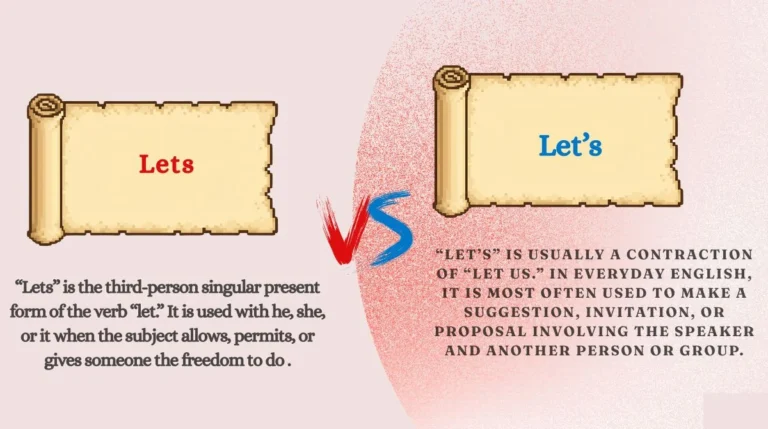
“Lets” is the third-person singular present form of the verb “let.” It is used with he, she, or it when the subject allows, permits, or gives someone the freedom to do something.
The base verb is let.
- I let
- You let
- We let
- They let
- He lets
- She lets
- It lets
Notice the important grammar point: let usually stays the same, but with he, she, and it, it becomes lets.
When Do We Use “Lets”?
Use lets when one person or thing gives another person permission or allows something to happen.
For example:
My father lets me drive his car.
Here, my father is the subject. Because “my father” is singular, we use lets.
The word can also describe something that makes an action possible or allows something to happen.
Grammar Rule for “Lets”
The basic structure is:
Subject + lets + person/object + base verb
Examples:
- She lets her children play outside.
- The teacher lets us use dictionaries.
- My boss lets me leave early.
- This app lets users save their work.
After lets, the next verb is normally in the base form.
We say:
She lets me go.
Not:
She lets me goes.
That second sentence is incorrect because lets already carries the third-person singular grammar. The verb after it stays in its base form.
Examples of “Lets”
- My mother lets me stay up late on weekends.
- Our teacher lets us ask questions during the lesson.
- This phone lets you take clear pictures at night.
- John lets his dog sleep on the sofa.
- The manager lets employees work from home on Fridays.
- Her parents let her choose her own clothes.
- This machine lets you control the temperature easily.
- My brother lets me use his computer when he is away.
Common Learner Confusion
The biggest problem is that learners often see lets and think it means “let us.” It does not.
Compare these sentences:
Sarah lets me use her laptop.
Here, lets means allows.
Now look at:
Let’s use Sarah’s laptop.
Here, let’s means let us, or more naturally, “I suggest that we use Sarah’s laptop.”
The apostrophe is not decoration. It shows that let’s is a contraction.
A useful question is:
Who is allowing something?
If the answer is he, she, or it, you may need lets.
What Does “Let’s” Mean?
“Let’s” is usually a contraction of “let us.” In everyday English, it is most often used to make a suggestion, invitation, or proposal involving the speaker and another person or group.
For example:
Let’s go for a walk.
This means:
Let us go for a walk.
In natural modern English, the sentence is usually understood as:
I suggest that we go for a walk.
When Do We Use “Let’s”?
We use let’s when we want to suggest that we do something together.
It is extremely common in spoken English.
You might say:
Let’s eat.
Let’s watch a movie.
Let’s finish this work.
Let’s call him tomorrow.
The word is friendly, simple, and very common.
It can be used with friends, family, classmates, coworkers, and in many other everyday situations.
Grammar Rule for “Let’s”
The normal structure is:
Let’s + base verb
Examples:
- Let’s go.
- Let’s eat.
- Let’s study.
- Let’s wait.
- Let’s start.
- Let’s talk.
Do not add to after let’s in this structure.
We say:
Let’s go home.
Not:
Let’s to go home.
We also do not change the main verb into the third-person singular form.
We say:
Let’s start.
Not:
Let’s starts.
Examples of “Let’s”
- Let’s go to the park after lunch.
- Let’s study together tonight.
- Let’s watch a movie before bed.
- Let’s ask the teacher for help.
- Let’s meet at the café at six.
- Let’s try this new restaurant.
- Let’s finish the project today.
- Let’s take a short break.
What About “Let’s” in Questions?
Let’s can also appear in questions, especially when asking about a suggestion or checking agreement.
For example:
Let’s go now, shall we?
This asks the listener to agree with the suggestion.
You may also hear forms such as:
Let’s not talk about that, okay?
Here, let’s not is used to suggest that we should avoid doing something.
Common Learner Confusion
Students sometimes forget the apostrophe and write:
Lets go!
This is one of the most common mistakes in informal writing.
The correct form is:
Let’s go!
The apostrophe tells the reader that let’s is the shortened form of let us.
Difference Between “Lets” and “Let’s” (Detailed)
The most important difference is grammatical.
Lets is a verb.
Let’s is usually a contraction.
They may sound alike, but they do different jobs in a sentence.
| Feature | Lets | Let’s |
|---|---|---|
| Apostrophe | No | Yes |
| Full form | — | Let us |
| Grammar | Present simple verb | Contraction |
| Common subject | He, she, it | We |
| Main meaning | Allows or permits | Makes a suggestion |
| Example | She lets me drive. | Let’s drive. |
| Can it mean “allows”? | Yes | No |
| Common in suggestions | No | Yes |
Usage Difference
Look at these two sentences:
My father lets me use his car.
Let’s use the car.
The first sentence tells us that my father allows me to use the car.
The second sentence is a suggestion. The speaker is saying that we should use the car.
One small apostrophe changes the role of the word.
Grammar Logic
With lets, there is normally a third-person singular subject:
He lets me borrow his book.
She lets her son play outside.
The website lets users create an account.
The subject performs the action of allowing.
With let’s, the speaker is including themselves in the action:
Let’s play outside.
This means:
Let us play outside.
The suggestion includes the speaker and at least one other person.
Sentence Structure Difference
The structures are also different.
“Lets”
Subject + lets + object + base verb
Example:
The teacher lets us leave early.
“Let’s”
Let’s + base verb
Example:
Let’s leave early.
That simple structure is worth remembering because it helps you choose the correct form quickly.
Meaning Comparison
Consider this pair:
The coach lets us practice after school.
Meaning: The coach allows us to practice.
Let’s practice after school.
Meaning: I suggest that we practice after school.
The first sentence is about permission.
The second is about suggestion.
That is the heart of the difference.
Grammar Rules You Must Remember
Rule 1: Use “let’s” for suggestions
When you suggest doing something together, use let’s.
Let’s go home.
Let’s order pizza.
Let’s talk about the problem.
Think of let’s as a friendly way to say, “I suggest we do this.”
Rule 2: Use “lets” after he, she, or it
When the subject is singular in the third person, use lets.
She lets me use her phone.
He lets his children watch TV.
The software lets you edit the file.
There is no apostrophe because this is the normal verb form.
Rule 3: Use the base verb after “lets” and “let’s”
Both forms are followed by the base form of a verb in these common structures.
Correct:
She lets me go.
Let’s go.
Incorrect:
She lets me goes.
Let’s goes.
The word go remains in its base form.
Rule 4: “Let’s” can become “let us”
One of the easiest grammar tests is to replace let’s with let us.
Let’s leave now.
becomes:
Let us leave now.
The meaning still works.
But this test does not work in:
She lets me leave.
You cannot replace lets with let us there.
This is a fast way to check your writing.
Common Mistakes Students Make
Many learners make these mistakes because English contractions are easy to overlook. The apostrophe is small, especially when people type quickly on a phone.
Mistake 1: Writing “lets” for a suggestion
❌ Lets go to the beach.
✅ Let’s go to the beach.
Why? Because this is a suggestion involving the speaker and another person.
Mistake 2: Writing “let’s” when you mean “allows”
❌ My teacher let’s us use calculators.
✅ My teacher lets us use calculators.
Here, the teacher is allowing the students to use calculators. The word is the verb lets, not the contraction let’s.
Mistake 3: Adding “to” after “let’s”
❌ Let’s to watch a movie.
✅ Let’s watch a movie.
After let’s, use the base form directly.
Mistake 4: Changing the verb after “lets”
❌ She lets me goes outside.
✅ She lets me go outside.
The first verb already has the needed grammar:
She lets me…
The next verb remains in the base form:
…go outside.
Mistake 5: Confusing “let’s” with “lets”
Read each sentence carefully:
David lets me borrow his notes.
David gives permission.
Let’s borrow some notes from David.
This is a suggestion.
A simple trick is to focus on the meaning, not just the spelling.
Easy Correction Tips
When you see lets, ask:
Does this mean “allows”?
If yes, lets is probably correct.
When you see let’s, ask:
Can I replace it with “let us”?
If yes, use let’s.
For example:
Let’s start.
→ Let us start.
It works, so let’s is correct.
Easy Trick to Remember the Difference
Here is a very simple memory trick:
Let’s = Let us
The apostrophe replaces the missing letter and reminds you that two words have been joined.
Let us → Let’s
Whenever you are making a suggestion, think:
Let’s = Let us = We should
For example:
Let’s eat.
Think:
We should eat.
Now compare that with lets.
Lets = Allows
Think:
She lets me go.
You can replace lets with allows:
She allows me to go.
This is an excellent test because the meanings are very different.
So remember:
LET’S = LET US
LETS = ALLOWS
That one idea can solve most questions instantly.
A Real-Life Logic Trick
Imagine two people standing outside a restaurant.
One person says:
Let’s eat here.
They are making a suggestion.
Now imagine a restaurant manager talking about a rule:
The restaurant lets customers bring their own cake.
That sentence is about permission.
One person is suggesting something in the first sentence. Someone is allowing something in the second.
Daily Life Examples (Very Important)
These examples show how both forms appear in natural, everyday English.
Example 1
Ali: I’m hungry.
Sara: Let’s get something to eat.
Here, Sara suggests that they eat together.
Example 2
Tom: Can I use your charger?
Mike: Sure. My brother lets me use his charger too.
Here, lets means allows.
Example 3
Teacher: We have ten minutes left.
Student: Let’s finish the exercise.
The student is making a suggestion.
Example 4
Emma: Can your parents stay awake until midnight?
Jack: Yes, my mother lets me stay up late on weekends.
Here, lets means gives permission.
Example 5
A: We need to clean the room.
B: Okay. Let’s do it now.
The speaker suggests a shared action.
Example 6
My manager lets me work from home on Fridays.
The manager gives permission.
Example 7
Let’s call John before we leave.
This means:
I suggest that we call John.
Example 8
This website lets you change your password online.
The website allows users to do something.
Example 9
Let’s not argue about it.
This is a suggestion to stop or avoid an argument.
Example 10
Her father lets her choose her own subjects at school.
Her father gives her permission to make that choice.
These examples show a useful pattern. Let’s usually points toward an action that the speaker wants to do together with someone else. Lets usually tells us that a person or thing gives permission or allows an action.
Practice Section
Choose the correct option in each sentence: lets or let’s.
1. ______ go for a walk after dinner.
Answer: Let’s
This is a suggestion.
2. My teacher ______ us use our phones for the activity.
Answer: lets
The teacher allows the students to use their phones.
3. ______ start the meeting at nine.
Answer: Let’s
The speaker is making a suggestion.
4. This program ______ you save your work automatically.
Answer: lets
The program allows you to save your work.
5. ______ ask Dad before we leave.
Answer: Let’s
The speaker suggests asking Dad.
Quick Challenge
Try making two sentences of your own:
- One sentence using lets to mean “allows.”
- One sentence using let’s to make a suggestion.
For example:
My teacher lets us ask questions.
Let’s ask another question.
Creating your own examples is one of the best ways to remember the difference.
FAQs
What is the difference between “lets” and “let’s”?
Lets is the present simple form of let used with he, she, or it. It usually means “allows.”
Let’s is usually a contraction of let us. It is commonly used to make a suggestion.
Can we use “let’s” in questions?
Yes. Let’s can appear in questions when a speaker is checking a suggestion or asking for agreement.
For example:
Let’s go now, shall we?
It can also appear in negative suggestions such as:
Let’s not worry about it.
Is “let’s” formal or informal?
Let’s is common in both everyday and professional English. It is natural in conversations, meetings, emails, presentations, and many other situations.
For more formal writing, you may sometimes choose a different structure, but let’s itself is not incorrect or overly informal.
Does “lets” always mean “allows”?
In many common sentences, yes. It is the third-person singular form of let, so it often means allows or permits.
For example:
The app lets users change their settings.
Here, the app allows users to change them.
Why does “let’s” have an apostrophe?
The apostrophe shows that let’s is a contraction of let us.
The apostrophe replaces letters removed when the two words are shortened.
Let us → Let’s
That is why the apostrophe matters.
How can I quickly remember which one to use?
Use this simple test:
Let’s = Let us
Lets = Allows
So:
Let’s go.
means:
Let us go.
And:
She lets me go.
means:
She allows me to go.
This test works for most everyday examples.
Conclusion
The difference between lets and let’s is small in spelling but important in meaning and grammar. Once you understand the two basic ideas, the choice becomes much easier.
Use lets when you are talking about he, she, or it allowing something:
She lets me borrow her book.
Use let’s when you are making a suggestion involving yourself and another person:
Let’s study together.
The easiest memory trick is:
Lets = allows
Let’s = let us
Whenever you see an apostrophe, ask whether you can expand the word to “let us.” If you can, let’s is the right choice.
Do not worry if you have made this mistake before. Many English learners confuse these forms because they sound alike. Pay attention to the meaning, practice with short sentences, and the difference will soon become automatic. A tiny apostrophe can change a sentence, but it does not have to be difficult to understand.

Evan Rellmont is a writer who turns thoughtful ideas into meaningful words, creating stories and reflections that connect, inspire, and leave a lasting impression.