
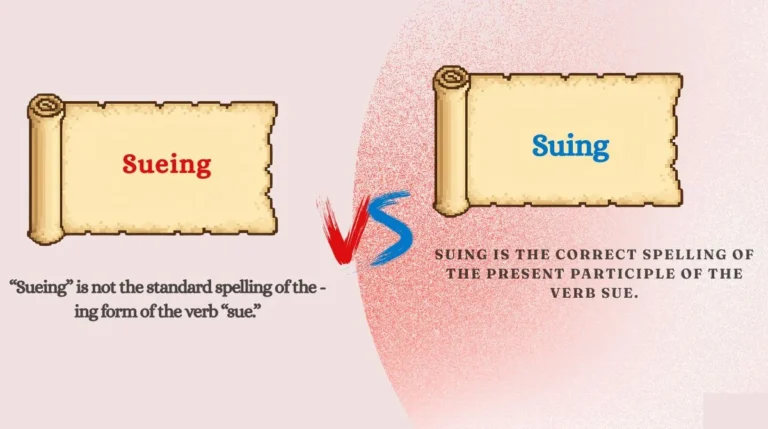
Have you ever looked at a word and thought, “That spelling looks right,” only to find out that it is wrong? Sueing vs suing is a good example of this problem.
Many English learners write sueing because the base verb is sue, and they simply add -ing to the end.
It seems logical, but English spelling does not always work by adding letters in the most obvious way.
The correct spelling is suing, not sueing.
The word comes from the verb sue, which means to take legal action against a person or organization. When we make its present participle or -ing form, we write suing.
Oxford lists suing as the -ing form of sue, and Cambridge also gives suing as the present participle.
This small spelling difference matters because suing can appear in newspapers, legal news, business writing, emails, and everyday conversations. You may hear sentences such as “She is suing the company” or “They are suing for damages.”
By the end of this guide, you will know exactly why suing is correct, why sueing is incorrect, how to use sue in sentences, and how to avoid making this spelling mistake again.
What Does “Sueing” Mean?
The first thing to remember is simple:
“Sueing” is not the standard spelling of the -ing form of the verb “sue.”
In standard English, sueing is considered a misspelling when you mean the action of taking legal action. The correct form is suing. Major learner dictionaries list suing as the present participle of sue.
Why do people write sueing?
The mistake usually happens because learners know a basic spelling pattern:
verb + ing = -ing form
For many verbs, that works:
- play → playing
- work → working
- read → reading
- help → helping
So a learner may look at sue and think:
sue + ing = sueing
That looks reasonable at first. However, the spelling of the base verb changes here. The final e in sue is not kept when -ing is added.
So we get:
sue → suing
not:
sue → sueing
When should you use “sueing”?
You generally should not use sueing in standard English when you are trying to form the -ing form of sue.
For example:
Incorrect: The customer is sueing the company.
Correct: The customer is suing the company.
Incorrect: They are sueing for damages.
Correct: They are suing for damages.
Incorrect: She is sueing her former employer.
Correct: She is suing her former employer.
Why does “sueing” look confusing?
The main problem is the unusual ending of the word sue. It already ends with the letter e, but that does not mean the e stays before -ing.
English has several spelling patterns that do not look exactly like simple addition. That is why it helps to learn the actual word form rather than trying to create it from memory each time.
Think of sueing as a spelling that follows a false pattern. It may look logical, but it is not the accepted spelling of the word.
Examples to understand the mistake
Here are several examples showing the correct form:
- The company is suing the supplier for damages.
- She is suing the newspaper for libel.
- The family is suing the hospital.
- They are suing for compensation.
- He is suing his former business partner.
- The athlete is suing the organization.
- The customer threatened to start suing the company.
- She is considering suing after the accident.
These examples use suing, never sueing.
Common learner confusion
There is another reason learners sometimes hesitate: the spelling does not seem to match the pronunciation perfectly.
The verb sue is pronounced /suː/. Oxford gives its -ing form as suing, pronounced /ˈsuːɪŋ/.
So even though you can hear the sounds clearly, the spelling may still feel unusual.
The best approach is to remember this pair:
sue → suing
Once this pair becomes familiar, the problem becomes much easier.
What Does “Suing” Mean?
Suing is the correct spelling of the present participle of the verb sue.
To sue someone means to take legal action against that person or organization, usually by making a legal claim in court. Cambridge defines sue as taking legal action against a person or organization, especially by making a legal claim for money because of harm caused.
The word suing means that this legal action is happening or is being described as an ongoing activity.
For example:
She is suing the company.
This means she is taking legal action against the company.
When do we use “suing”?
We usually use suing when the action is connected to a continuous or ongoing situation.
A common structure is:
subject + be + suing + person/organization + for + reason
Examples include:
- She is suing the company for damages.
- He is suing the newspaper for libel.
- They are suing the manufacturer for negligence.
- The customer is suing the airline for compensation.
Cambridge and Oxford both give examples and patterns such as sue somebody for something, including suing for damages, compensation, or other legal claims.
The grammar behind “suing”
Suing is the present participle of sue.
It can be used with forms of be to make continuous tenses:
am suing
is suing
are suing
For example:
- I am suing the company.
- She is suing the landlord.
- They are suing the manufacturer.
You can also see it after other verbs or expressions:
- He considered suing the business.
- She talked about suing them.
- They threatened to sue, but later decided against suing.
Examples with “suing”
- She is suing the company for damages.
- The customer is suing the airline.
- They are suing the builder over the poor work.
- He is suing his former employer.
- The family is suing the hospital.
- The writer is suing the newspaper for libel.
- The workers are suing for compensation.
- She is thinking about suing the manufacturer.
Notice that suing can describe an action that is taking place now or a legal action under discussion.
A useful point about the word “sue”
The verb can be transitive or intransitive.
We can say:
They sued the company.
Here, the company is the object.
We can also say:
They sued for damages.
Here, the focus is on what they were legally seeking.
Oxford notes both uses, including patterns such as sue somebody for something and the more formal sue for something.
There is also a formal use in expressions such as sue for divorce or sue for peace.
Difference Between Sueing and Suing
The main difference is very simple: suing is correct, while sueing is incorrect as the standard -ing form of sue.
| Word | Correct? | Meaning | Use |
|---|---|---|---|
| sueing | ❌ No | Intended to mean “taking legal action” | Avoid in standard English |
| suing | ✅ Yes | Taking legal action against someone | Correct -ing form of sue |
Usage difference
There is no real meaning difference between the two spellings. The problem is not that they describe two different actions.
Instead, one is the accepted spelling and the other is a spelling error.
Think of it like this:
sue = base verb
suing = -ing form
So:
- sue → suing
- sued → past form
- sues → third-person singular present
Oxford lists the forms as sue, sues, sued, sued, suing.
Grammar logic
The important grammar point is that sue does not become sueing when -ing is added.
The spelling changes to:
sue + ing → suing
You should learn the complete form as a vocabulary pair rather than trying to spell it by simply placing -ing after every letter of the base word.
Compare:
- sue → suing
- see → seeing
- agree → agreeing
This can help you notice that verbs ending in -ee and the verb sue do not always follow the same visual pattern as words such as make → making.
Sentence structure difference
Because sueing is a misspelling, normal English sentence structures use suing:
Correct: She is suing her employer.
Structure:
She + is + suing + her employer.
Another example:
They are suing the company for damages.
Structure:
They + are + suing + the company + for damages.
The spelling change does not change the grammar. It simply gives us the correct form of the verb.
Meaning comparison
Both sueing and suing may be intended by a writer to mean legal action, but only suing is the standard spelling.
So remember:
There is no special meaning of “sueing.” It is simply a misspelling of “suing.”
Grammar Rules You Must Remember
Rule 1: The correct -ing form is “suing”
When you need the continuous form of sue, write suing.
Correct: The company is suing the supplier.
Incorrect: The company is sueing the supplier.
Oxford and Cambridge both list suing as the present participle of sue.
Rule 2: Do not keep the “e” before “-ing” in “sue”
Many learners make the mistake of writing every letter from the base verb and then adding -ing.
That creates:
sue + ing = sueing
But the accepted form is:
sue → suing
The final e is not written in the -ing form.
Rule 3: Use “am,” “is,” or “are” before “suing” in continuous sentences
When describing an ongoing legal action, a common pattern is:
am/is/are + suing
Examples:
- I am suing the company.
- She is suing the landlord.
- They are suing the manufacturer.
This is the present continuous structure.
Rule 4: “Suing” can be followed by a person, organization, or legal purpose
Common patterns include:
suing someone
He is suing the company.
suing someone for something
She is suing the company for damages.
suing for something
They are suing for compensation.
These patterns are consistent with the dictionary usage of sue.
Common Mistakes Students Make
Spelling mistakes like this usually happen because English learners try to follow a simple rule too strictly.
Mistake 1: Adding “-ing” without changing the spelling
Wrong: He is sueing the bank.
Correct: He is suing the bank.
The learner knows that -ing makes a continuous form but does not know that the spelling of the base verb changes.
Mistake 2: Thinking “sueing” is related to “seeing”
Some learners notice:
see → seeing
and assume:
sue → sueing
But English spelling does not always work by making visually similar words behave in exactly the same way.
See becomes seeing, while sue becomes suing.
Mistake 3: Writing the wrong word in formal situations
This spelling error can look especially noticeable in business or legal writing.
Imagine writing:
Our client is sueing the company.
A reader may understand the meaning immediately, but the spelling is still incorrect.
The better version is:
Our client is suing the company.
Mistake 4: Forgetting the difference between “sue” and “suing”
Some students write suing correctly but then use it where the base form sue is needed.
For example:
Correct: We may sue the company.
Not:
Incorrect: We may suing the company.
After may, we need the base verb.
The same is true with:
- can sue
- will sue
- might sue
- should sue
But after is/are/am, we can use suing:
- is suing
- are suing
- am suing
Easy correction tip
When you see -ing, stop and ask:
“What is the base verb?”
If the base verb is sue, remember its special -ing form:
sue → suing
That quick check can prevent the mistake.
Easy Trick to Remember the Difference
Here is a simple memory trick:
SUE loses E before ING.
Think:
SUE − E + ING = SUING
You can picture the word SUE dropping its final E before -ing joins it.
So:
❌ SUE + ING = SUEING
✅ SUE − E + ING = SUING
Another trick is to memorize the pair as a fixed word family:
sue – sued – suing
Say it aloud:
sue, sued, suing
This helps because you are not trying to build the word from scratch every time.
Real-life logic
Imagine reading a news headline:
“Company Is Suing Former Partner”
The word suing looks familiar because news reports often discuss legal disputes.
Whenever you see an ongoing legal action, think:
suing
Not sueing.
You can also connect it with the pronunciation:
sue sounds like “soo.”
suing sounds like “SOO-ing.”
The spelling may seem unusual at first, but the correct form becomes easy after a little practice.
Daily Life Examples
You do not need to be a lawyer to understand or use this word. It may appear in news stories, social media posts, workplace conversations, and everyday discussions.
Example 1
A: Why is the company in the news?
B: A customer is suing it for damages.
Example 2
A: Did they solve the problem?
B: No. The customer is thinking about suing.
Example 3
A: What happened to the newspaper?
B: The actor is suing the paper for libel.
Example 4
A: Are they going to take legal action?
B: Yes, they are suing the manufacturer.
Example 5
A: Why did she hire a lawyer?
B: She is suing her former employer.
Example 6
A: Can a customer sue a company?
B: Yes, depending on the situation, they may have grounds to sue.
Example 7
A: What are they doing now?
B: They are suing the landlord over the dispute.
Example 8
A: Is the family taking the hospital to court?
B: Yes, they are suing the hospital.
Example 9
A: Why is the athlete angry?
B: He is suing the organization for damages.
Example 10
A: Did she decide to take legal action?
B: Yes. She is now suing the company.
Notice how natural suing sounds once you get used to it. It can be used in both simple conversations and more formal writing.
Practice Section
Choose the correct word: sueing or suing.
1. She is ______ the company for damages.
a) sueing
b) suing
2. The customer threatened to start ______ the manufacturer.
a) sueing
b) suing
3. They are ______ their former landlord.
a) sueing
b) suing
4. The newspaper is being accused, and the actor may be ______.
a) sueing
b) suing
5. He is thinking about ______ for compensation.
a) sueing
b) suing
Answers
- b) suing
- b) suing
- b) suing
- b) suing
- b) suing
Every answer is suing because that is the correct present participle of sue.
FAQs
1. What is the difference between sueing and suing?
Suing is the correct spelling. Sueing is a misspelling of the -ing form of sue. The verb sue means to take legal action against someone or an organization, and its present participle is suing.
2. Is sueing a correct word?
No, not when you mean the -ing form of sue. Standard English uses suing instead. Dictionaries such as Oxford and Cambridge list suing as the correct present participle.
3. Why is it suing and not sueing?
The final e in sue is not retained when the word takes the -ing ending. The accepted spelling is suing. A useful way to remember it is: sue − e + ing = suing.
4. Can we use “suing” in questions?
Yes. Suing can be used in questions with forms of be.
For example:
Is she suing the company?
Are they suing for damages?
Why is he suing his former employer?
5. Is “suing” formal or informal?
Suing is a normal English word. The verb sue is common in legal, business, news, and everyday contexts. Oxford and Cambridge both list it as a standard verb.
6. What are the main forms of the verb “sue”?
The main forms are:
sue → sues → sued → sued → suing
For example:
- I sue the company.
- She sues the company.
- They sued the company.
- The company was sued.
- She is suing the company.
Oxford lists these verb forms directly.
Conclusion
The difference between sueing vs suing is not a difference in meaning. It is a spelling issue.
The correct word is suing.
Sue is a verb that means to take legal action against a person or organization. Its present participle is suing, not sueing. Both Oxford and Cambridge dictionaries confirm suing as the correct -ing form.
The easiest way to remember this is:
sue − e + ing = suing
So when you need the continuous form, write:
She is suing the company.
Not:
She is sueing the company.
Do not worry if this spelling felt strange at first. Many English learners make the same mistake because sueing looks like the natural result of adding -ing. With a little practice, sue → suing will become automatic.
Whenever you see this verb in a sentence, remember one small rule: drop the final “e,” then add “-ing.” That is all you need to get this spelling right.

Evan Rellmont is a writer who turns thoughtful ideas into meaningful words, creating stories and reflections that connect, inspire, and leave a lasting impression.