
Choosing between busses or buses can be surprisingly confusing, especially for English learners. Both spellings look reasonable, and both have appeared in dictionaries.
The problem becomes even more confusing because English often doubles a final consonant before adding an ending.
For example, we write running, stopped, and bigger. So, when learners see the word bus, they may naturally think that its plural should be busses.
However, modern English usually uses buses when talking about more than one vehicle.
Major dictionaries such as Oxford and Cambridge list buses as the normal plural, while also recognizing busses as a variant, particularly in American English.
Merriam-Webster also explains that busses exists but has become rare.
This small spelling difference matters because bus is one of the most common transportation words in everyday English. You may talk about school buses, city buses, airport buses, or buses that take people to work.
By the end of this guide, you will know exactly when to use buses, why busses sometimes appears, which form is best for normal writing, and how the related verb forms such as bused, bussed, busing, and bussing work.
What Does “Busses” Mean?
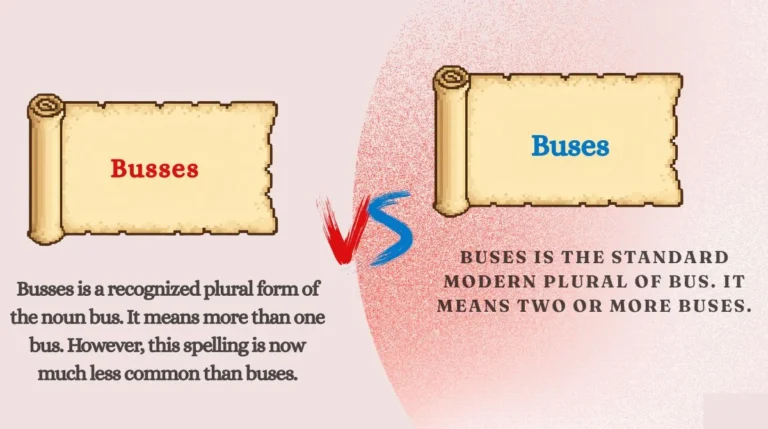
Busses is a recognized plural form of the noun bus. It means more than one bus. However, this spelling is now much less common than buses.
Oxford lists the plural as buses, while noting that busses is also used in US English. Cambridge gives a similar explanation: buses is the regular plural, with busses also accepted in American English.
Merriam-Webster goes a little further and explains that busses has become so rare that many modern readers may think it is simply a spelling mistake. Historically, however, it was not always considered wrong. In fact, Merriam-Webster says that busses was once the preferred plural in its dictionaries before buses became the dominant form.
When Should You Use “Busses”?
You may find busses in older writing, certain American sources, or dictionaries that list alternative forms. It is grammatically understandable because it refers to more than one bus.
For ordinary modern English, though, there is little reason for a learner to choose busses. Buses is far more natural and is the spelling readers are most likely to expect.
For example:
- The school has five busses for students.
- Several busses were waiting outside the station.
- The city added new busses to the transportation system.
- We saw three busses near the airport.
- The company owns twenty busses.
- The old busses were replaced last year.
- Many busses were delayed because of heavy traffic.
- The busses arrived one after another.
All of these sentences can be understood, and busses can be found as a plural variant. But in present-day standard writing, buses is generally the better choice.
A Common Learner Confusion
The biggest problem is that learners often apply a spelling pattern that works with many other words.
Consider:
- class → classes
- glass → glasses
- kiss → kisses
- dress → dresses
Because bus ends in s, it feels natural to add another s before -es and write busses.
There is nothing strange about thinking this way. English spelling simply does not follow one perfect rule for every word. In the case of bus, buses became the standard modern spelling even though busses remains a recognized variant.
So, if you are writing an essay, website article, school assignment, email, or formal document, buses is usually the safest choice.
What Does “Buses” Mean?
Buses is the standard modern plural of bus. It means two or more buses.
A bus is a large road vehicle that carries passengers, usually along a route with regular stops. Oxford, Cambridge, and Merriam-Webster all list buses as the normal plural form.
When Should You Use “Buses”?
Use buses whenever you are talking about more than one vehicle called a bus.
For example:
- The buses are full of students.
- Two buses stopped at the station.
- The city needs more buses.
- Several buses were late this morning.
- The school bought new buses.
- We waited for the buses outside the hotel.
- The airport has free shuttle buses.
- Electric buses are becoming more common in many cities.
Notice that the meaning is simple: one bus, two or more buses.
The Basic Grammar Rule
The noun bus is a countable noun. That means you can count individual buses:
- one bus
- two buses
- three buses
- many buses
- several buses
For a regular plural, we add -es:
bus + es = buses
The plural ending is pronounced /ɪz/, so buses sounds approximately like “BUS-iz.”
This is similar to words such as:
- box → boxes
- watch → watches
- class → classes
- dish → dishes
There is one useful point to remember here: the spelling of buses has only one s before -es, but the final sound is still pronounced clearly.
Why “Buses” Is the Best Choice for Most Learners
If you are learning English today, buses should be your default spelling.
It is the form given first by Oxford and Cambridge, and Merriam-Webster says it is the overwhelmingly preferred modern plural.
That means you do not need to worry every time you write about more than one bus. Simply remember:
bus → buses
Difference Between Busses and Buses
The good news is that these two words are not completely different in meaning.
When they are being used as plural nouns, both busses and buses can mean more than one bus. The main difference is frequency and modern usage.
| Point | Busses | Buses |
|---|---|---|
| Basic meaning | More than one bus | More than one bus |
| Grammar | Plural noun | Plural noun |
| Modern frequency | Rare | Very common |
| Dictionary status | Recognized variant | Standard/common form |
| Best choice for learners | Usually avoid | Recommended |
| Formal writing | Less natural | Preferred |
| US usage | Found as a variant | Very common |
| UK usage | Uncommon | Normal choice |
1. Usage Difference
The biggest difference is how frequently the two forms are used.
Buses is the normal spelling in everyday modern English. Busses is much less common. Merriam-Webster specifically notes that busses is now rare enough that many readers may mistake it for an error.
So compare:
There were five buses outside the school.
This sounds completely natural.
There were five busses outside the school.
This is understandable, and dictionaries recognize it, but many modern readers would find it unusual.
2. Grammar Logic
Both forms can serve as the plural of the noun bus.
The important point is that you should not think:
“Busses is always wrong.”
That is too simple.
It is better to think:
“Busses exists, but buses is the normal modern spelling.”
This distinction is important because English has many words with alternative historical or regional forms.
3. Sentence Structure
There is no special sentence structure for busses versus buses.
Both can appear after numbers:
- four buses
- four busses
Both can be used after quantifiers:
- many buses
- many busses
- several buses
- several busses
Both can follow determiners:
- the buses
- the busses
- these buses
- these busses
The difference is not grammar structure. The difference is which spelling is standard and natural today.
4. Meaning Comparison
As plural nouns referring to vehicles, they have essentially the same meaning.
Buses: the normal modern plural.
Busses: an accepted but uncommon variant plural.
This is why changing busses to buses usually does not change the meaning of a sentence. It simply changes the spelling to the form most readers expect.
Grammar Rules You Must Remember
Rule 1: Use “Buses” as the Normal Plural of “Bus”
For modern English, the safest rule is:
bus → buses
Example:
There are six buses at the station.
This is the spelling you should normally use in schoolwork, professional writing, websites, exams, and everyday communication.
Rule 2: “Busses” Is a Variant, Not a Completely Wrong Word
Do not assume that every appearance of busses is automatically an error.
Major dictionaries recognize it as an alternative plural, especially in American English. However, it is much less common than buses.
Example:
Older books may use busses for the plural of bus.
Rule 3: Do Not Confuse “Busses” With the Verb “Buss”
English also has a different word, buss, which can mean to kiss. Its third-person singular form is busses.
For example:
He busses his wife on the cheek.
This sentence does not mean “he uses buses.” Here, busses comes from the verb buss.
Modern dictionaries distinguish this verb from bus, the transportation word.
That is another reason the spelling busses can create confusion.
Rule 4: Learn the Verb Forms Separately
The verb bus means to transport someone by bus. It can also have a restaurant-related meaning, such as removing dirty dishes from tables.
Its forms can appear as:
- bus
- buses
- bused
- busing
Alternative forms such as busses, bussed, and bussing are also recognized. Oxford and Merriam-Webster list these variants.
For example:
The school buses students to the sports center.
Here, buses is a verb, not a plural noun.
That sentence can be confusing because buses can be either a noun or a verb depending on context.
Common Mistakes Students Make
English learners often make this mistake because the spelling busses seems logical. The final s in bus makes students expect a doubled consonant.
Mistake 1: Automatically Choosing “Busses”
Wrong for normal modern usage:
There are ten busses outside.
Better:
There are ten buses outside.
The first sentence is not impossible, but buses is the standard choice for most situations.
Mistake 2: Thinking “Buses” Is Missing an S
Some learners look at buses and think it should contain two s letters:
bus + es = busses
But English does not always follow the spelling pattern learners expect. Modern dictionaries give buses as the regular plural.
Think of the word as a complete spelling:
BUS → BUSES
Do not try to redesign the word each time.
Mistake 3: Confusing the Noun and Verb
Consider:
The buses are waiting outside.
Here, buses is a plural noun.
Now consider:
The company buses employees to the factory.
Here, buses is a verb.
The spelling is exactly the same, but the grammar is different.
A simple test is to ask:
“Am I talking about vehicles?”
If yes, buses may be a plural noun.
If the word tells you what someone or something does, it may be the verb buses.
Mistake 4: Assuming Every Double-S Form Is More Correct
English has words such as classes, glasses, and kisses, so students may think double s is always necessary after a word ending in s.
But spelling does not work through one universal rule. Vocabulary history, pronunciation, and established usage all influence modern English spelling.
With bus, the form that has become dominant is buses. Merriam-Webster notes that buses overtook busses in frequency and is now overwhelmingly preferred.
Easy Correction Tip
Whenever you mean more than one vehicle, remember:
One bus, two buses.
This single sentence will prevent most spelling mistakes.
Easy Trick to Remember the Difference
Here is an easy memory trick for beginners:
One bus → many buses
Imagine a bus stop with one vehicle:
BUS
Now imagine several vehicles arriving:
BUSES
The spelling changes by adding -es without doubling the final s.
You can also remember it with this little rhythm:
One bus, two buses.
One bus, three buses.
Many buses on the road.
The important thing is not to spend too much time wondering whether the final s should be doubled.
You may see busses in dictionaries or older writing, so recognize it when you encounter it. But when you need to write the word yourself, choose buses.
There is another useful memory point:
Busses looks unusual because it can remind readers of the separate word “buss,” meaning a kiss.
Merriam-Webster notes that this separate word may also have influenced the confusion around the plural spelling.
So your practical rule is:
Use BUSES when you mean more than one bus.
Daily Life Examples
These examples show how the word appears in normal spoken and written English.
Example 1: At School
Student: How do you get to school?
Ali: I usually take one of the school buses.
Here, buses is a plural noun because there is more than one school bus available.
Example 2: At a Bus Station
Sara: Are the buses leaving from this gate?
Tom: Yes. The next one leaves in ten minutes.
The word refers to multiple vehicles that leave from the station.
Example 3: Talking About Traffic
There were so many buses on the road this morning.
This is a common way to talk about public transportation and busy roads.
Example 4: Airport Travel
The hotel has free shuttle buses for its guests.
Hotels often use shuttle buses to transport guests between the airport and the hotel.
Example 5: City Transport
The city is buying new electric buses.
Here, buses is again the plural noun.
Example 6: Asking for Directions
Man: Which buses go to the city center?
Woman: The number 4 and number 7 buses.
This is a very natural use in conversation.
Example 7: Late Transportation
The buses were late because of the heavy rain.
The plural noun is used because several buses were affected.
Example 8: A School Trip
Four buses carried the students to the museum.
The sentence describes several vehicles transporting a large group.
Example 9: Talking About a Bus Company
That company operates hundreds of buses every day.
The word refers to a large number of vehicles.
Example 10: Verb Use
The school buses students to the sports center on Fridays.
This example is different. Here, buses is a verb, meaning “takes students by bus.” Oxford and Merriam-Webster both recognize this verb use.
This is an important sentence because the same spelling can have a different grammatical job.
Practice Section
Choose the correct option in each sentence.
1. The school has six ______ for its students.
A. busses
B. buses
2. We saw several ______ near the train station.
A. buses
B. busses
3. The company ______ workers from the station every morning.
A. buses
B. busess
4. Many city ______ are crowded during rush hour.
A. buses
B. busses
5. The old ______ were replaced with electric vehicles.
A. buses
B. busses
Answers
1. Buses — This is the standard modern plural.
2. Buses — Use buses as the normal plural noun.
3. Buses — Here, buses is a verb meaning “transports by bus.”
4. Buses — This refers to more than one city bus.
5. Buses — This is the standard spelling in modern English.
Remember that busses can be found as an alternative plural form, so the main lesson is not that the word is completely nonexistent. The practical lesson is that buses is the spelling you should normally choose.
FAQs
1. What is the difference between busses and buses?
When used as plural nouns, both can refer to more than one bus. However, buses is the normal and much more common modern spelling, while busses is a recognized but uncommon variant.
2. Is “busses” grammatically correct?
Yes, busses can be a correct plural form of bus. Major dictionaries recognize it. However, it is uncommon today, so learners should normally use buses instead.
3. Is “buses” the correct spelling for more than one bus?
Yes. Buses is the standard modern plural form and is the best choice for most English writing. Oxford and Cambridge both list it as the primary plural form.
4. Why do some people write “busses”?
The spelling busses has a long history and was once used more widely. It remains a dictionary-recognized variant, particularly in American English. Today, however, it is much less common than buses.
5. Should I use “busses” or “buses” in formal writing?
Use buses. It is the more common modern spelling and will look natural to readers in school, business, academic, and general writing.
6. Is “buses” also a verb?
Yes. Buses can be the third-person singular form of the verb bus. For example: The company buses employees to work. The verb means to transport people by bus.
7. What is the past tense of “bus”?
The past tense can be bused or bussed. Oxford lists both forms, and Merriam-Webster does the same. The choice can vary by style and region, but bused is a recognized form.
8. What should I remember as an English learner?
Keep the basic pattern simple:
one bus → two buses → many buses
You may see busses, but buses should be your normal choice when writing modern English.
Conclusion
The difference between busses or buses is easier than it first appears. Both spellings can exist as plural forms of bus, but they are not equally common. Buses is the standard modern form and the spelling most learners should use in everyday, academic, and professional English. Busses is a recognized variant, but it is much less common and may look unusual to many readers.
The easiest rule is simply:
One bus → two buses.
Also remember that buses can sometimes be a verb, as in The school buses students to the museum. Context tells you whether the word is a noun or a verb.
You do not need to worry when you see the spelling busses in older or American writing. Just recognize it as an alternative form. When you are writing your own English, choose buses. That small habit will make your spelling more natural and help you avoid a very common learner mistake.

Evan Rellmont is a writer who turns thoughtful ideas into meaningful words, creating stories and reflections that connect, inspire, and leave a lasting impression.