
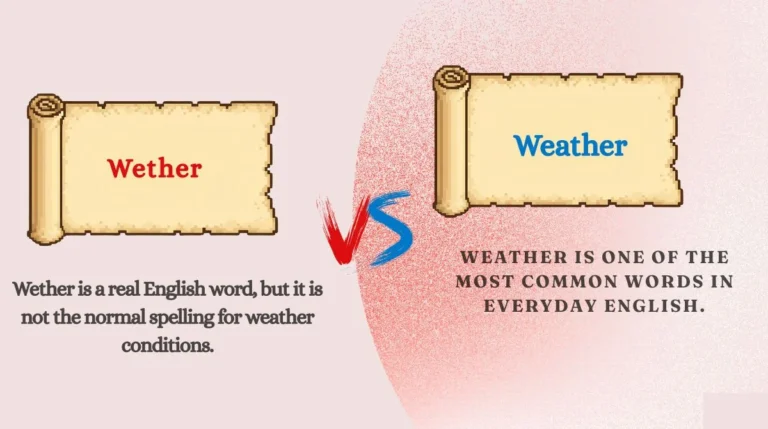
Have you ever typed “wether” when you meant “weather”? You are not alone.
English has many words that sound the same but have completely different spellings and meanings. Wether and weather are a good example.
They can sound almost identical when spoken, so it is easy to choose the wrong spelling when writing.
The confusion becomes even bigger because there is a third word, whether, which also sounds the same in many varieties of English.
These three words look similar, but they do very different jobs.
So, is it wether or weather? In most everyday situations, weather is the word you need when you are talking about rain, sunshine, heat, cold, wind, clouds, or other conditions outside.
Wether is a real English word too, but it has a very specific meaning related to animals. It usually means a castrated male sheep.
Knowing this difference is useful because these words often appear in everyday conversations, school writing, emails, news reports, and online messages.
By the end of this guide, you will know exactly when to use wether, when to use weather, and why whether can also cause confusion.
You will also learn simple grammar rules, common mistakes, examples, memory tricks, and practice questions that will help you remember the correct spelling.
What Does “Wether” Mean?
Wether is a real English word, but it is not the normal spelling for weather conditions.
A wether is a male sheep that has been castrated, meaning it has had its reproductive organs removed. Some dictionaries also record the word for a castrated male goat. It is mainly used in farming, agriculture, animal science, and sheep-related contexts.
This is an important point: wether is not a common everyday word for most English speakers.
If you are talking about sunshine, storms, temperature, rain, or snow, you almost certainly do not want wether. You want weather.
When Should You Use “Wether”?
Use wether when you are specifically talking about a castrated male sheep, or in a farming context where that term is needed.
For example:
- The farmer separated the wethers from the breeding sheep.
- The young wether was healthy and strong.
- The shepherd counted the ewes, lambs, and wethers.
- Several wethers were moved to another field.
- The farmer checked each wether before winter.
- A healthy wether can live with other sheep in the flock.
- The agricultural report included information about wether lambs.
- The shepherd identified the animal as a wether.
Cambridge Dictionary defines wether as a male sheep that has been castrated, while Merriam-Webster gives the same main meaning and also notes that the word can refer to a castrated male goat.
Grammar Rule for “Wether”
Wether is mainly used as a noun.
A noun names a person, place, thing, or animal. In this case, wether names a particular type of male sheep.
The plural form is usually wethers.
For example:
- One wether
- Two wethers
- A healthy wether
- Several wethers
You will rarely need this word unless you are discussing sheep, farming, agriculture, or related topics.
A Common Learner Problem
Many learners see the word wether and assume it is a misspelling of weather. Sometimes that is true, but not always.
For example:
The wether is cold today.
This is almost certainly wrong if the writer is describing the temperature.
The correct sentence is:
The weather is cold today.
But this sentence could be correct:
The farmer checked the wether before moving the flock.
Here, wether refers to the animal.
So, do not automatically think that wether is an incorrect word. It is a real word; it simply has a very different meaning.
What Does “Weather” Mean?
Weather is one of the most common words in everyday English.
It usually refers to the condition of the atmosphere at a particular time and place. This includes things such as temperature, rain, snow, sunshine, wind, clouds, and storms.
When you look outside and say, “It is raining,” you are talking about the weather.
When you check an app before leaving home, you are checking the weather.
When a flight is delayed because of a storm, the problem may be related to the weather.
Examples:
- The weather is beautiful today.
- We checked the weather before leaving.
- The rainy weather ruined our picnic.
- The weather has been very hot this week.
- Bad weather caused the flight to be delayed.
- What will the weather be like tomorrow?
- The cold weather made everyone stay indoors.
- Spring weather can change quickly.
When Should You Use “Weather”?
Use weather when you are talking about outdoor atmospheric conditions.
Think about these common topics:
Rain: The weather is rainy.
Sunshine: The weather is sunny.
Temperature: The weather is hot or cold.
Wind: The weather is windy.
Snow: The weather is snowy.
Storms: The weather is stormy.
You can also use weather in many everyday expressions.
For example:
What’s the weather like today?
We should check the weather before we travel.
The weather is getting worse.
The weather looks perfect for a walk.
Grammar Rule for “Weather”
Weather can be used as a noun and, in some contexts, as a verb.
As a noun, it refers to atmospheric conditions:
The weather is pleasant.
I don’t like cold weather.
As a verb, weather can mean to survive or endure something difficult. For example:
The company weathered the financial crisis.
You may also hear the expression “weather the storm.” It means to survive a difficult situation or period.
We have faced many problems, but we will weather the storm.
However, beginners will most often meet weather as a noun, especially when discussing conditions outside.
A Common Learner Problem
The biggest mistake is adding or removing the a after we.
Many learners write:
The wether is nice.
The correct spelling is:
The weather is nice.
The spelling contains “weath-”:
weather
A useful way to notice the spelling is to connect it with words such as:
- weather forecast
- weather report
- bad weather
- weather conditions
- cold weather
- hot weather
These expressions are extremely common in English.
Difference Between Wether and Weather
The two words look almost the same and sound the same in many accents, but their meanings are completely different.
| Word | Meaning | Part of Speech | Common Use | Example |
|---|---|---|---|---|
| wether | A castrated male sheep; sometimes a castrated male goat | Noun | Farming and animal contexts | The farmer examined the wether. |
| weather | Conditions in the atmosphere, such as rain, wind, heat, and snow | Noun; sometimes verb | Everyday English | The weather is warm today. |
The biggest difference is meaning.
Wether = an animal
Weather = conditions outside
That simple distinction can save you from many spelling mistakes.
Usage Difference
Imagine you are talking to a friend about tomorrow.
You might say:
What will the weather be like tomorrow?
You would not say:
What will the wether be like tomorrow?
That second sentence sounds strange because you are suddenly talking about a sheep.
Now imagine you are reading an agriculture report:
The farmer purchased several wethers.
Here, wether is correct because the sentence is about animals.
Grammar Logic
The two words also behave differently because they belong to different areas of meaning.
Weather is related to the natural world and atmospheric conditions.
Wether is related to livestock.
This gives you an easy mental division:
Weather → sky
Wether → sheep
Sentence Structure Difference
Because weather is often used as a general noun, you will see it in phrases such as:
The weather is cold.
The weather changed suddenly.
We are waiting for better weather.
The weather forecast says it will rain.
Wether, on the other hand, behaves like an ordinary countable animal noun:
A wether was standing near the gate.
The farmer bought two wethers.
Several wethers were moved to the new field.
This difference is useful because sentence meaning can usually tell you which spelling is needed.
Meaning Comparison
Consider these sentences:
The weather is terrible.
This means the outdoor conditions are terrible.
The wether is terrible.
This could technically mean the animal is terrible in some way, but it would be a very unusual sentence.
That is why weather is the natural choice in normal daily conversation.
What About “Whether”?
Although the main confusion is wether or weather, many learners are actually trying to choose between weather and whether.
These are different words too.
Whether is generally used to talk about choices, possibilities, doubts, or indirect questions. Merriam-Webster defines it as a conjunction used in situations such as “if it is true” and when presenting alternatives.
For example:
I don’t know whether he is coming.
We need to decide whether to stay or leave.
She asked whether I was ready.
I don’t know whether it will rain.
Notice the difference:
Weather = conditions outside
Whether = choice, possibility, or uncertainty
This creates a very useful three-word comparison:
Wether → sheep
Weather → sky
Whether → choice
All three are commonly treated as homophones because they are pronounced the same or nearly the same in many forms of English, which is one reason learners find them confusing.
Grammar Rules You Must Remember
Rule 1: Use “weather” for rain, sunshine, temperature, and storms
Whenever you are talking about the conditions outside, use weather.
Correct:
The weather is very hot today.
Incorrect:
The wether is very hot today.
Think about the sky and the air. That means weather.
Rule 2: Use “wether” only for a specific animal
A wether is a castrated male sheep and, in some dictionary definitions, a castrated male goat.
Correct:
The farmer sold three wethers.
Incorrect:
The wether forecast says it will rain.
The second sentence should use weather.
Rule 3: Use “whether” for alternatives and uncertainty
Use whether when you are discussing two possibilities, a choice, or an indirect question.
Correct:
I don’t know whether she will come.
Correct:
We need to decide whether to buy it.
A helpful pattern is:
whether + option A or option B
For example:
I can’t decide whether to go by bus or train.
Rule 4: Sound does not tell you the spelling
This is perhaps the most important rule.
You cannot always choose the correct spelling by listening because wether, weather, and whether may sound the same in normal speech.
That means you must use the meaning of the sentence.
Ask yourself:
“Am I talking about the sky?”
Use weather.
“Am I talking about a sheep?”
Use wether.
“Am I talking about a choice or possibility?”
Use whether.
This works much better than trying to hear the spelling in your head.
Common Mistakes Students Make
The reason these words cause so many mistakes is simple: English spelling does not always match pronunciation.
You may know exactly what you want to say, but once you start typing, you have to choose the right spelling.
Here are some common mistakes.
Mistake 1: Using “wether” for outdoor conditions
Wrong:
The wether is beautiful today.
Correct:
The weather is beautiful today.
Tip: Remember that weather has “hea” in it, just like many words connected with the outside world and atmospheric conditions.
Mistake 2: Writing “weather” when you mean “whether”
Wrong:
I don’t know weather he will come.
Correct:
I don’t know whether he will come.
Here, you are not talking about rain or sunshine. You are expressing uncertainty.
Mistake 3: Assuming “wether” is always wrong
Wrong idea:
Wether is never a real word.
Actually, wether is a real dictionary word. It refers mainly to a castrated male sheep and is used especially in farming or animal-related contexts.
So the spelling is not the problem. The meaning is what matters.
Mistake 4: Confusing “whether” with “weather” in questions
Look at these two sentences:
Will the weather be good tomorrow?
This asks about outdoor conditions.
Do you know whether the shop is open tomorrow?
This asks about a possibility or fact.
The words may sound similar, but the grammar makes the difference clear.
Easy Trick to Remember the Difference
Here is a very simple memory trick.
Wether = Wool
Think:
Wether → Wool → Sheep
A wether is a type of male sheep. Sheep give us wool, so connecting wether with wool can help you remember it.
Weather = What’s Outside?
Think:
Weather → What’s outside?
When you look outside, you might see:
- rain
- sunshine
- clouds
- snow
- wind
That is weather.
Whether = Which One?
Think:
Whether → Which possibility?
For example:
I don’t know whether to stay or leave.
There is a choice between two possibilities.
So remember:
Wether = sheep
Weather = sky
Whether = choice
This three-word trick is one of the easiest ways to keep the spellings apart.
Daily Life Examples
Here are some natural examples you might hear or use in real life.
Example 1: Checking the forecast
“Have you checked the weather?”
“Yes. It may rain this evening.”
Here, weather refers to atmospheric conditions.
Example 2: Planning a trip
“Should we go hiking tomorrow?”
“I’m not sure. Let’s check the weather first.”
Again, the word is weather.
Example 3: Talking about heat
“The weather is much hotter this week.”
This sentence is common in everyday conversation.
Example 4: Talking about rain
“Bad weather kept us at home all day.”
The word describes the conditions outside.
Example 5: Talking about a decision
“I don’t know whether I should call him.”
This is not about the sky. It is about uncertainty, so whether is correct.
Example 6: Giving two choices
“I can’t decide whether to take the train or the bus.”
The word whether introduces alternatives.
Example 7: Talking about farming
“The farmer separated the wethers from the breeding sheep.”
Here, wethers is correct because the sentence is about animals.
Example 8: Talking about tomorrow
“Do you know what the weather will be like tomorrow?”
This is a very common question.
Example 9: Talking about uncertainty
“She hasn’t decided whether she will join us.”
Again, whether expresses uncertainty.
Example 10: Talking about difficult conditions
“The team had to work in very cold weather.”
The word clearly refers to temperature and outdoor conditions.
Practice Section
Choose the correct word: wether, weather, or whether.
1. The ______ is perfect for a picnic today.
a) wether
b) weather
c) whether
2. I don’t know ______ he will attend the meeting.
a) wether
b) weather
c) whether
3. The farmer moved the ______ into another field.
a) wether
b) weather
c) whether
4. We should check the ______ before going to the beach.
a) wether
b) weather
c) whether
5. She is trying to decide ______ she should accept the job.
a) wether
b) weather
c) whether
Answers
1. weather — We are talking about conditions outside.
2. whether — The sentence expresses uncertainty about someone attending.
3. wether — The sentence is about a particular type of male sheep.
4. weather — We check weather before outdoor activities.
5. whether — The sentence involves a decision between possibilities.
A good learner does not just memorize the answers. Try to explain why each answer is correct. That will help the difference stay in your memory.
FAQs
What is the difference between wether and weather?
Wether is a noun for a castrated male sheep and can also refer to a castrated male goat in some dictionary definitions. Weather refers to atmospheric conditions such as rain, wind, snow, heat, and sunshine.
For everyday conversations about conditions outside, weather is almost always the word you need.
Is “wether” a real word?
Yes. Wether is a real English word, so it is not simply a spelling mistake. It is a specialized farming and animal term referring mainly to a castrated male sheep.
Most people encounter the word much less often than weather.
Can “wether” mean weather?
No. Wether and weather have different meanings.
If you are talking about rain, sunshine, temperature, storms, or wind, use weather. A wether refers to a particular animal.
What does “whether” mean?
Whether is used when talking about possibilities, alternatives, choices, or uncertainty.
For example:
I don’t know whether she is coming.
It is also common in structures such as whether…or….
Can “whether” be used in questions?
Yes. It commonly appears in indirect questions.
For example:
Do you know whether he is at home?
The sentence asks about a possibility, not about the weather outside.
Is weather a noun or a verb?
Weather is most commonly a noun when it refers to atmospheric conditions:
The weather is cold.
It can also be a verb meaning to survive, endure, or withstand something difficult:
The company weathered the crisis.
For beginners, the noun use is the one you will see most often.
Conclusion
The difference between wether and weather becomes much easier once you focus on meaning instead of sound.
Weather is the everyday word for conditions outside. It covers rain, sunshine, wind, snow, temperature, storms, and similar atmospheric conditions.
Wether is a much less common word. It mainly refers to a castrated male sheep and is mostly used in farming or animal-related situations.
There is also whether, which is used for choices, possibilities, and uncertainty. Because these words can sound alike, spelling mistakes are very common.
Just remember the simple trick:
Wether = sheep
Weather = sky
Whether = choice
Once you connect each spelling with its meaning, the confusion starts to disappear. The next time you write one of these words, stop for a second and ask yourself what you are actually talking about. That small habit can prevent a lot of common English mistakes.

Evan Rellmont is a writer who turns thoughtful ideas into meaningful words, creating stories and reflections that connect, inspire, and leave a lasting impression.