
Have you ever written a sentence like “What is the rational behind this decision?” and wondered whether rational was the right word? This is a very common mistake, especially for English learners.
The two words look almost the same, sound related, and come from the same word family. However, they do very different jobs in a sentence.
Rational is usually an adjective. It describes someone or something that is based on reason, logic, facts, or clear thinking.
We can talk about a rational person, a rational decision, or a rational explanation.
Dictionaries such as Oxford and Cambridge define it as being based on reason rather than emotion.
Rationale, on the other hand, is a noun. It means the reason, set of reasons, or explanation behind a decision, action, belief, or plan. It is especially common in formal, academic, business, and professional English.
The confusion becomes easier to understand when you remember one simple idea: rational describes the thinking or decision, while rationale names the reason behind it.
By the end of this guide, you will know exactly when to use each word, how to build sentences with them, which common mistakes to avoid, and how to remember the difference without memorizing complicated grammar rules.
What Does “Rational” Mean?
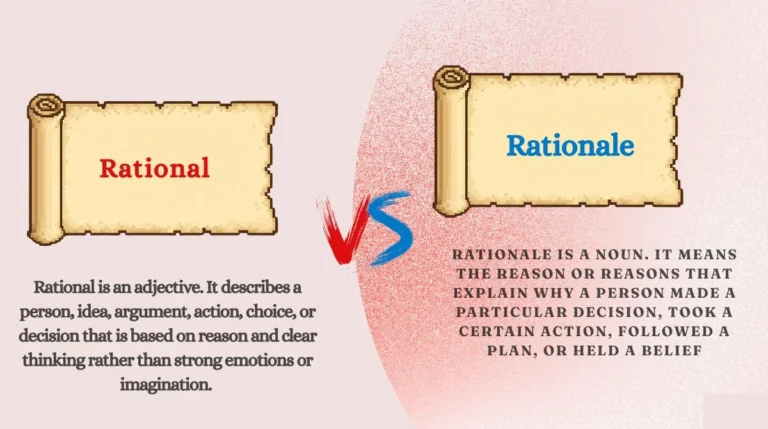
Rational is an adjective. It describes a person, idea, argument, action, choice, or decision that is based on reason and clear thinking rather than strong emotions or imagination. Oxford describes it as something based on reason rather than emotions, and it can also describe a person who is able to think clearly and make decisions reasonably.
In simple English, rational means sensible, logical, or reasonable.
For example, imagine that you need to buy a laptop. You compare the price, battery life, storage, and performance before choosing one. That is a rational decision because you are using facts and logic.
The word can describe both people and things.
You can say:
- a rational person
- a rational decision
- a rational argument
- a rational explanation
- rational behavior
- rational thinking
- a rational choice
When Should You Use “Rational”?
Use rational when you want to describe something as reasonable or logical.
A common sentence pattern is:
rational + noun
Examples include:
She made a rational decision.
His argument was rational and easy to understand.
We need a rational explanation for the problem.
You can also use rational after linking verbs such as be, seem, become, remain, or feel.
Try to be rational about the situation.
His explanation seems rational.
She remained rational during the discussion.
It can also describe a person directly:
He is a very rational person.
This means that he usually thinks clearly and makes decisions based on reason.
Grammar Rule for “Rational”
The most important grammar fact is this:
Rational is an adjective.
An adjective describes a noun or gives information about a person, thing, idea, or action.
So we say:
a rational decision
a rational student
a rational explanation
We do not normally use rational as the noun meaning “the reason behind something.”
For example:
❌ What is the rational for this change?
✅ What is the rationale for this change?
The first sentence uses an adjective where a noun is required. The second sentence uses the correct noun.
8 Examples of “Rational”
- We need to make a rational decision before spending the money.
- She gave a rational explanation for being late.
- Try to stay rational when you are angry.
- His choice was completely rational.
- A rational person considers the facts before making a decision.
- There must be a rational reason for the change.
- The manager gave a rational argument during the meeting.
- It is not always easy to remain rational when you are under pressure.
Common Learner Confusion with “Rational”
Many students know that rational is connected with “reason,” so they use it whenever they want to say reason.
That is where the mistake happens.
Compare these:
Her decision was rational.
Here, rational describes the decision.
What was the rationale for her decision?
Here, rationale means the reason or explanation behind the decision.
A useful question to ask yourself is:
Am I describing something as logical, or am I naming the reason?
If you are describing something, rational is usually the right choice.
What Does “Rationale” Mean?
Rationale is a noun. It means the reason or reasons that explain why a person made a particular decision, took a certain action, followed a plan, or held a belief. Cambridge calls it the reasons or intentions that cause a particular set of beliefs or actions, while Oxford describes it as the principles or reasons that explain a decision, course of action, or belief.
In simple English:
Rationale = the reason behind something.
It is close in meaning to words such as:
- reason
- basis
- explanation
- justification
However, rationale often sounds more formal than the everyday word reason. Cambridge labels it as formal, and the word is especially common in professional, academic, business, scientific, and official writing.
When Should You Use “Rationale”?
Use rationale when you want to talk about the reason or explanation behind a decision, action, policy, plan, or belief.
Common structures include:
the rationale for + noun
the rationale for the decision
the rationale for + -ing form
the rationale for changing the schedule
the rationale behind + noun
the rationale behind the new policy
the rationale of + noun
This is possible, although for and behind are often more natural in modern usage.
For example:
What is the rationale behind this rule?
The manager explained the rationale for the new system.
I understand the rationale for changing the deadline.
Grammar Rule for “Rationale”
The key grammar point is simple:
Rationale is a noun.
Because it is a noun, it can be used in places where a noun is needed.
For example:
I understand the rationale.
The rationale is unclear.
We discussed the rationale behind the policy.
It can also be used with articles:
a rationale
the rationale
And it can be modified by adjectives:
a clear rationale
a strong rationale
a logical rationale
a scientific rationale
The plural form is rationales. Merriam-Webster lists rationale as a noun meaning an underlying reason or an explanation of the principles behind something.
8 Examples of “Rationale”
- What is the rationale behind this new rule?
- The teacher explained the rationale for the change.
- I do not understand the rationale for closing the office early.
- The company provided a clear rationale for the decision.
- Scientists need to explain the rationale behind the study.
- The committee discussed the rationale for the proposed changes.
- Can you explain your rationale?
- There was a strong rationale for choosing the cheaper option.
Common Learner Confusion with “Rationale”
The biggest problem is pronunciation and spelling.
Learners sometimes see rationale and think it is simply a longer version of rational. It is not.
These words are related, but they are not interchangeable.
The plan is rational.
This says the plan is logical or reasonable.
The rationale for the plan is cost reduction.
This tells us the reason for the plan.
Also, remember that rationale often sounds more formal than reason. In casual conversation, people usually say:
Why did you do that?
or
What was the reason?
In a formal report, you may see:
What was the rationale behind the decision?
Both communicate a similar idea, but the second sounds more formal.
Difference Between Rational and Rationale
The easiest way to understand the difference is to focus on their grammatical jobs.
Rational describes.
Rationale names a reason.
Here is a clear comparison:
| Feature | Rational | Rationale |
|---|---|---|
| Part of speech | Adjective | Noun |
| Basic meaning | Based on reason or logic | Reason or explanation behind something |
| Main question | “What is it like?” | “Why was it done?” |
| Common use | Describes people, decisions, ideas, actions | Explains decisions, actions, plans, policies |
| Example | a rational decision | the rationale for the decision |
| Similar word | reasonable, logical | reason, basis, explanation |
| Style | Common in everyday and formal English | More formal and professional |
Usage Difference
Consider this pair:
The decision was rational.
The rationale for the decision was financial.
The first sentence tells us about the quality of the decision. It says the decision was logical.
The second sentence tells us why the decision was made. It gives the reason behind it.
Another pair makes the difference even clearer:
Sarah is rational.
Sarah explained her rationale.
In the first sentence, rational describes Sarah.
In the second sentence, rationale is the reason or explanation Sarah gave.
Grammar Logic
Think of the words this way:
Rational → adjective → describes
Rationale → noun → names
This is why the following sentence is correct:
We made a rational choice.
“Rational” describes the noun “choice.”
And this is correct:
We explained the rationale for our choice.
“Rationale” is the thing being explained: the reason for the choice.
Sentence Structure Difference
With rational, common patterns are:
Subject + be + rational
He is rational.
Rational + noun
a rational argument
Subject + verb + a rational + noun
They made a rational choice.
With rationale, common patterns are:
What + is + the rationale + for/behind…?
What is the rationale behind this policy?
The rationale + for + noun/-ing
The rationale for the change is simple.
Subject + explain + the rationale
The manager explained the rationale.
Meaning Comparison
Imagine a school changes its exam schedule.
You could say:
The school made a rational decision.
This means the decision was sensible.
You could also say:
The school explained the rationale for the decision.
This means the school explained why it made that choice.
So the two terms can appear in the same topic, but they perform different grammatical jobs.
Grammar Rules You Must Remember
Rule 1: Rational Is an Adjective
Use rational to describe a person, idea, argument, decision, action, or explanation.
She made a rational choice.
Here, “rational” describes “choice.”
Do not use rational when you need a noun meaning “reason.”
❌ I don’t understand the rational behind it.
✅ I don’t understand the rationale behind it.
Rule 2: Rationale Is a Noun
Use rationale to name the reason or explanation behind an action or decision.
The manager explained the rationale for the new policy.
The word “rationale” is the object of “explained” and functions as a noun.
A simple test is to replace it with reason:
The manager explained the reason for the new policy.
The sentence still makes sense. That tells you that rationale is being used as a noun.
Rule 3: Use “Rationale for” and “Rationale Behind” Correctly
Two very common structures are:
rationale for something
the rationale for the decision
and
rationale behind something
the rationale behind the decision
Both are common and natural. Oxford specifically lists “rationale behind/for/of something,” while Cambridge gives examples with both “rationale for” and “rationale behind.”
You can also use rationale for doing something:
What is the rationale for changing the policy?
Rule 4: Do Not Confuse “Rational” with “Rationale” Because They Share the Same Root
The words are historically related, which helps explain their similar appearance. Merriam-Webster traces rational to Latin rationalis, connected with ratio, meaning reason, and explains that rationale was borrowed from a Latin form related to the same word family.
Their shared history does not mean they have the same grammar.
Think about modern English rather than only their spelling:
rational = describing
rationale = explaining the reason
That distinction will save you from most mistakes.
Common Mistakes Students Make
Mistake 1: Using “Rational” Instead of “Rationale”
❌ What is the rational behind this decision?
✅ What is the rationale behind this decision?
Why is the first sentence wrong?
Because “the ___ behind this decision” needs a noun. Rational is an adjective.
A quick correction is to replace the word with reason.
What is the reason behind this decision?
Since reason works, rationale works too.
Mistake 2: Using “Rationale” to Describe a Decision
❌ She made a rationale decision.
✅ She made a rational decision.
The word before “decision” needs to describe the decision. Therefore, an adjective is needed.
Rational is an adjective.
Rationale is a noun.
So:
a rational decision
not:
a rationale decision
Mistake 3: Saying “He Is Rationale”
❌ He is very rationale.
✅ He is very rational.
You are describing the person, so you need an adjective.
He is rational.
This means he is able to think clearly and make decisions based on reason. Oxford specifically uses rational for people who can think clearly and decide based on reason rather than emotion.
Mistake 4: Thinking “Rationale” Is Always Better Than “Reason”
Some learners believe that longer words sound more intelligent.
That is not always true.
In everyday conversation, reason is usually easier and more natural:
What is the reason?
In a business report or academic discussion, rationale may fit better:
What is the rationale behind the proposal?
The important thing is not choosing the more complicated word. The important thing is choosing the word that fits the situation.
Mistake 5: Confusing the Pronunciation
The words are also pronounced differently.
Rational is commonly pronounced approximately:
RASH-uh-nuhl
Rationale is commonly pronounced approximately:
rash-uh-NAL
Cambridge lists the stress differently, with the final syllable receiving the main stress in rationale, while rational has its main stress earlier in the word.
This difference can help you recognize the words when you hear them.
Easy Trick to Remember the Difference
Here is a simple classroom trick:
Rational = Reasonable
Both words describe something that makes sense.
a rational choice = a reasonable choice
Rationale = Reason
The beginning of rationale may remind you of reason.
the rationale = the reason
So remember:
Rational → reasonable
Rationale → reason
Another useful trick is to ask yourself:
“Am I describing, or am I explaining?”
If you are describing a decision as logical, choose rational.
It was a rational decision.
If you are explaining why the decision happened, choose rationale.
The rationale for the decision was cost.
This trick works in most everyday situations.
Real-Life Logic
Imagine your friend chooses to walk instead of taking a taxi because the destination is only five minutes away.
You might say:
That was a rational choice.
Then your friend explains:
My rationale was that the taxi would cost too much.
See the difference?
The choice can be rational.
The reason behind the choice is the rationale.
Daily Life Examples
These examples show how native and fluent speakers may use these words in real situations.
Example 1: Shopping
A: Why did you buy the cheaper phone?
B: It was a rational decision. I don’t need expensive features.
Here, rational describes the decision.
Example 2: School
Teacher: Why did you choose this topic?
Student: My rationale was that it is easy to research.
Here, rationale means the reason for the choice.
Example 3: Work
Manager: Why are we changing the meeting time?
Employee: The rationale is to make it easier for everyone to attend.
The word names the reason behind the change.
Example 4: Family
A: You should cancel the trip because the weather is dangerous.
B: That’s a rational suggestion.
“Rational” describes the suggestion.
Example 5: Money
A: Why are you saving so much money?
B: My rationale is simple. I want to buy a house.
The second speaker is explaining the reason.
Example 6: Personal Decisions
Try not to make important decisions when you are extremely angry. It can be difficult to stay rational in that state. Cambridge notes that being rational involves clear thought rather than decisions dominated by emotion.
Example 7: Business
The company announced a new pricing plan and explained the rationale behind the change.
This is a natural formal use of the noun.
Example 8: Conversation
A: What’s your rationale for taking the train?
B: It’s faster during rush hour.
Here, rationale means “your reason.”
Example 9: Problem Solving
We need to find a rational solution instead of blaming each other.
The adjective describes the solution.
Example 10: Rules
The teacher explained the rationale for the rule, so the students understood why it was necessary.
This sentence contains the exact relationship between the two words: the rule has a rationale, and that rationale explains it.
Practice Section
Choose the correct word: rational or rationale.
1. What is the ______ behind this decision?
2. She made a very ______ choice.
3. The manager explained the ______ for the policy.
4. Try to remain ______ during the argument.
5. What is the ______ for changing the schedule?
Answers
1. rationale
“What is the rationale behind this decision?” Here, you need a noun meaning “reason.”
2. rational
“A rational choice” uses an adjective to describe the choice.
3. rationale
“The manager explained the rationale” uses the noun for the explanation or reason.
4. rational
“Remain rational” means remain reasonable and clear-thinking.
5. rationale
“The rationale for changing the schedule” means the reason for making the change.
A useful way to check your answers is to substitute reasonable for rational and reason for rationale.
FAQs
1. What is the difference between rational and rationale?
Rational is an adjective meaning reasonable, logical, or based on clear thought. Rationale is a noun meaning the reason or explanation behind a decision, action, or belief.
For example, “a rational decision” describes the decision, while “the rationale for the decision” gives its reason.
2. Can I use “rationale” in questions?
Yes. Rationale is commonly used in questions, especially formal ones.
You can say:
What is the rationale behind this policy?
or:
What is the rationale for this decision?
Both are natural structures.
3. Is “rationale” formal or informal?
Rationale is generally formal. It is common in academic, business, scientific, legal, and professional writing.
In everyday conversation, reason is often more natural.
4. Is “rational” an adjective?
Yes. Rational is primarily an adjective when it means reasonable or based on reason.
For example:
a rational person
a rational argument
a rational explanation
Merriam-Webster also records a noun use of “rational” in specialized contexts, particularly for a rational number, but that is a different meaning from the one discussed here.
5. Can I say “rationale decision”?
No. The correct phrase is rational decision.
“Rational” describes the decision, so an adjective is required:
She made a rational decision.
“Rationale” is a noun, so it cannot normally be used in that position.
6. Is “rationale” the same as “reason”?
They are very close in meaning, but not always equal in style. Rationale often refers to the reason or set of reasons that explains a particular decision, action, or belief and tends to sound more formal.
For everyday speech, “reason” is usually the simpler choice.
Conclusion
The difference between rational and rationale becomes much easier once you focus on their grammar.
Rational is an adjective. It describes someone or something as reasonable, logical, or based on clear thinking. You can have a rational decision, rational argument, rational explanation, or rational person.
Rationale is a noun. It means the reason, reasons, or explanation behind a decision, action, plan, or belief. It is especially common in formal and professional English.
The easiest memory trick is:
Rational = reasonable
Rationale = reason
So, say:
a rational decision
but:
the rationale for the decision
Once you start noticing this difference in books, emails, reports, and conversations, the two words will stop looking confusing. Practice making a few sentences of your own, and soon you will choose the correct word naturally.

Evan Rellmont is a writer who turns thoughtful ideas into meaningful words, creating stories and reflections that connect, inspire, and leave a lasting impression.