
Have you ever written “role call” when you actually meant “roll call”? You are not alone. These two expressions sound exactly the same when spoken, but they are not interchangeable in standard English.
The confusion happens because roll and role are homophones.
That means they have different spellings and meanings, but they are pronounced alike. When you hear a teacher say, “I’m going to take roll,” it is easy to imagine that the spelling should be “role.”
However, the correct expression for checking attendance is roll call.
A roll call is the act of reading names from a list to check who is present.
Cambridge Dictionary defines it as reading the names of people on a list to make sure they are present, while Oxford describes it as reading a list of names to check who is there.
The word role, on the other hand, is connected with a person’s job, function, duty, or character in a play, movie, or situation.
By the end of this guide, you will know exactly when to use roll call, why role call is usually incorrect for attendance, and how to remember the difference without having to think twice.
What Does “Roll Call” Mean?
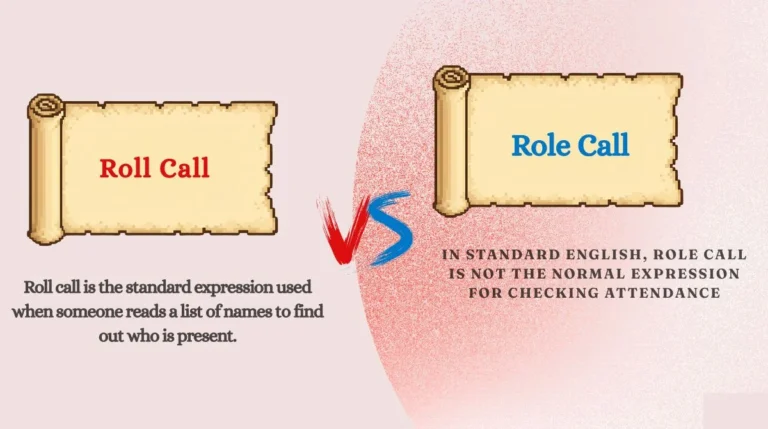
Roll call is the standard expression used when someone reads a list of names to find out who is present.
A roll can mean an official list of names. Oxford gives examples such as the electoral roll and explains that someone can “call” or “take” the roll by reading the names to check whether everyone is present.
So, the meaning becomes quite logical:
roll = a list of names
call = read the names aloud
Together, roll call means calling out the names on a list, usually to check attendance.
This expression is especially common in schools, colleges, meetings, military settings, and other organized groups. Cambridge also lists take/call the roll as a phrase, especially in American English.
When Should You Use “Roll Call”?
Use roll call when you are talking about checking who is present.
For example:
- The teacher took roll before starting the lesson.
- We have roll call every morning at 8:00.
- Please stay quiet during roll call.
- The coach did a roll call before practice.
- I arrived just before roll call.
- The students answered during roll call.
- Our class monitor helps with roll call.
- The officer began the morning roll call.
Notice that the phrase has nothing to do with a person’s job or character. It is connected with a list of names and attendance.
“Roll Call” as a Noun
The expression roll call is a noun phrase.
You can use it as the subject or object of a sentence:
- Roll call starts at nine.
- We finished roll call quickly.
- The teacher announced roll call.
- I missed roll call this morning.
You can also use the verb phrases call the roll and take the roll.
For example:
- The teacher called the roll.
- The teacher took the roll.
- The principal came in while we were taking roll.
Cambridge specifically records take/call the roll as the act of reading names to make sure people are present.
A Quick Example
Imagine a classroom with 20 students. The teacher has a list containing all 20 names.
The teacher says:
“Ali?”
Ali says, “Present.”
Then:
“Sara?”
Sara says, “Here.”
The teacher continues until every student’s name has been checked.
That process is roll call.
The word roll works because one meaning of roll is an official list of names.
Common Confusion About “Roll”
Many learners see the word roll and think about rolling a ball.
That is a real meaning of roll, but it is not the meaning used here. English words often have several meanings.
For example:
- The ball rolled down the road.
- She rolled the dough.
- The teacher called the roll.
The first two examples use roll as a verb connected with movement. The third uses roll as a noun meaning a list of names.
Oxford notes this specific “list of names” meaning and gives examples involving people being on a school or voter roll.
What Does “Role Call” Mean?
Now we come to the confusing form: role call.
In standard English, role call is not the normal expression for checking attendance. When you mean the activity of reading names to see who is present, the correct spelling is roll call. Cambridge and Oxford both give roll call for this meaning.
The reason people write role call is simple: role and roll sound the same.
But role has a completely different meaning.
A role can mean a person’s duty, function, position, or part in a play or movie. Cambridge defines it as the position or purpose someone or something has in a situation, organization, society, or relationship. It also uses role for an actor’s part in a film or play.
Merriam-Webster gives similar meanings, including a character played by an actor and a function or part performed in a particular situation.
Examples of “Role”
Here are some natural examples:
- She has an important role in the project.
- My role is to help new students.
- He played the role of a doctor in the movie.
- Parents have an important role in a child’s education.
- What is your role in the company?
- She accepted the role of team leader.
- The actor got the leading role.
- Technology plays a major role in modern life.
In each sentence, role refers to a duty, function, position, or character.
Why “Role Call” Looks Correct to Some Learners
Suppose you hear:
“The teacher is taking roll.”
If you are unfamiliar with the expression, you might think the teacher is asking about students’ roles.
But that is not what is happening.
The teacher is checking the roll, meaning the official list of students.
This is a classic homophone problem. The pronunciation does not help because role and roll are pronounced the same in standard English. Oxford even lists them as homophones.
So the spelling must come from the meaning.
Difference Between Roll Call and Role Call
The biggest difference is very simple:
Roll call = checking attendance
Role = a duty, function, position, or acting part
For attendance, use roll call.
Comparison Table
| Feature | Roll Call | Role Call |
|---|---|---|
| Standard expression for attendance? | Yes | No |
| Main word | Roll | Role |
| Meaning of key word | List of names | Duty, function, position, or character |
| Common context | School, meeting, military, attendance | Jobs, projects, films, plays, responsibilities |
| Correct for checking students? | Yes | No |
| Example | The teacher took roll call. | Usually incorrect for attendance |
Usage Difference
Consider these two sentences:
The teacher started roll call.
This means the teacher started checking attendance.
Now compare:
She has an important role in the project.
This means she has an important function or responsibility.
The words sound alike, but their meanings are completely different.
Grammar Logic
Roll call is a noun phrase made from:
roll + call
Here, roll is a noun meaning a list of names, and call refers to calling those names aloud.
Role is a noun by itself. It refers to what someone does, what position they have, or what character they represent.
That means there is no grammar reason to replace roll with role in the attendance expression.
Sentence Structure Difference
With roll call, you can say:
- The teacher took roll call.
- We had roll call at 8 a.m.
- The principal called the roll.
- I was late for roll call.
With role, you normally see structures such as:
- play a role
- have a role
- take on a role
- perform a role
- fulfill a role
- a leading role
- an important role
For example:
- She plays an important role in the team.
- He took on the role of manager.
- The actor played the role of a teacher.
These structures clearly show that role is about function, responsibility, or character.
Grammar Rules You Must Remember
Rule #1: Use “Roll Call” for Attendance
Whenever you mean checking who is present, write roll call.
Correct:
The teacher began roll call at 9:00.
Incorrect for this meaning:
The teacher began role call at 9:00.
Cambridge and Oxford both define roll call specifically in relation to checking whether people are present.
Rule #2: “Roll” Can Mean an Official List
One important meaning of roll is an official list of names.
Examples include:
- electoral roll
- school roll
- voter roll
- membership roll
Oxford explains that a roll can be an official list of names and gives examples such as the electoral roll and people being on a school roll.
This is the meaning behind roll call.
Think:
roll = list
call = read the names
Rule #3: Use “Role” for Duties or Functions
Use role when you mean the job, responsibility, function, or position someone has.
Examples:
- My role is to answer customer questions.
- Teachers have an important role in education.
- What role does she play in the company?
- He took on a new role last month.
Cambridge defines role as a position or purpose someone or something has in a situation or organization.
Rule #4: Use “Role” for an Acting Part
In movies and plays, role means the character an actor plays.
Examples:
- She got the lead role.
- He played the role of a detective.
- The actor was perfect for the role.
- It was his first major film role.
This meaning is also listed by Cambridge and Merriam-Webster.
Common Mistakes Students Make
The most common mistake is based on sound.
Because roll and role sound alike, learners often choose the spelling they recognize more easily.
Mistake 1: Writing “Role Call” for Attendance
❌ The teacher took role call.
✅ The teacher took roll call.
Why?
Because the teacher is checking a list of names, not discussing anyone’s duties or positions.
Mistake 2: Using “Roll” for a Job or Function
❌ She has an important roll in the company.
✅ She has an important role in the company.
Why?
Her role means her function or responsibility.
Mistake 3: Confusing an Actor’s Role
❌ He played the leading roll.
✅ He played the leading role.
An actor plays a role, not a roll.
Mistake 4: Thinking “Role Call” Is More Logical
A learner may think:
“The teacher calls people, so why isn’t it role call?”
Because English expressions are not always created from the meaning we expect.
The word roll already has the special meaning of an official list of names. Therefore, roll call is the established expression.
Merriam-Webster also treats roll and role as distinct words that are commonly confused because they are pronounced alike.
Easy Correction Tip
Before choosing the spelling, ask yourself:
Am I talking about a list of names?
If yes, choose roll.
Am I talking about a job, function, or character?
If yes, choose role.
That one question will solve most of the confusion.
Easy Trick to Remember the Difference
Here is a simple memory trick students can use.
Think: Roll = List
Imagine a long piece of paper containing many names. That is a roll.
Then imagine a teacher reading the names:
Ahmed?
Sara?
John?
Maria?
The teacher is calling the roll.
So remember:
ROLL = LIST → ROLL CALL = ATTENDANCE
Now think about a job or responsibility.
A person might say:
“My role is to help customers.”
That is about a responsibility, not a list.
So:
ROLE = JOB/FUNCTION → ROLE IN A PROJECT
There is another useful connection:
- role → actor → character
- roll → list → attendance
Merriam-Webster notes that role can mean a character played by an actor or a function in a situation, while roll has a range of meanings including an official list.
A One-Line Memory Trick
You call a roll, but you play a role.
This sentence is worth remembering.
You call the roll when checking attendance.
You play a role in a movie, play, team, project, or situation.
Daily Life Examples
Here are some natural examples you might hear at school, work, or in everyday conversation.
1. At School
Teacher: “Good morning, everyone. I’m going to take roll.”
This means the teacher is checking who is present.
2. Asking About Class
Student: “Did the teacher take roll already?”
Friend: “Yes. She finished a few minutes ago.”
Here, roll refers to the attendance list.
3. Arriving Late
Student: “Sorry I’m late. Did I miss roll call?”
Teacher: “Yes, but I’ll mark you present.”
Again, this is attendance.
4. At a Meeting
Chairperson: “Before we begin, we’ll take roll.”
The chairperson is checking which members are present.
5. At a Training Session
Trainer: “Please remain seated during roll call.”
The trainer is checking attendance.
6. Talking About a Job
Manager: “What is your role on this project?”
Employee: “I’m responsible for checking the reports.”
Here, role means responsibility or function.
7. Talking About a Movie
Friend: “What role does she play in the film?”
You: “She plays the main character.”
Here, role means an acting part.
8. Talking About Family
Teacher: “Parents play an important role in a child’s education.”
This is about their function and responsibility.
9. Talking About Teamwork
Coach: “Everyone has a different role on the team.”
Each player has a different responsibility.
10. Using Both Words in One Conversation
You can even use roll and role in the same conversation:
Teacher: “I’ll take roll first. Then we’ll discuss everyone’s role in the group project.”
This is a perfect example because the two words have completely different meanings even though they sound the same.
Practice Section
Choose the correct word: roll or role.
1. The teacher took ___ before the test.
Answer: roll
2. She has an important ___ in the company.
Answer: role
3. Did you miss ___ call this morning?
Answer: roll
4. He played the ___ of a police officer.
Answer: role
5. Everyone should understand their ___ in the team.
Answer: role
Why Are the Answers Different?
Sentence 1 is about checking attendance, so we use roll.
Sentence 2 is about a person’s function or responsibility, so we use role.
Sentence 3 refers to attendance, so the full phrase is roll call.
Sentence 4 is about an actor’s character, so we use role.
Sentence 5 is about responsibility in a group, so we use role.
A good learner does not only memorize spellings. The better habit is to identify the meaning first and choose the word second.
FAQs
What is the difference between roll call and role call?
Roll call is the correct expression for checking attendance by reading names from a list. Role means a duty, function, position, or acting character.
So, when a teacher checks which students are present, the correct term is roll call.
Is “role call” ever correct?
Role call is generally not the standard expression when you mean attendance. For that meaning, use roll call.
The form role has a different meaning related to duties, functions, positions, or characters. In a completely different context, the two words could appear next to each other as ordinary words, but that does not make role call the standard attendance phrase.
Why do roll and role sound the same?
Roll and role are homophones. They have different meanings and spellings but the same pronunciation in standard English.
This is why learners often confuse them when writing. Oxford specifically identifies role and roll as homophones.
Is roll call formal or informal?
Roll call is a normal, standard expression. It can be used in schools, workplaces, meetings, military settings, and other organized situations.
For example, “We have roll call at 8 a.m.” is perfectly natural. You may also hear take roll or call the roll, especially in American English.
Can I say “take roll” instead of “take roll call”?
Yes. Take roll and call the roll are established expressions.
For example:
- The teacher took roll.
- The teacher called the roll.
- We had roll call at nine.
Cambridge lists take/call the roll as phrases for reading names to check attendance.
Is “role” only used for actors?
No. Role has several common meanings.
It can mean an actor’s part in a film or play, but it can also mean someone’s duty, function, purpose, or position in a situation or organization.
For example:
- She played a role in the movie.
- She plays an important role in the company.
- Parents have a major role in education.
Conclusion
The confusion between roll call and role call is completely understandable because roll and role sound the same. However, their meanings are different, and choosing the right spelling becomes easy once you connect each word with its meaning.
Use roll call when someone checks attendance by reading a list of names. The word roll can mean an official list, which is why this expression is correct.
Use role when you are talking about a person’s duty, responsibility, function, position, or acting part.
The easiest sentence to remember is:
You call a roll, but you play a role.
Once you learn that simple connection, you will be much less likely to write role call when you mean attendance. A little practice with real sentences will make the difference feel natural.

Evan Rellmont is a writer who turns thoughtful ideas into meaningful words, creating stories and reflections that connect, inspire, and leave a lasting impression.