
Have you ever typed “pronounciation” and wondered whether it was correct? You are not alone.
This is one of those English spelling mistakes that looks completely reasonable at first.
The confusion usually comes from the word “pronounce.” The verb is spelled pronounce, so many learners naturally think its noun form should be “pronounciation.” It seems logical.
However, standard English uses a different spelling: pronunciation.
There is an important little detail to remember here. Pronounciation is a common misspelling, while pronunciation is the standard spelling.
Major dictionaries such as Oxford, Cambridge, and Merriam-Webster list pronunciation as the noun.
Merriam-Webster also notes that the confusion is understandable because the verb pronounce contains ou, while the noun is written with u instead.
Knowing the correct spelling matters because pronunciation is a very common word in everyday English.
You will see it in English classes, dictionaries, language apps, school assignments, job interviews, and conversations about speaking.
By the end of this guide, you will know exactly why pronunciation is correct, why pronounciation causes confusion, how to pronounce the word, and how to remember its spelling without checking a dictionary every time.
What Does “Pronounciation” Mean?
Here is the most important point first:
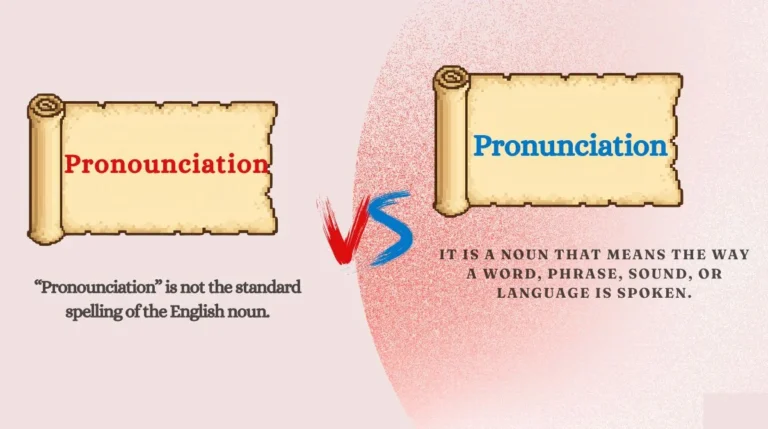
“Pronounciation” is not the standard spelling of the English noun.
It is generally treated as a misspelling of “pronunciation.” Wiktionary lists it as a misspelling and also records it as an obsolete historical form. In modern standard English, however, learners should use pronunciation.
So, if you write:
❌ Her pronounciation is very clear.
You should write:
✅ Her pronunciation is very clear.
Why Do People Write “Pronounciation”?
The mistake is easy to understand.
Look at these two words:
pronounce → pronounciation
At first glance, the second spelling appears to follow a normal pattern. The word pronounce contains oun, so a learner may simply keep those letters when changing the word into a noun.
But English word forms do not always change in a perfectly predictable way.
The standard noun is:
✅ pronunciation
not:
❌ pronounciation
There is also a pronunciation difference behind the confusion. The verb pronounce is pronounced roughly as /prəˈnaʊns/, while pronunciation is pronounced /prəˌnʌn.siˈeɪ.ʃən/. Cambridge gives the noun as /prəˌnʌn.siˈeɪ.ʃən/ in both British and American English.
When Should You Use “Pronounciation”?
In normal modern English writing, you should not use “pronounciation” when you mean the standard noun.
You might see it on websites, social media, informal messages, or in learner writing, but that does not make it the preferred spelling.
For schoolwork, professional writing, websites, emails, essays, and formal communication, choose pronunciation.
Example Sentences
Here are some sentences showing the incorrect form and the correction:
- ❌ I want to improve my pronounciation.
✅ I want to improve my pronunciation. - ❌ Your pronounciation of this word is wrong.
✅ Your pronunciation of this word is wrong. - ❌ The teacher explained the correct pronounciation.
✅ The teacher explained the correct pronunciation. - ❌ Her English pronounciation is excellent.
✅ Her English pronunciation is excellent. - ❌ Check the pronounciation before you say the name.
✅ Check the pronunciation before you say the name. - ❌ This website helps students with pronounciation.
✅ This website helps students with pronunciation. - ❌ His pronounciation sounds very natural.
✅ His pronunciation sounds very natural. - ❌ I made a mistake in the spelling of pronounciation.
✅ I made a mistake in the spelling of pronunciation.
Common Learner Confusion
The biggest problem is that pronounce and pronunciation are related words, but they do not keep exactly the same spelling in the middle.
Think of them as two related family members with slightly different spellings:
pronounce = verb
pronunciation = noun
The change is small, but it is important.
What Does “Pronunciation” Mean?
Pronunciation is the correct spelling.
It is a noun that means the way a word, phrase, sound, or language is spoken. Oxford defines it as the way in which a language or a particular word or sound is pronounced.
For example:
Her pronunciation is very clear.
This means the way she says words is clear.
You can also talk about the pronunciation of one specific word:
What is the pronunciation of this word?
Here, you are asking how the word should be spoken.
How Do You Pronounce “Pronunciation”?
The word pronunciation is pronounced approximately:
/prəˌnʌn.siˈeɪ.ʃən/
A simple way to think about it is:
pro-NUN-ci-A-tion
The middle sounds more like “nun” than “noun.”
Cambridge gives the British and American pronunciation as /prəˌnʌn.siˈeɪ.ʃən/.
That is one reason the spelling can feel strange at first. The word pronounce contains the sound /naʊns/, but pronunciation has /nʌn/ in the corresponding part.
When Do We Use “Pronunciation”?
We use pronunciation whenever we are talking about how something is spoken.
You might discuss:
- the pronunciation of a word
- English pronunciation
- correct pronunciation
- difficult pronunciation
- British pronunciation
- American pronunciation
- the pronunciation of a person’s name
- pronunciation problems
- pronunciation practice
Cambridge provides both British and American pronunciation information and uses phonetic symbols and audio to show how words are spoken.
Example Sentences
- Your pronunciation is much better now.
- I need help with the pronunciation of this word.
- The teacher corrected my pronunciation.
- English pronunciation can be difficult for beginners.
- What is the correct pronunciation of your name?
- She practices her pronunciation every morning.
- His pronunciation sounds very natural.
- The dictionary includes the pronunciation of each word.
Pronunciation and Grammar
Because pronunciation is a noun, it can work in several common sentence structures.
For example:
Subject + be + pronunciation
Her pronunciation is excellent.
Or:
Subject + improve + possessive + pronunciation
I want to improve my pronunciation.
Or:
the pronunciation of + noun
The pronunciation of this name is difficult.
You can also use the plural:
There are several pronunciations of the word.
Oxford notes that pronunciation can be both uncountable and countable depending on meaning. For example, you can talk generally about “English pronunciation,” or about “more than one pronunciation” of a particular word.
Difference Between Pronounciation and Pronunciation
The answer is quite simple:
Pronunciation is the correct standard spelling.
Pronounciation is normally a misspelling.
There is not a useful modern meaning difference between the two forms. When someone writes pronounciation, they usually mean pronunciation.
Comparison Table
| Point | Pronounciation | Pronunciation |
|---|---|---|
| Standard spelling | ❌ No | ✅ Yes |
| Meaning | Usually intended to mean pronunciation | Way a word or language is spoken |
| Word type | Misspelled form | Noun |
| Suitable for formal writing | ❌ No | ✅ Yes |
| Dictionary-standard modern form | ❌ No | ✅ Yes |
| Correct spelling for school/work | ❌ No | ✅ Yes |
| Common source of confusion | Based on pronounce | Standard noun form |
Usage Difference
There is really only one correct choice for normal modern writing.
❌ I need to improve my pronounciation.
✅ I need to improve my pronunciation.
The first sentence contains a spelling error. The second uses the standard noun.
Grammar Logic
The important grammar point is that pronunciation is a noun, while pronounce is a verb.
Compare:
Please pronounce this word.
Here, pronounce describes an action.
Now compare:
Your pronunciation is clear.
Here, pronunciation names the way the word is spoken.
This is a useful distinction:
pronounce = do the action
pronunciation = the way the action is performed
Sentence Structure Difference
Pronounce often appears with an object:
Can you pronounce my name?
She pronounced the word correctly.
Pronunciation is a noun:
Her pronunciation is excellent.
I like his pronunciation of difficult words.
You can therefore tell the two words apart not only by spelling but also by their role in a sentence.
Meaning Comparison
The meaning of pronunciation focuses on speech.
It can refer to the sounds, stress, or way a word is spoken. Dictionary.com describes it in terms of the production of speech sounds and the accepted patterns of sounds and stress.
For example:
The pronunciation of “record” can change depending on whether it is a noun or a verb.
This sentence is about the way the word is said.
Grammar Rules You Must Remember
Rule 1: Use “pronunciation” as the noun
When you are talking about the way something is spoken, use pronunciation.
✅ Her pronunciation is improving.
❌ Her pronounciation is improving.
Remember that the noun does not keep the ou spelling found in pronounce.
Rule 2: “Pronounce” and “pronunciation” are different word forms
Pronounce is a verb.
Please pronounce the word slowly.
Pronunciation is a noun.
Your pronunciation is clear.
This difference helps you choose the correct word based on the sentence.
Rule #3: Do not spell it as “pronounciation”
The extra o is the main spelling problem.
Compare them carefully:
❌ pronounciation
✅ pronunciation
A useful visual reminder is:
pro-NUN-ci-a-tion
not:
pro-NOUN-ci-a-tion
Merriam-Webster discusses this exact confusion and explains why the spelling feels natural even though pronunciation is the standard form.
Rule 4: The word ends in “-ciation”
Look at the final part:
pronun + ciation
Not:
pronoun + ciation
The full spelling is:
P-R-O-N-U-N-C-I-A-T-I-O-N
A quick check can help:
pronunciation ✅
pronounciation ❌
Common Mistakes Students Make
Mistake 1: Copying the spelling of “pronounce”
This is the most understandable mistake.
A learner sees:
pronounce
and thinks:
pronounciation
But related words do not always preserve every letter.
Correct:
pronunciation
Mistake 2: Adding an extra “o”
Some learners remember the word visually as pronounciation because the sound of pronounce is strong in their memory.
This produces:
❌ pronounciation
Instead, remember:
✅ pronunciation
There is no extra o after the n.
Mistake 3: Pronouncing the word as “pro-nown-ciation”
Some speakers also pronounce the word as if it contained the “noun” sound.
A standard pronunciation is closer to:
pro-NUN-ciation
Cambridge transcribes it as /prəˌnʌn.siˈeɪ.ʃən/.
Mistake 4: Thinking spelling should always match related words
English spelling has many patterns, but it also has many historical changes.
Merriam-Webster explains that pronounce and pronunciation ultimately come from the same Latin source, while their spelling developed differently as the words passed through earlier forms of English and Anglo-French.
So there is a historical reason for the difference, but beginners do not need to memorize the whole history.
Wrong vs Correct
| Wrong | Correct |
|---|---|
| pronounciation | pronunciation |
| pronounciations | pronunciations |
| English pronounciation | English pronunciation |
| correct pronounciation | correct pronunciation |
| pronunciation of a word | pronunciation of a word |
Easy Correction Tip
Whenever you type pronounciation, stop and look at the middle.
Ask yourself:
“Is there an extra O?”
If there is, remove it.
pronounciation → pronunciation
Easy Trick to Remember the Difference
Here is a simple memory trick that works well for learners.
Think: “NUN, not NOUN”
Look at the middle:
pro-NUN-ciation
The correct spelling contains:
NUN
It does not contain:
NOUN
So remember:
Pronunciation has NUN, not NOUN.
This is much easier than trying to memorize a long spelling rule.
You can also use another trick:
Pronounce → Pronunciation
Write both words together:
pronounce
pronunciation
Now look at the middle carefully.
The verb has ou:
pronounce
The noun has u:
pronunciation
The spelling changes when the noun is formed.
Real-Life Logic
Imagine your English teacher says:
“Please pronounce this word.”
That is an instruction to say the word.
Then the teacher might say:
“Your pronunciation is improving.”
Now the teacher is talking about how you say the word.
So:
pronounce = say it
pronunciation = how you say it
This simple difference can help you remember both the meaning and the spelling.
Daily Life Examples
Here are natural examples you might hear at school, at work, or in everyday conversations.
1. In an English Class
Teacher: Can you pronounce this word?
Student: I’m not sure. Can you say it slowly?
Here, pronounce is the verb because the student is being asked to say the word.
2. Asking About a Name
What is the correct pronunciation of your last name?
This is a polite way to ask someone how their name should be spoken.
3. Talking About Improvement
I have been practicing my English pronunciation every day.
This is common when someone is learning English.
4. Correcting a Friend
I think the pronunciation is a little different.
This sounds more natural than saying, “Your English is wrong.”
5. Using a Dictionary
Check the pronunciation in the dictionary before you say it.
Modern dictionaries often provide phonetic information and audio recordings to help learners hear the correct sounds. Cambridge, for example, provides British and American pronunciations with phonetic transcriptions and audio.
6. Talking About Different Accents
The pronunciation is different in British and American English.
This does not necessarily mean one is wrong. Different varieties of English can use different accepted pronunciations.
7. Asking for Help
Could you help me with the pronunciation of this word?
This is a very natural classroom sentence.
8. Talking About a Difficult Word
This word has a difficult pronunciation for me.
A learner may understand the meaning but still struggle to say it.
9. At Work
I want to make sure I use the correct pronunciation of the client’s name.
This shows care and respect when speaking with another person.
10. Talking About Progress
My pronunciation is getting better because I listen to English every day.
This is a useful sentence for English learners because regular listening can help them become familiar with natural speech.
Practice Section
Choose the correct word in each sentence.
1. I want to improve my English ________.
A. pronounciation
B. pronunciation
2. Can you ________ this word for me?
A. pronounce
B. pronunciation
3. Her ________ is very clear.
A. pronounce
B. pronunciation
4. What is the correct ________ of this name?
A. pronunciation
B. pronounciation
5. Please ________ the word slowly.
A. pronunciation
B. pronounce
Answers
1. B — pronunciation
“I want to improve my English pronunciation.”
2. A — pronounce
“Can you pronounce this word for me?”
3. B — pronunciation
“Her pronunciation is very clear.”
4. A — pronunciation
“What is the correct pronunciation of this name?”
5. B — pronounce
“Please pronounce the word slowly.”
Notice the pattern:
pronounce is the action.
pronunciation is the noun.
FAQs
What is the difference between pronounciation and pronunciation?
Pronunciation is the correct standard spelling of the noun. It means the way a word, sound, or language is spoken. Pronounciation is normally a misspelling of that word.
Is pronounciation a correct English word?
In modern standard English, you should use pronunciation instead. “Pronounciation” is commonly treated as a misspelling, although historical sources show older forms of the word. It should not be used as the normal spelling in school, business, or formal writing.
Why is pronunciation spelled differently from pronounce?
The two words are historically related, but their spellings developed differently. English learners often expect pronounce + -ation to produce “pronounciation,” but the standard noun is pronunciation. Merriam-Webster explains that historical changes in the word’s development help account for the spelling difference.
How do you pronounce pronunciation?
Cambridge gives the pronunciation as /prəˌnʌn.siˈeɪ.ʃən/ in both British and American English. For a simple learner-friendly guide, think of it as pro-NUN-ci-A-tion.
Is pronunciation a noun or a verb?
Pronunciation is a noun. The related verb is pronounce.
For example:
Please pronounce the word.
Here, pronounce is the verb.
Your pronunciation is good.
Here, pronunciation is the noun.
Can I use pronunciation in a question?
Yes. It is very common in questions.
For example:
What is the pronunciation of this word?
You can also ask:
How do you pronounce this word?
Both questions are correct, but they use different word forms: pronunciation is the noun, while pronounce is the verb.
Conclusion
The confusion between pronounciation and pronunciation is easy to understand, especially because the verb pronounce contains ou. However, the standard English noun is clearly pronunciation.
So, whenever you are writing about the way a word, name, sound, or language is spoken, use:
✅ pronunciation
Avoid:
❌ pronounciation
The easiest memory trick is to think “NUN, not NOUN.” The correct spelling contains pronun-ciation, not pronoun-ciation.
It also helps to remember the difference between the related words:
pronounce = verb
pronunciation = noun
You may need to see and write this word several times before the spelling feels natural. That is completely normal. Keep using pronunciation in your messages, notes, essays, and English practice. After a little repetition, the incorrect extra o will start to look wrong.
Good English is not about never making mistakes. It is about noticing mistakes, understanding them, and getting better each time.

Evan Rellmont is a writer who turns thoughtful ideas into meaningful words, creating stories and reflections that connect, inspire, and leave a lasting impression.