
Other than or other then? Many English learners stop for a second when they want to use this phrase.
The two expressions look almost the same, and the words than and then are easy to mix up because they sound similar in fast speech.
However, they do not have the same job in a sentence.
The correct expression in most cases is other than. It is used when you want to mean except, apart from, or sometimes different from. For example, “I eat everything other than seafood” means that you eat everything except seafood.
The word then, on the other hand, usually relates to time, sequence, or a result.
We use it in sentences such as “I was younger then” or “Finish your homework, then watch TV.” That is why other then is normally not the expression you need when you mean “except.”
This small spelling difference can matter in school writing, emails, exams, conversations, and professional English.
Once you understand what than and then do separately, the confusion becomes much easier.
By the end, you will know exactly when to use other than, why other then is usually wrong, how native speakers use the phrase, and how to avoid this common mistake in everyday English.
What Does “Other Than” Mean?
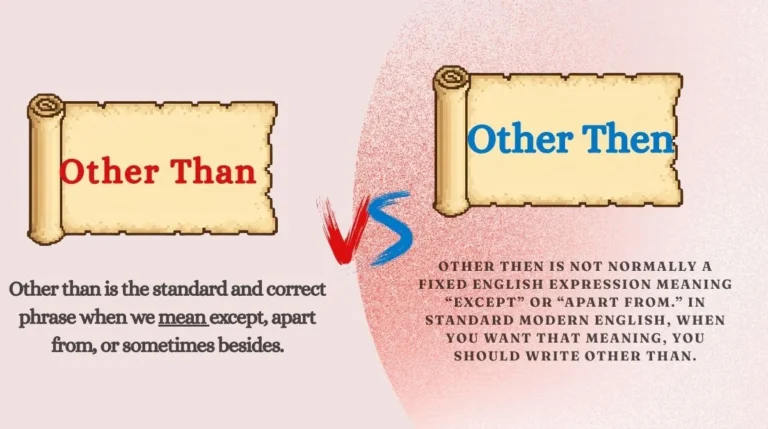
Other than is the standard and correct phrase when we mean except, apart from, or sometimes besides.
It can be used to leave one person, thing, activity, or idea out of a group. It can also be used when comparing something with another thing and showing that it is different.
Simple definition
Other than = except / apart from / different from
Here are a few simple examples:
- I do not know anyone other than Sarah.
- We have no choice other than to wait.
- I eat almost everything other than fish.
- Is there anything other than coffee?
- Other than English, he speaks Arabic.
- I have no hobbies other than reading.
- She did not buy anything other than a notebook.
- Nothing other than hard work can improve your skills.
In each sentence, other than adds an exception or shows something outside the main group.
When should you use “other than”?
Use other than when the meaning is close to except or apart from.
For example:
Everyone came other than Tom.
This means:
Everyone came except Tom.
You can also use it to talk about activities or things:
I have no plans other than studying tonight.
The speaker has no other plans apart from studying.
There is another use that can mean different from:
The new model looks quite different other than the old one.
However, this particular use can depend on the sentence and regional style. In many situations, different from or other than is clearer.
Grammar rule for “other than”
Other than can be followed by different types of words, including:
- a noun
- a pronoun
- a gerund (-ing form)
- sometimes a phrase or clause
Examples:
No one other than me knew the answer.
She enjoys nothing other than reading.
We had no option other than to leave.
Who other than John could have done this?
Notice that than is part of the expression. It is not being used to show a comparison like “bigger than” or “older than.”
Why do learners get confused?
The main problem is that than and then are very close in pronunciation.
English learners often remember the sound first and the spelling second. In quick conversation, the difference may not feel obvious.
Another reason is that then is a very common English word, so learners sometimes write it automatically.
For example, someone may think:
“I don’t drink anything other then water.”
The intended meaning is “except water,” so other than is correct:
“I don’t drink anything other than water.”
That one letter changes the phrase.
What Does “Other Then” Mean?
This is where the issue becomes interesting.
Other then is not normally a fixed English expression meaning “except” or “apart from.” In standard modern English, when you want that meaning, you should write other than.
The word then has a different role.
What does “then” normally mean?
Then usually refers to:
- a time in the past or future,
- the next step in a sequence,
- a result or consequence.
Examples:
I was living in London then.
First wash the vegetables, then cut them.
If you are tired, then take a break.
So when you write other then, the word then does not perform the job that than performs in other than.
Examples of “then” used correctly
Here are eight sentences showing normal uses of then:
- I was very young then.
- We can eat first and then go home.
- If that is true, then we need to change the plan.
- She lived here back then.
- I finished my work and then called him.
- We did not have smartphones then.
- First read the question, then choose your answer.
- I will see you then.
None of these examples means “except.”
Can “other then” ever appear?
You may occasionally see the words other then next to each other in writing, but that does not make them a standard alternative to other than.
For example, in a longer sentence, other and then might happen to appear close together for completely separate grammatical reasons. But that is very different from treating other then as a phrase.
For learners, the safest rule is simple:
When you mean except or apart from, use other than.
Common learner confusion
Consider these examples:
❌ I know no one other then my brother.
✅ I know no one other than my brother.
❌ Other then weekends, I am busy every day.
✅ Other than weekends, I am busy every day.
❌ I do not want anything other then tea.
✅ I do not want anything other than tea.
The mistake is not about pronunciation. It is about choosing the wrong word based on its meaning.
Difference Between “Other Than” and “Other Then”
The easiest way to understand the difference is to remember that than and then belong to different grammar groups.
| Expression | Main function | Meaning | Example |
|---|---|---|---|
| Other than | Prepositional phrase | except, apart from | I eat everything other than meat. |
| Then | Adverb | at that time, next, as a result | Finish your work, then rest. |
| Other then | Not a standard fixed phrase for “except” | Usually incorrect for the intended meaning | ❌ I drink nothing other then water. |
Usage difference
Other than removes something from a group.
Everyone other than Ali passed.
Ali is the exception.
Then tells us about time, order, or consequence.
We had dinner and then went home.
Dinner happened first. Going home happened afterward.
That is a completely different idea.
Grammar logic
The word than often appears in structures involving comparison or contrast, and it is also part of fixed expressions such as:
other than
The word then is mainly an adverb.
It can refer to a time:
Things were different then.
It can show order:
First study, then sleep.
It can show a result:
If you agree, then we can start.
Because these jobs are different, swapping than and then changes the grammar.
Sentence structure
A common structure is:
other than + noun/pronoun/gerund
Examples:
other than John
other than pizza
other than working
other than me
By contrast, then usually appears as an adverb:
We left then.
Finish this then call me.
I was busy then.
It does not normally fit into the structure:
❌ other then John
when the intended meaning is “except John.”
Meaning comparison
Compare these two:
I have no hobbies other than reading.
This means reading is the only hobby, or the only hobby being mentioned.
Now look at:
I studied then went to bed.
Here then means “after that.”
One phrase talks about exception. The other talks about sequence.
Grammar Rules You Must Remember
Rule 1: Use “other than” for “except”
When you can replace the phrase with except or apart from, choose other than.
Nobody other than Maria knew.
You can say:
Nobody except Maria knew.
That is a strong test.
Another example:
I do not eat anything other than vegetables.
Meaning:
I do not eat anything except vegetables.
Rule 2: Use “then” for time or sequence
When the meaning is after that, at that time, or next, use then.
Finish your breakfast, then brush your teeth.
Here, “then” tells us what happens next.
Another example:
We lived in Karachi then.
Here, “then” refers to a particular time in the past.
Rule 3: Do not choose a word just because it sounds right
This is one of the biggest problems with than and then.
Their pronunciation can be easy to confuse, especially when people speak quickly.
Always check the meaning.
Ask yourself:
Am I saying “except”?
If yes, use than in other than.
Ask:
Am I saying “after that” or “at that time”?
If yes, use then.
Rule 4: Learn the whole phrase, not just the individual word
Instead of memorizing isolated words, remember this useful unit:
other than = except
This makes the choice automatic.
You do not need to stop every time and think about the grammar history of than. Just connect the full phrase with its meaning.
For example:
Other than Sam = except Sam
That simple connection can prevent many spelling mistakes.
Common Mistakes Students Make
Mistake 1: Writing “other then” when they mean “except”
❌ I have no choice other then waiting.
✅ I have no choice other than waiting.
Why?
Because the phrase means apart from waiting.
A useful check is to substitute “except”:
I have no choice except waiting.
That confirms than.
Mistake 2: Mixing up “than” and “then” in other sentences
This problem is larger than just one expression.
For example:
❌ She is taller then me.
✅ She is taller than me.
Here than is used for comparison.
And:
❌ We finished dinner, than we left.
✅ We finished dinner, then we left.
Here then means “after that.”
So the general lesson is important:
Than = comparison or part of certain expressions
Then = time, order, or result
Mistake 3: Trusting pronunciation
Some learners write what they think they hear.
That can lead to:
other then
instead of:
other than
The best solution is not to depend only on sound. Learn common phrases as complete chunks.
Mistake 4: Using “other than” when “then” is needed
The confusion can happen in the opposite direction too.
❌ We went home other than watched a movie.
✅ We went home and then watched a movie.
The sentence is about sequence, so then is correct.
Mistake 5: Forgetting that context decides the answer
You cannot choose between than and then simply by looking at the word before it.
The meaning of the entire sentence matters.
Compare:
Nothing other than water is allowed.
and:
Drink water and then rest.
The words may look similar, but the jobs are entirely different.
Easy Trick to Remember the Difference
Here is a simple memory trick that works well for students.
OTHER THAN = EXCEPT
Think:
Than = exception
So:
Other than John = except John
You can imagine crossing one person out of a group.
Everyone came other than John.
John is the exception.
THEN = NEXT
Think:
Then = next
For example:
First study, then sleep.
You can picture one step followed by another.
Another memory clue is:
ThEN → think of n for “next.”
This is not a grammar rule, of course. It is simply a memory aid.
Quick test
Whenever you are unsure, replace the phrase mentally.
If it means:
except / apart from
✅ other than
If it means:
after that / at that time
✅ then
This tiny test is surprisingly effective.
Daily Life Examples
The phrase other than appears often in normal conversations. Here are some natural examples.
1. Talking about food
A: Do you eat anything other than chicken?
B: Yes, I also eat fish and vegetables.
Here, “other than” means apart from chicken.
2. Talking about hobbies
A: What do you do other than study?
B: I play football and read books.
The speaker is asking about activities apart from studying.
3. Talking about work
I do not need anything other than your signature.
The speaker needs only the signature.
4. Talking about people
Other than my parents, nobody knows about the plan.
This means nobody except the speaker’s parents knows.
5. Talking about travel
Have you visited any country other than Turkey?
The question asks whether the person has visited another country besides Turkey.
6. Talking about possessions
I have nothing other than my phone with me.
The speaker has only a phone.
7. Talking about choices
We had no option other than taking the bus.
There was no alternative except taking the bus.
8. Talking about school
Other than English, which subjects do you enjoy?
The question excludes English and asks about other subjects.
9. Talking about money
I brought only cash. I have nothing other than a small card.
The speaker is describing what they have besides the item already mentioned.
10. Talking about daily routines
I do not do much other than work during the week.
The speaker spends most of the week working.
These examples show why the phrase is useful. You will hear and read it in homes, schools, workplaces, travel conversations, and online discussions.
Practice Section
Choose other than or then in each sentence.
1.
I do not drink anything ___ water.
2.
Finish your homework, ___ you can play.
3.
Who ___ Ahmed knows the answer?
4.
We lived there back ___.
5.
She has no hobby ___ painting.
Answers
1. other than
“I do not drink anything other than water.”
2. then
“Finish your homework, then you can play.”
3. other than
“Who other than Ahmed knows the answer?”
4. then
“We lived there back then.”
5. other than
“She has no hobby other than painting.”
A good way to check yourself is to ask what the sentence means. Is it talking about an exception? Choose other than. Is it talking about time or what happens next? Choose then.
FAQs
What is the difference between “other than” and “other then”?
Other than means except, apart from, or sometimes different from.
Then usually refers to time, order, or a result.
So other then is not normally the correct phrase when you mean “except.”
Is “other than” correct grammar?
Yes. Other than is a standard and widely used English expression. It can introduce an exception, an alternative, or something apart from what has already been mentioned.
For example:
I have no plans other than studying.
Is “other then” ever correct?
The two words can appear next to each other in a sentence in unusual contexts, but other then is not the standard phrase meaning “except.” For that meaning, use other than.
Can I use “other than” in questions?
Yes. It is very common in questions.
What do you do other than work?
Have you visited any place other than London?
Who other than your teacher can help you?
These questions ask about something apart from the thing already mentioned.
Is “other than” formal or informal?
Other than works in both everyday and formal English. You can use it in casual conversation, school assignments, emails, and professional writing.
For example:
Other than minor errors, the report is excellent.
Is “other than” the same as “except”?
Often, yes. In many sentences, the two expressions can be exchanged without changing the main meaning.
Everyone other than Tom arrived.
Everyone except Tom arrived.
There can be small differences in style or emphasis, but the basic idea is the same.
Conclusion
The difference between other than and other then becomes much easier once you focus on meaning instead of sound.
Use other than when you mean except, apart from, or something outside the main group:
I like all fruit other than bananas.
Use then when you are talking about a time, the next step, or a result:
We ate dinner and then went home.
The expression other then is usually a spelling mistake when a writer actually means other than. This error is common because than and then look and sound very similar.
The best habit is to pause and ask one simple question: Does the sentence mean “except”? If the answer is yes, choose other than.
With a little practice, this choice will become automatic. Read the examples aloud, write your own sentences, and pay attention to how the words are used in real English. Small grammar differences like this become easy when you connect each word with its job and meaning.

Evan Rellmont is a writer who turns thoughtful ideas into meaningful words, creating stories and reflections that connect, inspire, and leave a lasting impression.