
English has many word combinations that look like they should be written as one word. Inbetween, in between, and in-between are a good example.
They sound almost the same when we speak, so it is easy to think that they are simply three spelling choices.
However, they are not equal.
The form inbetween is generally not standard English when you mean the normal phrase meaning “between two things.” Standard dictionaries recognize in between as a phrase and in-between as an adjective or noun.
Merriam-Webster, for example, lists in-between as an adjective or noun and in between as an adverb or preposition. Cambridge also gives in between as a phrase and in-between as an adjective.
This small difference matters in school assignments, emails, articles, exams, and professional writing.
A sentence such as “She sat inbetween her friends” may be understandable, but the standard spelling is “She sat in between her friends.”
There is another useful point to learn, too. Sometimes you do not need in at all. You can simply use between: “She sat between her friends.”
By the end of this guide, you will know when to use in between, when in-between needs a hyphen, why inbetween should usually be avoided, and how to choose the correct form without guessing.
What Does “Inbetween” Mean?
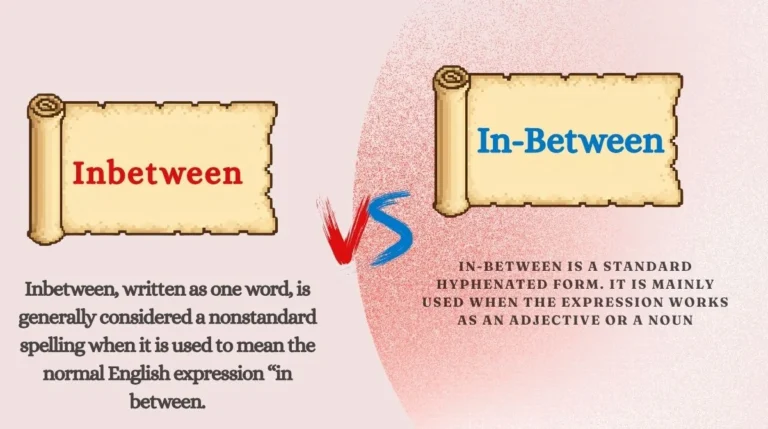
Inbetween, written as one word, is generally considered a nonstandard spelling when it is used to mean the normal English expression “in between.” In standard writing, you should normally write it as in between or, in certain adjective and noun uses, in-between. Wiktionary specifically lists inbetween as a misspelling of in-between and in between.
When should you use “inbetween”?
For normal English writing, the safest answer is: do not use inbetween as one word.
You may see the form online, in usernames, creative names, casual posts, or other informal contexts. Seeing it does not mean that it is the standard spelling for school or professional English.
For example:
- ❌ The shop is inbetween the bank and the school.
- ✅ The shop is in between the bank and the school.
Here are more examples:
- ❌ She stood inbetween her parents.
- ✅ She stood in between her parents.
- ❌ There is a small gap inbetween the two walls.
- ✅ There is a small gap in between the two walls.
- ❌ We had a short break inbetween classes.
- ✅ We had a short break in between classes.
- ❌ The answer lies somewhere inbetween the two choices.
- ✅ The answer lies somewhere in between the two choices.
Why do people write “inbetween”?
The mistake is easy to understand. When people speak quickly, in between can sound like one smooth unit. English also has many words that have developed into one word over time, such as inside, within, and without. That can make inbetween look natural to learners.
There is also a simple visual reason. Writers often combine familiar word groups without realizing that the standard form is still separate.
The important point is that spelling and pronunciation are not always the same thing. A phrase can sound like one unit while still being written as two words.
So, for essays, exams, websites, formal emails, and other careful writing, remember:
inbetween → generally avoid
What Does “In-Between” Mean?
In-between is a standard hyphenated form. It is mainly used when the expression works as an adjective or a noun. Merriam-Webster defines in-between as an adjective or noun meaning something intermediate, or something between two positions or extremes.
Cambridge also recognizes in-between as an adjective for something that falls between clear stages, states, or categories.
In-between as an adjective
An adjective describes a noun. We use in-between when it comes directly before a noun to describe something that is neither one extreme nor the other.
Examples:
- She is at an in-between stage in her English learning.
- We need an in-between size because small is too tight and large is too loose.
- He chose an in-between color that was neither very dark nor very light.
- The children are in an in-between age group.
- This is an in-between step before the final level.
- They live in an in-between area between the city and the countryside.
- She was looking for an in-between option.
- The weather is strange during this in-between season.
Notice the pattern:
in-between + noun
For example:
- an in-between size
- an in-between stage
- an in-between option
- an in-between color
The hyphen helps show that in-between is working together as one adjective.
In-between as a noun
The expression can also work as a noun. In this use, it refers to a middle position, a middle choice, or something that is neither one thing nor the other.
Examples:
- There is no in-between.
- I do not want the smallest or largest size; I need the in-between.
- She prefers the in-between.
- His opinion is somewhere in the in-between.
- The movie explores the in-between of childhood and adulthood.
- We need something that sits in the in-between.
Merriam-Webster lists in-between as a noun meaning an intermediate term, thing, or class.
Common confusion
A very common mistake is using a hyphen just because the phrase contains in and between.
For example:
- ❌ She sat in-between her two friends.
- ✅ She sat in between her two friends.
In this sentence, in between is functioning as a phrase showing position. It is not directly describing a noun, so the hyphen is normally unnecessary.
Difference Between Inbetween and In-Between
The biggest problem here is that the two forms are not really equal competitors.
| Form | Standard use | Grammar role | Example |
|---|---|---|---|
| inbetween | Generally nonstandard | Not the normal standard form | ❌ She sat inbetween them. |
| in-between | Standard | Adjective or noun | ✅ an in-between size |
| in between | Standard | Adverb or prepositional phrase | ✅ She sat in between them. |
There is also a third form that is extremely important:
between
Often, you can simply remove in.
For example:
- ✅ She sat between her parents.
- ✅ She sat in between her parents.
Both can be grammatical, depending on the sentence and intended emphasis. Dictionaries recognize between as a preposition and adverb, including meanings related to space and time.
Usage difference
Consider these sentences:
The boy sat between his brothers.
Here, between directly introduces the two people.
Now compare:
The boy sat in between his brothers.
This emphasizes his position in the space separating them.
Both are widely understandable and grammatical in suitable contexts. Cambridge gives examples of between for physical position and also recognizes in between as an expression for the space or time separating things.
Grammar logic
The word between can act as a preposition:
The café is between the bank and the library.
It can also act as an adverb:
There are two houses with a narrow path in between.
Oxford notes that between is used as an adverb for the space or period separating points, objects, dates, or events, and says it is usually in between in this adverbial use.
When in between is used as a phrase, it commonly tells us that something is located or happens in the space or time separating two points.
For example:
The meeting starts at 10, and lunch is at 1. We have a short break in between.
Here, in between refers to the period separating the two events.
Sentence structure
A useful way to think about the patterns is:
in between + two things
The school is in between the hospital and the park.
Or:
verb + in between
We stopped for coffee in between.
But with a noun being directly described:
in-between + noun
We chose an in-between option.
And as a noun:
There is no in-between.
This makes the spelling much easier to understand.
Grammar Rules You Must Remember
Rule 1: Do not normally write “inbetween”
When you mean the ordinary expression, write in between as two words.
❌ The pharmacy is inbetween the two stores.
✅ The pharmacy is in between the two stores.
This is the most important rule for learners.
Rule 2: Use “in-between” when it works as an adjective
When the expression directly describes a noun, the hyphenated form is appropriate.
✅ We need an in-between size.
✅ She is going through an in-between stage.
✅ That is an in-between option.
The hyphen joins the words so the reader can easily understand that together they modify the following noun.
Rule 3: Use “in-between” as a noun when it means a middle position
You can also use the hyphenated form as a noun.
✅ There is no in-between.
✅ I prefer the in-between.
✅ He was stuck in the in-between.
Here, the expression itself names the middle position or middle choice.
Rule 4: “Between” can often be used without “in”
Do not automatically add in before between.
Compare:
✅ The school is between the bank and the library.
✅ The school is in between the bank and the library.
Both can be acceptable, but between is often the simpler choice.
For time, too:
✅ The shop is closed between noon and 2 p.m.
Here, between already provides the relationship between the two time points. Cambridge and Oxford both give between for periods of time separating events or times.
A good learner habit is to ask:
Do I really need “in”?
Sometimes the answer is no.
Common Mistakes Students Make
Mistake 1: Writing “inbetween” as one word
This is by far the most common spelling error.
❌ We talked inbetween classes.
✅ We talked in between classes.
Mistake 2: Using a hyphen everywhere
Some learners discover that in-between exists and then start using it in every sentence.
❌ She sat in-between her two sisters.
✅ She sat in between her two sisters.
The hyphenated version is especially useful when in-between acts as an adjective or noun.
Mistake 3: Confusing an adjective with a phrase
Look at the difference:
We need an in-between option.
Here, in-between describes option, so the hyphen is useful.
We met in between classes.
Here, in between tells us when the meeting happened. It is a phrase, so we normally write it without a hyphen.
Mistake 4: Adding “in” when “between” is enough
❌ Divide the money in between the three students.
A clearer construction is:
✅ Divide the money between the three students.
The word between itself can be used with more than two items. Merriam-Webster notes that the traditional idea that between is only for exactly two things is unfounded; it has long been used for relationships involving more than two items as well.
Easy correction tip
When proofreading, look at the next word.
If in-between directly describes a noun, the hyphen may be appropriate:
an in-between choice
If you are talking about a position, place, or time, in between is usually the form you want:
The chair is in between the desks.
And if you see inbetween, stop and check it. In ordinary standard English, you probably need to separate it.
Easy Trick to Remember the Difference
Here is a very simple memory trick:
One word = stop. Two words = normal phrase. Hyphen = describing.
Think of three boxes:
INBETWEEN ❌
One word → usually avoid it.
IN BETWEEN ✅
Two words → use it for a position, space, or time.
IN-BETWEEN ✅
Hyphen → use it when it acts as an adjective or noun.
Now remember this example:
The chair is in between the tables.
It tells us where the chair is.
But:
We need an in-between table.
Here, in-between describes the table.
Another easy pair:
She waited in between meetings.
She needed an in-between appointment time.
The first describes a period of time. The second describes the type of time.
This little test works surprisingly well:
Is it describing something? → consider in-between.
Is it telling where or when something happens? → in between.
Is it written as one word? → check it; in standard English, it is usually wrong.
Daily Life Examples
These examples show how native and fluent English speakers commonly use the expressions in everyday situations.
1. At school
“I usually do my homework in between classes.”
The phrase refers to the time separating classes.
2. Talking about location
“The bank is in between the supermarket and the post office.”
Here, in between describes a physical position.
3. Choosing clothes
“This jacket is an in-between size, so it fits me perfectly.”
Here, in-between describes the size.
4. Talking about age
“My daughter is in an in-between stage right now.”
She is between two clear stages of development.
5. During work
“I answer emails in between meetings.”
The emails are answered during the time separating meetings.
6. At home
“Put the small table in between the two chairs.”
The phrase tells us where to put the table.
7. Choosing an option
“I don’t want the cheapest or the most expensive. Give me something in-between.”
Here, the idea is a middle choice. Depending on the style of writing, in-between can function as a noun.
8. Talking about colors
“The wall is an in-between shade of blue and gray.”
The hyphenated phrase describes the shade.
9. Talking about time
“We can meet at 9 or 11, but there isn’t much time in between.”
Here, in between refers to the period separating the two times. Cambridge gives similar uses for the time or space separating events.
10. Everyday conversation
A: “Do you want tea or coffee?”
B: “Something in-between would be nice.”
This means the speaker wants a middle option rather than either extreme.
Practice Section
Choose the correct form: inbetween, in between, or in-between.
1.
The restaurant is ___ the hotel and the cinema.
2.
We took a short break ___ two lessons.
3.
She bought an ___ size because medium was too small and large was too big.
4.
There is no ___; you must choose one option.
5.
He stood ___ his two friends for the photograph.
Answers
1. in between
The phrase describes the restaurant’s position.
2. in between
It refers to the time separating two lessons.
3. in-between
It directly describes the noun size, so the hyphenated adjective is suitable.
4. in-between
It acts as a noun referring to a middle choice or position.
5. in between
It describes where he stood.
Remember: inbetween is not the standard spelling for these ordinary uses.
FAQs
What is the difference between inbetween and in-between?
Inbetween is generally a nonstandard spelling and should normally be avoided in careful English. In-between is a standard hyphenated form used mainly as an adjective or noun, such as an in-between stage. Merriam-Webster lists in-between as an adjective or noun.
Is “inbetween” one word?
For standard English, you should normally write in between as two words when it functions as the ordinary phrase. The one-word spelling inbetween is generally treated as nonstandard or a misspelling in this meaning.
Should I write “in between” or “in-between”?
It depends on the grammar role. Use in between for the ordinary phrase referring to a position, space, or time. Use in-between when it works as an adjective or noun, such as an in-between option or there is no in-between. Cambridge and Merriam-Webster both recognize these different uses.
Can I use “between” instead of “in between”?
Yes. In many sentences, between is enough.
For example:
The shop is between the bank and the school.
You can also say:
The shop is in between the bank and the school.
The exact choice can depend on sentence structure and emphasis, but between itself already expresses a relationship involving a space, time, or position.
Is “in-between” formal or informal?
The hyphenated in-between is a standard English form. It can be used in formal writing when its grammatical role calls for it, especially as an adjective or noun. For example, an in-between stage is perfectly normal. Cambridge labels one adjective sense informal in its American entry, while its general dictionary also recognizes the adjective use.
Why do people write “inbetween”?
Mostly because the expression sounds like one unit when spoken quickly. English learners may also assume that in + between should be combined like some other English words. However, spelling should be learned separately from pronunciation, and standard dictionaries distinguish in between and in-between from the one-word form.
Conclusion
The spelling choice becomes much easier once you focus on the grammar instead of only looking at the letters.
For normal everyday use, remember that in between is written as two words. It commonly refers to a position, space, or period separating two things. For example, “The café is in between the bank and the library” and “I studied in between classes.”
The hyphenated form in-between is also correct, but it has a more specific job. It can work as an adjective, as in “an in-between stage” or “an in-between size,” and it can also work as a noun, as in “There is no in-between.” Merriam-Webster and Cambridge both recognize these uses.
The one-word form inbetween is the one to avoid in standard English. It may appear online or in informal creative writing, but it is not the normal standard spelling for this expression.
One final tip: when you see inbetween, pause and ask whether you really mean in between or in-between. That small check can prevent an easy spelling mistake.

Evan Rellmont is a writer who turns thoughtful ideas into meaningful words, creating stories and reflections that connect, inspire, and leave a lasting impression.