
Have you ever written totalling and wondered whether it should be totaling instead? You are not alone.
This is a very common spelling question, especially for English learners who read both British and American English.
The good news is simple: both “totalling” and “totaling” are correct spellings. The main difference is the variety of English you are using.
Totalling is the usual British English spelling, while totaling is the usual American English spelling. Oxford’s dictionaries list both forms and specifically identify totalling as the British form and totaling as the US form.
This small spelling difference comes from a larger pattern in English.
British English often keeps the final l when adding -ing to certain words, while American English often uses a single l in cases such as totaling.
You may see the same kind of difference in words such as cancelled/canceled and travelled/traveled.
Understanding this difference is useful when you write emails, school assignments, reports, websites, or business documents.
It also helps you avoid thinking that one spelling is simply a mistake.
By the end, you will know exactly when to use totalling, when to use totaling, why the spellings differ, and which one is best for your audience.
What Does “Totalling” Mean?
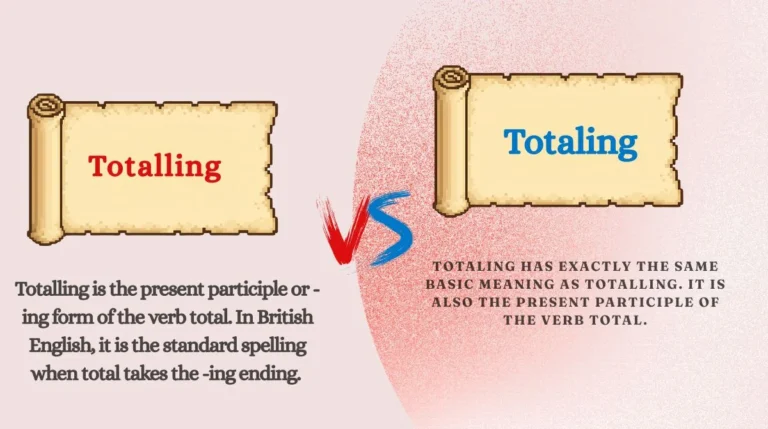
Totalling is the present participle or -ing form of the verb total. In British English, it is the standard spelling when total takes the -ing ending. Oxford lists totalling as the British English form.
The verb total can mean to add numbers or amounts together to get a final amount. It can also mean that a group of amounts reaches a particular number or value.
Oxford gives examples of total being used both for adding figures and for reaching a particular total.
So, when we say:
“The expenses are totalling £500.”
we mean that the expenses are adding up to £500.
The form totalling can appear in several grammatical situations. It can be part of the present continuous tense, or it can describe an action that happens alongside another action.
When should you use “totalling”?
Use totalling when you are following British English spelling conventions. It is especially common in the United Kingdom and in writing that follows British spelling rules.
For example:
- The bills are totalling more than £1,000.
- We are totalling the scores now.
- The donations are totalling nearly £5,000.
- She spent the evening totalling the monthly expenses.
- The items were totalling a much higher amount than expected.
- The costs came to $2,000, totalling more than we had planned.
- The company sold 800 units, totalling $40,000 in revenue.
- The three invoices were totalling the same amount.
The word can also be used after a noun or phrase to give extra information:
The project included three phases, totalling six months of work.
Here, totalling six months gives additional information about the three phases.
The grammar behind “totalling”
The base verb is:
total
Add -ing:
total + ing → totalling
This gives us the British spelling.
One important point is that the spelling does not change the pronunciation in a meaningful way. Totalling and totaling are pronounced essentially the same. Collins also lists both spellings as forms of the verb total.
Common confusion about “totalling”
Many learners see two l letters and think totalling must be incorrect because the base word is total. But the extra l is not a mistake in British English.
The spelling reflects a regional convention.
You might write:
The orders are totalling 500 units.
That is perfectly acceptable in British English.
The important thing is consistency. If the rest of your writing uses British spellings such as colour, centre, and organise, then totalling is the natural choice.
What Does “Totaling” Mean?
Totaling has exactly the same basic meaning as totalling. It is also the present participle of the verb total.
The difference is spelling, not meaning.
In American English, totaling is the standard form. Oxford’s American dictionary gives totaling as the normal US -ing form.
For example:
The expenses are totaling $750.
This means the expenses add up to $750.
When should you use “totaling”?
Use totaling when you are following American English spelling conventions.
You will commonly see it in American newspapers, websites, business documents, textbooks, and everyday writing.
Examples include:
- The repairs are totaling more than $2,000.
- We are totaling the points now.
- The donations are totaling $10,000.
- He spent the afternoon totaling the receipts.
- The project costs are totaling far more than expected.
- The company received 500 orders, totaling $25,000.
- The expenses were totaling almost double the original estimate.
- The boxes contain 1,200 items, totaling 600 kilograms.
The form can also appear after a comma:
The store sold 300 tickets, totaling $6,000 in sales.
Why does American English use one “l”?
American spelling commonly uses a single l in totaling, while British English normally uses ll in totalling. This is part of broader spelling differences between the two varieties of English.
The same general idea appears in several other words:
- travelled / traveled
- cancelled / canceled
- labelled / labeled
- modelling / modeling
The exact spelling pattern can vary from word to word, so it is better to learn common forms rather than assume that every word follows one perfect rule.
Common confusion about “totaling”
Some learners believe that totaling is a misspelling because they were taught British English. Others believe totalling is wrong because they mainly read American English.
Neither conclusion is correct.
The two spellings are legitimate. The best choice depends on the English variety you are following.
If your school, employer, publication, or website follows American English, use totaling.
If it follows British English, use totalling.
Difference Between Totalling and Totaling
The most important thing to remember is this:
There is no difference in meaning. There is a difference in regional spelling.
Both words come from the verb total, and both mean adding amounts together or reaching a particular total. Oxford and Collins recognize both forms.
Comparison Table
| Feature | Totalling | Totaling |
|---|---|---|
| Base word | total | total |
| Meaning | Adding up or reaching a total | Adding up or reaching a total |
| Common spelling | British English | American English |
| Number of “l”s before -ing | Two | One |
| Pronunciation | Essentially the same | Essentially the same |
| Correct? | Yes | Yes |
| Best for UK-style writing | Yes | Less common |
| Best for US-style writing | Less common | Yes |
Usage difference
Imagine that five students collect money for a school event.
A British English writer might say:
The donations are totalling £800.
An American English writer might say:
The donations are totaling $800.
The grammar and meaning are the same. The spelling changes because the regional writing style changes.
Grammar logic
Both forms are based on the same verb:
total
The verb can be used in different ways.
As a simple verb:
The costs total $500.
With third-person singular:
The costs total $500.
The bill totals $500.
In the past:
The costs totaled $500.
The costs totalled $500.
With -ing:
The costs are totaling $500.
The costs are totalling £500.
Oxford’s entries specifically show the US forms totaled and totaling, alongside the British forms totalled and totalling.
Sentence structure difference
There is no special grammar structure that belongs only to one spelling.
Both can be used:
Subject + be + -ing form
We are totalling the figures.
We are totaling the figures.
Both are grammatically correct.
They can also appear in a shortened descriptive phrase:
The five payments, totalling $900, were made in June.
The five payments, totaling $900, were made in June.
Again, the structure and meaning remain the same.
Meaning comparison
Unlike confusing word pairs such as advice/advise or affect/effect, totalling and totaling do not have different meanings.
They do not describe two different actions.
The only real issue is spelling preference by English variety.
That makes this an especially easy word pair once you understand the pattern.
Grammar Rules You Must Remember
Rule 1: Both spellings are correct
Do not mark one spelling as wrong simply because you prefer the other.
Correct:
The expenses are totalling $1,000.
Correct:
The expenses are totaling $1,000.
The choice depends on the English variety you are using.
Rule 2: Use “totalling” in British English
When your writing follows British spelling, totalling is the normal choice.
For example:
The three bills are totalling £450.
This is especially suitable for UK-focused schoolwork, business writing, and publications.
Rule #3: Use “totaling” in American English
American English normally uses totaling.
For example:
The repairs are totaling $3,500.
This form fits standard American spelling conventions.
Rule 4: Be consistent throughout your writing
Do not randomly switch between British and American spellings.
For example, this looks inconsistent:
The total cost is £2,000, and the payments are totaling a large amount. The colour of the receipt is blue.
If you are using British English, it would be more natural to use:
The total cost is £2,000, and the payments are totalling a large amount. The colour of the receipt is blue.
Consistency makes your writing look more polished and professional.
Common Mistakes Students Make
This spelling question creates several common mistakes. Most happen because learners are taught one variety of English and then see another one online.
Mistake 1: Thinking “totalling” is always wrong
Some students learn American English first and assume the double l is incorrect.
Wrong idea:
“Totalling” is always a spelling mistake.
That is not true.
Totalling is a standard British English spelling.
Mistake 2: Thinking “totaling” is always wrong
The opposite mistake is just as common.
A student may learn British English and then see totaling in an American website.
They may think:
“Someone forgot an l.”
Not necessarily. Totaling is standard American English.
Mistake 3: Mixing spelling styles
This happens often in long articles.
For example, a writer may use:
travelled
colour
organise
totaling
The first three spellings strongly suggest British English, while totaling is the usual American form.
A more consistent British version would be:
travelled
colour
organise
totalling
This does not mean every mixed-spelling sentence is impossible to understand. It simply means consistent style is better.
Mistake 4: Changing the meaning because of the spelling
Some learners believe that totalling means “adding numbers” while totaling means something else.
That is incorrect.
The two spellings have the same core meaning.
Mistake 5: Using the wrong base verb
Remember that both forms come from total.
Correct:
We are totalling the figures.
Correct:
We are totaling the figures.
Not:
We are totallering the figures.
The spelling question is only about whether the l is doubled before -ing.
Easy Trick to Remember the Difference
Here is a very simple memory trick:
Think: British = extra L
When you think about British spelling, remember the extra l:
British → totalling
When you think about American spelling, remember the shorter form:
American → totaling
You do not need to memorize a complicated grammar rule.
Just remember:
UK → LL
US → L
For example:
UK:
The costs are totalling £3,000.
US:
The costs are totaling $3,000.
Real-life logic
Think about the websites you read.
If most of your English comes from British sources such as UK schools, British publications, or UK-based websites, you will probably see:
totalling
If you mostly read American websites, textbooks, or business content, you will probably see:
totaling
That is why both spellings may look familiar.
A second memory trick
Look at another familiar pair:
cancelled / canceled
British English often keeps the double l.
American English often uses the single l.
So you can connect:
totalling → cancelled → British
and
totaling → canceled → American
This will not solve every British-American spelling difference, but it is a useful reminder.
Daily Life Examples
These examples show how the word appears in natural situations. You can replace totalling with totaling when writing in American English.
1. At a shop
“How much did everything cost?”
“The items are totalling about £75.”
In American English:
“The items are totaling about $75.”
2. At work
“Have you checked the invoices?”
“Yes. They are totalling nearly £4,000.”
3. During a school event
“How much money did the class collect?”
“Our donations are totalling £600 so far.”
4. Planning a trip
“How much are the hotel and travel costs?”
“They’re totalling around £900.”
5. Checking a restaurant bill
“Is this the final amount?”
“Yes, everything is totalling £85.”
6. Talking about a business
“How many sales did the company make?”
“The online orders are totalling more than £20,000 this month.”
7. At home
“How much have you spent on repairs?”
“The costs are totalling about £300.”
8. Discussing exam scores
“What was your final score?”
“My five tests are totalling 420 points.”
9. Reporting donations
“How much has the charity received?”
“The contributions are totalling more than £10,000.”
10. A report or presentation
“How many hours did the team work?”
“The project tasks are totalling 250 staff hours.”
These examples show an important point: the word often appears when someone is discussing money, numbers, scores, costs, quantities, or measurements.
The noun total itself is commonly used for the final amount you get after adding several numbers together.
Practice Section
Choose the correct spelling for each sentence.
1. The bills are ___ nearly $2,000.
a) totalling
b) totaling
2. The British report says the expenses are ___ £5,000.
a) totalling
b) totaling
3. The American company reported costs ___ $3 million.
a) totalling
b) totaling
4. We are ___ the scores before announcing the winner.
a) totalling
b) totaling
5. The six payments were ___ $900 in all.
a) totalling
b) totaling
Answers
1. b) totaling — American spelling.
2. a) totalling — British spelling.
3. b) totaling — American spelling.
4. Both are correct — choose based on your English variety.
5. Both are correct — the meaning does not change.
A useful lesson here is that some questions do not have only one possible answer. When there is a British-American spelling difference, both forms may be correct.
FAQs
What is the difference between totalling and totaling?
There is no difference in meaning. Both are the -ing form of the verb total and can mean adding amounts together or reaching a particular total.
The main difference is regional spelling: totalling is standard British English, while totaling is standard American English.
Is “totalling” British or American English?
Totalling is primarily the British English spelling.
It is also used in some other varieties influenced by British spelling. Oxford lists totalling as the British English -ing form of total.
Is “totaling” correct in American English?
Yes. Totaling is the standard American English spelling.
American dictionaries and style conventions commonly use one l before the -ing ending in this word. Oxford’s American dictionary lists totaling as the normal US form.
Can I use “totalling” in American English?
You can, but it may look unusual to an American reader because totaling is the normal American form.
There is nothing wrong with the meaning, but matching the spelling style of your audience usually makes your writing look more natural.
Can I use “totaling” in British English?
People in Britain will understand totaling, and it is not difficult to recognize.
However, totalling is the usual British spelling, so it is the better choice when you are deliberately following British English conventions.
Are totalling and totaling pronounced differently?
No major pronunciation difference separates them.
The additional l in the British spelling does not create a completely different spoken word. Collins lists the two spellings as forms of the same verb.
Which spelling should I use on my website?
Choose the spelling that matches the English variety used across your website.
If your site follows British English, use totalling. If it follows American English, use totaling.
The most important thing is consistency. Avoid switching styles from page to page without a reason.
Is “totalling” a verb?
Yes. Totalling is the present participle or -ing form of the verb total.
For example:
We are totalling the expenses.
The verb total can mean to add several amounts together or to reach a particular total.
Is “totaling” a real word?
Yes. Totaling is a completely correct English word.
It is the standard American English spelling of the -ing form of total. It has the same meaning as British English totalling.
Conclusion
So, totalling or totaling? The answer is that both are correct.
The difference is not grammar, pronunciation, or meaning. It is mainly a matter of regional spelling. British English normally uses totalling, with two l letters, while American English normally uses totaling, with one l. Oxford confirms these regional forms in its dictionary entries.
The easiest way to remember the difference is:
British English → totalling
American English → totaling
When you write for a specific audience, follow that audience’s spelling style. If your school or website uses British English, choose totalling. If you are writing for an American audience, choose totaling.
Most importantly, do not worry when you see the other spelling. It does not mean the writer made a mistake. It simply shows that English has more than one accepted spelling system.
Once you understand this, this confusing word pair becomes quite easy. Keep reading real English, notice the spelling patterns, and choose one style consistently in your own writing.

Evan Rellmont is a writer who turns thoughtful ideas into meaningful words, creating stories and reflections that connect, inspire, and leave a lasting impression.