
The words patron and benefactor are often used when talking about people who help others, support organizations, or give money to a good cause.
Because both words can describe a person who provides support, English learners sometimes think they mean exactly the same thing. They do not.
The difference is usually small, but it matters in careful English. A benefactor is someone who gives help, money, or another benefit to a person, group, or cause.
The word often focuses on the benefit given. A patron, on the other hand, is someone who supports a person, activity, organization, or field, often over a period of time.
A patron may provide money, but support can also involve regular backing, encouragement, or sponsorship.
There is another reason these words cause trouble: patron has more than one meaning. In everyday English, a patron can also be a customer or user of a place, such as a restaurant, library, theater, or shop.
Understanding this difference will help you choose the right word in writing and conversation. You will learn when to use each term, how they work in sentences, and how to avoid common mistakes.
What Does “Patron” Mean?
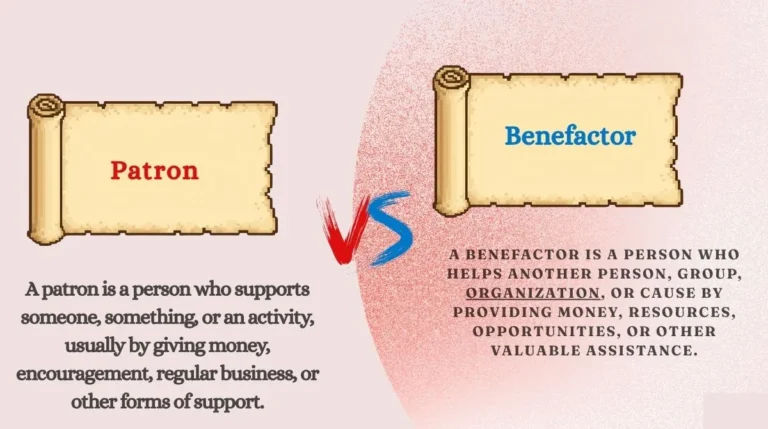
A patron is a person who supports someone, something, or an activity, usually by giving money, encouragement, regular business, or other forms of support.
The word is especially common when we talk about artists, writers, musicians, theaters, museums, charities, cultural programs, or organizations.
For example, a wealthy person who regularly pays for an artist’s work may be called a patron of the arts.
When Do We Use “Patron”?
We use patron when the idea of support is important. The support may be financial, but it does not always have to be direct cash.
A person can be a patron of:
- an artist
- a museum
- a theater
- a charity
- a cultural organization
- a school
- a library
- a particular art or activity
For example:
The museum has several private patrons.
This means several people support the museum, often financially or through other valuable assistance.
The word can also describe someone who regularly uses a service or business:
The restaurant’s patrons enjoyed the new menu.
Here, patrons simply means customers.
So, context is very important.
Grammar Rule for “Patron”
Patron is a countable noun.
You can use:
- a patron
- one patron
- several patrons
- many patrons
- the patron
Its plural form is patrons.
Common structures include:
patron of + person/activity/organization
She is a patron of the local theater.
patron of the arts
He became a well-known patron of the arts.
patron + of a place
The library’s patrons must follow the rules.
Example Sentences with “Patron”
- The artist thanked her patron for supporting her work.
- He has been a loyal patron of the theater for many years.
- The university received support from a generous patron.
- She became a patron of several young musicians.
- The museum’s patrons helped fund a new exhibition.
- The restaurant welcomes its regular patrons every evening.
- He was a famous patron of literature and the arts.
- The library offers free services to all of its patrons.
Notice that the meaning changes slightly depending on context. In sentences about art or charity, patron usually means supporter. In a restaurant or library, it usually means customer or user.
Common Learner Confusion About “Patron”
Many learners assume that a patron is always a person who gives money. That is not always true.
For example:
The café has many regular patrons.
This does not mean wealthy people who financially support the café. It simply means regular customers.
Another common mistake is thinking that patron and customer are completely interchangeable in every situation. While both can refer to people who buy goods or use services, patron can sound more formal and is often used for institutions such as libraries, museums, theaters, and restaurants.
Also remember that a patron often has a continuing connection with what they support. The word can suggest loyalty, regular support, or an ongoing relationship.
What Does “Benefactor” Mean?
A benefactor is a person who helps another person, group, organization, or cause by providing money, resources, opportunities, or other valuable assistance.
The key idea is the benefit received by someone else.
The word is often associated with generosity. A benefactor might pay for someone’s education, donate money to a hospital, help a charity, or provide financial support for a community project.
For example:
An anonymous benefactor paid for the student’s education.
The person gave valuable help to the student, and the word benefactor focuses on that helpful action.
When Do We Use “Benefactor”?
Use benefactor when someone is acting as a giver of benefits or assistance.
The word is common in contexts such as:
- charities
- scholarships
- hospitals
- universities
- community projects
- donations
- foundations
- financial assistance
- people in need
A benefactor does not have to be extremely rich. However, the word often suggests that the person has provided meaningful or valuable help.
For example:
The school thanked its benefactors for their generous donations.
This tells us that the people provided important support, especially through giving.
Grammar Rule for “Benefactor”
Benefactor is a countable noun.
You can use:
- a benefactor
- one benefactor
- several benefactors
- many benefactors
- the benefactor
The plural form is benefactors.
A common sentence pattern is:
benefactor of + person/organization/cause
She became a benefactor of the local hospital.
You can also use:
benefactor + of + person
He was a generous benefactor of young students.
Example Sentences with “Benefactor”
- The hospital received a large donation from an anonymous benefactor.
- Her benefactor helped her continue her education.
- The university thanked its benefactors at the annual ceremony.
- A local businessman became a major benefactor of the charity.
- The young scientist found a benefactor who supported his research.
- The shelter survived because of several generous benefactors.
- His benefactor paid for the medical treatment.
- The foundation was established by a wealthy benefactor.
Common Learner Confusion About “Benefactor”
The biggest confusion is that learners often think benefactor and donor always mean exactly the same thing.
They are related, but not identical.
A donor is someone who gives something, especially money, to a person or organization. A benefactor is someone who provides help or benefit. That help can include money, but the idea is broader.
For example:
She donated $500 to the charity.
You can call her a donor.
But if someone regularly supports the charity, funds important projects, or provides substantial assistance, benefactor may be more suitable.
The word can also sound more formal or literary than donor.
Difference Between Patron and Benefactor
At first glance, patron and benefactor seem almost identical because both describe people who help or support others. The main difference is the kind and focus of the support.
A patron is usually a supporter, often with an ongoing relationship with a person, activity, organization, or field.
A benefactor is usually a giver of benefits, especially someone who provides important financial or material help.
Patron vs Benefactor Comparison Table
| Point | Patron | Benefactor |
|---|---|---|
| Basic meaning | A person who supports someone, activity, or organization | A person who provides help or benefits |
| Main focus | Ongoing support or backing | Benefit, assistance, or generosity |
| Money required? | No | Often, but not always |
| Common areas | Arts, culture, businesses, institutions | Charities, education, healthcare, people in need |
| Relationship | Can suggest an ongoing connection | Focuses more on the help given |
| Another meaning | Customer or user of a place | No common customer meaning |
| Style | Neutral to formal | Usually formal |
| Example | She is a patron of the arts. | He is a benefactor of the university. |
1. Usage Difference
Consider these two sentences:
She is a patron of the arts.
This means she supports the arts, perhaps through money, attendance, sponsorship, or long-term involvement.
Now compare:
She is a benefactor of the arts.
This focuses more strongly on her giving valuable support or resources.
Both sentences can be correct, but the second one gives more attention to the benefit she provides.
2. Grammar Logic
Both words are nouns that refer to people.
We commonly use:
a patron of + noun
a benefactor of + noun
Examples:
He is a patron of the museum.
He is a benefactor of the museum.
The grammar is similar, but the meaning is slightly different.
The first sentence highlights his supporting role.
The second highlights the benefit he provides.
3. Sentence Structure Difference
Both words often appear after verbs such as:
- be
- become
- remain
- thank
- support
- recognize
Examples:
She became a patron of the theater.
She became a benefactor of the theater.
You can also use possessive structures:
The patron’s support helped the artist.
The benefactor’s donation helped the school.
The important thing is to choose the noun based on what you want to emphasize.
4. Meaning Comparison
A simple way to see the difference is:
Patron = supporter
Benefactor = helper or giver of benefits
A patron may support something for years.
A benefactor may be remembered for a major gift or act of generosity.
However, these meanings can overlap. A person can be both a patron and a benefactor.
For example, imagine a woman who regularly supports a museum and also gives it money for a new building. She can be described as a patron of the museum because she supports it, and a benefactor because she provides significant financial help.
Grammar Rules You Must Remember
Rule 1: Use “patron” for a supporter, but remember its customer meaning
A patron can support an activity or organization, but it can also mean a customer or user.
The museum has many loyal patrons.
Here, the meaning depends on context.
The restaurant’s patrons were waiting for their meals.
Here, patrons means customers.
Do not assume that every use of patron involves charity or donations.
Rule 2: Use “benefactor” when someone gives valuable help or benefits
Benefactor usually emphasizes the assistance received by another person or group.
The student thanked her benefactor for paying her school fees.
The important idea is that the person received a benefit.
This word works especially well in formal writing about education, charities, institutions, and donations.
Rule 3: A patron does not have to give money
This is an important point.
You can be a patron through continued support or involvement.
He is a patron of the local theater and attends every major performance.
The sentence does not say that he donated money.
A benefactor, however, is more strongly associated with tangible help.
Rule 4: One person can be both a patron and a benefactor
These words are not opposites.
The museum’s patron became a major benefactor after donating funds for its new gallery.
The same person first had a supporting relationship with the museum and then provided a major financial benefit.
This is why you should not think of the two words as completely separate categories.
Common Mistakes Students Make
Mistake 1: Thinking “patron” always means donor
Incorrect:
Every patron gives money to the organization.
This is too broad.
A patron may provide support in several ways, and in everyday contexts the word may simply mean customer.
Better:
The theater has many loyal patrons.
The exact type of support depends on the context.
Mistake 2: Using “benefactor” for every customer
Incorrect:
The shop thanked its benefactors for buying their products.
That sounds unusual unless those customers are giving unusual or meaningful help.
Better:
The shop thanked its regular patrons for their support.
Here, patrons naturally refers to customers.
Mistake 3: Treating the two words as perfect synonyms
You may see:
She is a patron of the university.
and
She is a benefactor of the university.
Both can be correct, but they do not highlight exactly the same idea.
Patron focuses on support.
Benefactor focuses on the benefit or assistance provided.
Mistake 4: Forgetting that “patron” can describe a customer
This is especially common for learners who only study the word in formal contexts.
The library’s patrons must return books on time.
Here, patrons are simply library users.
Mistake 5: Using “benefactor” when “supporter” is more natural
In everyday conversation, saying:
My benefactor helped me buy lunch.
may sound overly formal.
You could simply say:
Someone helped me buy lunch.
or:
A friend supported me when I needed help.
Benefactor is often more natural in formal, institutional, charitable, historical, or literary contexts.
An Easy Correction Tip
Before choosing the word, ask yourself:
Am I talking about someone who supports something, or someone who provides an important benefit?
If the focus is support or continued backing, think patron.
If the focus is help, donation, or valuable benefit, think benefactor.
Easy Trick to Remember the Difference
Here is a simple memory trick:
Patron = Partner in support
Think of a patron as someone who stands behind a person, activity, organization, or place.
Patron → Support
A patron might regularly support a theater, artist, museum, restaurant, or library.
Benefactor = Benefit giver
The word benefactor contains the idea of benefit.
Think:
Benefactor → Benefit
A benefactor gives something helpful or valuable to someone else.
For example:
The patron supports the museum.
The benefactor gives the museum valuable financial help.
There is another useful trick.
Imagine an artist needs help.
A person who keeps supporting the artist’s work is a patron.
A person who gives the artist a large grant to continue working is a benefactor.
In real life, that same person might be both.
Daily Life Examples
These examples show how the two words sound in natural English.
Example 1: At a Museum
A: Who paid for the new art gallery?
B: A private benefactor donated the money.
Here, benefactor fits because the focus is on a valuable financial gift.
Example 2: At a Theater
A: How does the theater get so much support?
B: It has several loyal patrons.
Here, patrons means people who regularly support the theater.
Example 3: At a Restaurant
A: Why is the restaurant thanking its patrons?
B: They are celebrating their regular customers.
Here, patrons means customers, not donors.
Example 4: At a School
A: Who funded the new science lab?
B: A generous benefactor provided the money.
The sentence highlights the financial help.
Example 5: About Art
A: Was she a famous artist?
B: No, but she was a famous patron of the arts.
She supported artists or artistic activities.
Example 6: About Education
A: How did he afford university?
B: A benefactor helped pay his tuition.
The focus is on the help he received.
Example 7: About a Library
A: Who are these people in the library?
B: They are patrons using the study rooms.
Here, patrons means library users.
Example 8: About a Charity
A: The charity received a large donation last month.
B: Yes, one of its benefactors gave the money.
The word highlights the person’s generous assistance.
Example 9: About Long-Term Support
A: Why has the artist been able to work for so many years?
B: She has a patron who regularly supports her projects.
The idea of continued support makes patron a good choice.
Example 10: Both Words Together
A: Who is that man at the opening?
B: He has been a patron of the museum for years and recently became one of its biggest benefactors.
This is a useful example because both words are correct, but each one gives a different piece of information.
Practice Section
Choose patron or benefactor to complete each sentence.
1.
The university received a large donation from a wealthy ______.
2.
The restaurant thanked its loyal ______ for visiting every week.
3.
She is a well-known ______ of young artists.
4.
The hospital’s anonymous ______ paid for new medical equipment.
5.
The library’s ______ must return borrowed books on time.
Answers
1. Benefactor
A person who gives important financial help to the university can be called a benefactor.
2. Patrons
Here, the word means regular customers of the restaurant.
3. Patron
She supports young artists, so patron is the natural choice.
4. Benefactor
The sentence focuses on a valuable financial contribution.
5. Patrons
People who use a library are commonly called its patrons.
FAQs About Patron vs Benefactor
1. What is the difference between patron and benefactor?
A patron is generally a person who supports a person, activity, organization, or institution. A benefactor is someone who gives help or provides a benefit, often through money or resources.
The words can overlap, but the focus is slightly different.
2. Can a patron also be a benefactor?
Yes. One person can be both.
For example, someone may regularly support a museum as a patron and later donate money for a major project, making that person a benefactor as well.
3. Is “patron” a formal word?
Patron can sound formal, especially when it means a supporter of the arts or an institution.
However, it is also common in everyday English when referring to customers or users of places such as restaurants, theaters, and libraries.
4. Is “benefactor” formal or informal?
Benefactor is generally more formal than common words such as helper, supporter, or donor.
It is often used in writing and speech about charities, universities, hospitals, scholarships, foundations, and major acts of generosity.
5. Can “patron” mean “customer”?
Yes. Patron can mean a customer or user of a business or public place.
For example:
The café’s patrons enjoyed their breakfast.
Here, patrons simply means customers.
6. Which word should I use for someone who gives money to charity?
Both may work, depending on the situation.
Donor is the most direct word for someone who gives money. Benefactor is useful when the person provides meaningful help or support. Patron can work when the person has an ongoing supporting role.
Conclusion
Understanding patron vs benefactor becomes much easier when you focus on the main idea behind each word. A patron is usually a supporter. The person may support an artist, museum, theater, organization, or activity over time. In everyday English, patron can also mean a customer or user of a place.
A benefactor is someone who gives help or provides a benefit to another person, group, or organization. Money is often involved, but the word can describe other valuable forms of assistance too.
Remember this simple pair: patron = supporter, while benefactor = benefit giver. These meanings sometimes overlap, so the context matters.
Try using both words in your own sentences. The more you see them in real situations, the more natural the difference will become. With a little practice, choosing between them will feel much easier.

Evan Rellmont is a writer who turns thoughtful ideas into meaningful words, creating stories and reflections that connect, inspire, and leave a lasting impression.