
Continuous and continual look almost the same, sound very similar, and both come from the idea of something continuing.
That is why even good English learners sometimes pause when they see a sentence such as “continuous rain” or “continual problems.”
The easiest way to begin is to remember one simple idea: continuous usually describes something that goes on without a break, while continual usually describes something that happens again and again.
For example, if rain falls for five hours without stopping, you can call it continuous rain. If your little brother keeps asking you questions every few minutes, you might describe them as continual questions.
However, the difference is not always strict. Modern English often allows some overlap between the two words.
Major dictionaries note that continual can sometimes mean continuous, and continuous can sometimes be used for repeated events.
Still, the traditional difference is useful because it helps learners choose the word that sounds most natural in everyday English.
By the end of this guide, you will know when to use each adjective, how their meanings differ, which common mistakes to avoid, and how to remember the difference without memorizing a difficult grammar rule.
What Does “Continuous” Mean?
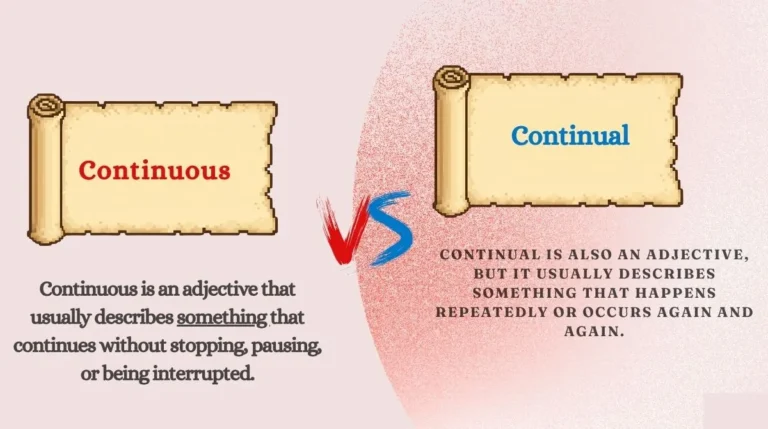
Continuous is an adjective that usually describes something that continues without stopping, pausing, or being interrupted.
Think of a straight line with no gaps. That is a good picture of the word continuous. The action, sound, activity, flow, or situation stays connected from one moment to the next.
Cambridge defines continuous as something that happens without a pause or interruption. It can describe things that last over a period of time, and it can also describe something that forms one unbroken line or area.
When should you use “continuous”?
Use continuous when you want to show that something is happening steadily or existing as one unbroken stretch.
It commonly appears with words such as:
- continuous rain
- continuous noise
- continuous pain
- continuous flow
- continuous work
- continuous improvement
- continuous speech
- continuous supply
For example, “The machine made a continuous noise” means the noise did not keep stopping and starting. It stayed on.
There is also a special grammar meaning. In English grammar, continuous describes verb forms such as I am working, she was sleeping, and they have been waiting. These are also called progressive forms. They show an action that continues over a period of time.
Grammar rule for “continuous”
Continuous + noun is a common structure.
Examples:
continuous rain
continuous movement
continuous pressure
continuous support
You can also use continuous after a linking verb:
The noise was continuous.
The rain remained continuous throughout the night.
The important point is the meaning: there is no real break in the activity or state being described.
Examples of “continuous”
- We had continuous rain all afternoon.
- The baby cried for continuous attention.
- The factory provides a continuous supply of electricity.
- She was in continuous pain after the accident.
- The road has a continuous line in the middle.
- The fan makes a continuous humming sound.
- His continuous efforts helped the team improve.
- The river creates a continuous flow of water.
Notice how the word focuses on an unbroken condition. The rain in example 1 keeps falling. The humming sound in example 6 continues steadily. The line in example 5 has no gaps.
A common learner confusion
Many learners use continuous whenever something happens many times.
That is not always the best choice.
Imagine a teacher who asks you the same question every five minutes:
“Did you finish your homework?”
The questions are repeated. There are small gaps between them. A natural choice is:
The teacher asked continual questions.
By contrast, imagine a loud alarm that keeps sounding without stopping for ten minutes:
The alarm made a continuous sound.
The difference is small but useful: continuous = no break; continual = repeated.
What Does “Continual” Mean?
Continual is also an adjective, but it usually describes something that happens repeatedly or occurs again and again.
This means there may be short breaks between one event and the next. The important idea is repetition.
Cambridge describes continual as something that happens repeatedly, often in a way that is annoying or inconvenient. Oxford gives a similar main meaning and notes that it commonly refers to an action happening again and again.
When should you use “continual”?
Use continual when an event keeps coming back, even though it may stop for a while between occurrences.
Some natural combinations include:
- continual interruptions
- continual complaints
- continual problems
- continual questions
- continual changes
- continual demands
- continual arguments
- continual delays
For example:
We had continual problems with the old car.
This usually does not mean one single problem continued every second. Instead, different problems kept appearing.
Another example:
I can’t study because of the continual interruptions.
Perhaps someone interrupts you, stops, leaves, and then comes back later to interrupt you again. The action is repeated rather than literally unbroken.
Grammar rule for “continual”
Like continuous, continual is an adjective and commonly comes before a noun:
continual problems
continual change
continual interruptions
It can also be used to describe a continuing state, especially in formal or descriptive writing:
They lived in continual fear.
The machine was a continual source of trouble.
This is one reason the two words can sometimes be confusing. Continual has developed a broader range of use over time. Modern dictionaries recognize that it can sometimes carry the meaning of continuous, especially in phrases describing an ongoing state.
Examples of “continual”
- The office was filled with continual interruptions.
- We faced continual delays at the airport.
- His continual complaints annoyed everyone.
- The car needed continual repairs.
- She asked continual questions during the lesson.
- They experienced continual changes in their schedule.
- The project suffered from continual problems.
- He received continual reminders from the company.
In each example, something happens repeatedly. It comes back or happens over and over.
Does “continual” always mean something negative?
No.
It is often used with unwanted things, such as complaints, interruptions, arguments, or problems, which can make the word feel slightly negative in many sentences. Cambridge and Oxford both highlight this common use.
But continual can also describe neutral or positive things:
The continual development of technology has changed our lives.
So do not think that continual automatically means “bad.” The meaning depends on the noun and the context.
Difference Between Continuous and Continual
The simplest distinction is this:
Continuous = something does not stop.
Continual = something happens repeatedly.
That one idea solves most everyday cases.
| Point | Continuous | Continual |
|---|---|---|
| Main idea | Without interruption | Repeated again and again |
| Breaks | Usually no breaks | Breaks may occur |
| Focus | Unbroken duration | Repeated events |
| Common examples | continuous rain, continuous sound | continual problems, continual interruptions |
| Feeling | Often neutral | Often used for annoying or unwanted repetition |
| Grammar | Adjective | Adjective |
| Related adverb | continuously | continually |
1. Usage difference
Consider these two sentences:
It rained continuously for six hours.
The rain did not stop.
Now compare:
It rained continually throughout the week.
This can suggest that rain kept occurring again and again, perhaps with periods when it stopped.
The distinction becomes even clearer with interruptions:
The baby made a continuous sound.
This suggests an unbroken sound.
The baby made continual sounds.
This suggests many separate sounds over time.
2. Grammar logic
The key question is:
Is it one uninterrupted action, or is it a series of repeated actions?
If the answer is “one uninterrupted action,” continuous is usually the natural choice.
If the answer is “many repeated actions,” continual is usually the natural choice.
A simple timeline helps:
Continuous:
Start ───────────────── End
Continual:
Event — pause — Event — pause — Event
The second timeline does not necessarily have equal gaps. It simply shows that the action happens repeatedly.
3. Sentence-structure difference
Both words work as adjectives, so the basic sentence pattern is similar:
continuous + noun
continuous noise
continual + noun
continual noise
But changing the adjective can change the picture in the reader’s mind.
Compare:
We heard continuous noise from the machine.
The machine probably kept making one steady noise.
We heard continual noise from the neighbors.
This may suggest repeated noise or recurring disturbances.
The grammar is similar, but the meaning changes.
4. Meaning comparison
Here is another useful pair:
She was in continuous pain.
This means the pain did not let up.
She suffered from continual pain.
This may also mean the pain persisted, and modern English allows this use. In fact, dictionaries note that the traditional boundary between these words is becoming less strict.
For learners, it is still smart to use the traditional distinction whenever it clearly fits. It makes your writing precise and easy to understand.
Grammar Rules You Must Remember
Rule 1: Use “continuous” for something without a break
When an activity, sound, process, flow, or condition continues without interruption, continuous is usually the best choice.
We experienced continuous rain for three hours.
The rain kept falling. There was no meaningful pause.
More examples:
The patient was in continuous pain.
The machine needs a continuous supply of water.
The road has a continuous white line.
Think one unbroken stretch.
Rule 2: Use “continual” for repeated events
When something happens many times, with possible pauses in between, continual is usually more suitable.
The meeting was disturbed by continual interruptions.
The interruptions were separate events. One interruption ended before another began.
More examples:
He had continual arguments with his brother.
The website has been affected by continual delays.
Her continual questions showed that she was interested.
Think again and again.
Rule 3: Do not treat the distinction as an absolute law
English changes over time, and real usage is not always perfectly divided.
Oxford specifically notes that continual can also mean continuous, while continuous can sometimes be used for repeated events. It also says the distinction between the words is gradually disappearing.
That means you may see:
continual change
even when the change feels ongoing.
You may also see:
continuous attacks
when the writer means repeated attacks over a period.
So learning the traditional distinction is helpful, but you do not need to panic when you encounter an example that does not fit it perfectly.
Rule 4: Remember the difference in the adverbs too
The related adverbs are:
- continuously = without stopping
- continually = repeatedly
For example:
The water flowed continuously through the pipe.
The flow did not stop.
He continually changed his mind.
He changed it again and again.
Oxford notes that continually can also be used for something without a break, while continuously can be used informally for repeated activity. Still, the traditional distinction remains very useful for clear writing.
Common Mistakes Students Make
The biggest mistake is treating continuous and continual as exact synonyms in every situation.
They are close, but they can create different meanings.
Mistake 1: Using “continuous interruptions”
Consider:
❌ The class was stopped by continuous interruptions.
This can be understood, and in modern English it is not necessarily impossible. But if you mean separate interruptions happening repeatedly, the more traditional and precise choice is:
✅ The class was stopped by continual interruptions.
Why? Because an interruption is normally a separate event. One interruption ends, and another happens later.
Mistake 2: Using “continual” for an unbroken physical flow
Suppose water is moving through a pipe without stopping:
✅ The system needs a continuous flow of water.
The word flow here describes an uninterrupted stream, so continuous fits naturally.
You could encounter continual flow in real writing, but continuous flow is the clearer everyday choice for an unbroken physical flow.
Mistake 3: Assuming “continual” always means negative
Some learners remember examples such as “continual complaints” and start believing the word itself means something bad.
That is not correct.
The continual growth of the company created new jobs.
Here, continual does not mean annoying. It describes repeated or ongoing development.
The noun and context create the feeling.
Mistake 4: Confusing the words with “always”
These words do not simply mean always.
For example:
He continually forgets his keys.
This means he forgets them repeatedly.
It does not necessarily mean he is forgetting his keys every single second.
Likewise:
The machine ran continuously for ten hours.
This means it ran without stopping for that period.
Easy correction tip
When you are unsure, ask yourself:
“Did it stop?”
If the answer is no, choose continuous in most cases.
If the answer is yes, but it happened again and again, choose continual.
That quick question works surprisingly well.
Easy Trick to Remember the Difference
Here is a classroom trick that many learners find easy.
Think of “continuous” as one long line
Imagine writing this:
________________________
There are no gaps.
That is continuous.
Now imagine this:
● ● ● ● ●
The dots keep appearing, but there are spaces between them.
That is continual.
So remember:
Continuous = one long line.
Continual = repeated dots.
You can also use two everyday situations.
Imagine rain.
If rain falls for two hours without stopping:
continuous rain
Now imagine your phone.
Your phone keeps giving you notifications every few minutes:
continual notifications
The rain is one uninterrupted activity. The notifications are repeated events.
One more memory trick:
Continuous → continue with no cut.
Continual → comes again and again.
It is not a perfect word-history lesson, but it is a useful memory aid for learners.
Daily Life Examples
Here are natural examples you may hear in everyday conversations.
1. Talking about rain
A: How was your trip?
B: Terrible! We had continuous rain for almost the whole day.
The rain did not really stop.
2. Talking about complaints
A: Why did you leave that job?
B: There were continual complaints from customers.
The complaints kept coming repeatedly.
3. Talking about noise
A: What’s that sound?
B: The air conditioner. It makes a continuous buzzing noise.
The buzzing stays on.
4. Talking about interruptions
A: Did you finish your report?
B: Not yet. I had continual interruptions all morning.
People kept interrupting the speaker.
5. Talking about pain
A: How is your injury now?
B: Better, but I had continuous pain last night.
The pain did not stop.
6. Talking about questions
A: Why were you late?
B: My little son asked continual questions while we were getting ready.
The questions came again and again.
7. Talking about water
A: Why do you need this pump?
B: The plants need a continuous supply of water.
The supply needs to remain steady.
8. Talking about changes
A: The schedule looks different again.
B: Yes, there have been continual changes this month.
The schedule has changed repeatedly.
9. Talking about studying
A: How did you improve your English?
B: I practiced continuously for several weeks without taking long breaks.
The focus is on an unbroken period of practice.
10. Talking about someone’s habits
A: Why is Sam checking his phone?
B: He continually checks it during meetings.
He does it repeatedly.
These examples show why context matters. The words often look interchangeable at first, but the mental picture is different.
Practice Section
Choose continuous or continual in each sentence.
1. We had __________ rain throughout the night.
2. The teacher became frustrated by the students’ __________ questions.
3. The machine produces a __________ sound.
4. Our old car has caused __________ problems this year.
5. The hospital needs a __________ supply of clean water.
Answers
1. continuous
The rain is presented as an uninterrupted activity.
2. continual
The students asked questions repeatedly.
3. continuous
The sound is described as steady and unbroken.
4. continual
The problems happened again and again.
5. continuous
The water supply needs to remain unbroken or steady.
A useful habit is to explain the answer to yourself, not just memorize it. Ask whether you see one uninterrupted action or repeated events.
FAQs About Continuous vs Continual
What is the difference between continuous and continual?
Continuous usually means happening without stopping or interruption. Continual usually means happening repeatedly or again and again. For example, continuous rain does not stop, while continual complaints happen repeatedly. Modern English sometimes allows the two words to overlap.
Can we use continuous in questions?
Yes. There is no grammar problem with using continuous in questions.
For example:
Was the noise continuous?
Has the pain been continuous?
Did you experience continuous rain?
The important thing is the meaning. Use it when you are asking about something that continued without a break.
Can we use continual in questions?
Yes. Continual can also appear naturally in questions.
For example:
Why are there continual delays?
Did the team face continual problems?
Are these continual interruptions necessary?
These questions usually refer to something that keeps happening repeatedly.
Is continuous more formal than continual?
Neither word is simply “the formal one.” Both are standard English adjectives and can appear in everyday speech and formal writing.
The main difference is meaning, not formality. Continuous usually highlights an unbroken action, while continual usually highlights repeated events.
Can continuous and continual mean the same thing?
Sometimes, yes.
Modern dictionaries explain that the distinction between the words has become less strict. Continual can sometimes mean “without interruption,” and continuous can sometimes describe repeated activity. Even so, the traditional distinction remains useful for learners who want precise, natural English.
Which is correct: continuous problems or continual problems?
Both expressions can be found, but continual problems is often the clearer choice when you mean that problems keep appearing one after another.
Continuous problems may be understood as problems that persist without a break, and modern usage does allow this wording. For repeated problems, however, continual problems matches the traditional distinction more closely.
Conclusion
The difference between continuous and continual becomes much easier when you stop focusing on their similar spelling and focus on the kind of action they describe.
Continuous usually means something happens without a break. Think of continuous rain, continuous noise, continuous pain, or a continuous flow of water.
Continual usually means something happens again and again. Think of continual interruptions, continual complaints, continual questions, or continual delays.
There is some overlap in modern English, and dictionaries recognize that the traditional difference is not always followed. Still, the basic rule is a great guide: continuous = unbroken; continual = repeated.
When you write or speak, picture the situation in your mind. Is it one long, uninterrupted line? Choose continuous. Are separate events returning again and again? Choose continual.
A few real-life examples and a little practice will make the difference feel natural very quickly.

Evan Rellmont is a writer who turns thoughtful ideas into meaningful words, creating stories and reflections that connect, inspire, and leave a lasting impression.