
When you are learning English, some clothing words can be confusing because they describe clothes that are often worn together.
Leotard and tights are a good example. You may hear a dance teacher say, “Wear your leotard and tights,” and wonder why two different words are needed for clothes that both fit closely to the body.
The confusion usually comes from the fact that both items are common in ballet, gymnastics, dance, theater, and exercise.
They are both close-fitting, stretchy, and often made from similar materials. However, they do not cover the same parts of the body.
A leotard is a close-fitting one-piece garment that covers the upper body and ends at the tops of the legs. It may have short sleeves, long sleeves, or no sleeves.
Cambridge describes it as a tight piece of clothing that covers the body but not the legs, while Oxford explains that it fits closely from the neck or shoulders to the tops of the legs.
Tights, on the other hand, cover the legs and usually the feet, beginning around the waist or hips. In dance and exercise, tights can be thicker than the very thin tights worn under dresses and skirts.
Learning the difference is useful because you may need these words when talking about clothes, school uniforms, ballet lessons, gymnastics, performances, shopping, or getting dressed.
By the end, you will know exactly what each word means, how to use them in sentences, why tights is normally treated as a plural noun, and how to avoid common learner mistakes.
What Does “Leotard” Mean?
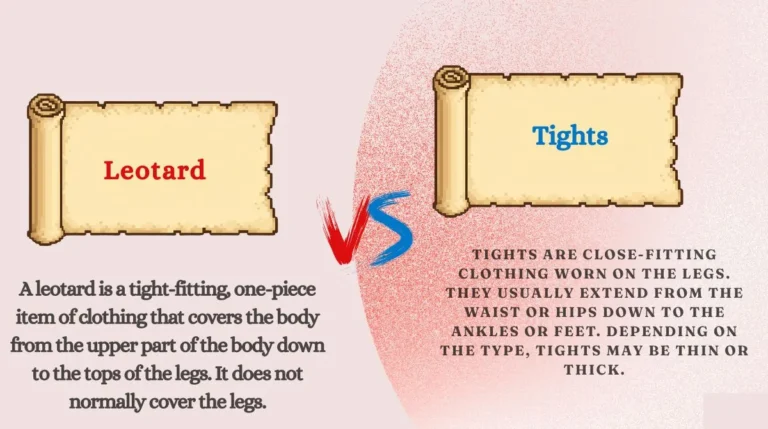
A leotard is a tight-fitting, one-piece item of clothing that covers the body from the upper part of the body down to the tops of the legs. It does not normally cover the legs. It is often worn by dancers, gymnasts, acrobats, and people doing physical exercise.
Think of a leotard as a one-piece outfit for the torso and upper legs.
It can be sleeveless, short-sleeved, or long-sleeved. The exact style can change, but the important idea stays the same: it is a close-fitting garment that covers the upper body and stops around the hips or upper thighs.
The word leotard is a countable noun. That means you can talk about a leotard, one leotard, two leotards, or several leotards.
When do we use “leotard”?
We usually use leotard when talking about clothing for:
- ballet and other forms of dance
- gymnastics
- acrobatics
- stage performances
- exercise and movement
- some types of physical training
For example:
- The dancer wore a black leotard to class.
- My daughter needs a new leotard for ballet.
- The gymnast chose a blue leotard for practice.
- This leotard has long sleeves.
- She packed her leotard and ballet shoes.
- The teacher asked everyone to bring a clean leotard.
- He bought two leotards for the competition.
- The costume department designed a bright red leotard.
Notice the grammar in these examples. We can put a before the singular noun:
- a leotard
- the leotard
- my leotard
- this leotard
We can also make it plural:
- leotards
- two leotards
- several leotards
- many leotards
A common learner confusion with “leotard”
Some learners think that a leotard covers the whole body because it looks like a very tight outfit. Usually, that is not correct.
A standard leotard covers the torso but not the legs. Tights are often added when the person wants the legs covered. Cambridge and Oxford both make this distinction in their definitions.
For example:
She wore a leotard and tights.
This means she had one garment covering her upper body and another garment covering her legs.
It is also useful to know the difference between a leotard and a unitard. A unitard generally continues down the legs, while a traditional leotard does not. So, when you picture a leotard, think upper body + upper legs, not full legs.
Another interesting detail is the word’s history. Leotard comes from the name of Jules Léotard, a nineteenth-century French aerial performer.
What Does “Tights” Mean?
Tights are close-fitting clothing worn on the legs. They usually extend from the waist or hips down to the ankles or feet. Depending on the type, tights may be thin or thick.
In everyday British English, tights can mean the thin clothing worn under skirts and dresses. In dance and exercise, the same word can refer to thicker, stretchy clothing that covers the legs. Cambridge gives both of these meanings.
In American English, pantyhose is commonly used for the very thin type worn under skirts and dresses, while tights often refers to thicker legwear. Oxford also notes the British-English and North-American distinction.
The most important grammar point is this:
Tights is normally a plural noun.
You do not usually say:
I bought a tights.
Instead, you say:
I bought a pair of tights.
This is similar to words such as trousers, shorts, and jeans. The item has two leg sections, so English normally treats the clothing word as plural.
When do we use “tights”?
We can use tights when talking about:
- ballet and dance clothing
- clothing worn under dresses and skirts
- exercise clothing
- warm legwear
- stage costumes
- certain types of performance clothing
Here are some examples:
- She bought a new pair of tights for ballet class.
- My black tights have a small hole.
- The dancer wore pink tights with her leotard.
- I need thicker tights because it is cold outside.
- These tights are very comfortable.
- The child put on her tights before the performance.
- She wore green tights under her dress.
- Please bring a clean pair of tights tomorrow.
Grammar rule for “tights”
Because tights is normally plural, we use plural grammar with it:
- These tights are comfortable.
- My tights are new.
- The tights look good.
- Her tights were on the chair.
We do not normally say:
These tights is comfortable.
The correct form is:
These tights are comfortable.
When you need to count them as individual items, use a pair of tights:
- a pair of tights
- two pairs of tights
- three pairs of tights
This is one of the biggest grammar differences between leotard and tights.
Difference Between Leotard and Tights
The easiest way to understand leotard vs tights is to look at what part of the body each item covers.
A leotard mainly covers the upper body and stops at the tops of the legs. Tights cover the lower body and legs, usually from the waist or hips down to the ankles or feet.
That is why dancers often wear them together.
Leotard vs tights comparison table
| Feature | Leotard | Tights |
|---|---|---|
| Basic meaning | Close-fitting one-piece garment | Close-fitting legwear |
| Main body area | Torso and upper legs | Waist, hips, legs, and often feet |
| Covers the legs? | Normally no | Yes |
| Covers the upper body? | Yes | No |
| Grammar | Countable singular/plural noun | Usually plural noun |
| Common form | a leotard | a pair of tights |
| Common users | Dancers, gymnasts, performers | Dancers, exercisers, people wearing skirts/dresses |
| Can be worn together? | Yes | Yes |
| Example | She wore a leotard. | She wore tights. |
The main usage difference
Imagine a ballet dancer getting ready for class.
First, she puts on a leotard. This covers her torso. Then she puts on tights. These cover her legs.
So you can think of the outfit like this:
Leotard = upper body
Tights = legs
That simple picture solves most confusion.
Cambridge even uses the example of ballet students wearing a leotard and tights, showing how naturally the two clothing words can appear together.
Grammar logic
The grammar is also different.
Leotard is a normal countable noun:
- a leotard
- one leotard
- two leotards
Tights is normally plural:
- tights
- a pair of tights
- two pairs of tights
Compare these:
I need a leotard.
I need a pair of tights.
Not:
I need a tights.
This difference is especially important for learners who are studying English articles such as a and an.
Sentence structure difference
With leotard, common structures include:
Subject + wear + a/the/my + leotard
She wears a leotard.
Subject + buy + a + leotard
I bought a leotard.
With tights, you can use:
Subject + wear + tights
She wears tights.
Or:
Subject + buy + a pair of tights
I bought a pair of tights.
This is why the two words may look similar in meaning but behave differently in a sentence.
Meaning comparison
The words are related because both describe close-fitting clothing, especially in dance and exercise. However, they are not synonyms.
Calling tights a leotard changes the meaning because one word refers mainly to the upper-body garment and the other refers to legwear.
For example:
She is wearing a leotard.
This tells us about the garment on her torso.
She is wearing tights.
This tells us about the clothing covering her legs.
She is wearing a leotard and tights.
Now we know she is wearing both pieces.
Grammar Rules You Must Remember
Rule 1: Use “a” with a singular leotard
Leotard is a countable noun, so a singular form can take a or the.
Correct:
She bought a leotard.
The girl wore a leotard to class.
I like that leotard.
You can also make it plural:
The store sells colorful leotards.
A common mistake is forgetting the article:
She bought leotard.
For a singular countable noun, this is normally incorrect in standard English. Say:
She bought a leotard.
Rule 2: Treat “tights” as a plural noun
The word tights normally takes plural grammar.
Correct:
My tights are too small.
Incorrect:
My tights is too small.
This rule is easy to remember when you treat tights like trousers or shorts.
For one item, English commonly uses a pair of tights:
I need a pair of tights.
For more than one:
She bought two pairs of tights.
Rule 3: Use “a pair of tights” when counting tights
Because tights is plural, we usually do not place a number directly before it.
Incorrect:
I bought two tights.
Correct:
I bought two pairs of tights.
For one:
I bought a pair of tights.
However, in casual conversation, you may sometimes hear people talking about “a tight” in another sense, but that does not mean one complete item of standard legwear. For learners, a pair of tights is the safe and natural expression.
Rule 4: “Leotard” and “tights” can be used together
These words are not competing names for the exact same garment. They often describe two different parts of an outfit.
For example:
The dancer wore a purple leotard and tights.
The children need leotards and tights for the class.
Her leotard matched her pink tights.
Remember that one garment covers the upper body while the other covers the legs. That is why the combination makes sense.
Common Mistakes Students Make
Many mistakes happen because both clothing items are associated with ballet and gymnastics. Learners may remember the general idea of “tight dance clothes” but forget which word names which garment.
Mistake 1: Saying “a tights”
Incorrect:
She is wearing a tights.
Correct:
She is wearing tights.
Or:
She is wearing a pair of tights.
The problem is grammatical. Tights is normally plural.
Mistake 2: Saying “a tights” with “is”
Incorrect:
My tights is black.
Correct:
My tights are black.
The plural form requires a plural verb.
Mistake 3: Thinking a leotard covers the legs
A learner may imagine a leotard as a full-body suit because it is tight and usually used for exercise.
Remember that a traditional leotard does not normally cover the legs. Tights are the garment that provides leg coverage.
Mistake 4: Confusing tights with leggings
Tights and leggings can look similar, especially in modern sportswear, but they are not always used in exactly the same way.
Tights are traditionally close-fitting legwear and often continue to the feet. Leggings usually stop at the ankles and are worn more like trousers.
For example:
She wore black tights under her dress.
She wore black leggings with a long shirt.
Both can cover the legs, but the clothing styles and typical uses are different.
Mistake 5: Using “leotard” for the whole outfit
A dancer may wear:
a leotard + tights + ballet shoes
The leotard is only one part of the outfit. It should not automatically be used to describe everything the dancer is wearing.
Easy correction tips
When you see the word leotard, ask yourself:
“Does this cover the upper body?”
Usually, yes.
When you see tights, ask:
“Do these cover the legs?”
Yes.
Then check the grammar:
a leotard
but
a pair of tights
That three-part memory can prevent most mistakes.
Easy Trick to Remember the Difference
Here is a simple classroom trick:
Think “top” for leotard and “legs” for tights.
Leotard → body
Tights → legs
Picture a dancer standing in front of a mirror.
The leotard is the close-fitting clothing on the dancer’s torso. The tights continue down the legs. They work as a team, but they are two different garments.
There is also a useful word connection:
tights sounds connected to tight.
Tights are clothing that fits tightly around the legs.
For leotard, focus less on the spelling and more on the shape. Imagine a one-piece dance garment ending around the upper legs.
Another useful memory sentence is:
The leotard covers the body; the tights cover the legs.
Say that sentence a few times and the difference becomes much easier to remember.
A real-life logic trick
Imagine you are buying clothes for a ballet class.
The shop assistant asks:
“Do you need a leotard or tights?”
You can answer:
“I need a leotard for my upper body.”
or:
“I need a pair of tights for my legs.”
If you need both:
“I need a leotard and a pair of tights.”
This is much easier than trying to memorize a long dictionary definition.
Daily Life Examples
These examples use natural sentences you may hear in real conversations.
Example 1: At a dance class
Teacher: Did you bring your leotard and tights?
Student: Yes. They are in my bag.
Here, the teacher is asking about two pieces of dance clothing.
Example 2: Shopping for ballet clothes
Parent: What do you need for ballet?
Child: I need a pink leotard and a pair of tights.
The word a goes with the singular countable noun leotard, while a pair of is used with tights.
Example 3: Getting ready
Sara: What are you wearing for practice?
Mia: My black leotard and blue tights.
Both words can appear naturally in the same sentence.
Example 4: Talking about a problem
Anna: Why did you change your clothes?
Lisa: There was a hole in my tights.
This is a common way to talk about damaged tights.
Example 5: Asking about size
Customer: Do you have this leotard in a larger size?
Shop Assistant: Yes, we have one in the next size.
Notice that leotard works like an ordinary singular noun.
Example 6: Choosing an outfit
Teacher: Which tights should I wear with this leotard?
Student: The black ones would look nice.
The two garments can be matched by color and style.
Example 7: Preparing for a performance
Mom: Have you packed everything?
Daughter: I packed my leotard, tights, shoes, and costume.
This shows that a leotard and tights are often treated as separate items in a dance outfit.
Example 8: Talking about cold weather
Emily: Are you cold in that dress?
Nora: A little. I should wear tights.
Here, tights provide extra coverage for the legs.
Example 9: At a gymnastics lesson
Coach: Please make sure your leotard fits properly.
Student: Okay. I will change before class.
The word leotard is common in gymnastics and other physical activities.
Example 10: Buying more than one item
Customer: How many pairs of tights do you need?
Dancer: Two pairs. I also need two leotards.
This example shows the different counting patterns clearly.
Practice: Choose the Correct Option
Choose the correct word or phrase in each sentence.
1. She wore a black ______ to ballet class.
A. tights
B. leotard
2. I bought a new pair of ______ yesterday.
A. leotard
B. tights
3. My tights ______ very comfortable.
A. is
B. are
4. The dancer packed her ______ and ballet shoes.
A. leotard
B. tights
5. We need two ______ for the performance.
A. leotards
B. pairs of leotard
Answers
1. B — leotard
A leotard is the close-fitting one-piece garment worn on the upper body.
2. B — tights
We normally say a pair of tights.
3. B — are
Tights is normally treated as a plural noun, so use are.
4. A — leotard
The sentence names the garment worn on the upper body.
5. A — leotards
Because leotard is countable, the plural form is leotards.
FAQs
What is the difference between a leotard and tights?
A leotard is a close-fitting one-piece garment that covers the upper body and normally stops at the tops of the legs. Tights cover the legs and usually begin at the waist or hips. Dancers often wear both together.
Can you wear a leotard with tights?
Yes. This is very common in dance, ballet, gymnastics, and similar activities. The leotard covers the torso, while the tights cover the legs. Cambridge specifically gives ballet clothing as an example of a leotard being worn with tights.
Is “tights” singular or plural?
Tights is normally treated as a plural noun. We say, “My tights are new,” not “My tights is new.” When counting one item, English commonly uses a pair of tights.
Can we say “a tights”?
No, not in standard English when referring to one complete garment of tights. Say tights or a pair of tights. For example, “I bought a pair of tights” is correct.
Is “leotard” a countable noun?
Yes. Leotard is a countable noun. You can say a leotard, one leotard, two leotards, or several leotards. This makes its grammar different from the usual plural form of tights.
Are tights and leggings the same thing?
Not always. Tights traditionally fit closely around the legs and may cover the feet, while leggings usually stop at the ankles and are worn more like trousers. The exact styles can vary, but they are generally treated as different types of clothing.
Conclusion
The difference between leotard and tights is much easier once you focus on the part of the body each garment covers.
A leotard is a close-fitting one-piece garment for the upper body that normally ends at the tops of the legs. Tights are close-fitting legwear that covers the legs and may also cover the feet. They are often worn together by dancers, gymnasts, and performers.
The grammar is important, too. Leotard is a countable noun, so you can say a leotard or two leotards. Tights is normally plural, so use a pair of tights when you need to count one item.
The easiest memory trick is simple: leotard = body, tights = legs.
Once you understand that basic picture and practice a few natural sentences, you will have much less trouble choosing the right word. Try using both words in your everyday English, especially when talking about clothes, dance, exercise, or shopping.

Evan Rellmont is a writer who turns thoughtful ideas into meaningful words, creating stories and reflections that connect, inspire, and leave a lasting impression.