
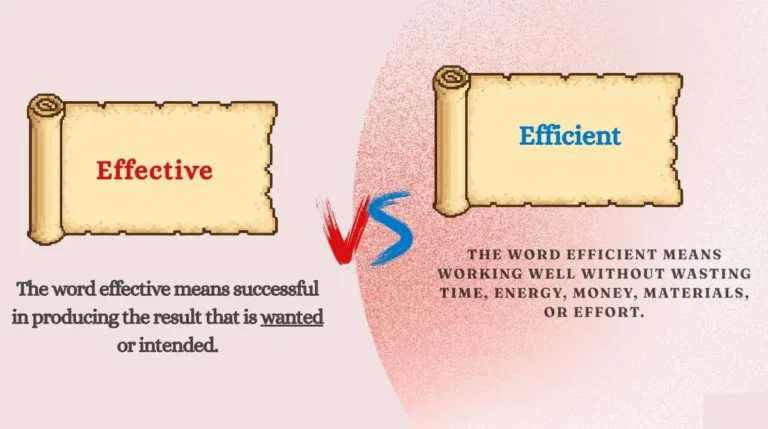
The words effective and efficient are very common in English. You may hear them at school, at work, in business, or in everyday conversations.
The problem is that they often appear in similar sentences, so many learners think they mean exactly the same thing.
They are related, but there is an important difference.
When something is effective, it works and produces the result you want. When something is efficient, it does the job with little waste of time, energy, money, or other resources.
In simple words, effective is about getting the right result, while efficient is about getting the result in a smart way.
For example, a study method can be effective because it helps you pass an exam. But it may not be efficient if you spend ten hours studying something that you could learn in three hours.
Knowing this difference can make your English more accurate. It also helps you describe people, methods, tools, systems, plans, and processes more clearly.
By the end of this guide, you will know how to use effective vs efficient correctly, understand their grammar, avoid common mistakes, and choose the right word in real-life situations.
What Does “Effective” Mean?
The word effective means successful in producing the result that is wanted or intended.
When something is effective, it works. It achieves its purpose.
Think about the question:
“Does it work?”
If the answer is yes, you can often use effective.
For example, if a teacher uses a simple teaching method and students understand the lesson, that method is effective. If a medicine helps reduce pain, it is effective. If a safety rule prevents accidents, it is effective.
When Do We Use “Effective”?
We use effective when we want to focus on the result or outcome.
It can describe many things, including:
- methods
- plans
- treatments
- rules
- communication
- strategies
- solutions
- tools
- actions
- people
The key idea is success.
Grammar Rule for “Effective”
Effective is an adjective.
It normally comes before a noun or after a linking verb such as be, seem, become, look, or prove.
Common patterns include:
effective + noun
- an effective method
- an effective solution
- an effective strategy
be + effective
- This method is effective.
- The treatment was effective.
Examples of “Effective”
- Regular practice is an effective way to improve your English.
- The teacher found an effective method for helping weak students.
- This medicine is effective against the infection.
- She gave an effective presentation at the meeting.
- The new rule has been very effective.
- Exercise can be an effective way to reduce stress.
- We need an effective solution to this problem.
- His advice proved effective in the end.
Common Learner Confusion
A common mistake is to think that effective automatically means fast or easy.
It does not.
Something can work very well and still take a long time.
For example:
The treatment was effective, but recovery took several weeks.
The treatment produced the desired result, so it was effective. The sentence does not say that the treatment was quick.
Another important point is that something can be effective without being efficient.
Imagine a worker completes a task correctly but takes twice as long as necessary. The worker was effective because the task was completed successfully. However, the process was not very efficient.
So remember:
Effective = successful result.
What Does “Efficient” Mean?
The word efficient means working well without wasting time, energy, money, materials, or effort.
The focus is not only on the final result. It is also on how the result is achieved.
Think about the question:
“Does it work in a smart and economical way?”
If the answer is yes, efficient may be the better word.
For example, a machine that makes 1,000 products quickly while using very little energy is efficient. A worker who finishes a task accurately in a short amount of time may also be described as efficient.
When Do We Use “Efficient”?
We use efficient when we are talking about the use of resources.
These resources can include:
- time
- money
- energy
- fuel
- materials
- effort
- space
- labor
It is often used to describe systems, workers, machines, processes, businesses, and methods.
Grammar Rule for “Efficient”
Efficient is also an adjective.
It can appear before a noun:
- an efficient system
- an efficient worker
- an efficient machine
It can also follow a linking verb:
- The new system is efficient.
- She is very efficient.
- This process seems efficient.
Common patterns include:
efficient + noun
be/seem/become + efficient
Examples of “Efficient”
- She is an efficient employee who finishes her work on time.
- The new machine is more efficient than the old one.
- We need a more efficient way to organize these files.
- Public transport can be an efficient way to travel around a busy city.
- The company has introduced an efficient system for handling orders.
- He is very efficient at managing his time.
- This car is more fuel-efficient than my old one.
- The team developed an efficient process that saves both time and money.
Common Learner Confusion
Many students use efficient whenever they mean good.
But efficient does not simply mean good.
For example:
She is a good teacher.
This tells us very little about how she uses time or resources.
She is an efficient teacher.
This suggests that she teaches or handles her work in an organized way, without wasting time or effort.
Also, a thing can be efficient even when it is not the most effective option.
For example, a study technique may allow you to finish your homework very quickly, but you may remember very little afterward.
That technique might be efficient, but not very effective.
So remember:
Efficient = little waste, smart use of resources.
Difference Between Effective and Efficient
The easiest way to understand the difference is to focus on two questions:
Effective: Did it achieve the desired result?
Efficient: Did it achieve the result with little waste?
This difference is small but very useful.
| Word | Main Meaning | Main Focus | Example |
|---|---|---|---|
| Effective | Produces the desired result | Success or outcome | The treatment was effective. |
| Efficient | Produces a result with little waste | Time, effort, money, energy, etc. | The new system is efficient. |
Usage Difference
Use effective when the result matters most.
The advertising campaign was effective.
This means the campaign achieved its purpose, perhaps by bringing in more customers.
Use efficient when the process matters.
The advertising campaign was efficient.
This suggests that the campaign achieved its goal while using resources wisely.
You can even use both words together:
The new system is both effective and efficient.
That means it gets the desired result and does so without unnecessary waste.
Grammar Logic
Both effective and efficient are adjectives.
They can modify nouns:
- an effective plan
- an efficient plan
They can also appear after linking verbs:
- The plan is effective.
- The plan is efficient.
The grammar is similar, but the meaning changes.
Compare:
This is an effective way to learn vocabulary.
The method helps you learn vocabulary successfully.
This is an efficient way to learn vocabulary.
The method helps you learn vocabulary without spending unnecessary time or effort.
Sometimes the same thing can be both:
Flashcards are an effective and efficient way to review new words.
They can help you remember the words while making good use of your study time.
Sentence Structure Difference
There is no major grammatical structure difference between the two words because both are adjectives.
For example:
Subject + be + adjective
- The plan is effective.
- The plan is efficient.
Adjective + noun
- an effective plan
- an efficient plan
The difference is mostly semantic, which means the meaning or focus is different.
Meaning Comparison
Imagine that you need to clean a very dirty room.
You spend three hours cleaning it, and at the end the room is completely clean.
Your cleaning method was effective because it produced the desired result.
Now imagine you clean the same room in 45 minutes using less effort and without wasting cleaning products.
That method was efficient.
The best method is both:
It gets the job done and uses resources wisely.
This is why effective and efficient are often mentioned together in business, education, management, technology, and daily life.
Grammar Rules You Must Remember
Rule 1: Use “Effective” for Successful Results
Use effective when something successfully achieves its purpose.
Example:
The teacher’s new method was effective because students improved their test scores.
The important point is the result: the students improved.
Rule 2: Use “Efficient” for Saving Time, Energy, or Resources
Use efficient when something works without unnecessary waste.
Example:
The new computer system is efficient because it saves employees several hours each week.
Here, the focus is on saving time.
Rule 3: Something Can Be Effective but Not Efficient
A method can work even when it wastes resources.
Example:
The advertising strategy was effective, but it was not efficient because it cost too much money.
The strategy achieved the goal, but it used more money than necessary.
This is one of the most useful differences to remember.
Rule 4: Something Can Be Efficient but Not Effective
A method can save time or effort but still fail to produce the desired result.
Example:
His study routine was efficient, but it was not effective because he still failed the exam.
He may have spent only a short amount of time studying, but the method did not help him achieve the real goal.
The ideal situation is to be both effective and efficient.
Common Mistakes Students Make
The confusion usually happens because both words are connected with the idea of something working well.
Students often learn them as synonyms, but they are not exact synonyms.
Mistake 1: Using “Efficient” When You Mean “Successful”
Incorrect:
The medicine was efficient in treating the illness.
Better:
The medicine was effective in treating the illness.
Why?
The sentence is mainly talking about whether the medicine worked.
You may use efficient when talking about how treatment is delivered, but effective is normally the natural choice for success in treating a problem.
Mistake 2: Using “Effective” When the Main Idea Is Saving Time
Incorrect:
She is an effective worker because she completes the task very quickly with little waste.
This sentence is not impossible, but efficient is more precise if the main point is speed and good use of resources.
Better:
She is an efficient worker because she completes the task quickly with little waste.
Mistake 3: Thinking “Effective” Means “Fast”
Incorrect idea:
The process is effective because it takes only five minutes.
Taking five minutes does not prove that something is effective.
Better:
The process is efficient because it takes only five minutes.
To call something effective, you need to focus on the result.
Mistake 4: Thinking “Efficient” Means “Perfect”
Efficient does not mean perfect.
A process can be efficient while still producing a poor result.
For example:
The company has an efficient delivery system, but the product itself is poor.
The delivery process may be fast and organized, but that does not make the product effective or successful.
Easy Correction Tip
Before choosing the word, ask yourself:
Am I talking about the result?
Choose effective.
Am I talking about saving time, money, energy, or effort?
Choose efficient.
This simple question can solve most mistakes.
Easy Trick to Remember the Difference
Here is a very easy memory trick:
Effective = End Result
Think about the letter E in effective as End result.
Ask:
“Did I get what I wanted?”
If yes, the action or method was effective.
Efficient = Economy
Think about efficient as being connected to economy.
An efficient system avoids waste.
Ask:
“Did I use my time, money, energy, or effort wisely?”
If yes, it was efficient.
A Simple Real-Life Example
Suppose you have an exam tomorrow.
You study for six hours and finally understand everything.
Your study method was effective.
Now imagine your friend understands the same material in two hours because they use a better study plan.
Your friend’s method was more efficient.
The strongest result would be:
A study method that is both effective and efficient.
It helps you learn well without wasting your time.
So keep this sentence in your mind:
Effective gets the job done. Efficient gets the job done with less waste.
Daily Life Examples
These words appear naturally in everyday English. Here are some simple conversation-style examples.
1. At School
Student: Do you think flashcards are useful?
Teacher: Yes. They can be an effective way to learn new vocabulary.
Here, the focus is on successful learning.
2. At Work
Manager: How is Ali doing with his new responsibilities?
Coworker: He is very efficient. He finishes his work quickly and rarely misses a deadline.
The focus is on time and organization.
3. Talking About a Machine
Person A: Is this washing machine any good?
Person B: Yes. It is effective at removing stains and very efficient with water.
The two words describe different strengths.
4. Discussing a Plan
A: Did the emergency plan work?
B: Yes, it was very effective.
The important fact is that the plan succeeded.
5. Saving Time
A: How do you finish your emails so quickly?
B: I use an efficient system that helps me sort them by priority.
The focus is on saving time and effort.
6. Studying English
A: Is watching English videos a good way to learn?
B: It can be effective, especially when you listen carefully and practice afterward.
The focus is on whether it helps you learn.
7. Household Chores
A: Why do you use that cleaning machine?
B: It’s very efficient. It cleans the floor quickly and uses very little water.
The focus is on time and resources.
8. Health and Exercise
A: Is walking an effective form of exercise?
B: Yes, regular walking can be an effective way to stay active.
The focus is on the result.
9. Running a Business
A: Why did the company change its ordering process?
B: They wanted a more efficient system that would reduce delays and paperwork.
The focus is on improving the process.
10. A Useful Combination
A: Is your new study plan good?
B: Yes. It’s effective because I remember more, and efficient because I spend less time studying.
This example shows the difference perfectly.
Practice Section
Choose the correct word: effective or efficient.
1.
The new software is very ______ because it saves the staff a lot of time.
2.
The teacher used an ______ method that helped all the students understand the lesson.
3.
The plan was ______ because it achieved the goal, but it took too much money to carry out.
4.
We need a more ______ way to manage our daily schedule.
5.
The treatment was highly ______ and helped the patient recover.
Answers
1. Efficient
The sentence focuses on saving time.
2. Effective
The method successfully helped students understand.
3. Effective
The plan achieved the goal, even though it was costly.
4. Efficient
The focus is on managing time and effort better.
5. Effective
The treatment worked and produced the desired result.
FAQs
1. What is the difference between effective and efficient?
Effective means something successfully produces the desired result. Efficient means something achieves a result while using time, energy, money, or effort wisely. Something can be effective without being efficient, and vice versa.
2. Can something be both effective and efficient?
Yes. In fact, that is often the ideal situation. For example, a study method can be effective because it helps you learn well and efficient because it helps you learn without wasting time or effort.
3. Is “effective” formal or informal?
Effective is a normal English adjective used in both formal and informal situations. You can use it in everyday speech as well as in school, business, academic, and professional writing.
4. Is “efficient” only used for machines and businesses?
No. Efficient can describe people, systems, methods, machines, routines, and processes. You can say an efficient worker, an efficient machine, or an efficient way to study.
5. Is effective the same as successful?
They are very close in some situations, but they are not always interchangeable. Effective usually means that something produces the intended result or works well for its purpose. Successful is broader and can describe people, events, projects, or achievements.
6. Can I say “efficient method” and “effective method”?
Yes, but they express different ideas. An effective method gets the desired result. An efficient method gets the result while using resources wisely. Depending on the situation, a method may be one, the other, or both.
Conclusion
The difference between effective vs efficient becomes much easier when you focus on the main idea behind each word.
Effective is about the result. Something is effective when it works and achieves its intended purpose.
Efficient is about the process and resources. Something is efficient when it works without wasting time, energy, money, materials, or effort.
A simple way to remember the difference is:
Effective = gets the right result.
Efficient = gets the result with less waste.
For example, a study method can be effective because it helps you pass your exam. It can be efficient because it helps you prepare in less time. The best method is often both effective and efficient.
Try to notice these words in conversations, books, lessons, and workplace English. The more examples you see and use, the more natural the difference will feel.

Evan Rellmont is a writer who turns thoughtful ideas into meaningful words, creating stories and reflections that connect, inspire, and leave a lasting impression.