
Many English learners see the words Neandertal and Neanderthal and wonder whether one of them is a spelling mistake.
At first glance, the difference looks very small. One word has an h, while the other does not.
That tiny letter can make students hesitate when writing about ancient humans, history, fossils, evolution, or anthropology.
The good news is that both Neandertal and Neanderthal are accepted spellings in English.
They refer to the same ancient human group and come from the name of the Neander Valley in Germany.
The difference mainly comes from an old German spelling. In the older form, Thal meant “valley.” German spelling later changed Thal to Tal, which is why both forms can still be found today.
The Max Planck Institute for Evolutionary Anthropology also explains that both versions are correct.
This topic matters because you may see both spellings in books, websites, science lessons, dictionaries, and research papers. You may also hear the word used as a noun or an adjective.
By the end, you will know exactly what Neandertal means, what Neanderthal means, why the two spellings exist, how to use them in sentences, how to pronounce them, and which important form should keep its h in scientific writing.
What Does “Neandertal” Mean?
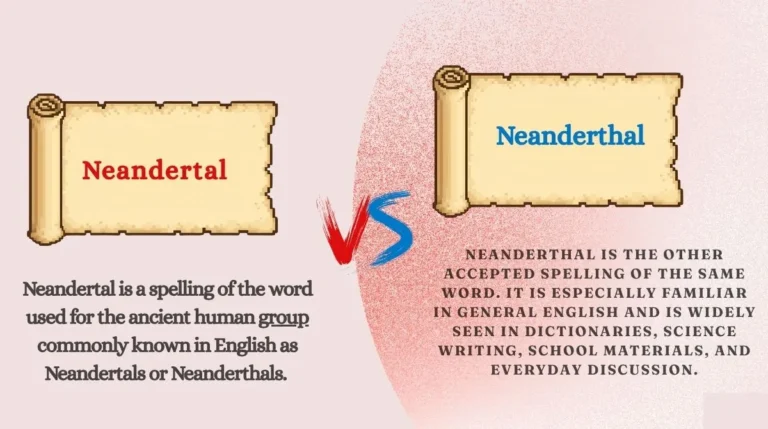
Neandertal is a spelling of the word used for the ancient human group commonly known in English as Neandertals or Neanderthals. It can also be used as an adjective to describe something connected with these ancient humans.
For example, you can say:
- Neandertal fossils were discovered in Europe.
- Scientists studied Neandertal DNA.
- The museum has a Neandertal skull.
- Researchers found evidence of Neandertal tools.
The word is closely connected with the Neander Valley in Germany, where important fossils were discovered in 1856. The Smithsonian explains that the German word Tal means “valley,” and that Tal is the modern form of the older spelling Thal.
When should you use “Neandertal”?
Use Neandertal when you see this spelling in a source, scientific discussion, or writing style that prefers the modern German form. It can work as a noun or an adjective.
As a noun:
A Neandertal lived in this region thousands of years ago.
As an adjective:
Scientists examined Neandertal remains.
There is no special grammar rule that makes Neandertal difficult. It behaves like an ordinary English noun or adjective.
Grammar rule for “Neandertal”
When Neandertal means the ancient human, it is normally treated as a proper term and is usually written with a capital N.
The plural form is:
Neandertal → Neandertals
Examples:
One Neandertal was found at the site.
Several Neandertals lived in the region.
As an adjective, the word usually stays unchanged:
Neandertal culture
Neandertal fossils
Neandertal DNA
Example sentences with “Neandertal”
- The museum displays a Neandertal skull.
- Scientists found Neandertal fossils in Europe.
- The researchers studied Neandertal DNA.
- A Neandertal could survive in very cold conditions.
- The class learned about Neandertal history.
- Several Neandertals lived in this area thousands of years ago.
- The team discovered more evidence of Neandertal activity.
- Modern humans and Neandertals are closely related.
Common learner confusion
The most common mistake is thinking that Neandertal is a completely different word from Neanderthal.
It is not.
They are spelling variants referring to the same group. Cambridge lists Neandertal as another form of Neanderthal, while the Max Planck Institute states directly that both versions are correct.
Another confusion is pronunciation. The missing h does not create a different sound. The two forms are pronounced essentially the same. The “th” in Neanderthal is commonly pronounced with a t sound rather than the English “th” sound.
So you should not think:
Neandertal = one pronunciation
Neanderthal = another pronunciation
That is not how the two spellings normally work.
What Does “Neanderthal” Mean?
Neanderthal is the other accepted spelling of the same word. It is especially familiar in general English and is widely seen in dictionaries, science writing, school materials, and everyday discussion.
Cambridge gives Neanderthal as the main entry and lists Neandertal as another form. It defines the noun as one of the ancient people who lived in Europe and Asia and also records a figurative meaning for someone who behaves in a rude or offensive way.
For example:
Scientists found a Neanderthal fossil.
The researchers studied Neanderthal DNA.
The word can also be an adjective:
Neanderthal tools
Neanderthal remains
Neanderthal anatomy
When should you use “Neanderthal”?
Use Neanderthal when this is the spelling used by the dictionary, publication, teacher, organization, or style guide you are following. It is completely acceptable in English.
You will often see it in phrases such as:
Neanderthal fossils
Neanderthal DNA
Neanderthal man
Neanderthal population
Neanderthal culture
The important point is that the h is not an error. It reflects the older spelling of the German place-name from which the word developed.
Grammar rule for “Neanderthal”
When referring to the ancient human group, Neanderthal can function as either a noun or an adjective.
As a singular noun:
A Neanderthal was found at the site.
As a plural noun:
Many Neanderthals lived in Europe.
As an adjective:
Scientists studied Neanderthal fossils.
The adjective does not change:
Neanderthal tools
Neanderthal tools were discovered.
Not:
Neanderthals tools
The adjective form stays Neanderthal before the noun.
Example sentences with “Neanderthal”
- The archaeologist found a Neanderthal fossil.
- Scientists continue to study Neanderthal DNA.
- Neanderthals lived in Europe and parts of Asia.
- The museum has a realistic Neanderthal reconstruction.
- We learned about Neanderthal life in science class.
- Modern humans and Neanderthals share a common evolutionary history.
- The researchers examined Neanderthal tools.
- A Neanderthal skeleton was discovered in Germany in the nineteenth century.
A second meaning of “neanderthal”
There is one extra point English learners should know.
In modern English, neanderthal can also be used figuratively, usually in lowercase, to describe someone or something seen as rude, old-fashioned, or unwilling to change. Cambridge records this figurative sense, and Dictionary.com also lists it as a noun and adjective.
For example:
His neanderthal attitude toward technology caused problems.
This meaning is not about an actual ancient human.
Because this use can sound insulting or disapproving, learners should be careful with it. In scientific or historical writing, Neanderthal with a capital N usually refers to the ancient human group.
Difference Between Neandertal and Neanderthal
Now we can make the difference much easier.
The main point is this:
Neandertal and Neanderthal usually have the same meaning. The difference is spelling, not a different ancient human group.
The spelling difference comes from German language history. The valley was once written Neanderthal, using the older German spelling Thal for “valley.” German spelling reform changed Thal to Tal. However, the traditional Neanderthal spelling continued to be used in English, while Neandertal became common in some scientific and American usage.
| Feature | Neandertal | Neanderthal |
|---|---|---|
| Meaning | Ancient human group | Ancient human group |
| Spelling | No h | Includes h |
| Pronunciation | Essentially the same | Essentially the same |
| Part of speech | Noun / adjective | Noun / adjective |
| Plural | Neandertals | Neanderthals |
| Origin | Modern German Tal | Older German Thal |
| Correct in English? | Yes | Yes |
| Scientific species name | Not the formal Latin name | Used in the common name |
| Common use | Common in some scientific contexts | Very familiar in general English |
Usage difference
There is no large meaning difference between the two words.
You can write:
Scientists found Neandertal fossils.
You can also write:
Scientists found Neanderthal fossils.
The basic meaning is the same.
The choice may depend on the publication, country, scientific tradition, or personal style. The Max Planck Institute notes that Neandertal is more common in the USA in its own usage, while many English-language sources continue to use Neanderthal.
Grammar logic
From a grammar point of view, these are not two completely separate vocabulary items like affect and effect.
They are spelling variants.
Both can appear as nouns:
A Neandertal lived here.
A Neanderthal lived here.
Both can appear as adjectives:
Neandertal fossils
Neanderthal fossils
Both can have regular plural forms:
Neandertals
Neanderthals
That is why learning one spelling does not mean the other is wrong.
Sentence-structure difference
There is almost no sentence-structure difference.
Compare:
Researchers studied Neandertal DNA.
and:
Researchers studied Neanderthal DNA.
The structure is identical:
subject + verb + adjective + noun
Another pair:
The museum displayed a Neandertal skull.
The museum displayed a Neanderthal skull.
Again, the grammar stays exactly the same. Only the spelling changes.
Meaning comparison
There is also an important distinction between the common name and the formal scientific name.
The formal scientific species name is Homo neanderthalensis. The Smithsonian identifies this as the species name associated with the fossils found in the Neander Valley. The spelling of this scientific name retains neanderthalensis with the h.
So remember:
Neandertal / Neanderthal = common English forms
Homo neanderthalensis = formal scientific name
Do not remove the h from the scientific species name simply because you prefer Neandertal in ordinary English.
Grammar Rules You Must Remember
Rule 1: Both spellings can be correct
Do not automatically mark Neandertal or Neanderthal as wrong.
Both forms are recognized English spellings for the ancient human group. Cambridge lists Neandertal as an alternative form, and the Max Planck Institute says both versions are correct.
Example:
Neandertal fossils were discovered in Europe.
Neanderthal fossils were discovered in Europe.
Both sentences are grammatically correct.
Rule 2: The “h” comes from an older German spelling
The word comes from the name of the Neander Valley in Germany.
The older German form was written Neanderthal, while modern German uses Neandertal. The German word Tal means “valley.”
Example:
The fossils were found in the Neander Valley.
This history explains why English still has two spellings.
Rule 3: Keep the scientific name exactly as established
When you write the formal biological name, use:
Homo neanderthalensis
Do not change it to:
Homo neandertalensis
The established scientific species name retains the h. This is a different matter from choosing between the common English spellings.
Example:
The scientific name is Homo neanderthalensis.
This rule is especially useful for students writing science assignments or research reports.
Rule 4: Use the plural forms correctly
For one individual:
a Neanderthal
For more than one:
Neanderthals
The same pattern applies to the h-less form:
a Neandertal
Neandertals
Do not add an apostrophe to make a normal plural.
Incorrect:
Neanderthal’s lived here.
Correct:
Neanderthals lived here.
The apostrophe is only needed for possession:
The Neanderthal’s skull was examined.
Common Mistakes Students Make
These words create a few predictable mistakes.
Mistake 1: Thinking one spelling is wrong
A student may see:
Neandertal
and correct it to:
Neanderthal
That correction is not necessarily needed. Both forms are accepted.
Easy tip: Check the style of the source you are using before changing the spelling.
Mistake 2: Changing the scientific name
Some learners think that if Neandertal is correct, then the scientific name should also lose the h.
That is incorrect.
Incorrect:
Homo neandertalensis
Correct:
Homo neanderthalensis
The common English spelling and the formal taxonomic name are not the same thing.
Mistake 3: Using “Neanderthal” as if it were always an adjective
A sentence such as:
I read a Neanderthal.
can be grammatically correct if you mean a member of the ancient group.
But:
I read a Neanderthal book.
has a different structure. Here, Neanderthal works as an adjective describing book.
The same word can therefore have different grammatical jobs depending on the sentence.
Mistake 4: Confusing “Neanderthal” with a modern insult
A person may say:
My boss is a neanderthal.
This is a figurative use, not a scientific statement.
It means the speaker considers the person rude, backward, or very old-fashioned. Dictionaries record this as a figurative meaning, often with a disapproving sense.
For formal writing, especially when talking about people today, it is better to understand the tone before using this expression.
Mistake 5: Assuming the “th” has the normal English “th” sound
The spelling Neanderthal may tempt learners to pronounce the final part like the “th” in think or this.
But the word is commonly pronounced with a t sound. Cambridge gives pronunciations that end in a “t” sound, and the Max Planck Institute specifically notes that the two spellings are pronounced the same and that the “th” is pronounced as t.
A simple pronunciation guide is roughly:
nee-AN-der-tal
The exact vowel sound can vary by accent.
Easy Trick to Remember the Difference
Here is the easiest memory trick:
Think: Tal = valley.
The ancient humans got their name from the Neander Valley in Germany.
The modern German word for valley is Tal.
The older spelling was Thal.
So:
Tal → Neandertal
Thal → Neanderthal
That is the reason for the extra h.
You do not need to memorize two definitions because there are not two main definitions behind these spellings. There is mainly one meaning and two accepted spellings.
Another useful trick is:
H = historical spelling
This is not a full rule for German history, but it is a handy memory aid for English learners. The h helps remind you that Neanderthal preserves the older spelling tradition.
And remember the scientific form separately:
Homo neanderthalensis
The scientific name keeps the h.
Daily Life Examples
Here are some easy conversation-style examples that show how these words work naturally.
1. Talking about school
A: What are you studying in science?
B: We are learning about Neanderthals and modern humans.
2. Talking about spelling
A: Is “Neandertal” spelled without an h?
B: Yes. Neandertal and Neanderthal are both used.
3. Talking about a museum
A: What did you see at the museum?
B: I saw a reconstruction of a Neanderthal.
4. Talking about fossils
A: What kind of fossil did they discover?
B: They discovered Neandertal remains.
5. Talking about DNA
A: Why do scientists study Neanderthal DNA?
B: It can help researchers understand human evolution.
6. Checking a homework sentence
Student: Is this sentence correct: “Neandertals lived in Europe”?
Teacher: Yes, that sentence is correct.
7. Writing a science report
Student: Should I write Neandertal or Neanderthal?
Teacher: Either can be correct, but follow the spelling style used by your source.
8. Talking about pronunciation
A: How do you pronounce Neanderthal?
B: It is commonly pronounced something like “nee-AN-der-tal.”
9. Using the figurative meaning
A: He still refuses to use email.
B: He can be a real neanderthal sometimes.
Here, neanderthal is figurative and means someone seen as very old-fashioned or backward.
10. Using the scientific name
A: What is the scientific name?
B: Homo neanderthalensis.
This is the formal scientific name, so its spelling should be kept exactly as established.
Practice Section
Choose the correct option in each sentence. Remember that some questions have two acceptable answers.
1. Scientists discovered ancient ______ remains.
A. Neandertal
B. Neanderthal
C. Both A and B
2. The formal scientific name is ______.
A. Homo neandertalensis
B. Homo neanderthalensis
C. Homo neanderthalis
3. Several ______ lived in Europe and Asia.
A. Neandertals
B. Neanderthals
C. Both A and B
4. The researchers examined ______ DNA.
A. Neandertal
B. Neanderthal
C. Both A and B
5. Which sentence uses the plural correctly?
A. Neanderthal’s lived here.
B. Neanderthals lived here.
C. Neanderthales lived here.
Answers
1. C — Both A and B
Both spellings are accepted common forms.
2. B — Homo neanderthalensis
The formal species name keeps the h.
3. C — Both A and B
Both Neandertals and Neanderthals are used as plurals.
4. C — Both A and B
Both forms can work as adjectives before DNA.
5. B — Neanderthals lived here.
A normal plural does not need an apostrophe.
FAQs About Neandertal vs Neanderthal
What is the difference between Neandertal and Neanderthal?
There is usually no difference in meaning. Both are accepted spellings for the same ancient human group.
The difference comes from German spelling history: older German used Thal, while modern German uses Tal for “valley.”
Is Neandertal the correct spelling?
Yes. Neandertal is a correct and established spelling.
Cambridge lists it as another form of Neanderthal, and scientific organizations also use the h-less spelling.
Is Neanderthal the correct spelling?
Yes. Neanderthal is also correct and remains a very common English spelling.
The extra h comes from the older German form Thal, meaning “valley.”
How do you pronounce Neanderthal?
It is commonly pronounced approximately nee-AN-der-tal.
The final th is generally pronounced like a t, not like the “th” in think. Cambridge and the Max Planck Institute both give pronunciation information consistent with this.
Is Neanderthal a noun or an adjective?
It can be both.
As a noun, it can mean an individual member of the ancient human group:
A Neanderthal lived in this region.
As an adjective, it can describe something related to them:
Neanderthal fossils were discovered.
What is the plural of Neandertal and Neanderthal?
The plural of Neandertal is Neandertals.
The plural of Neanderthal is Neanderthals.
Both forms are formed normally by adding -s.
Is Homo neanderthalensis spelled with an h?
Yes.
The established formal scientific name is Homo neanderthalensis. The h-less spelling used in the common name should not be transferred automatically to the scientific name.
Can “neanderthal” describe a modern person?
Yes, but this is a figurative and generally disapproving use.
A lowercase neanderthal can describe someone viewed as rude, backward, or very old-fashioned. Because it can sound insulting, learners should consider the situation before using it.
Conclusion
Neandertal and Neanderthal can look like two different words, but the main difference is simply their spelling. Both are accepted forms for the ancient human group known by the scientific name Homo neanderthalensis.
The reason for the two spellings is historical. The name came from the Neander Valley in Germany. Older German used Thal for “valley,” while modern German changed it to Tal. That is why English readers can meet both Neanderthal and Neandertal.
For grammar, both forms can work as nouns and adjectives. Their plural forms are Neandertals and Neanderthals. The pronunciation is also essentially the same.
The most important detail to remember is the scientific name: Homo neanderthalensis. Keep the h there.
Once you understand the history behind the spelling, this confusing word becomes much easier. When you see either form, you can recognize that both belong to the same word family and the same fascinating part of human history.

Evan Rellmont is a writer who turns thoughtful ideas into meaningful words, creating stories and reflections that connect, inspire, and leave a lasting impression.