
Have you ever written accent when you meant ascent, or assent when you meant ascent? You are not alone.
These three words confuse many English learners because they look similar and two of them, ascent and assent, are pronounced the same in standard English.
The spelling may be different, but when you hear them in a conversation, it can be hard to know which word the speaker means.
Cambridge gives ascent and assent the pronunciation /əˈsent/, while accent normally has the stress on the first syllable, /ˈæk.sənt/ in British English.
The good news is that their meanings are completely different.
Accent is connected with speech, pronunciation, or emphasis.
Ascent means moving upward or climbing.
Assent means agreement or approval.
Learning these three simple meanings can save you from many spelling and grammar mistakes.
You will see them in school writing, news reports, workplace English, travel conversations, and everyday speech.
Once you connect each word with a simple idea, the difference becomes much easier to remember.
By the end of this guide, you will know exactly when to use accent, ascent, and assent, how their grammar works, why students mix them up, and how to choose the correct word without guessing.
What Does “Accent” Mean?
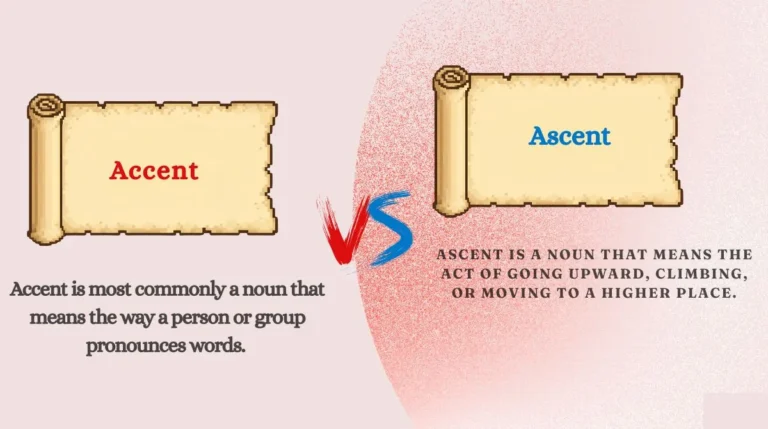
Accent is most commonly a noun that means the way a person or group pronounces words. People from different countries, regions, or social groups may speak the same language with different accents.
For example, someone may speak English with a British accent, American accent, Australian accent, or Indian accent.
Cambridge defines accent as the way people in a particular area, country, or social group pronounce words. The word can also refer to emphasis placed on a syllable or word.
When Do We Use Accent?
Use accent when you are talking about:
- the way someone pronounces words
- a regional or national style of speech
- stress or emphasis in pronunciation
- a written mark added to a letter in some languages
- emphasis given to something
For English learners, the most common meaning is related to pronunciation.
For example:
She has a strong British accent.
The sentence does not mean that she speaks a different language. It means she pronounces English in a way associated with Britain.
Grammar Rule for Accent
Accent can be used as both a noun and a verb.
As a noun:
He has a slight American accent.
As a verb, accent can mean to emphasize something. Cambridge lists this verb use as meaning to give special emphasis.
The teacher accented the first syllable of the word.
In everyday English, however, emphasize or stress is often more common than the verb accent when discussing pronunciation.
Examples of Accent
- Maria has a beautiful Spanish accent.
- I could tell from his accent that he was from Scotland.
- She is trying to improve her English accent.
- His accent changed after living abroad for many years.
- The teacher explained which syllable has the accent.
- You can hear a strong regional accent in her speech.
- The word has an accent on the final syllable.
Common Learner Confusion
Learners sometimes think accent means only a foreign way of speaking. That is too narrow.
An accent can be associated with a country, region, city, community, or social group. Also, people who speak the same language may still have different accents.
Another confusion comes from pronunciation. Accent begins with a strong first syllable:
AC-cent
That makes it different from ascent and assent, which are usually pronounced:
a-SCENT
What Does “Ascent” Mean?
Ascent is a noun that means the act of going upward, climbing, or moving to a higher place.
It can describe a person climbing a mountain, a plane rising into the air, or even a person becoming more successful or powerful.
Cambridge lists ascent as the act of climbing or moving upward. It can also mean an upward slope or a rise to a higher position.
When Do We Use Ascent?
Use ascent when something moves from a lower position to a higher position.
You may use it when talking about:
- climbing a mountain
- going up a hill
- a plane rising
- moving upward on stairs or a path
- rising in status, success, or power
The central idea is always upward movement or rise.
Grammar Rule for Ascent
Ascent is a noun.
Do not normally use ascent as the verb for climbing.
Correct:
The hikers began their ascent.
Incorrect:
The hikers ascent the mountain.
The verb is ascend:
The hikers ascended the mountain.
The Language Portal of Canada also identifies ascent as the noun related to the verb ascend.
Examples of Ascent
- The climbers began their ascent before sunrise.
- The plane made a smooth ascent into the sky.
- Our ascent up the hill was slow and tiring.
- The final part of the ascent was very steep.
- They stopped halfway through the mountain ascent.
- The elevator began its ascent to the top floor.
- His rapid ascent to power surprised everyone.
Common Learner Confusion
The biggest problem with ascent is its pronunciation. It sounds like assent.
That means listening alone is not always enough.
You need to look at the meaning and the sentence.
Ask yourself:
Is something going up?
If the answer is yes, ascent may be the correct word.
For example:
The plane began its ascent.
A plane is moving upward, so ascent is correct.
What Does “Assent” Mean?
Simple Definition of Assent
Assent means agreement, approval, or acceptance of an idea, request, plan, or decision.
It can be used as both a noun and a verb.
As a noun:
The manager gave his assent to the plan.
As a verb:
The manager assented to the plan.
The Language Portal of Canada describes assent as giving approval and confirms that it can function as both a noun and a verb.
When Do We Use Assent?
Assent is commonly used when someone formally or clearly agrees with something.
You may see it in:
- formal writing
- legal language
- official decisions
- academic writing
- business situations
- discussions about permission or approval
In casual conversation, people often use simpler words such as agree, approve, or say yes.
Grammar Rule for Assent
As a noun:
We need your assent before starting the project.
As a verb, it is commonly followed by to:
She assented to the proposal.
A useful pattern is:
assent to + idea/plan/request
Do not normally say:
She assented with the proposal.
Instead, say:
She assented to the proposal.
Examples of Assent
- The committee gave its assent to the new policy.
- She nodded her assent.
- The parents gave their assent to the school trip.
- He assented to the terms of the agreement.
- The board finally gave its assent.
- After hearing the explanation, she assented to the plan.
- The proposal cannot move forward without their assent.
Common Learner Confusion
Assent is often confused with ascent because they sound exactly or almost exactly alike in standard pronunciation. Both are commonly pronounced /əˈsent/.
The spelling clue can help:
Assent = agreement
Think of someone saying yes.
If the sentence is about approval, permission, support, or agreement, assent is the word you need.
Difference Between Accent, Ascent, and Assent
These three words may look like members of the same family, but their meanings are far apart.
| Word | Main Meaning | Part of Speech | Example |
|---|---|---|---|
| Accent | Way of pronouncing words or emphasis | Noun / Verb | She has a British accent. |
| Ascent | Upward movement or climb | Noun | The ascent was difficult. |
| Assent | Agreement or approval | Noun / Verb | They gave their assent. |
1. Usage Difference
The easiest way to separate them is to focus on the basic idea behind each word.
Accent = sound
He has a strong Australian accent.
This sentence is about how he speaks.
Ascent = up
The climbers started their ascent.
This sentence is about moving upward.
Assent = yes
The manager gave his assent.
This sentence is about agreeing or approving.
These three ideas cover most common situations.
2. Grammar Logic
There is also an important grammar difference.
Accent can be a noun or verb.
Her accent is easy to understand.
The design accents the room.
Ascent is a noun.
The ascent took three hours.
Its related verb is ascend:
They ascended the mountain.
Assent can be a noun or verb.
We received their assent.
They assented to the proposal.
Keeping these parts of speech in mind makes the choice much easier.
3. Sentence Structure Difference
Look at the typical sentence patterns:
Accent + noun
She has a different accent.
Ascent + of/up/to
The ascent of the mountain was difficult.
The plane began its ascent.
Assent + to + noun
He gave his assent to the proposal.
She assented to the decision.
Notice that assent as a verb often takes to.
4. Meaning Comparison
A quick mental comparison looks like this:
Accent → How something sounds
Ascent → Something moves upward
Assent → Someone agrees
There is no need to memorize a long dictionary definition every time you write. Remembering these three central meanings is usually enough.
5. Pronunciation Difference
Pronunciation causes a lot of trouble here.
Accent is usually pronounced with stress on the first syllable:
AC-cent
Cambridge gives the noun pronunciation as /ˈæk.sənt/ in both British and American English.
Ascent is pronounced:
a-SCENT
Cambridge lists it as /əˈsent/.
Assent is also pronounced:
a-SCENT
So ascent and assent are homophones in standard English: they sound the same but have different spellings and meanings.
That is why context matters so much when you hear them.
Grammar Rules You Must Remember
Rule 1: Use “accent” for pronunciation or emphasis
When you are discussing how someone speaks, use accent.
Her English accent is easy to understand.
You can also use it for emphasis:
The speaker put an accent on the final word.
A useful question is: Is this about sound or emphasis?
If yes, think accent.
Rule 2: Use “ascent” for upward movement
Use ascent when something is going upward.
The plane began its ascent.
It can describe actual physical movement:
The hikers continued their ascent.
It can also describe figurative progress:
His ascent to the top of the company was quick.
The basic idea remains the same: moving higher.
Rule 3: Use “assent” for agreement or approval
Use assent when a person or group agrees with something.
The council gave its assent to the plan.
As a verb:
She assented to the request.
Remember the useful pattern:
assent to something
Rule 4: Remember that “ascent” and “assent” sound alike
Do not depend only on pronunciation.
For both words, you may hear a-SCENT.
Instead, check the meaning.
The hikers began their ascent.
They are going up.
The board gave its assent.
They are saying yes.
Same sound, completely different meaning.
Common Mistakes Students Make
These words are usually confused because their spellings are similar and ascent and assent sound alike.
Mistake 1: Using “accent” for climbing
Wrong:
The hikers began their accent up the mountain.
Correct:
The hikers began their ascent up the mountain.
Why? The hikers are moving upward.
Easy tip: ascent = up.
Mistake 2: Using “ascent” when you mean agreement
Wrong:
The manager gave his ascent to the proposal.
Correct:
The manager gave his assent to the proposal.
The manager is not climbing. He is approving something.
Easy tip: assent = agree.
Mistake 3: Using “assent” for speech
Wrong:
She has a beautiful British assent.
Correct:
She has a beautiful British accent.
The sentence is about pronunciation.
Easy tip: accent = speech.
Mistake 4: Treating “ascent” like a verb
Wrong:
They ascent the mountain every summer.
Correct:
They ascend the mountain every summer.
Or:
They begin their ascent every summer.
Ascent is the noun. Ascend is the verb.
Mistake 5: Using “assent with”
Wrong:
He assented with the decision.
Correct:
He assented to the decision.
The verb assent commonly takes to when followed by the thing being agreed to.
An Easy Correction Method
Before choosing a word, stop and ask one simple question:
What am I talking about?
If it is speech, choose accent.
If it is going up, choose ascent.
If it is agreeing, choose assent.
This takes only a second, but it can prevent a spelling mistake.
Easy Trick to Remember the Difference
Here is a simple three-word memory trick:
Accent = Sound
Think about a person talking.
Accent → how you sound
He speaks with a French accent.
Ascent = Up
Think about a person climbing a mountain.
Ascent → going up
Their ascent was difficult.
You can also connect ascent with the verb ascend, which means to go upward.
Assent = Yes
Think about someone nodding and saying:
“Yes, I agree.”
Assent → agreement
She gave her assent to the plan.
You can remember the whole lesson with just three ideas:
Accent = sounds
Ascent = rises
Assent = agrees
Imagine these three pictures in your mind:
A person speaking → accent
A climber going up → ascent
A person nodding yes → assent
That visual trick is especially helpful for students who often mix up spelling.
Daily Life Examples
Here are ten simple examples you may hear or use in real conversations.
1. Talking about speech
A: Where is Sarah from?
B: I’m not sure, but she has a strong British accent.
2. Talking about learning English
A: Your English sounds much clearer now.
B: Thanks! I’ve been working on my pronunciation and accent.
3. Talking about a flight
A: Why are my ears popping?
B: The plane is starting its ascent.
4. Talking about hiking
A: Are we close to the top?
B: Almost. The final part of the ascent is steep.
5. Talking about a decision
A: Did your parents agree to your trip?
B: Yes, they gave their assent.
6. Talking about a business plan
A: Has the director approved the proposal?
B: Yes, we received her assent yesterday.
7. Talking about pronunciation
A: Why do these two words sound different?
B: The accent falls on different syllables.
8. Talking about a mountain
A: How long did the climb take?
B: The ascent took nearly five hours.
9. Talking about permission
A: Can we start the project now?
B: We need the manager’s assent first.
10. Talking about regional speech
A: I knew he wasn’t from here.
B: Yes, his accent gave it away.
These examples show why context matters. The words may look similar, but the surrounding sentence usually makes the meaning clear.
Practice Section
Choose the correct word: accent, ascent, or assent.
1. Maria has a strong Australian ______.
2. The hikers began their ______ before sunrise.
3. The committee gave its ______ to the proposal.
4. His British ______ was easy to recognize.
5. The plane’s ______ was surprisingly smooth.
Answers
1. accent
Maria has a strong Australian accent.
2. ascent
The hikers began their ascent before sunrise.
3. assent
The committee gave its assent to the proposal.
4. accent
A British accent describes the way someone pronounces English.
5. ascent
A plane’s ascent is its movement upward.
A quick way to check your answers is to remember:
speech = accent
up = ascent
agreement = assent
FAQs About Accent vs Ascent vs Assent
What is the difference between accent, ascent, and assent?
Accent relates mainly to pronunciation, speech, or emphasis.
Ascent means an upward movement, climb, or rise.
Assent means agreement or approval. The simplest memory trick is: accent = sound, ascent = up, assent = yes.
Are ascent and assent pronounced the same?
Yes. In standard English, ascent and assent are generally pronounced /əˈsent/. They are homophones, which means they have the same pronunciation but different meanings and spellings.
Is accent only about the way someone speaks?
No. Accent can describe a person’s pronunciation, but it can also refer to emphasis on a particular syllable, word, or musical note. It can also mean a written mark placed over a letter in some languages.
Is ascent a noun or a verb?
Ascent is a noun. It means upward movement, climbing, or rising. The related verb is ascend.
Correct:
The ascent was difficult.
Also correct:
They ascended the mountain.
Is assent formal or informal?
Assent is more common in formal or serious writing than in casual everyday speech. People often use agree, approve, or say yes in normal conversation. Assent is especially common in official, legal, academic, or organizational contexts.
How can I remember ascent and assent?
Think of ascent = up because it is related to ascend. Think of assent = agreement, as in giving approval or saying yes. Both sound like “uh-SENT,” so the meaning and spelling are important.
Conclusion
Accent, ascent, and assent are easy to confuse because their spellings look alike, while ascent and assent usually sound exactly the same. The key is to connect each word with one clear idea.
Accent is about speech, pronunciation, or emphasis.
Ascent is about moving upward or climbing.
Assent is about agreeing or giving approval.
Remember the simple classroom trick:
Accent = sound.
Ascent = up.
Assent = yes.
Also remember that ascent is a noun related to ascend, while assent can work as both a noun and a verb and is commonly followed by to.
The best way to make these words feel natural is to use them in your own sentences. Write one sentence about an accent, one about climbing, and one about agreement. After a little practice, you will be much less likely to mix them up.

Evan Rellmont is a writer who turns thoughtful ideas into meaningful words, creating stories and reflections that connect, inspire, and leave a lasting impression.