
Have you ever seen both unalienable and inalienable and wondered whether one of them is a spelling mistake? You are not alone.
These two words look almost the same, sound very similar, and carry almost the same meaning.
That can make them confusing, especially for English learners who find the expression “inalienable rights” in books, news reports, history lessons, or legal writing.
The good news is that both “unalienable” and “inalienable” are real English words.
Both are adjectives, and both describe something that cannot be taken away, denied, or transferred to someone else.
Cambridge Dictionary lists unalienable as a synonym of inalienable, while modern dictionary usage generally treats inalienable as the more common form.
So, what is the real difference?
The main difference is not meaning. It is mostly about usage, history, and frequency.
The word inalienable is the normal choice in modern English. Unalienable is less common today and has a strong connection with the famous wording of the 1776 U.S. Declaration of Independence, which refers to certain “unalienable Rights.”
By the end of this guide, you will know exactly when to use each spelling, how they work in sentences, why the two forms exist, and how to remember the difference easily.
What Does “Inalienable” Mean?
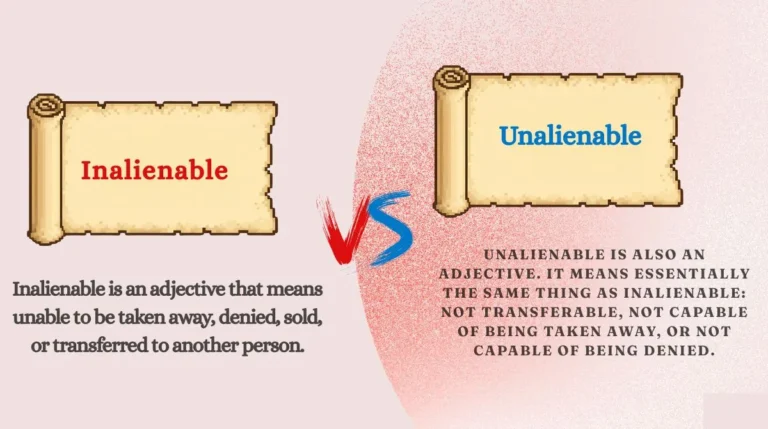
Inalienable is an adjective that means unable to be taken away, denied, sold, or transferred to another person.
The word is often used for things that are considered naturally or permanently connected to a person. It is especially common when talking about rights, freedoms, liberties, human dignity, or important principles.
Cambridge Dictionary defines inalienable as something that is unable to be removed and gives “inalienable right” as a common example.
Simple meaning
Think of it this way:
Inalienable = something you cannot legally or naturally give away or have taken away.
For example, when someone says “an inalienable right,” they mean a right that is believed to belong to a person and cannot simply be taken from that person.
When should you use “inalienable”?
Use inalienable when you want to describe a right, quality, principle, or possession that cannot be transferred or removed.
It is especially useful in formal writing, academic English, legal discussions, government documents, and conversations about human rights.
Some common combinations are:
- inalienable rights
- inalienable freedom
- inalienable liberty
- inalienable dignity
- inalienable right to life
- inalienable human rights
- inalienable principle
Grammar rule for “inalienable”
Inalienable is an adjective.
You can place it directly before a noun:
She believes that freedom is an inalienable right.
You can also use it after a linking verb such as is, are, was, or were:
These rights are inalienable.
The spelling does not change for singular or plural nouns.
Examples of “inalienable”
- Every person deserves certain inalienable rights.
- Freedom is considered an inalienable part of human dignity.
- The constitution protects several inalienable rights.
- She described education as an inalienable opportunity for every child.
- They argued that the right to speak freely is inalienable.
- Some values are so important that people regard them as inalienable.
- Human dignity should not be treated as something that can simply be bought or sold.
- The writer called personal freedom an inalienable principle.
Common learner confusion about “inalienable”
Many students think inalienable means simply “very important.” That is not quite right.
Something can be very important without being inalienable.
For example:
My favorite book is very important to me.
This does not make the book inalienable.
The key idea is that the thing cannot be transferred, surrendered, removed, or denied, depending on the context.
That is why inalienable is strongly connected with words such as rights and freedom.
Another common mistake is assuming that inalienable means “not alien.” It does not have that everyday meaning. The word comes from the idea of something being alienable, meaning capable of being transferred or given to another person.
What Does “Unalienable” Mean?
Unalienable is also an adjective. It means essentially the same thing as inalienable: not transferable, not capable of being taken away, or not capable of being denied.
Cambridge lists unalienable as a synonym for inalienable. Dictionary.com also explains that the two words have the same basic meaning.
Simple meaning
A simple way to understand it is:
Unalienable = impossible to take away, deny, or transfer.
So, in most situations, you could replace inalienable with unalienable without changing the basic meaning.
For example:
Freedom is an inalienable right.
and
Freedom is an unalienable right.
Both sentences can express the same basic idea.
When should you use “unalienable”?
The important point is that unalienable is valid, but it is much less common in modern everyday English.
It is especially connected with historical, literary, and American founding language because of the Declaration of Independence. The National Archives transcription of the 1776 document preserves the phrase “certain unalienable Rights.”
Because of this history, unalienable may sound old-fashioned, ceremonial, or highly formal to modern readers.
That does not make it incorrect.
Grammar rule for “unalienable”
Just like inalienable, unalienable is an adjective.
It can come before a noun:
They spoke about unalienable rights.
Or after a linking verb:
These rights are unalienable.
Examples of “unalienable”
- The document refers to certain unalienable rights.
- The speaker described freedom as an unalienable part of human life.
- They believed that every person possessed unalienable rights.
- The lesson focused on the unalienable freedoms mentioned in the historic document.
- The writer used the word unalienable because the passage was based on older American history.
- For many readers, the phrase “unalienable rights” immediately sounds historical.
- The constitution was discussed alongside the idea of unalienable human rights.
- The old speech described liberty as an unalienable gift.
Common learner confusion about “unalienable”
The biggest problem is spelling.
Some learners see unalienable and think the word is wrong because they are more familiar with inalienable. Others see inalienable and think the original form should be unalienable because they remember the Declaration of Independence.
Neither assumption is correct.
Both spellings exist. The modern difference is mainly one of frequency and style, rather than meaning. Dictionary.com notes that inalienable is now the more common form, while unalienable is strongly associated with the historic phrase used in the Declaration of Independence.
Difference Between Unalienable and Inalienable
The easiest answer is this:
Unalienable and inalienable have the same basic meaning.
Both describe something that cannot be transferred, taken away, or denied.
The main difference is how commonly they are used and the context in which they sound natural.
Comparison Table
| Feature | Inalienable | Unalienable |
|---|---|---|
| Part of speech | Adjective | Adjective |
| Basic meaning | Cannot be taken away or transferred | Cannot be taken away or transferred |
| Meaning difference | Almost none | Almost none |
| Modern usage | Much more common | Less common |
| Formal writing | Common | Possible, but less usual |
| Everyday modern English | Preferred | Uncommon |
| Historical writing | Used | Strong historical connection |
| Famous expression | “inalienable rights” | “unalienable Rights” |
| Best beginner choice | Yes | Usually not |
1. Usage difference
The biggest difference is usage frequency.
Inalienable is the normal modern spelling. It appears frequently in discussions of human rights, freedoms, law, philosophy, politics, education, and social issues. Cambridge and Dictionary.com both recognize it as the standard modern form.
Unalienable is less common. You may still find it in historical texts, formal speeches, old-fashioned language, or writing that deliberately echoes the Declaration of Independence.
So a modern writer would usually choose:
Everyone has inalienable rights.
rather than:
Everyone has unalienable rights.
The second sentence is not automatically wrong. It simply sounds less usual.
2. Grammar logic
Both words perform exactly the same grammatical job.
They are adjectives, so they describe nouns:
an inalienable right
an unalienable right
You can also place either word after be:
The right is inalienable.
The right is unalienable.
There is no special grammar rule that makes one form function differently.
3. Sentence structure
The sentence structure is the same for both words.
Adjective + noun:
It is an inalienable right.
It is an unalienable right.
Subject + be + adjective:
The right is inalienable.
The right is unalienable.
Adjective + noun in plural form:
They discussed inalienable rights.
They discussed unalienable rights.
This is why learners should not spend too much time looking for a grammar difference that does not really exist.
4. Meaning comparison
There is no important basic difference in meaning.
Both words come from the idea of alienable, which refers to something that can be transferred or sold. The negative prefixes in- and un- create the opposite sense. Dictionary.com explains that alienable means capable of being sold or transferred, while inalienable and unalienable describe the opposite.
Think of the relationship like this:
alienable → transferable
inalienable → not transferable
unalienable → not transferable
5. Which spelling sounds more natural today?
For most modern writing, inalienable will sound more natural.
Consider these examples:
Human rights are inalienable.
Freedom is an inalienable right.
Every person has inalienable dignity.
These are modern and natural.
Now compare:
Human rights are unalienable.
The sentence is still understandable and grammatically valid, but it has a more formal or historical feel.
6. Why do both forms exist?
English often has more than one way to create a negative word.
Here, un- and in- both contribute a negative meaning.
The two forms developed over time, and language preference changed. Dictionary.com reports that unalienable was historically more popular, but inalienable gradually became the much more common modern form.
That is a useful lesson for English learners: a less common word is not necessarily an incorrect word.
Grammar Rules You Must Remember
Rule 1: Both words are adjectives
Both inalienable and unalienable describe nouns.
She believes in inalienable rights.
The document protects unalienable rights.
Do not treat them as verbs or nouns in these sentences.
The related noun is inalienability, which refers to the quality of being inalienable.
For example:
The law discusses the inalienability of certain rights.
Rule 2: “Inalienable” is usually the better modern choice
When writing a modern email, essay, article, school assignment, or general explanation, inalienable is normally the safer choice.
Freedom is an inalienable human right.
This sounds natural to modern readers.
Use unalienable when the historical or stylistic context makes it appropriate.
Rule 3: Both words can come before “right” or “rights”
The common expression is:
an inalienable right
or:
certain unalienable rights
Both are grammatically correct.
The difference is that inalienable rights is much more common in current general English, while unalienable Rights is strongly associated with the historical wording of the Declaration of Independence.
Rule 4: Do not confuse “inalienable” with “inalienability”
These words are related, but their grammar is different.
Inalienable = adjective
Freedom is inalienable.
Inalienability = noun
The inalienability of the right was discussed.
This difference matters in formal writing because you cannot always replace one with the other.
Incorrect:
Freedom is inalienability.
Correct:
Freedom is inalienable.
Correct:
The inalienability of freedom was discussed.
Common Mistakes Students Make
Mistake 1: Thinking “unalienable” is wrong
This is probably the most common mistake.
A learner may know inalienable and assume that adding un- makes an incorrect word.
That is not true.
Unalienable is a valid adjective and a synonym of inalienable. It is simply less common in modern English.
Wrong assumption:
“Unalienable” is always a spelling mistake.
Better understanding:
“Unalienable” is correct, but “inalienable” is usually more common today.
Mistake 2: Using “inalienable” when you simply mean “important”
These words are not exact synonyms.
You might say:
Education is very important.
But calling education inalienable makes a much stronger claim. It suggests that the right or quality cannot be taken away or transferred.
So ask yourself:
Am I talking about something that cannot be taken away or transferred?
If yes, inalienable may be appropriate.
Mistake 3: Thinking the two words have completely different meanings
Some learners search for a hidden difference between them.
For normal English use, that is unnecessary.
an inalienable right
and
an unalienable right
express essentially the same idea.
The real distinction is mainly modern preference versus historical association.
Mistake 4: Forgetting that both are adjectives
Do not write:
He inalienabled his rights.
That does not work.
The word is an adjective:
His rights are inalienable.
Or:
He believed those were inalienable rights.
Mistake 5: Assuming the Declaration spelling is the only correct spelling
Historical documents sometimes preserve spellings that differ from the forms commonly preferred today.
The National Archives transcription of the Declaration preserves its original spelling, including “unalienable Rights.”
That historical spelling does not mean modern writers must always use unalienable.
Easy Trick to Remember the Difference
Here is a simple trick that works well.
Think: “INALIENABLE = IN modern English”
When you are writing something for today, remember:
IN = Inalienable is the usual modern choice.
So:
Modern writing → INALIENABLE
Historical wording → UNALIENABLE may appear
Another easy trick is to focus on the middle word:
alienable = able to be transferred
Then put a negative prefix in front:
in + alienable = not transferable
un + alienable = not transferable
Both paths reach almost the same meaning.
Real-life memory example
Imagine that someone gives you a right that is considered impossible to take away.
You can think:
“This right cannot be transferred. It is inalienable.”
Now imagine opening a history textbook and seeing the famous American founding expression.
You may see:
unalienable Rights
So remember:
INALIENABLE = the usual modern word
UNALIENABLE = the historical, less common variant
This is not a strict grammar rule. It is simply a useful way to remember normal usage.
Daily Life Examples
These examples show how the words may appear in natural English conversations and simple writing.
Example 1
A: What does “inalienable right” mean?
B: It means a right that cannot simply be taken away or transferred.
Example 2
A: Why do textbooks use the phrase “inalienable rights”?
B: Because it is commonly used when talking about basic human rights and freedoms.
Example 3
A: Is “unalienable right” also correct?
B: Yes. It has the same basic meaning, but it sounds less common and more historical.
Example 4
A: Which spelling should I use in my school essay?
B: Inalienable is usually the more natural modern choice unless you are discussing a historical quotation.
Example 5
A: I saw “unalienable Rights” in a history book.
B: That makes sense. The Declaration of Independence uses that spelling.
Example 6
A: Can I say, “Freedom is inalienable”?
B: Yes. That is grammatically correct because inalienable is an adjective.
Example 7
A: Can I ask, “Are human rights inalienable?”
B: Yes. The adjective can be used naturally in questions.
Example 8
A: Is my favorite phone an inalienable possession?
B: Not normally. A phone can usually be sold or transferred, so “inalienable” would not be the natural word.
Example 9
A: Why does the word sound so formal?
B: Because it is often used in legal, academic, historical, and political writing rather than casual conversation.
Example 10
A: So, are the two spellings synonyms?
B: Yes. Their basic meaning is the same. Inalienable is simply much more common in modern English.
Practice Section
Choose the better word for each sentence. In most modern contexts, think about which spelling sounds more natural today.
1. Every person should have certain ______ rights.
A. inalienable
B. alienable
2. The historical document uses the spelling ______ Rights.
A. inalienable
B. unalienable
3. Freedom is considered an ______ part of human dignity.
A. inalienable
B. alienable
4. Is “unalienable” a real English word?
A. Yes
B. No
5. Which form is generally more common in modern English?
A. inalienable
B. unalienable
Answers
1. A — inalienable
The sentence describes rights that cannot be taken away or transferred.
2. B — unalienable
The Declaration of Independence is famous for using the spelling “unalienable Rights.”
3. A — inalienable
This is the standard modern spelling and works naturally with “part of human dignity.”
4. A — Yes
Unalienable is a valid English adjective and a synonym of inalienable.
5. A — inalienable
Inalienable is the more common modern form.
FAQs
What is the difference between unalienable and inalienable?
There is almost no difference in basic meaning. Both words describe something that cannot be taken away, denied, or transferred to another person. Inalienable is much more common in modern English, while unalienable has a stronger historical connection.
Is unalienable a correct word?
Yes, unalienable is correct. It is a recognized adjective and is listed as a synonym of inalienable by Cambridge Dictionary. It is simply less common in modern general English.
Which is more common: inalienable or unalienable?
Inalienable is more common in modern English. Unalienable is especially familiar because of the wording of the U.S. Declaration of Independence, which uses “certain unalienable Rights.”
Can I use inalienable in a question?
Yes. It is an adjective, so you can use it in questions just like other adjectives.
For example:
Are these rights inalienable?
Or:
Is freedom an inalienable right?
Both are grammatically correct.
Is inalienable a formal word?
Yes. Inalienable is generally considered formal, especially when used in expressions such as inalienable rights. It is common in legal, academic, historical, and serious discussions about rights and freedoms.
Why does the Declaration of Independence say unalienable instead of inalienable?
The original 1776 Declaration uses the spelling unalienable. The National Archives preserves that wording in its transcription. Modern English generally prefers inalienable, so the difference reflects historical language preference rather than a difference in meaning.
Conclusion
Unalienable and inalienable are not two completely different words. They are adjectives with nearly the same meaning. Both describe something that cannot be taken away, denied, or transferred.
For modern English, inalienable is usually the form you should choose. It is common in phrases such as inalienable rights, inalienable freedom, and inalienable dignity. Unalienable is also correct, but it is less common and often carries a historical or formal feeling. Its strongest connection is with the famous wording of the U.S. Declaration of Independence, which uses “unalienable Rights.”
So, when you are writing a normal modern sentence, remember:
Modern English → inalienable
Historical or original Declaration wording → unalienable
The important thing is not to think that one spelling is simply “right” and the other is “wrong.” Both belong to English; they just have different levels of modern popularity. With a little practice, this confusing pair becomes very easy to recognize and use correctly.

Evan Rellmont is a writer who turns thoughtful ideas into meaningful words, creating stories and reflections that connect, inspire, and leave a lasting impression.