
Have you ever seen the words silicone and silicon and wondered which one is correct? You are not alone.
These two words look almost the same, and they are pronounced in a very similar way. That small extra “e” can make a big difference, though.
The confusion becomes even stronger because both words are connected to science and modern technology. You may hear about silicon chips in computers, while a kitchen store may advertise silicone bakeware.
A person may talk about silicone products, but another person may mention silicon in electronics.
They sound related because they really are related, but they do not mean the same thing.
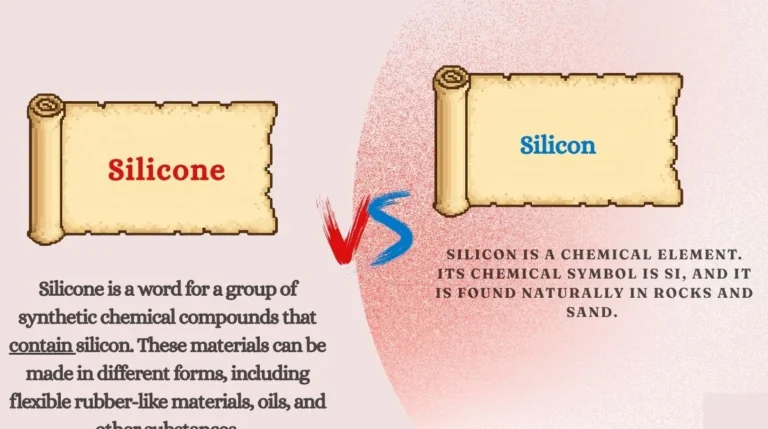
Silicon is a chemical element. It is used in electronics and is also found naturally in rocks and sand.
Silicone, on the other hand, refers to a group of synthetic compounds made with silicon and other elements.
Silicone is known for being flexible, heat-resistant, and useful in products such as sealants, kitchen tools, medical devices, and other everyday materials.
Understanding the difference will help you spell these words correctly and use them naturally.
By the end, you will know exactly when to use silicone and when to use silicon, along with easy examples and simple memory tricks.
What Does “Silicone” Mean?
Silicone is a word for a group of synthetic chemical compounds that contain silicon. These materials can be made in different forms, including flexible rubber-like materials, oils, and other substances. They are commonly used because they can resist heat and water and can remain useful under many conditions.
In everyday English, silicone is often connected with things you can touch or use. Think about a soft baking mold, a waterproof seal around a bathtub, a flexible phone accessory, or certain medical products. These may be made from silicone or contain silicone.
When should you use “silicone”?
Use silicone when you are talking about the material or group of compounds used to make practical products.
For example:
- The cake mold is made of silicone.
- I bought a silicone spatula for the kitchen.
- Silicone sealant was used around the window.
- This bottle has a soft silicone handle.
- The manufacturer uses silicone for flexible parts.
- Silicone can resist heat and water.
- She cleaned the silicone mat after baking.
- The doctor explained how the device uses silicone materials.
These sentences all refer to a material, not the basic chemical element itself.
Grammar rule for “silicone”
Silicone is generally used as a noun. It is normally treated as an uncountable noun when referring to the material in general.
For example:
This product is made from silicone.
You would not normally say:
This product is made from a silicone.
However, you can use a silicone in a different sense when the word refers to a particular type or compound, although this is less common in basic everyday English.
You will often see silicone used before another noun as a modifier:
- silicone rubber
- silicone sealant
- silicone mold
- silicone oil
- silicone case
This is why learners sometimes think silicone is an adjective. In these phrases, it is functioning as a noun used to describe another noun.
Common learner confusion about “silicone”
The biggest problem is the extra e.
Many learners write silicon when they mean the flexible material used in products. For example, someone may write:
I bought a silicon baking mat.
When the material is silicone, the better sentence is:
I bought a silicone baking mat.
A simple question can help: Are you talking about a material used to make flexible or protective products? If yes, silicone is probably the word you need.
What Does “Silicon” Mean?
Silicon is a chemical element. Its chemical symbol is Si, and it is found naturally in rocks and sand. It is especially important in modern technology because it is used to make electronic components and computer chips.
Silicon is a solid, gray element with important electrical properties. It is widely used in electronics because it works as a semiconductor. Semiconductors are important materials in electronic devices and integrated circuits.
This is where the famous phrase Silicon Valley comes from. The name refers to the importance of silicon-based semiconductor technology in the technology industry.
When should you use “silicon”?
Use silicon when you are talking about the chemical element, especially in science, electronics, computers, and technology.
Examples:
- Silicon is an important element in modern electronics.
- The computer chip is made using silicon.
- Silicon is found in rocks and sand.
- Scientists study the properties of silicon.
- The company develops silicon-based technology.
- A silicon wafer is used in chip manufacturing.
- Silicon is a semiconductor material.
- Many electronic devices depend on silicon technology.
Cambridge Dictionary describes silicon as a chemical element used in computers and other electronic machines.
Grammar rule for “silicon”
Like silicone, silicon is generally a noun.
It is normally uncountable when referring to the element as a substance:
Silicon is widely used in electronics.
You do not usually need an article when speaking about the element in general.
However, you may see a silicon when the word describes a particular form, device component, or specific piece of material in a technical context. In everyday learner English, it is safest to think of silicon as the name of the chemical element.
The most common related expressions include:
- silicon chip
- silicon wafer
- silicon semiconductor
- silicon-based technology
- silicon transistor
- Silicon Valley
A silicon chip, for example, is a small piece of silicon used in computers, calculators, and other electronic devices.
Common learner confusion about “silicon”
The spelling is the first problem. The second problem is the pronunciation.
Silicon is pronounced approximately SIL-ih-kun, while silicone sounds like SIL-ih-kohn. Cambridge lists these pronunciations separately, so listening carefully can help you notice the difference.
Remember that the final sound is different:
silicon → ends with -kun
silicone → ends with -kohn
That small sound difference matches the difference in spelling.
Difference Between Silicone and Silicon
The easiest way to understand the difference is to remember one central fact:
Silicon is an element. Silicone is a group of synthetic materials made with silicon.
They are related, but they are not interchangeable.
| Feature | Silicone | Silicon |
|---|---|---|
| What is it? | A group of synthetic compounds | A chemical element |
| Symbol | Not a chemical element symbol | Si |
| Main area | Household, industrial, medical, and manufacturing uses | Science, electronics, and technology |
| Common products | Sealants, molds, flexible materials, oils | Computer chips and electronic components |
| Usually used as | Noun; also noun modifier | Noun; also noun modifier |
| Example | silicone sealant | silicon chip |
| Pronunciation | Ends like “cone” | Ends like “kun” |
| Key idea | A useful synthetic material | An element used in technology |
1. Usage difference
Silicone is usually about a material used to make things.
For example:
The kitchen tool has a silicone grip.
Here, silicone describes the material of the grip.
Silicon is usually about the element itself, especially when discussing electronics.
For example:
The processor contains silicon components.
Here, silicon is connected to technology and the chemical element.
2. Meaning difference
The two words have a scientific connection, but their meanings are different.
Silicon is one particular chemical element. It is found in nature and has the symbol Si. Silicone is not simply another spelling of that element. It is a family of synthetic compounds that use silicon as an important part of their chemical structure.
Think of it this way:
silicon = element
silicone = material family
That distinction solves most questions about these words.
3. Sentence structure difference
Both words can appear after made of, made from, used in, or similar expressions, but the meaning changes.
Compare:
The chip is made using silicon.
This is about electronic technology.
The seal is made of silicone.
This is about a synthetic material used as a flexible or protective substance.
They can also come before another noun:
silicon chip
silicon wafer
silicone mold
silicone sealant
Look at the noun that follows the word. It often gives you a useful clue.
4. Think about the real-life object
When you see a product, ask what you are talking about.
A silicone baking mat is a soft, heat-resistant material used in cooking.
A silicon chip is a technological component used in electronic devices.
That is why saying the wrong word can change the meaning.
Grammar Rules You Must Remember
Rule 1: Use “silicon” for the chemical element
When you mean the chemical element with the symbol Si, use silicon.
Example:
Silicon is widely used in electronic devices.
This sentence talks about the element and its technological use.
Rule 2: Use “silicone” for synthetic materials
When you mean the family of synthetic compounds used to make things such as sealants, rubber-like materials, and other products, use silicone.
Example:
The workers used silicone sealant around the glass.
The word refers to the sealing material.
Rule 3: Learn the common compound phrases
Certain word combinations make the difference easy to remember.
Technology commonly gives you phrases such as:
silicon chip
silicon wafer
silicon transistor
Household and industrial products commonly give you phrases such as:
silicone mold
silicone sealant
silicone rubber
Learning these combinations is much easier than trying to memorize a long scientific explanation.
Rule 4: Listen to the ending
The pronunciation gives you another clue.
Silicon ends with a sound similar to “kun.”
Silicone ends with a sound similar to “cone.”
You can quietly say the sentence in your head before writing it. This can help you choose the right spelling.
Common Mistakes Students Make
These mistakes are common because the words differ by only one letter.
Mistake 1: Writing “silicon” for kitchen products
Wrong:
This is a silicon spatula.
Correct:
This is a silicone spatula.
A spatula can be made from silicone, so silicone is the correct word.
Mistake 2: Writing “silicone” for computer technology
Wrong:
The processor uses silicone.
Correct:
The processor uses silicon.
When talking about the chemical element used in semiconductor technology, choose silicon. Silicon is a key semiconductor material used for electronic devices.
Mistake 3: Assuming the words are simply different spellings
They are not.
This is one of the most important things to remember.
Silicon and silicone are separate words with separate meanings. Silicone is related to silicon, but it is not simply the longer spelling of the element’s name.
Mistake 4: Confusing “silicone” with “silicon chip”
A learner may see a product made from silicone and a computer product made from silicon and assume the words can be exchanged.
They cannot.
Correct:
The phone contains a silicon chip.
Correct:
The phone case is made of silicone.
The first sentence is about electronics. The second is about a material used to make a product.
Easy correction tip
Whenever you see one of these words, ask:
“Am I talking about the element or a manufactured material?”
Element → silicon
Manufactured material → silicone
That one question will solve most spelling problems.
Easy Trick to Remember the Difference
Here is a very simple memory trick:
Silicon = science + chips
Think:
Si = silicon = science and semiconductors
When you hear about computers, processors, chips, and electronic technology, think silicon.
Silicone = products + “cone”
Think about a silicone mold in your kitchen.
Now notice the spelling:
silicone → conE
You can connect the ending to the word cone in your mind.
So:
silicone → flexible product material
silicon → chemical element and electronics
Another useful trick is to imagine two shelves.
On the technology shelf, put silicon chips and silicon wafers.
On the household shelf, put silicone molds, silicone sealants, and silicone tools.
Once you build that mental picture, the spelling becomes much easier.
Daily Life Examples
These examples show how native English speakers might naturally use the two words in everyday conversation.
Example 1
A: What is this baking mold made of?
B: It is made of silicone.
The conversation is about a kitchen product, so silicone is correct.
Example 2
A: Why is silicon important in computers?
B: Because it is widely used in semiconductor technology.
Here, the topic is electronics, so silicon is correct.
Example 3
A: Is this sealant safe for the bathroom?
B: Yes, it is a silicone sealant designed for that kind of use.
Example 4
A: What is inside the computer chip?
B: The chip uses silicon as an important semiconductor material.
Example 5
A: Why is this spatula so flexible?
B: The handle is made of silicone.
Example 6
A: Have you heard of Silicon Valley?
B: Yes. It is strongly associated with the technology industry.
The word is silicon, not silicone.
Example 7
A: Can I put this silicone mold in the oven?
B: Check the product instructions first, but silicone products are commonly used for baking.
Example 8
A: Is silicon found naturally?
B: Yes. It is found in materials such as rocks and sand.
Example 9
A: The window is leaking. What should we use?
B: We may need silicone sealant around the frame.
Example 10
A: Why do people talk about silicon chips so much?
B: Because silicon has played a major role in computer and electronics technology.
Notice the pattern. Silicone usually appears when we are talking about a material or product. Silicon usually appears when the topic is the chemical element, especially electronics and science.
Practice Section
Choose the correct word: silicone or silicon.
1. The computer chip is made using ______.
2. I bought a ______ baking mat.
3. The worker used ______ sealant around the sink.
4. ______ is an important material in semiconductor technology.
5. This flexible kitchen tool is made of ______.
Answers
1. silicon
A computer chip is associated with silicon and semiconductor technology.
2. silicone
A baking mat is commonly made from silicone.
3. silicone
Silicone is widely used in sealants and similar products.
4. silicon
Here, the sentence is talking about the chemical element.
5. silicone
The sentence describes a manufactured, flexible material.
A useful way to practice is to stop memorizing the spelling by itself. Learn the word together with common phrases such as silicon chip and silicone sealant.
FAQs
What is the difference between silicone and silicon?
Silicon is a chemical element with the symbol Si. It is important in electronics and semiconductor technology. Silicone refers to a group of synthetic compounds made with silicon and used in products such as sealants, rubber-like materials, and other goods.
Is silicone made from silicon?
Silicone contains silicon as an important part of its chemical structure, but the two words do not describe the same substance. Silicon is the element, while silicone is a family of synthetic compounds. So, silicon is a chemical element, while silicone is a manufactured material family.
Is silicon used in computers?
Yes. Silicon is widely used in semiconductor technology and electronic devices. Silicon chips are used in computers, calculators, and other electronic machines.
Is silicone a type of plastic?
Silicone and plastic are not simply the same thing. Silicone is a separate family of synthetic materials with its own chemical structure and properties. It is often used in flexible products, sealants, oils, and other applications.
Which is correct: silicone sealant or silicon sealant?
The usual term for the sealing material is silicone sealant. Silicone is used in sealants and can provide a flexible seal around surfaces such as glass or other building materials.
Which is correct: silicone chip or silicon chip?
The standard term is silicon chip. A silicon chip is a small piece of silicon used in computers, calculators, and other electronic devices.
Conclusion
The difference between silicone and silicon is small in spelling but important in meaning.
Silicon is a chemical element. You will often see it in conversations about computers, chips, electronics, semiconductors, science, and technology. Its chemical symbol is Si.
Silicone refers to a group of synthetic compounds used to make many practical products. You may find it in sealants, kitchen tools, flexible materials, oils, and other manufactured products.
The easiest memory trick is this: silicon belongs with science and chips, while silicone belongs with products and flexible materials. Also remember the pronunciation: silicon ends like “kun,” while silicone ends like “cone.”
Do not worry if you have mixed them up before. Many learners do. Just practice common phrases such as silicon chip and silicone sealant, and the difference will soon feel natural.

Evan Rellmont is a writer who turns thoughtful ideas into meaningful words, creating stories and reflections that connect, inspire, and leave a lasting impression.