
English has many words that look almost the same but have completely different meanings.
Re-sign and resign are a great example. The only visible difference is the small hyphen in re-sign, but that tiny mark can change the meaning of the whole word.
This can be confusing because re-sign and resign are also pronounced differently. Re-sign usually means to sign something again, while resign usually means to leave a job or give up a position.
When people see the two words in writing, they may not always notice the hyphen.
In speech, the difference can be even more confusing because both words contain the same letters.
Understanding the difference is useful in emails, workplace conversations, school writing, news reports, sports articles, and everyday English. Imagine reading, “The player will resign with the club.”
That sentence may look strange because the intended word could actually be re-sign.
The good news is that the difference is easy to understand once you learn the basic idea.
By the end of this guide, you will know what re-sign means, what resign means, how their grammar works, how they are pronounced, and how to avoid common mistakes.
What Does “Re-sign” Mean?
Re-sign means to sign something again.
The word is made from two parts:
re- + sign = re-sign
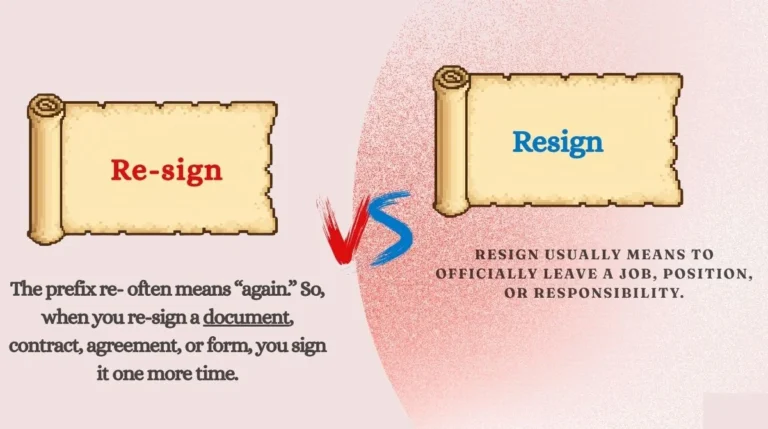
The prefix re- often means “again.” So, when you re-sign a document, contract, agreement, or form, you sign it one more time.
For example:
The company asked me to re-sign the contract.
This means the person had already signed the contract before and now needs to sign it again.
The word is especially common when talking about contracts, employment agreements, sports deals, leases, legal papers, or other documents.
When Should You Use “Re-sign”?
Use re-sign when an action involving signing is happening again.
You might re-sign:
- a work contract
- a rental agreement
- a legal document
- an application form
- a business agreement
- a sports contract
- a permission form
The key idea is signing again.
Grammar Rule for “Re-sign”
Re-sign is a verb.
It can be used in different verb forms:
- re-sign
- re-signed
- re-signing
- re-signs
Examples:
I need to re-sign the agreement.
She re-signed her employment contract yesterday.
The lawyer is asking us to re-sign the document.
The company re-signs important contracts every year.
Notice that the hyphen remains useful because it makes the meaning clear.
Example Sentences with “Re-sign”
Here are some simple examples:
- I need to re-sign my contract before Friday.
- The player decided to re-sign with the team for another year.
- Please re-sign the form because one page was missing.
- The landlord asked us to re-sign the lease.
- She re-signed the agreement after making a few changes.
- The company wants all employees to re-sign their contracts.
- He is ready to re-sign with the club.
- We had to re-sign the document because the first copy was incorrect.
These sentences all contain the same basic idea: sign again.
A Common Confusion with “Re-sign”
One of the biggest problems is that writers sometimes leave out the hyphen.
Compare:
The athlete will re-sign with the club.
and:
The athlete will resign from the club.
These sentences can mean very different things.
The first says the athlete will sign a new agreement to stay.
The second says the person will leave a position.
That small hyphen can save the reader from misunderstanding your meaning.
What Does “Resign” Mean?
Simple Definition
Resign usually means to officially leave a job, position, or responsibility.
For example:
She decided to resign from her job.
This means she chose to leave her job.
The word resign is commonly used in workplaces, companies, schools, governments, organizations, and clubs.
When Should You Use “Resign”?
Use resign when someone voluntarily leaves a position.
For example, a person may resign because they:
- found another job
- want a career change
- are moving to another city
- are retiring
- are unhappy with their role
- need more time for personal reasons
A person usually resigns from something.
Common structures include:
resign from + job/position/company
or
resign as + job title
Examples:
He resigned from the company.
She resigned as manager.
You can also say:
He submitted his resignation.
Here, resignation is the noun form.
Grammar Rule for “Resign”
Resign is a verb.
Its common forms are:
- resign
- resigned
- resigning
- resigns
Examples:
I may resign soon.
She resigned last month.
He is resigning from his position.
The director resigns after ten years of service.
The most important grammar pattern is:
resign from + position/place
or
resign as + title
Example Sentences with “Resign”
- She decided to resign from her job.
- The manager resigned after the meeting.
- He resigned as company director last week.
- I do not want to resign from this position.
- The president resigned from office.
- She is resigning because she wants to move abroad.
- The coach resigned after the team’s poor results.
- He officially resigned yesterday.
In each sentence, the person is leaving a job, role, or position.
Another Meaning of “Resign”
There is another less common use of resign that learners may see in formal English:
resign oneself to something
This means to accept something unpleasant because you believe you cannot change it.
For example:
She resigned herself to the fact that the trip was canceled.
This meaning is different from leaving a job.
However, for everyday English learners, the most important meaning is still to leave a job or position officially.
Difference Between Re-sign and Resign
The simplest way to remember the difference is this:
Re-sign = sign again
Resign = leave a job or position
Here is a clear comparison:
| Word | Meaning | Common Use | Example |
|---|---|---|---|
| Re-sign | Sign again | Contracts, forms, agreements | I need to re-sign the contract. |
| Resign | Leave a job or position | Jobs, offices, roles | She decided to resign from her job. |
Usage Difference
The biggest difference is the action.
When you re-sign, you are still signing something.
When you resign, you are leaving something.
Think about this simple situation:
A football player has a contract with a club. The contract ends, but the player wants to stay.
The player may re-sign with the club.
That means the player signs another contract.
Now imagine the same player no longer wants to play for the club.
The player may resign from the position or, depending on the context, simply leave the club.
So the meanings move in opposite directions:
re-sign → stay by signing again
resign → leave a position
Grammar Logic
The prefix re- usually means “again.”
For example:
- rewrite = write again
- reread = read again
- rebuild = build again
- recheck = check again
- re-sign = sign again
This makes re-sign easier to understand.
On the other hand, resign is a separate word meaning to leave a position. It should not normally be understood as “sign again” without the hyphen.
Sentence Structure Difference
The words often appear in different sentence patterns.
With re-sign, you may use:
re-sign + something
or
re-sign + with + organization
Examples:
Please re-sign the contract.
The player re-signed with the team.
With resign, common patterns include:
resign from + job/position/company
or
resign as + title
Examples:
She resigned from her position.
He resigned as chairman.
Meaning Comparison
Consider these examples carefully:
The employee re-signed the contract.
The employee signed the contract again.
The employee resigned from the company.
The employee left the company.
Now look at this pair:
The coach re-signed with the club.
The coach agreed to continue by signing a new deal.
The coach resigned from the club.
The coach left the job.
These are not small differences in meaning. They describe two completely different events.
Pronunciation: Why These Words Sound Confusing
Pronunciation is another reason learners mix up these words.
Re-sign is commonly pronounced with stress on sign:
ree-SIGN
The first part sounds like the word ree.
Resign, meaning to leave a job, is commonly pronounced:
ri-ZINE
The second syllable gets the stronger stress.
So:
- re-sign → ree-SIGN
- resign → ri-ZINE
The spelling is similar, but the pronunciation helps show the difference.
This becomes especially important in spoken English. When you hear someone say one of these words, listen to the stress and the context.
For example:
“The player will re-sign.”
This usually means the player will agree to another contract.
But:
“The manager will resign.”
This means the manager will leave the position.
Context often makes the meaning clear even when the words sound similar.
Grammar Rules You Must Remember
Rule 1: Use “Re-sign” for Signing Again
Use re-sign when someone signs a document or agreement a second time.
Example:
Please re-sign the contract before sending it back.
The person has already signed it once and must do it again.
Rule 2: Use “Resign” for Leaving a Job or Position
Use resign when someone officially leaves a job, office, role, or position.
Example:
Maria decided to resign from her job.
She is leaving the job.
Rule 3: “Resign from” and “Resign as” Are Common Patterns
Use resign from before an organization, job, or position.
He resigned from the company.
Use resign as before a title or role.
She resigned as manager.
A common learner error is using the wrong preposition.
Instead of:
She resigned from manager.
Say:
She resigned as manager.
Rule 4: Keep the Hyphen in “Re-sign” When You Mean “Sign Again”
The hyphen helps readers understand your meaning quickly.
Correct:
The employee will re-sign the agreement.
Potentially confusing:
The employee will resign the agreement.
Without the hyphen, the sentence may look like resign, which normally means leaving a position.
In modern writing, the hyphen is especially useful whenever removing it could create confusion.
Common Mistakes Students Make
Mistake 1: Using “Resign” When They Mean “Sign Again”
Wrong:
I need to resign the contract.
The sentence can be confusing because resign usually means leaving a job or position.
Correct:
I need to re-sign the contract.
The hyphen makes the intended meaning clear.
Mistake 2: Using “Re-sign” When Someone Is Leaving a Job
Wrong:
The manager decided to re-sign from his job.
Correct:
The manager decided to resign from his job.
There is no idea of signing again here. The person is leaving.
Mistake 3: Confusing “Resign” with “Resignation”
Students sometimes use a noun where a verb is needed.
Incorrect:
She resignation from her job yesterday.
Correct:
She resigned from her job yesterday.
Or:
She submitted her resignation yesterday.
Remember:
resign = verb
resignation = noun
Mistake 4: Forgetting “From” After Resign
Incorrect:
He resigned the company.
Better:
He resigned from the company.
The common pattern is resign from + organization/job/position.
However, in some formal uses, resign can take a direct object, especially in expressions such as “resign an office.” For everyday learners, using resign from is often the clearest choice.
Mistake 5: Missing the Difference in Sports News
Sports writing is one place where this confusion appears often.
Compare:
The striker re-signed with the club.
The striker agreed to continue.
The striker resigned from his role as captain.
The striker gave up the role.
This is why punctuation matters.
Easy Trick to Remember the Difference
Here is a very simple memory trick:
Re-sign = “Do it again”
The prefix re- often means again.
Think:
re + sign = sign again
Just like:
- rewrite = write again
- reread = read again
- replay = play again
- recheck = check again
So when you see re-sign, think:
“I am signing again.”
Resign = “Exit the job”
When you see resign, think:
“I am leaving my position.”
You can even remember it as:
RE-SIGN = return to the signature
RESIGN = remove yourself from the role
That is not the historical origin of the word, but it is a useful learner trick.
One Question Can Solve the Problem
Ask yourself:
“Is the person signing something again?”
If the answer is yes:
re-sign
If the answer is no, and the person is leaving a job or position:
resign
This one question can help you choose the right word quickly.
Daily Life Examples
Here are some natural examples you may hear or use in real conversations.
1. At Work
A: Did you sign the new employment agreement?
B: Not yet. HR asked me to re-sign it.
Here, the employee needs to sign the agreement again.
2. Talking About a Manager
A: Why isn’t James at work today?
B: He resigned from his position last week.
James left the job.
3. Sports Conversation
A: Is the captain staying with the team next season?
B: Yes. He plans to re-sign with the club.
He will sign a new contract and stay.
4. A Rental Agreement
A: Is your lease finished?
B: Almost. The landlord wants us to re-sign it.
They need to sign the lease again.
5. Office Email
A: Did you send the document?
B: I tried, but the manager asked me to re-sign the last page.
The document needs another signature.
6. Leaving a Job
A: Are you still working at that company?
B: No. I resigned from my job two months ago.
The speaker officially left the job.
7. Company Leadership
A: Who is the new director?
B: The previous director resigned as director last Friday.
The person gave up the role.
8. Sports Contract
A: Why are fans celebrating?
B: Their favorite player re-signed with the team.
The player agreed to stay.
9. Correcting a Form
A: Why did the office send the form back?
B: I forgot to sign one section, so I had to re-sign it.
The speaker signed the paperwork again.
10. Career Change
A: Is Sarah leaving the company?
B: Yes. She resigned because she got a new job.
She chose to leave her current position.
Practice Section
Choose the correct word: re-sign or resign.
1. The employee needs to ________ the contract because there is an error.
2. The manager decided to ________ from his position.
3. The football star will ________ with the club for another three years.
4. She plans to ________ as company director next month.
5. Please ________ the document and return it to the office.
Answers
1. re-sign
The employee needs to sign the contract again.
2. resign
The manager is leaving his position.
3. re-sign
The football player will sign another agreement with the club.
4. resign
The person is giving up the role of company director.
5. re-sign
The document needs another signature.
A useful habit is to look for clues such as contract, document, agreement, form, or job, position, director, manager. These words often tell you which meaning is intended.
FAQs
What is the difference between re-sign and resign?
Re-sign means to sign something again, usually a contract or agreement. Resign means to officially leave a job, position, or role. The hyphen in re-sign helps make the meaning clear.
Is re-sign one word or two words?
Re-sign is normally written as one hyphenated word when it means “sign again.” The hyphen helps readers distinguish it from resign, which has a different meaning.
Can resign be used in a question?
Yes. For example:
Did she resign from her job?
You can also ask:
Why did the manager resign?
These questions are about someone leaving a job or position.
Is re-sign formal or informal?
Re-sign is suitable for both formal and informal English. It is especially common in business, employment, legal, and sports contexts where contracts and agreements are involved.
What is the noun form of resign?
The noun form is resignation.
For example:
He announced his resignation.
The verb is resign, while the noun is resignation.
Can resign mean “sign again”?
No. In standard modern English, resign normally means to leave a job or position, or in a different formal expression, to accept something unpleasant. When you mean “sign again,” use re-sign.
Why is the hyphen important in re-sign?
The hyphen helps separate re- from sign and makes the intended meaning easier to understand. Without it, re-sign can be mistaken for resign, which means something very different.
How do you pronounce re-sign and resign?
Re-sign is commonly pronounced ree-SIGN. Resign, meaning to leave a job, is commonly pronounced ri-ZINE. The different stress patterns can help you recognize them in speech.
Conclusion
Re-sign and resign look almost identical, but their meanings are completely different. Re-sign means to sign something again, such as a contract, agreement, form, or sports deal. The prefix re- gives you a useful clue because it often means “again.”
Resign, on the other hand, means to officially leave a job, position, or role. Common patterns include resign from a job and resign as a manager. The noun form is resignation.
The easiest way to remember the difference is to ask what action is happening. Is someone signing again? Use re-sign. Is someone leaving a job or position? Use resign.
Pay attention to the hyphen, pronunciation, and the words around the sentence. A little practice will make this difference much easier. Once you start noticing the pattern in emails, contracts, workplace conversations, and news stories, choosing the correct word will become natural.

Evan Rellmont is a writer who turns thoughtful ideas into meaningful words, creating stories and reflections that connect, inspire, and leave a lasting impression.