
Many English learners have seen both whisky and whiskey and wondered whether one of them is wrong.
The words look almost identical, sound the same, and refer to the same general type of drink. So why does one spelling have an extra e?
The answer is mainly connected to regional English and the country where the drink is made. This is not a grammar mistake in the usual sense.
Both spellings are correct, but they are traditionally used in different places.
Cambridge Dictionary, for example, lists whisky as the usual UK spelling and whiskey as the usual US and Irish spelling.
This small spelling difference can be confusing when you read menus, news stories, product labels, recipes, or books from different English-speaking countries.
You may see Scotch whisky in one sentence and Irish whiskey in another.
The good news is that there is a simple way to remember it.
By the end of this guide, you will understand what both spellings mean, where each one is normally used, why the spelling changes, and how to choose the right form in your own writing.
You will also see practical examples that make the difference much easier to remember.
What Does “Whisky” Mean?
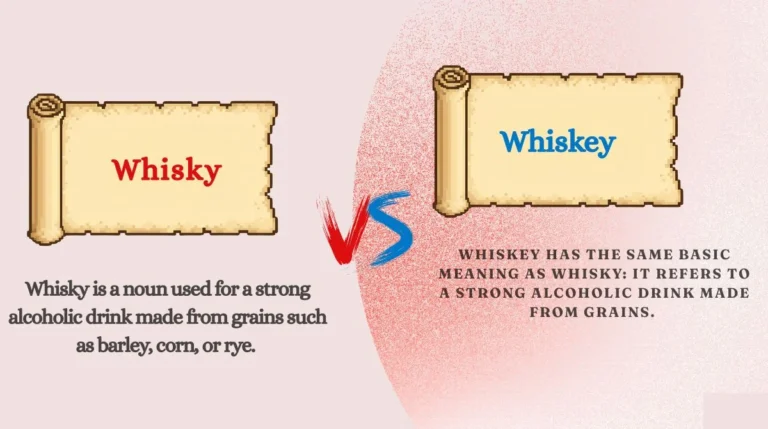
Whisky is a noun used for a strong alcoholic drink made from grains such as barley, corn, or rye. The word is especially common in British English, and it is strongly associated with Scotland, where the drink is called Scotch Whisky. Cambridge Dictionary gives whisky as the UK form and identifies whiskey as the US or Irish form.
The spelling whisky is also widely used for products made in other countries, including Japan and Canada. The Scotch Whisky Association notes that American whiskey is usually written with an e, while English, Welsh, Japanese, and many other varieties generally use whisky.
When Should You Use “Whisky”?
Use whisky when you are talking about a variety or product that normally follows this spelling tradition. It is the standard form in British English and is the spelling you will usually see in phrases such as:
- Scotch whisky
- single malt whisky
- blended whisky
- Japanese whisky
- whisky distillery
- whisky bottle
The word is a noun, so it names the drink itself.
Grammar Rule for “Whisky”
Whisky is normally an uncountable noun when you are talking about the drink in general.
For example:
Whisky is made from grains.
However, it can also be countable when you mean different varieties, types, or bottles in a particular context. You may therefore see sentences such as:
The shop sells several rare whiskies.
Here, whiskies means different kinds or examples of the drink.
Example Sentences With “Whisky”
- Scottish whisky is famous around the world.
- He ordered a glass of whisky after dinner.
- This whisky has a strong smoky flavor.
- My uncle collects old bottles of whisky.
- The company produces single malt whisky in Scotland.
- We learned how whisky is made during the tour.
- Japanese whisky has become popular internationally.
- She bought a bottle of whisky as a gift.
These sentences show that whisky can be used naturally in everyday descriptions, especially when the variety follows the spelling without an e.
A Common Confusion About “Whisky”
One common mistake is thinking that whisky is always the British word and whiskey is always the American word. That is too simple.
The spelling is often connected to the origin and tradition of the particular drink, not just the nationality of the person writing the sentence. Scotch is whisky, while American bourbon is normally whiskey. Irish products also commonly use whiskey.
So, a British writer talking about American bourbon would normally keep the established spelling whiskey.
What Does “Whiskey” Mean?
Whiskey has the same basic meaning as whisky: it refers to a strong alcoholic drink made from grains. The important difference is spelling and regional usage, not the basic dictionary meaning. Cambridge Dictionary lists whiskey as the usual spelling in US or Irish English.
The extra e is important because it is part of the traditional spelling used by many American and Irish producers.
You are most likely to see whiskey in phrases such as:
- Irish whiskey
- American whiskey
- bourbon whiskey
- Tennessee whiskey
- whiskey distillery
- whiskey glass
When Should You Use “Whiskey”?
Use whiskey when the variety or product normally uses the spelling with e.
This is especially common for American and Irish whiskey. The spelling appears in dictionaries, product names, newspapers, menus, and everyday American writing.
Grammar Rule for “Whiskey”
Like whisky, whiskey is generally an uncountable noun when you mean the drink as a substance.
For example:
Whiskey is often aged in wooden barrels.
When you mean different types or individual examples, the plural whiskeys can be used.
For example:
The competition included several American whiskeys.
The important point is that the spelling does not change the basic grammar of the word. Both forms are nouns and work in similar sentence structures.
Example Sentences With “Whiskey”
- He ordered an American whiskey at the restaurant.
- Irish whiskey is known for its smooth character.
- She bought a bottle of whiskey for her father.
- The recipe calls for a small amount of whiskey.
- Bourbon is a type of American whiskey.
- The distillery produces whiskey in small batches.
- They discussed different styles of Irish whiskey.
- He noticed the word “whiskey” on the bottle.
A Common Confusion About “Whiskey”
Learners sometimes think that whiskey is an incorrect spelling because whisky looks shorter and may be more familiar to them. That is not true.
Whiskey is a fully correct English spelling. In fact, it is the expected spelling for many American and Irish varieties. Cambridge explicitly identifies it as the US or Irish form.
The best choice depends on the variety, country, and style of English you are talking about.
Difference Between Whisky and Whiskey
The simplest answer is this:
Whisky and whiskey have the same basic meaning, but the spelling often tells you something about regional or production tradition.
The difference is mainly not grammatical. It is a spelling convention connected to different whisky-producing regions.
| Feature | Whisky | Whiskey |
|---|---|---|
| Basic meaning | A grain-based distilled spirit | A grain-based distilled spirit |
| Common spelling | UK and many non-American varieties | US and Irish English |
| Strong association | Scotland | Ireland and the United States |
| Example | Scotch whisky | Irish whiskey |
| American usage | Less common | Standard in most cases |
| Extra letter | No e | Has e |
| Pronunciation | Usually the same | Usually the same |
| Grammatical role | Noun | Noun |
1. Usage Difference
The most important difference is where the spelling is normally used.
When talking about Scotch, use:
Scotch whisky
Not:
Scotch whiskey
The Scotch Whisky Association consistently uses the spelling Scotch Whisky, and Scotch whisky has specific legal and geographical protection.
When talking about Irish products, the usual spelling is:
Irish whiskey
For American products, especially bourbon, whiskey is also the normal form.
So these are natural:
I enjoy Scotch whisky.
She bought Irish whiskey.
Bourbon is an American whiskey.
2. Grammar Logic
From a grammar point of view, there is very little difference.
Both words are nouns.
Both can be used after articles:
a whisky
a whiskey
Both can appear after quantity words:
some whisky
some whiskey
Both can be modified by adjectives:
Scottish whisky
American whiskey
The real issue is spelling convention, not sentence structure.
3. Sentence-Structure Difference
You can place either word into almost the same sentence pattern.
Compare:
This whisky is from Scotland.
This whiskey is from Ireland.
The structure is identical:
This + noun + verb + place
You can also say:
I bought a bottle of whisky.
I bought a bottle of whiskey.
Again, the grammar is exactly the same. The spelling changes because the product or regional variety changes.
4. Meaning Comparison
The general meaning is almost identical. Both words describe a distilled alcoholic spirit made from grain. Cambridge defines both forms in essentially the same way while distinguishing their regional spelling.
That is why learners should not treat these as two completely different vocabulary words.
Think of them as two conventional spellings of the same general word, with regional and production-related preferences.
5. Why Does Scotch Use “Whisky”?
Scotland traditionally uses the spelling without the e. The official industry name is Scotch Whisky, and the Scotch Whisky Association explains that the spelling varies by tradition and market. It also notes that American whiskey is usually spelled with an e, while English, Welsh, Japanese, and many other whiskies are not.
For example:
single malt whisky
Scotch whisky
blended whisky
These are standard expressions.
6. Why Does American Whiskey Use an “e”?
American producers generally use whiskey, and this spelling became established in American English.
For an English learner, the easiest approach is not to memorize every historical reason. Simply remember that American whiskey is the normal spelling.
That is especially helpful when writing about bourbon or other American styles.
Grammar Rules You Must Remember
Rule 1: Use “whisky” for Scotch
When the drink is specifically Scotch, the standard spelling is whisky.
Example:
He brought back a bottle of Scotch whisky from Scotland.
The official industry terminology is Scotch Whisky.
Rule 2: Use “whiskey” for American varieties
American English normally uses whiskey, especially for bourbon and other American styles.
Example:
Kentucky is famous for its whiskey.
Here, the spelling with e fits the American convention.
Rule 3: Irish products normally use “whiskey”
Irish English generally uses whiskey.
Example:
Irish whiskey is sold in many countries.
This is why Irish whiskey is a familiar phrase, even though Scotch is written as Scotch whisky. Cambridge identifies whiskey as the Irish form as well as the US form.
Rule 4: Do not change the spelling just because of your own English variety
Suppose you are writing in British English but discussing bourbon.
You should still normally write:
American whiskey
Do not automatically change every occurrence to whisky simply because you are using British English.
The spelling can describe the product or regional tradition. Keeping the established form makes your writing more accurate.
Common Mistakes Students Make
The confusion is understandable because the two spellings differ by only one letter. They also have the same pronunciation in ordinary English.
Mistake 1: Thinking “whiskey” is wrong
Some learners see whisky in a British dictionary or on a Scotch label and assume whiskey must be a spelling error.
That is incorrect.
Wrong idea:
Whiskey is always misspelled.
Correct idea:
Whiskey is a standard spelling, especially in American and Irish English.
Cambridge lists it as the US or Irish form.
Mistake 2: Writing “Scotch whiskey”
Many learners know that Scotland uses the word but forget the spelling.
For a grammar or vocabulary website, the safest standard form is:
Scotch whisky
The Scotch Whisky Association uses this official form consistently.
Mistake 3: Writing “Irish whisky”
You may occasionally see different spellings in broad contexts, but the standard traditional form for Irish products is:
Irish whiskey
That makes the regional distinction easier to understand.
Mistake 4: Changing the spelling inside a proper product name
A brand or producer may have its own established spelling. You should not “correct” the name simply because another spelling is more familiar.
For example, when discussing a specific product, use the spelling that appears in its official name.
Mistake 5: Thinking the two words have different pronunciations
For most English speakers, whisky and whiskey are pronounced essentially the same.
The spelling difference is much more noticeable in writing than in speech.
An Easy Correction Tip
Whenever you are unsure, ask yourself:
“What kind of whisky or whiskey am I talking about?”
Scotland?
whisky
Ireland or the United States?
whiskey
Another country?
Check the established local spelling, because usage is not limited to only two countries. The Scotch Whisky Association notes that many whisky traditions outside the US and Ireland use the spelling without the e.
Easy Trick to Remember the Difference
Here is a simple memory trick:
Think: E = Ireland and America
The word whiskey has an E.
Remember:
E → English-speaking American/Irish tradition
This is not a perfect historical rule for every product in every situation, but it is a very useful learner-friendly shortcut.
Then remember:
Scotland → whisky
You can make a tiny mental picture:
Scotch whisky
Irish whiskey
American whiskey
The first one has no e.
The other two normally have the e.
Another useful trick is to think of the phrase you see most often:
Scotch whisky
That phrase is so common that remembering it can help you remember the spelling.
Why This Trick Works
English spelling often reflects history and regional tradition. Not every spelling difference can be explained by a grammar rule.
The Scotch Whisky Association itself points out that the terms are distinguished by spelling traditions, with American whiskey generally using e and Scotch whisky using no e.
So you do not need a complicated grammar formula. You mainly need to connect the spelling with the variety.
Daily Life Examples
Here are some simple conversation-style examples showing how native speakers may use the two forms.
Example 1
A: What kind of Scotch did you buy?
B: I bought a bottle of Scottish whisky.
Example 2
A: Have you ever tried Irish whiskey?
B: No, but I would like to try it.
Example 3
A: Is bourbon a type of whiskey?
B: Yes, bourbon is an American type of whiskey.
Example 4
A: What does this bottle say?
B: It says “single malt whisky.”
Example 5
A: Is this Scotch or bourbon?
B: It is Scotch whisky.
Example 6
A: My friend brought back some Irish whiskey.
B: That sounds interesting.
Example 7
A: Which spelling should I use in this sentence?
B: If you are talking about Scotch, use whisky.
Example 8
A: Why does this American website spell it “whiskey”?
B: That spelling is standard in American English.
Example 9
A: I am writing about Scottish drinks for my school project.
B: Then whisky is the spelling you will probably need most often.
Example 10
A: Why do I see both spellings online?
B: Because different countries and whisky-producing traditions use different spellings.
These examples show something important: the spelling is usually connected to the specific product or variety, not simply to whether the writer personally uses British or American English.
Practice Section
Choose the correct spelling for each sentence.
1. Scotland is famous for its _____.
A. whiskey
B. whisky
2. Bourbon is a type of American _____.
A. whisky
B. whiskey
3. She bought a bottle of Irish _____.
A. whisky
B. whiskey
4. We visited a Scotch _____ distillery.
A. whisky
B. whiskey
5. The American article used the spelling _____.
A. whisky
B. whiskey
Answers
- B — whisky
- B — whiskey
- B — whiskey
- A — whisky
- B — whiskey
A good way to improve is to explain the reason for each answer, rather than simply memorizing the letters. Ask yourself which country or variety the sentence refers to.
FAQs
What is the difference between whisky and whiskey?
The two words have the same basic meaning. The main difference is spelling and regional tradition. Whisky is commonly used for Scotch and in many countries outside the US and Ireland, while whiskey is commonly used for American and Irish products.
Is whisky or whiskey correct?
Both are correct. Neither spelling is simply a mistake. The correct choice depends on the variety, country, or established usage. For Scotch, use whisky; for most American and Irish varieties, use whiskey.
Is Scotch whisky or Scotch whiskey?
The standard term is Scotch whisky. The Scotch Whisky Association uses this spelling, and “Scotch Whisky” is also a protected geographical indication under relevant legal frameworks.
Is Irish whiskey spelled with an e?
Yes. Irish whiskey is the standard spelling you will normally see. Cambridge lists whiskey as the US or Irish form.
Is American whiskey spelled whisky?
American English normally uses whiskey, especially when referring to American whiskey styles. The spelling whisky is more strongly associated with Scotch and other traditions that do not use the extra e.
Can I use whisky and whiskey in the same sentence?
Yes, when you are talking about different varieties. For example:
Scotch whisky and American whiskey are both made from grains.
Using both forms in one sentence is perfectly natural when the context calls for it.
Conclusion
The difference between whisky and whiskey is much easier once you stop treating it as a difficult grammar problem. Both words describe the same general kind of grain-based distilled drink, and both spellings are correct in English. The main difference is regional and traditional usage.
For the easiest rule, remember this:
Scotch = whisky
Irish = whiskey
American = whiskey
The spelling may vary for other countries and products, so when you are writing about a specific brand or variety, follow its established spelling.
For English learners, the most important thing is not to worry when you see both forms. Native English speakers use both every day. Once you connect each spelling with its common regional use, the difference becomes natural.
Keep an eye out for Scotch whisky, Irish whiskey, and American whiskey when reading English online. A few real examples will quickly make the pattern stick in your memory.

Evan Rellmont is a writer who turns thoughtful ideas into meaningful words, creating stories and reflections that connect, inspire, and leave a lasting impression.