
Have you ever typed “posible” and wondered whether it is correct English? You are not alone.
Many English learners leave out one s because the word sounds as if it may need only one. The correct English spelling, however, is possible with two s letters in the middle.
The good news is that this is an easy mistake to fix once you understand the spelling and grammar of the word.
Possible is a very common English adjective. We use it when something can happen, can be done, or may be true.
You will hear it in everyday conversations, emails, school writing, work discussions, and many other situations.
For example, we can say, “Is it possible to finish this today?” or “It is possible that she will come later.”
This topic is important because a small spelling mistake can make your writing look less accurate, especially in school, professional writing, and online content.
Learning the correct form will also help you understand related words such as possibly and possibility.
By the end of this guide, you will know why possible is correct, why posible is wrong in standard English, how to use the word in sentences, and how to remember the spelling without checking a dictionary every time.
What Does “Posible” Mean?
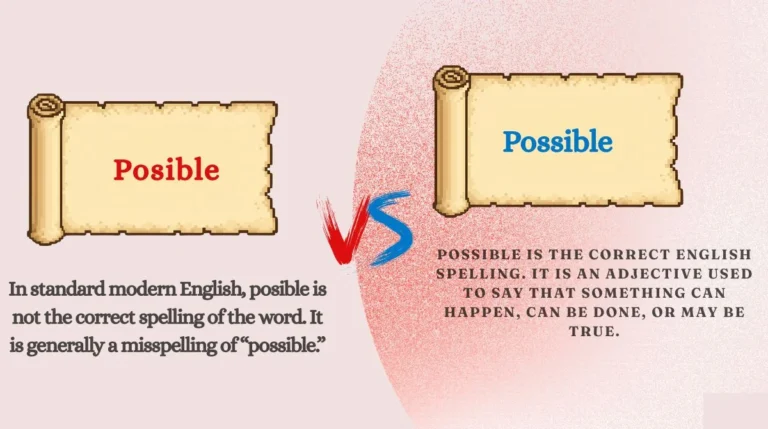
In standard modern English, posible is not the correct spelling of the word. It is generally a misspelling of “possible.”
When English learners write posible, they usually mean that something can happen, can be done, or may be true. The problem is simply the spelling. English requires two s letters in possible.
So, if you see posible in an English sentence, you should normally correct it to possible.
Is “Posible” a real English word?
For normal English writing, the answer is no. You should not use posible as the standard spelling of the adjective.
For example:
- ❌ Is it posible to call you tonight?
- ✅ Is it possible to call you tonight?
Another example:
- ❌ It is not posible to change the date.
- ✅ It is not possible to change the date.
The mistake often happens because the writer remembers the general sound of the word but forgets one of the letters.
When do learners use “posible”?
Learners usually write posible when they want to use the word possible.
They may also make this mistake because several English words do not contain double letters, so the spelling pattern can feel confusing.
The important thing is to remember that possible has two s letters:
po + ss + ible = possible
Grammar rule for “posible”
There is no normal grammar rule for using posible because it is not the standard English form.
Instead, use possible, which is an adjective.
Compare:
- ❌ It is posible.
- ✅ It is possible.
- ❌ A posible answer exists.
- ✅ A possible answer exists.
- ❌ Is it posible?
- ✅ Is it possible?
Examples showing the correction
Here are some common examples:
- ❌ Is it posible to meet tomorrow?
✅ Is it possible to meet tomorrow? - ❌ Anything is posible with enough practice.
✅ Anything is possible with enough practice. - ❌ Is a refund posible?
✅ Is a refund possible? - ❌ We need every posible solution.
✅ We need every possible solution. - ❌ It may be posible to fix the problem.
✅ It may be possible to fix the problem. - ❌ She asked whether it was posible to leave early.
✅ She asked whether it was possible to leave early. - ❌ We are looking for a posible explanation.
✅ We are looking for a possible explanation. - ❌ Nothing seemed posible at first.
✅ Nothing seemed possible at first.
Common learner confusion
The main problem is simple: posible looks similar to possible.
A learner may hear the word and think there is only one s sound, so one s should be enough. But English spelling does not always match pronunciation letter by letter.
That is why it is better to learn the whole spelling:
possible
rather than trying to build the word from the sound.
What Does “Possible” Mean?
Possible is the correct English spelling. It is an adjective used to say that something can happen, can be done, or may be true.
For example:
- It is possible to solve this problem.
- Is it possible to change the booking?
- There are several possible reasons.
- It is possible that he forgot.
The basic idea is “it can happen” or “it can be true.”
When should you use “possible”?
Use possible when you are talking about chance, opportunity, or something that can happen or exist.
For example, if a friend asks whether you can meet tonight, you might say:
“It is possible, but I need to finish my work first.”
Here, possible means that meeting can happen.
You can also use it for things that may be true:
“It is possible that the train is late.”
This means the train may be late, but you are not completely certain.
Grammar rule for “possible”
Possible is an adjective.
One common structure is:
It + be + possible + to + base verb
Examples:
- It is possible to win.
- It was possible to change the date.
- It may be possible to repair the phone.
Another important structure is:
It + be + possible + that + clause
Examples:
- It is possible that she is busy.
- It is possible that they forgot.
- It may be possible that the plan will change.
You can also put possible before a noun:
possible + noun
Examples:
- a possible solution
- a possible reason
- a possible problem
- a possible mistake
- a possible answer
Examples of “possible”
Here are some natural examples:
- Is it possible to get there before noon?
- It is possible that she will call later.
- We need to find a possible solution.
- Anything is possible if you keep trying.
- Is there any possible way to fix this?
- It may be possible to finish the project today.
- He gave us several possible reasons for the delay.
- A small change can make a big difference possible in the right situation.
The last sentence is less natural as written, so a better version would be:
A small change can make a big improvement possible.
This shows that possible can sometimes appear after a noun or object in more advanced sentence patterns.
Possible does not mean certain
This is an important point for learners.
When something is possible, it does not mean that it will definitely happen.
Compare:
It is possible that Ali will come.
This means Ali may come.
It does not mean:
Ali will definitely come.
So, possible expresses chance, not certainty.
Difference Between Posible and Possible
The difference is very simple:
Possible is the correct English spelling.
Posible is usually an incorrect spelling.
There is no normal grammar difference between them because posible is not the standard English adjective.
Comparison table
| Word | Correct English? | Meaning | Part of Speech | Example |
|---|---|---|---|---|
| posible | ❌ No | Usually intended to mean “possible” | — | ❌ Is it posible? |
| possible | ✅ Yes | Can happen, can be done, or may be true | Adjective | ✅ Is it possible? |
Usage difference
There is no real usage difference between the two forms in standard English.
When a writer uses posible, they almost always intend to write possible.
For example:
- ❌ We need a posible answer.
- ✅ We need a possible answer.
The first sentence contains a spelling error. The second sentence is correct.
Grammar logic
Possible is an adjective, so it describes a noun or tells us that an action can happen.
Look at these two patterns:
Possible + noun
We discussed every possible option.
Here, possible describes option.
Be + possible + to-infinitive
It is possible to change the schedule.
Here, possible describes the situation.
Another useful pattern is:
Be + possible + that-clause
It is possible that he is still sleeping.
This means there is a chance that he is still sleeping.
Sentence structure
You will commonly see possible in these structures:
1. It is possible to + verb
It is possible to learn English online.
2. It is possible that + subject + verb
It is possible that Tom forgot the meeting.
3. A possible + noun
We need a possible solution.
4. As … as possible
This is another very common expression.
Please arrive as early as possible.
Finish the work as quickly as possible.
Here, the meaning is “to the greatest degree that can reasonably be achieved.”
Meaning comparison
The word possible has several closely related uses, but its central idea stays the same:
Something has a chance of happening, existing, or being done.
The misspelling posible does not have a separate meaning.
So, when choosing between the two spellings, there is no need to think about meaning. Simply remember that the correct spelling contains ss.
Grammar Rules You Must Remember
Understanding the spelling is useful, but learning a few grammar patterns will make the word much easier to use naturally.
Rule 1: Use “possible” as an adjective
Because possible is an adjective, it can describe a noun.
Examples:
- We looked at every possible answer.
- There are several possible causes.
- She gave me a possible explanation.
- Is there another possible solution?
Think of it as a word that tells us something can exist or happen.
Rule 2: Use “possible to” for actions
A very common pattern is:
It is possible to + base verb
Examples:
- It is possible to learn this rule.
- Is it possible to cancel the order?
- It may be possible to fix the computer.
- Was it possible to contact him?
Do not use a past-tense verb directly after to.
For example:
- ❌ It is possible to went there.
- ✅ It is possible to go there.
After to, use the base form of the verb.
Rule 3: Use “possible that” before a full clause
Another useful pattern is:
It is possible that + subject + verb
Examples:
- It is possible that she is late.
- It is possible that they missed the bus.
- It is possible that we made a mistake.
Notice that that is followed by a full clause.
You can also use modal verbs:
It is possible that he may come later.
However, in many simple sentences, “possible” plus “may” can sound slightly repetitive, so choose the structure that feels natural for the meaning.
Rule 4: Remember the spelling “ss”
This is the most important rule when your problem is posible vs possible.
The correct spelling is:
P-O-S-S-I-B-L-E
There are two s letters.
A useful spelling family is:
- possible
- possibility
- possibly
They all keep the ss after “po.”
For example:
Is this possible?
There is a possibility.
He will possibly arrive tomorrow.
Learning these related forms together can make the spelling easier to remember.
Common Mistakes Students Make
Many learners make this mistake because English pronunciation and spelling do not always match perfectly.
When we speak quickly, we do not stop and think about every letter. We remember the sound, and our fingers type what seems right.
That is how posible often appears.
Mistake 1: Leaving out the second “s”
❌ Is it posible to finish today?
✅ Is it possible to finish today?
Tip: Break the word into parts:
po + ss + ible
Mistake 2: Thinking one “s” should be enough
A student may think:
“I only hear one /s/ sound, so maybe one s is correct.”
That is not a reliable way to spell English words.
Instead, learn the visual pattern:
possible
The middle ss is part of the standard spelling.
Mistake 3: Using “possible” where “possibly” is needed
These words are related, but they do different jobs.
Possible is an adjective:
It is possible.
Possibly is an adverb:
He will possibly come later.
A common mistake is:
❌ He will possible come tomorrow.
✅ He will possibly come tomorrow.
The adjective and adverb forms should not be mixed.
Mistake 4: Confusing “possible” with “possibility”
Both words are correct, but they have different grammatical roles.
Possible = adjective
It is possible.
Possibility = noun
There is a possibility.
Compare:
❌ There is a possible of rain.
✅ There is a possibility of rain.
And:
❌ It is possibility to win.
✅ It is possible to win.
A simple correction method
Whenever you write posible, stop and ask:
“Does this word need two s letters?”
The answer is yes.
Write:
possible
not:
posible
With a little practice, the correct spelling will become automatic.
Easy Trick to Remember the Difference
Here is one of the easiest tricks:
Remember: “Possible has two chances, so it has two S’s.”
It is a simple memory sentence, but it can help you remember the spelling.
Think:
po + SS + ible = possible
The double s is the part that learners often forget.
You can also connect possible with its related words:
possible → possibility → possibly
Look at all three:
- possible
- possibility
- possibly
The ss stays there every time.
That gives you a useful spelling family rather than one word to memorize by itself.
Use the word in a real sentence
Instead of repeating the spelling alone, say a sentence:
“Is it possible?”
“Yes, it is possible.”
“It is possible to learn.”
“Anything is possible.”
When you hear and use the word several times, the correct spelling becomes easier to remember.
A second memory trick
Imagine the two s letters are two little friends standing together:
po — SS — ible
Do not separate them.
Whenever you start typing posible, remember:
“Wait! Possible needs two S’s.”
It sounds simple, and that is exactly why it works.
Daily Life Examples
The word possible is extremely common in everyday English. Here are natural examples you might hear at home, at school, at work, or while talking with friends.
1. Asking for a favor
A: Is it possible to help me with this?
B: Sure. Give it to me.
Here, the speaker is asking whether the action can be done.
2. Making travel plans
A: Is it possible to catch the 8 a.m. train?
B: Yes, but we need to leave early.
The word shows that the plan can happen.
3. Talking about the future
It is possible that we will move next year.
The speaker is saying that the event may happen.
4. Talking about work
Please finish this as soon as possible.
This is very common in emails and workplace conversations.
It means the speaker wants it done without unnecessary delay.
5. Asking about a change
Is it possible to change my appointment?
This sentence is common when speaking to a doctor’s office, company, school, or service provider.
6. Talking about a problem
There are several possible reasons for the delay.
Here, possible describes the different reasons that may explain what happened.
7. Encouraging someone
Don’t give up. Anything is possible.
This is often used as encouragement. It suggests that success may happen even when something seems difficult.
8. Talking about plans
We are trying every possible way to solve the problem.
The speaker means they are considering every way that might work.
9. Making a polite request
Could you come as early as possible?
This means “come as early as you reasonably can.”
10. Talking about uncertainty
It is possible that Sara forgot the time.
The speaker is not certain. They are only saying that this is one reasonable explanation.
These examples show why possible is such a useful word in everyday English. It is not limited to grammar exercises. Native speakers use it constantly when talking about plans, choices, chances, problems, and future events.
Practice Section
Choose the correct word in each sentence: posible or possible.
1. Is it ______ to get a refund?
A. posible
B. possible
2. We need to consider every ______ solution.
A. posible
B. possible
3. It may be ______ to finish the work today.
A. posible
B. possible
4. Is it ______ that they are still at home?
A. posible
B. possible
5. Please reply as soon as ______.
A. posible
B. possible
Answers
- B. possible
- B. possible
- B. possible
- B. possible
- B. possible
The answer is the same each time because possible is the standard English spelling.
Try writing the word five times:
possible — possible — possible — possible — possible
Then use it in your own sentence. This small exercise can help the spelling stay in your memory.
FAQs
What is the difference between “posible” and “possible”?
In standard English, possible is the correct spelling. Posible is normally a spelling mistake.
Possible means that something can happen, can be done, or may be true. For example, “Is it possible to come tomorrow?”
Is “posible” a correct English word?
No, posible is not the standard spelling of the English adjective. If you want to say that something can happen or be done, use possible.
Remember that the correct form has two s letters: possible.
How do you spell possible correctly?
The correct spelling is:
P-O-S-S-I-B-L-E
A simple way to remember it is po + ss + ible. The double s comes after “po.”
Can I use “possible” in questions?
Yes. Possible is very common in questions.
For example:
Is it possible to change the date?
Is it possible to pay online?
Is it possible that he forgot?
These sentences ask whether something can happen or may be true.
Is “possible” an adjective?
Yes. Possible is an adjective.
It can describe a noun, as in “a possible answer,” or appear after a linking verb, as in “It is possible.” It is also common in the structure “It is possible to + verb.”
What is the difference between “possible,” “possibly,” and “possibility”?
Possible is an adjective:
It is possible.
Possibly is an adverb:
She will possibly come later.
Possibility is a noun:
There is a possibility of rain.
All three words are related, so learning them together can help build stronger vocabulary and spelling skills.
Conclusion
The choice between posible vs possible is easy once you remember one important point: possible is the correct English spelling, while posible is normally a misspelling.
The word possible is an adjective that means something can happen, can be done, or may be true. It is very common in everyday English, especially in questions such as “Is it possible?” and sentences such as “It is possible to change the plan.”
The easiest spelling trick is to remember the two s letters:
po + ss + ible = possible
You can also connect the word with possibility and possibly, which use the same double-s pattern.
Do not worry if you have written posible before. Spelling mistakes are a normal part of learning English. The important thing is to notice the pattern, practice it, and use the correct form in your writing. With a little repetition, possible will soon feel natural.

Evan Rellmont is a writer who turns thoughtful ideas into meaningful words, creating stories and reflections that connect, inspire, and leave a lasting impression.