
Among and amongst are two words that often confuse English learners.
They look different, but their meanings are very close. In fact, in most situations, you can use either word without changing the basic meaning of the sentence.
The confusion usually comes from pronunciation, spelling, and the fact that one form sounds more formal or old-fashioned to many learners.
Students may also wonder whether among is correct in American English and amongst is correct in British English.
Others think that one word should be used for people and the other for things. These ideas can make a simple grammar point seem harder than it really is.
Both among and amongst are prepositions. They can show that a person or thing is in a group, surrounded by other people or things, or included as part of a larger group.
For example, you can say, “She was sitting among her friends” or “She was sitting amongst her friends.” Both sentences are grammatically correct.
The main difference is not meaning. It is mostly about style, frequency, and variety of English.
Among is the more common choice in everyday modern English, while amongst is less common and can sound more formal, literary, or old-fashioned, especially in some varieties of English.
By the end of this guide, you will know exactly when to use each form, which one is more natural in daily speech, and how to avoid common mistakes.
What Does “Among” Mean?
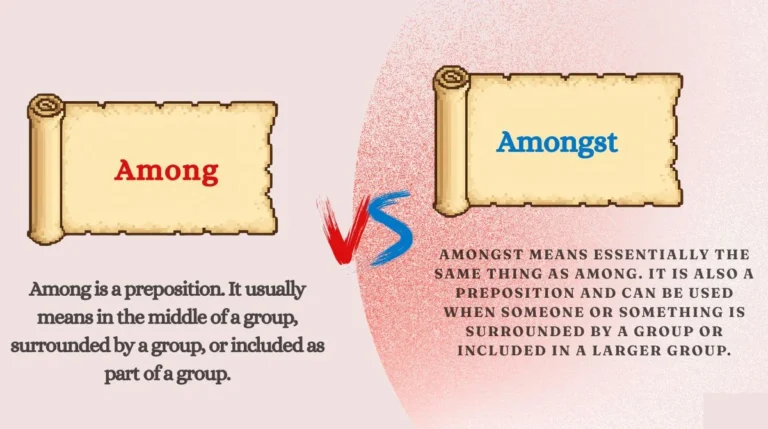
Among is a preposition. It usually means in the middle of a group, surrounded by a group, or included as part of a group.
It is commonly used when several people or things are considered together rather than as separate pairs. Cambridge explains that the word can mean being in the middle of or surrounded by other things, as well as being included in a group. It is often followed by a plural noun phrase.
When should you use “among”?
Use among when you are talking about a person or thing that is:
- inside a group
- surrounded by several people or things
- included in a larger group
- interacting with members of a group
- being shared or divided within a group
Here are some easy examples:
- She was sitting among her classmates.
- I found my old photo among these books.
- There was a small house among the trees.
- He felt comfortable among his friends.
- The teacher walked among the students.
- They shared the money among themselves.
- She is among the best players on the team.
- We found several mistakes among the answers.
Notice that among does not simply mean “between.” It gives the idea of being part of or surrounded by a group. Cambridge specifically describes this sense as being a part of, surrounded by, or included in something else.
Grammar rule for “among”
A common structure is:
among + plural noun
Examples:
- among friends
- among students
- among trees
- among the crowd
- among the winners
You can also use pronouns:
- among them
- among ourselves
- among yourselves
- among themselves
For example:
The children divided the toys among themselves.
Here, the word shows that the sharing happened within the group.
A useful point for learners
You may sometimes see among before a noun that does not look plural in the usual way. For example:
There was peace among the population.
The important idea is still a group or collection. English does not require every noun after among to have a visible plural ending. The meaning and grammar of the whole phrase matter.
What Does “Amongst” Mean?
Amongst means essentially the same thing as among. It is also a preposition and can be used when someone or something is surrounded by a group or included in a larger group. Cambridge lists it as an alternative to among, while Collins defines amongst as having the same meaning as among.
For example:
- She was standing amongst her friends.
- The flowers grew amongst the rocks.
- He felt safe amongst people he trusted.
- The letter was hidden amongst the old papers.
- She is highly respected amongst her colleagues.
- They talked amongst themselves.
- The answer was found amongst the final entries.
- He was amongst the first people to arrive.
As you can see, replacing among with amongst usually does not change the basic meaning.
When should you use “amongst”?
You can use amongst in many of the same grammatical situations as among. It is not a different grammatical category, and it is not a special word only for certain types of nouns.
The bigger issue is style.
Cambridge says amongst is sometimes used as an alternative to among and describes it as more formal and less common. Collins also describes it as literary or old-fashioned in some usage notes, and identifies it as chiefly British in American-English dictionary information.
This means that a sentence such as:
I was among friends.
usually sounds more natural and common in everyday modern English than:
I was amongst friends.
The second sentence is still correct. It simply has a slightly different style.
Difference Between Among and Amongst
The easiest way to understand the difference is this:
Meaning: Almost the same
Grammar: Almost the same
Main difference: Usage, style, and frequency
| Point | Among | Amongst |
|---|---|---|
| Part of speech | Preposition | Preposition |
| Basic meaning | In or surrounded by a group | In or surrounded by a group |
| Grammar | Correct | Correct |
| Everyday use | Very common | Less common |
| Style | Neutral and natural | More formal, literary, or old-fashioned in some contexts |
| British English | Very common | Also used |
| American English | Standard choice | Less common |
| Spoken English | Usually preferred | Less common |
| Can mean “included in a group”? | Yes | Yes |
| Can be used with “themselves”? | Yes | Yes |
1. Usage difference
The most important practical difference is frequency.
Among is the normal choice for most modern English speakers. It appears naturally in conversation, school writing, business writing, news, and general communication.
Amongst is also correct, but it is used less often. It may sound more formal, literary, traditional, or old-fashioned depending on the speaker and context.
Compare:
She was happy among her friends.
She was happy amongst her friends.
Both are grammatically correct. The first is simply more neutral for most learners.
2. Grammar logic
There is no major grammar rule that says one meaning belongs to among and another belongs to amongst.
Both can be followed by nouns such as:
- friends
- students
- people
- trees
- houses
- books
- flowers
- colleagues
Both can also be used in phrases such as:
among themselves
and
amongst themselves
Cambridge gives examples of both forms in this type of structure.
3. Sentence structure
The structures are almost identical.
Subject + verb + among + group
Example:
He walked among the crowd.
And:
Subject + verb + amongst + group
Example:
He walked amongst the crowd.
The sentence structure remains the same. Only the preposition changes.
4. Meaning comparison
There is usually no important difference in basic meaning.
The cat was hiding among the boxes.
The cat was hiding amongst the boxes.
Both tell us that the cat was in the middle of or surrounded by the boxes.
This is why the choice should usually be based on natural style, not on a different dictionary meaning.
Grammar Rules You Must Remember
Rule 1: Use “among” for a group or collection
Use among when someone or something is part of, inside, or surrounded by a group.
Example:
She stood among the other students.
She was not standing between only two students. She was part of a larger group.
Cambridge notes that among is typically used with a plural noun phrase when referring to a group.
Rule 2: “Amongst” can usually replace “among”
In most normal sentences, you can replace among with amongst without changing the basic meaning.
Among:
The bird disappeared among the trees.
Amongst:
The bird disappeared amongst the trees.
Both are correct.
The difference is mainly one of style and frequency rather than grammar.
Rule 3: Prefer “among” in ordinary modern English
For learners, among is the safest everyday choice.
Use it in conversation, school assignments, emails, general writing, and most situations where you want clear, natural English.
Natural:
We found the missing key among the books.
You could use amongst, but it may sound a little more formal or literary:
We found the missing key amongst the books.
This does not make the second sentence wrong. It simply gives it a different tone.
Rule 4: Do not think “amongst” is incorrect
A common learner mistake is to assume that amongst is a spelling error.
It is not.
Amongst is a real and correct English word. It is a variant of among, and it is still used, especially in British English and in more formal or literary styles.
So:
Among my friends, I feel relaxed. ✅
Amongst my friends, I feel relaxed. ✅
The first is simply more common in modern everyday English.
Common Mistakes Students Make
Learners often make mistakes with these words because they expect every different spelling to have a different meaning. That is not always true in English.
Mistake 1: Thinking “amongst” is wrong
Wrong idea: “Among is correct, but amongst is incorrect.”
That is false.
Correct: Both forms are valid.
Tip: Think of amongst as an alternative form, not a mistake.
Mistake 2: Using “among” for a two-item relationship
This is a different issue, but it is worth understanding.
English often uses between for two clearly separated things and among when something is viewed as part of a group or crowd. Cambridge makes this distinction in its guidance on between and among.
For example:
The agreement was between Ali and Sara.
Here, the two people are clearly identified.
For a group:
The teacher shared the books among the students.
The students form a larger group.
The old shortcut “between two, among three or more” can be useful for beginners, but real English is more flexible. The key question is how the relationship is being viewed: as separate individuals or as a group.
Mistake 3: Choosing “amongst” because it sounds smarter
Some learners believe a longer word must sound more advanced.
That can lead to unnatural English.
For everyday communication, this is usually better:
She sat among her friends.
There is no need to change it to amongst just to sound formal.
Tip: Clear and natural English is usually better than unnecessarily fancy English.
Mistake 4: Using the wrong spelling
The correct spellings are:
among ✅
amongst ✅
These are not correct:
amoung ❌
amongstt ❌
amongest ❌
A useful trick is to remember the shorter form first: among. Once you know that, you can remember amongst as the alternative form.
Easy Trick to Remember the Difference
Here is a very simple memory trick:
“Among = everyday choice”
Think of among as your regular, everyday word.
You can use it almost automatically when talking about groups.
among friends
among students
among trees
among the people
among the winners
Then remember:
“Amongst = among with extra style”
This is not a strict grammar rule, but it is a useful learner-friendly reminder.
When you see amongst, think:
“It means the same thing, but it may sound a little more formal, literary, or traditional.”
For example:
I feel comfortable among my friends.
This sounds very natural.
I feel comfortable amongst my friends.
This is also correct, but some speakers may hear it as more formal or literary.
If you are writing normal English and you are unsure which one to choose, among is usually the easiest and safest option.
Daily Life Examples
Here are some simple examples you may hear or use in real conversations.
1. Talking about friends
A: Where is Sam?
B: He’s sitting among his friends.
This means Sam is in the group of friends.
2. Talking about school
The teacher walked among the students during the test.
The teacher moved around inside the group of students.
3. Talking about nature
We found a small stream among the trees.
The stream was surrounded by trees.
4. Talking about sharing
We divided the pizza among the four children.
Each child received part of the pizza.
5. Talking about people
She is very popular among young students.
She is well liked within that group.
6. Talking privately
They discussed the problem among themselves.
Only the members of the group discussed it.
You can also say:
They discussed the problem amongst themselves.
Both are correct.
7. Talking about a crowd
I saw my brother among the crowd.
He was somewhere inside the group of people.
8. Talking about objects
My glasses are somewhere among these papers.
The glasses are mixed in with the papers.
9. Talking about a group of winners
She was among the top three students in her class.
She was included in that group.
10. Talking about everyday life
It feels good to be among people who understand you.
The word shows that the person is part of a group.
Practice Section
Choose the correct option in each sentence. In many cases, notice that both may be grammatically possible. The main question is which word sounds more natural in modern everyday English.
1. She was sitting ______ her closest friends.
A. among
B. between
2. We found the old letter ______ the books.
A. amongst
B. among
3. The teacher divided the students into groups and asked them to talk ______ themselves.
A. among
B. amongst
4. He is well known ______ professional footballers.
A. among
B. between
5. The little cottage stood ______ the trees.
A. among
B. amongst
Answers
1. Among — She was part of a larger group.
2. Among — This is the more common everyday choice, although amongst is also grammatically possible.
3. Among — Among themselves is very common; amongst themselves is also correct.
4. Among — He is known within a group of professional footballers.
5. Among — Amongst could also be used, but among is more neutral and common.
FAQs
What is the difference between among and amongst?
There is usually no major difference in meaning. Both can mean “in or surrounded by a group” or “included in a group.” The main difference is style and frequency. Among is more common, while amongst is less common and may sound more formal, literary, or old-fashioned.
Can I use amongst instead of among?
Yes. In most sentences, amongst can replace among without changing the basic meaning. For example, “She stood among the trees” and “She stood amongst the trees” are both correct. However, among is usually the more natural everyday choice.
Is amongst formal or informal?
Amongst is often considered more formal, literary, or traditional than among, although the exact feeling depends on the speaker and variety of English. Cambridge describes it as more formal and less common, while Collins labels it literary in its learner dictionary.
Is among more common than amongst?
Yes. Among is the more common form in modern English. Amongst is still used, especially in British English, but it occurs less frequently. For learners who want natural everyday English, among is generally the better default.
Can we use among and amongst in questions?
Yes. Both can appear in questions.
Who was among the guests?
You could also say:
Who was amongst the guests?
The meaning is essentially the same. Again, among is usually the more common and neutral form.
Is amongst British English and among American English?
Not exactly. Among is standard in both British and American English. Amongst is also used, particularly in British English, but it is less common. Collins describes it as a chiefly British variant in its American-English entry.
Conclusion
The difference between among and amongst is much easier than it first appears. Both are prepositions, and both can describe someone or something being in, surrounded by, or included in a group. In most sentences, replacing one with the other does not change the main meaning.
The biggest difference is style and frequency. Among is the common, neutral choice that works very well in everyday conversation, school writing, and general English. Amongst is also correct, but it is less common and can sound more formal, literary, or old-fashioned in some situations.
So, when you are unsure, choose among. It is simple, natural, and widely used.
The best way to remember the difference is to practice both forms in real sentences. Once you see them used with friends, students, crowds, trees, books, and groups, the choice will start to feel natural.

Evan Rellmont is a writer who turns thoughtful ideas into meaningful words, creating stories and reflections that connect, inspire, and leave a lasting impression.