
Have you ever written “sense” when you meant “since”? Or read a sentence such as “I have lived here sense 2020” and felt that something looked wrong?
You are not alone. Since and sense are confusing because they sound very similar when spoken, but they have completely different meanings and jobs in a sentence.
One usually talks about time or a reason, while the other is connected with meaning, understanding, feelings, or the five senses.
This small spelling difference can cause big mistakes in school writing, emails, social media posts, and everyday English.
The good news is that once you understand what each word does, the difference becomes much easier to remember.
Since can work as a preposition, conjunction, or adverb. It can show when something started, such as “since Monday,” or give a reason, such as “Since it was raining, we stayed inside.” Sense is mainly a noun or verb.
It can describe one of the five senses, a feeling, an idea, or the meaning of something.
By the end of this guide, you will know when to use each word, how their grammar works, which mistakes to avoid, and how to remember the difference without stopping to think every time.
What Does “Since” Mean?
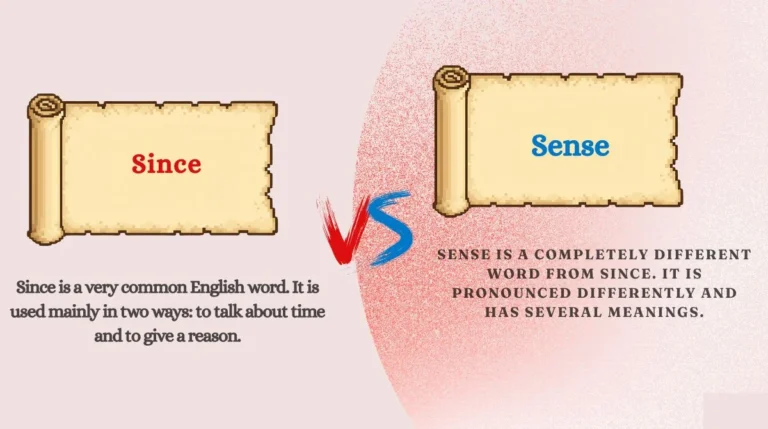
Since is a very common English word. It is used mainly in two ways: to talk about time and to give a reason.
When we use it for time, it points to a particular moment in the past. It tells us when something started and often suggests that the situation continued after that point. For example, “I have worked here since 2021” means the work started in 2021 and continues now.
Cambridge explains that since can be used as a preposition with a date, time, or noun phrase, as a conjunction with a clause, and as an adverb when the time is already understood.
Since for Time
We use since + a starting point.
The starting point may be:
- a year: since 2020
- a day: since Monday
- a specific time: since 8 a.m.
- an event or clause: since I met her
- a period in someone’s life: since childhood
Look at these examples:
- I have lived in Karachi since 2020.
- She has been busy since Monday.
- We have known each other since school.
- He has worked here since January.
- I have not seen Ali since last week.
- They have been married since 2018.
- She has felt better since she started exercising.
- I haven’t eaten anything since breakfast.
A useful point is that since usually refers to a starting point, not the length of time.
Compare:
- I have lived here since 2020. → 2020 is the starting point.
- I have lived here for six years. → Six years is the length of time.
This is why English learners should not normally say, “I have lived here since six years.” The natural form is “for six years.” Cambridge specifically notes that for is used with a period of time, while since refers to a point in time.
Since for a Reason
Since can also mean because or as.
For example:
- Since you are tired, you should rest.
- Since it was raining, we stayed home.
- Since nobody answered the phone, I left a message.
- Since the shop was closed, we came back later.
Here, since has nothing to do with time. It introduces a reason.
Notice the difference:
I have lived here since 2020.
Here, since = from that time until now.
Since you are here, help me with this box.
Here, since = because.
This second use is especially common in writing and in situations where the speaker assumes the reason is already clear or easy to understand. Cambridge describes this use of since as a conjunction introducing a reason.
Since as an Adverb
Sometimes the word comes alone because the time reference is already clear.
For example:
She moved to London in 2022 and has lived there ever since.
Here, since means from that time until now.
Another example:
I met him years ago, but I haven’t spoken to him since.
You do not need to repeat the event because the listener already understands what “since” refers to.
Common Confusion About “Since”
A common mistake is using since when you need sense.
For example:
❌ This doesn’t since right.
✅ This doesn’t make sense.
Another common mistake is using since with a length of time:
❌ I have been waiting since two hours.
✅ I have been waiting for two hours.
Remember: since = starting point, while for = length of time.
What Does “Sense” Mean?
Sense is a completely different word from since. It is pronounced differently and has several meanings.
As a noun, sense can refer to one of the five physical abilities: sight, hearing, smell, taste, and touch. It can also mean understanding, awareness, judgment, or the meaning of a word or sentence. As a verb, sense means to feel, notice, detect, or become aware of something.
Sense and the Five Senses
We often use sense when talking about our physical abilities.
For example:
- Dogs have a strong sense of smell.
- I lost my sense of taste when I was sick.
- Our sense of hearing changes as we get older.
- Touch is one of the five senses.
- She has an excellent sense of smell.
- The dark made it difficult to use my sense of sight.
The plural senses is also common:
The loud noise shocked all my senses.
Sense as Understanding or Meaning
Another important use is related to meaning or understanding.
This is where we get the very common expression “make sense.”
For example:
- Your explanation makes sense.
- This sentence doesn’t make sense.
- That idea makes perfect sense.
- I don’t sense any difference is grammatically possible, but it has a different meaning from “I don’t see the difference.”
- Can you explain this? It doesn’t make sense to me.
When something makes sense, it is logical, clear, or easy to understand.
Merriam-Webster defines sense as including the meaning conveyed by a word or phrase, as well as awareness, sensation, and rational understanding.
Sense as a Feeling or Awareness
Sense can also describe a feeling or awareness that is difficult to explain exactly.
For example:
- I had a sense that someone was watching me.
- She felt a strong sense of happiness.
- There was a sense of excitement in the room.
- He has a good sense of humor.
- I have a poor sense of direction.
- The students developed a sense of responsibility.
Notice some common expressions:
a sense of humor
a sense of direction
a sense of responsibility
a sense of danger
a sense of achievement
Sense as a Verb
As a verb, sense means to notice or become aware of something, sometimes without directly seeing it.
Examples:
- I could sense her anger.
- He sensed that something was wrong.
- She sensed danger and walked away.
- The dog sensed fear in the stranger.
- I sensed that he was nervous.
- We could sense excitement in the crowd.
Cambridge gives sense as a verb meaning to feel or be aware of something, while Merriam-Webster also includes detecting or becoming conscious of something.
Common Confusion About “Sense”
Because since and sense sound similar, learners often switch their spellings.
A very common mistake is:
❌ That doesn’t since any sense.
✅ That doesn’t make any sense.
Another one:
❌ I have lived here sense 2019.
✅ I have lived here since 2019.
The key is to focus on the meaning and grammar, not only on the sound.
Difference Between Since and Sense
Although the two words are close in spelling and sound, they do completely different jobs.
| Feature | Since | Sense |
|---|---|---|
| Main meaning | A starting time or a reason | Meaning, feeling, awareness, or physical ability |
| Common word class | Preposition, conjunction, adverb | Noun, verb |
| Talks about time? | Yes | No |
| Can mean “because”? | Yes | No |
| Related to the five senses? | No | Yes |
| Common expression | since Monday | make sense |
| Example | I have lived here since 2020. | This idea makes sense. |
| Pronunciation | /sɪns/ | /sens/ |
1. Usage Difference
Use since when you need to talk about a starting point in time or explain a reason.
Use sense when you are talking about meaning, understanding, awareness, feelings, judgment, or the five senses.
Compare:
I haven’t seen her since Friday.
→ This is about time.
Her explanation makes sense.
→ This is about understanding.
2. Grammar Difference
Since often connects parts of a sentence:
I have been here since Monday.
It can also introduce a clause:
Since it was late, we went home.
Sense, on the other hand, is usually a noun:
That doesn’t make sense.
Or a verb:
I can sense your concern.
These are not interchangeable grammar patterns.
3. Sentence Structure Difference
Common patterns with since include:
since + time
since 2021
since Monday
since breakfast
since + clause
since I arrived
since she moved here
since we started school
Common patterns with sense include:
make + sense
make sense
makes sense
made sense
a sense of + noun
a sense of humor
a sense of danger
a sense of freedom
sense + object
sense danger
sense fear
sense a problem
4. Meaning Comparison
Think about the ideas behind the words.
Since points backward to a time or gives a reason.
Sense helps you understand, feel, notice, or describe something.
That is why these sentences cannot be switched:
✅ I have known her since 2018.
❌ I have known her sense 2018.
And:
✅ This explanation makes sense.
❌ This explanation makes since.
Grammar Rules You Must Remember
Rule 1: Use “since” for a starting point in time
When you name the point when something began, since is often the correct choice.
✅ I have worked here since 2022.
❌ I have worked here for 2022.
The word 2022 is a starting point, so since fits naturally.
Rule 2: Use “for” for a period of time
Do not confuse a starting point with a duration.
✅ I have lived here for five years.
✅ I have lived here since 2021.
The first sentence tells us how long. The second tells us when the period started.
A quick test is:
- When did it start? → since
- How long? → for
Rule 3: Use “sense” in “make sense”
The expression make sense is extremely common.
✅ Your answer makes sense.
✅ That doesn’t make sense.
✅ Now I understand. It all makes sense.
Do not write “make since.”
A useful memory link is this: something that is logical or understandable has sense.
Rule 4: Use “since” to mean “because” when giving a reason
Sometimes since introduces a reason.
✅ Since you are busy, I’ll call you later.
✅ Since the road was blocked, we took another route.
Here, since can often be replaced by because without changing the basic meaning.
Because you are busy, I’ll call you later.
This is very different from the time meaning of since.
Common Mistakes Students Make
The main reason for these mistakes is simple: since and sense sound very similar. When people write quickly, they may remember the sound but not the meaning.
Mistake 1: Using “sense” for time
❌ I have been here sense morning.
✅ I have been here since morning.
Ask yourself: “Am I talking about a starting time?”
If yes, use since.
Mistake 2: Using “since” for meaning
❌ Your sentence doesn’t make since.
✅ Your sentence doesn’t make sense.
Here, you are talking about logic or meaning, so use sense.
Mistake 3: Confusing “since” and “for”
❌ She has worked there since ten years.
✅ She has worked there for ten years.
Or:
✅ She has worked there since 2016.
The first uses a period. The second uses a starting point.
Mistake 4: Using “since” when “because” is clearer
This is not always a grammar error, but it can create confusion.
Since it was late, we left.
This is correct, but a learner may wonder whether since refers to time or reason.
In some situations, because is clearer:
Because it was late, we left.
Choose the word that makes your meaning easiest to understand.
Mistake 5: Forgetting the expression “make sense”
Many learners translate directly from their first language and write an unusual phrase.
❌ This sentence makes since.
✅ This sentence makes sense.
Practice this expression as a complete phrase rather than learning the word alone.
Easy Trick to Remember the Difference
Here is a simple classroom trick.
Think: “Since = Start”
Both ideas begin with S.
Since → Starting point
Examples:
- since Monday
- since 2020
- since breakfast
- since I arrived
When you see a starting point in time, your brain should think since.
Think: “Sense = Meaning”
The word sense is connected to things you can understand, feel, notice, or experience.
You have:
- a sense of smell
- a sense of direction
- a sense of humor
- a sense of danger
And something can make sense.
So remember:
Since = starting time or reason
Sense = meaning, feeling, awareness, or the five senses
One extra clue can help with spelling: sense has the letter e before the final e-like sound in pronunciation, while since has i. More importantly, though, always check the meaning.
Daily Life Examples
These examples show how the words appear in normal conversation.
Example 1
A: How long have you lived here?
B: I have lived here since 2020.
The word refers to the time the person started living there.
Example 2
A: Why are you staying home?
B: Since I’m feeling sick, I decided to rest.
Here, since means because.
Example 3
A: Do you understand the teacher’s explanation?
B: Yes, it makes sense now.
Here, sense means understanding or logic.
Example 4
A: Something feels strange today.
B: I sense that something is wrong too.
Here, sense is a verb meaning to feel or notice.
Example 5
A: When did you start learning English?
B: I have studied English since high school.
The word introduces the starting point.
Example 6
A: Why did you cancel the trip?
B: Since the weather was terrible, we stayed home.
Here, since gives the reason.
Example 7
A: Why did you buy this book?
B: The review made sense, so I thought it would help me.
The word refers to logical meaning.
Example 8
A: Can you smell the food from here?
B: Yes. My sense of smell is pretty strong.
Here, sense refers to one of the five senses.
Example 9
A: Has Tom called you?
B: No. I haven’t heard from him since Monday.
This is a starting point in time.
Example 10
A: Why are you worried?
B: I have a sense of danger. Something doesn’t feel right.
Here, sense means an awareness or feeling.
These examples show why replacing one word with the other does not work. The words may sound alike, but their meanings are completely different.
Practice Section
Choose since or sense to complete each sentence.
1. I have known Sara _____ 2019.
2. This explanation doesn’t make _____.
3. _____ it was raining, we took a taxi.
4. He has been tired _____ this morning.
5. I could _____ that she was upset.
Answers
1. since
“I have known Sara since 2019.”
2. sense
“This explanation doesn’t make sense.”
3. Since
“Since it was raining, we took a taxi.”
4. since
“He has been tired since this morning.”
5. sense
“I could sense that she was upset.”
Extra Challenge
Try making two sentences of your own:
- one with since for time
- one with sense for meaning
Then make a third sentence using since to mean because.
This small exercise can make the difference much easier to remember.
FAQs
1. What is the difference between since and sense?
Since is commonly used for a starting point in time or to give a reason. Sense is related to meaning, understanding, feelings, awareness, judgment, or the five senses.
For example, “I have lived here since 2020” and “That doesn’t make sense.”
2. Can “since” be used in a sentence about reasons?
Yes. Since can mean because or as when it introduces a reason.
For example: “Since you are tired, you should go to bed.” It does not refer to time in this sentence.
3. Can “sense” be used as a verb?
Yes. Sense can be a verb meaning to notice, feel, detect, or become aware of something.
For example: “I sensed that he was nervous.” This is different from since, which does not have this meaning.
4. Is “since” formal or informal?
Since is a normal, common English word used in both speaking and writing. Its meaning depends on the context.
It can show time, as in “since Monday,” or a reason, as in “since it was late.”
5. Is “make sense” correct English?
Yes. Make sense is one of the most common expressions with sense.
We use it when something is logical, clear, understandable, or reasonable. For example, “Your explanation makes sense.”
6. How can I remember since vs sense?
Think of since as a word connected to a starting point or a reason. Think of sense as a word connected to meaning, understanding, feelings, or the senses.
A quick memory line is: Since = start; sense = meaning.
Conclusion
The difference between since and sense is much easier once you stop focusing only on their similar sound.
Use since when you talk about a starting point in time, such as since Monday, since 2020, or since I moved here. It can also introduce a reason, where it means something like because.
Use sense when you are talking about meaning, understanding, awareness, judgment, feelings, or one of the five senses. It is also the correct word in common expressions such as make sense, a sense of humor, and sense of smell.
Whenever you are unsure, ask yourself one simple question: Am I talking about a starting time or reason, or am I talking about meaning, feeling, or the senses? That question will usually lead you to the right spelling.
With a little practice, these two words will stop feeling confusing. The next time you write a sentence, check the meaning first. Good grammar often becomes easy when you understand the idea behind the word.

Evan Rellmont is a writer who turns thoughtful ideas into meaningful words, creating stories and reflections that connect, inspire, and leave a lasting impression.