
Anyway or anyways? This is a common question for English learners because both forms can be heard in everyday conversations.
You may see someone write, “Anyway, I need to go,” while another person says, “Anyways, I was telling you about my trip.” This can make the two words look like equal choices.
The good news is that the difference is actually quite simple. Anyway is the standard form and the one you should choose in most situations.
Anyways is also used, especially in informal spoken English in North American English, but it is less suitable for formal writing. Major learner dictionaries describe anyways as an informal form of anyway.
There is another reason learners find this word confusing: anyway has several jobs in a sentence.
It can mean “despite that,” help you return to an earlier topic, introduce another important reason, or add a small correction to something you just said.
After reading this guide, you will know what anyway means, when anyways can appear, which form is better for school or professional writing, and how native speakers use these words in real conversations.
What Does “Anyway” Mean?
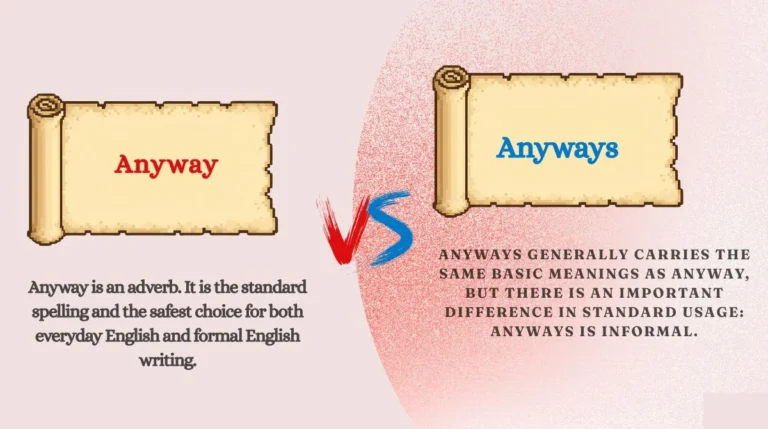
Anyway is an adverb. It is the standard spelling and the safest choice for both everyday English and formal English writing. Oxford lists anyway as the main form and notes that anyways is informal North American English.
The word does not have only one meaning. Its meaning depends on the situation and its position in the sentence.
1. Anyway can mean “despite that”
We often use anyway when something happens even though there is a reason not to do it. In simple English, it can mean “in spite of that” or “even so.” Cambridge gives this as one of its main uses.
For example:
- I was tired, but I finished my homework anyway.
- It was raining, but we went outside anyway.
- She did not feel well, but she went to work anyway.
- The shoes were expensive, but I bought them anyway.
- He knew the road was difficult, but he continued anyway.
- I did not like the movie, but I watched it anyway.
- We were late, but they waited for us anyway.
- She was nervous, but she gave the speech anyway.
In these examples, the action happened despite another fact.
2. Anyway can add another reason
The word can also introduce a reason that supports an earlier idea. In this use, it is often close to “besides” or “in any case.”
Consider:
- I do not need a new phone, and anyway, my old one still works.
- We should leave now; anyway, the store closes soon.
- I cannot come tonight, and anyway, I have a lot of work.
- She did not want the job, and anyway, the salary was too low.
- I will not buy that car. It is too expensive anyway.
- We cannot go to the beach. It is too cold anyway.
Here, the speaker adds another point that makes the first statement stronger.
3. Anyway can change or return to a topic
In conversations, anyway is very useful when a speaker wants to return to the main subject, move to a new point, or bring a conversation to an end. Cambridge describes this as a discourse-marker use, especially common in speech.
Examples:
- Anyway, what were you saying?
- Anyway, I need to finish my homework.
- Anyway, back to the meeting.
- Anyway, how was your trip?
- Anyway, I should get going now.
- Anyway, forget about that for a moment.
Notice the comma after Anyway when it comes at the beginning of a sentence in this conversational use.
4. Anyway can slightly correct or limit what you said
Sometimes a speaker says something and then makes it more exact.
For example:
- I think everyone enjoyed the party. Sam did, anyway.
- Most students passed the test. The younger students did, anyway.
- I do not know exactly where he lives. I think it is near the station, anyway.
- She is probably coming tonight, I hope so, anyway.
This use helps the speaker say, “That is what I mean, at least,” or make a small correction to the previous statement. Oxford includes this meaning in its definition of anyway.
Why do learners get confused about “anyway”?
A big problem is that learners sometimes expect every English word to have one fixed meaning. Anyway does not work that way.
Compare:
I was tired, but I studied anyway.
Here, it means despite being tired.
Now compare:
Anyway, what time does the bus leave?
Here, it helps move the conversation to another point.
The spelling stays the same, but the function changes according to context.
What Does “Anyways” Mean?
Anyways generally carries the same basic meanings as anyway, but there is an important difference in standard usage: anyways is informal.
Cambridge defines anyways as an informal form of anyway, while Oxford specifically labels it informal North American English. Cambridge’s learner dictionary also describes it as US spoken usage.
So you may hear:
- Anyways, what are you doing tonight?
- I was tired anyways.
- We decided to go anyways.
- Anyways, I need to leave now.
- It was too late anyways.
- She was going to call me anyways.
- Anyways, back to our main topic.
- I did not really want to go anyways.
People may use these sentences naturally in casual speech or informal messages.
Does “anyways” have a different meaning?
Usually, no.
In most modern informal use, anyways means essentially the same thing as anyway. Cambridge simply defines it as an informal form of anyway.
The main difference is style, not meaning.
For example:
I was tired, but I finished the work anyway.
and
I was tired, but I finished the work anyways.
The basic message is the same. The second sentence sounds more informal.
When can you use “anyways”?
You may see or hear anyways in:
- casual conversations
- text messages
- social media posts
- informal chats
- relaxed North American speech
It is especially common in spoken, casual English. But that does not mean it is the best choice everywhere.
For school assignments, business emails, academic writing, reports, applications, and other formal situations, anyway is the better option.
Why does “anyways” sound natural to some speakers?
English has many words that develop extra forms in casual speech. Speakers may naturally add -s to certain adverbs or use older regional forms that are not preferred in formal writing.
That is one reason you may hear anyways even when your grammar teacher tells you to write anyway.
So do not panic when you hear it. Understanding it is useful. Using anyway as your default is even safer.
Difference Between Anyway and Anyways
The easiest way to understand the difference is to remember this:
Anyway = standard form
Anyways = informal form, especially in North American speech
Both can usually communicate the same basic idea, but they do not have exactly the same level of formality.
Comparison Table
| Point | Anyway | Anyways |
|---|---|---|
| Part of speech | Adverb | Adverb |
| Meaning | Usually “despite that,” “in any case,” or a conversational transition | Usually the same meaning |
| Standard English | Yes | Less standard/formal |
| Formal writing | Recommended | Usually avoid |
| Everyday speech | Very common | Common in some informal varieties |
| North American English | Very common | Informal use is recognized |
| British formal English | Preferred form | Generally less suitable |
| Safe choice for students | Yes | No, when formal writing is expected |
Oxford identifies anyway as the standard entry and labels anyways as informal North American English. Cambridge similarly describes anyways as informal.
Usage difference
Imagine you are writing an email to your teacher:
I was very busy yesterday, but I finished the assignment anyway.
This sounds natural and appropriate.
Now write:
I was very busy yesterday, but I finished the assignment anyways.
The meaning is understandable, but the word choice is more casual.
For a text message to a close friend, that second version may be perfectly normal:
Anyways, are you coming tonight?
The key is not that anyways is impossible. The key is that anyway is the more widely accepted standard form.
Grammar logic
Both words work as adverbs. They do not normally change the main grammar of the sentence.
For example:
She went home anyway.
She went home anyways.
The verb went stays the same. The subject stays the same. The basic sentence structure stays the same.
The difference is mainly in register, meaning the level of formality.
Sentence structure difference
With anyway, common patterns include:
Subject + verb + anyway
I decided to go anyway.
Anyway + comma + sentence
Anyway, I need to go home.
Sentence + and anyway + reason
I cannot buy it, and anyway, it is too expensive.
With anyways, similar structures can occur in informal speech:
I decided to go anyways.
Anyways, I need to go home.
It was not important anyways.
So the sentence structure is mostly the same. The important difference is the style of the word.
Meaning comparison
There is usually no major meaning difference between the two forms.
Anyway is the standard choice:
It was raining, but we went anyway.
Anyways is informal:
It was raining, but we went anyways.
In both sentences, the idea is “despite the rain, we went.”
This is why it is better to think of the issue as a standard vs informal question rather than a completely different meaning question.
Grammar Rules You Must Remember
Rule 1: Use “anyway” as your default form
When you are unsure, choose anyway.
It is the standard form and works in everyday English as well as formal contexts.
Example:
I did not want to go, but I went anyway.
This is the safest form for students.
Rule 2: Use “anyways” mainly in informal speech and writing
Anyways is not simply a spelling mistake. It is a recognized informal form, particularly associated with North American English.
You may hear:
Anyways, what did you buy?
That can sound perfectly natural in relaxed conversation.
Still, in an exam or formal essay, choose anyway.
Rule 3: “Anyway” can move around in a sentence
Its position changes depending on what you want it to do.
At the beginning:
Anyway, let’s talk about your homework.
At the end:
I finished the homework anyway.
In the middle:
We should leave now because, anyway, the shop is closing.
Cambridge notes that anyway is often used in front position as a discourse marker and in end position when it means something like “despite that.”
Rule 4: Use a comma when “anyway” starts a conversational transition
When anyway begins a sentence and acts as a discourse marker, a comma is normally used in writing.
Anyway, what happened next?
Anyway, I should go now.
Anyway, back to the question.
This small punctuation rule helps make your writing clearer and more natural.
Common Mistakes Students Make
Many learners make mistakes with this pair because they hear anyways frequently in conversations or online.
Mistake 1: Thinking “anyways” is always wrong
This is too simple.
Anyways is a real informal form used in English, and major dictionaries recognize it. Cambridge calls it informal, while Oxford labels it informal North American English.
So this is better advice:
Understand “anyways,” but use “anyway” as your standard form.
That gives learners a practical rule.
Mistake 2: Using “anyways” in formal school writing
Consider:
Informal: Anyways, I disagree with this idea.
For a formal essay, this is better:
Formal: Anyway, I disagree with this idea.
Even better, depending on the sentence, you might remove the conversational marker completely:
I disagree with this idea.
Formal writing often benefits from direct, clear language.
Mistake 3: Forgetting that “anyway” has several meanings
A student may learn only one translation, such as “in any case,” and then feel confused by sentences like:
Anyway, where were we?
Here, anyway is not really giving the meaning “in any case.” It is helping the conversation return to a topic.
Similarly:
I did not enjoy the meal, but I ate it anyway.
Here, it means despite that.
The context tells you how to understand it.
Mistake 4: Adding “-s” because other adverbs have similar forms
Learners sometimes think:
any + way = anyway
any + ways = anyways
This may look logical, but English does not always work through simple spelling patterns. The important point is that anyway is the standard form, while anyways is an informal variant.
Wrong vs correct examples
Wrong for formal writing:
Anyways, I have completed the report.
Better:
Anyway, I have completed the report.
Casual conversation:
Anyways, what do you want to eat?
This may be heard naturally in informal speech.
Formal conversation or writing:
Anyway, what do you want to eat?
Easy correction tip
Whenever you are writing something for school, work, exams, or a public professional page, simply ask yourself:
Would “anyway” work here?
Almost always, the answer is yes.
That one habit will prevent most problems.
Easy Trick to Remember the Difference
Here is a simple memory trick:
“Anyway” is your all-purpose English word.
Think of anyway as your safe pair of shoes. You can wear it almost anywhere.
School?
Anyway.
Work?
Anyway.
Email?
Anyway.
Conversation?
Anyway.
Text message?
Anyway.
Formal article?
Anyway.
That is why anyway is the easiest form to learn first.
What about “anyways”?
Think of the extra s as a sign of speech style, not a new meaning.
You may hear someone say:
Anyways, let’s go.
But when you are writing carefully, change it to:
Anyway, let’s go.
Real-life logic
Imagine you are talking to your best friend. Casual speech is relaxed, so you may hear many informal forms.
Now imagine you are writing a university assignment. You want a standard form that nobody will question.
That is the real difference.
You do not need to memorize a complicated grammar formula. Just remember:
ANYWAY = standard and safe
ANYWAYS = informal variant
If you remember only those two lines, you will already get most questions right.
Daily Life Examples
Here are natural examples that show how anyway and anyways can appear in real conversations.
1. Talking about being tired
A: You look really tired.
B: I am, but I need to finish this work anyway.
The person continues despite being tired.
2. Returning to a topic
A: We were talking about your new job yesterday.
B: Oh, right. Anyway, I got the job!
Here, the word takes the speaker back to the main topic.
3. Giving another reason
A: Why don’t you buy that laptop?
B: It is too expensive. Anyway, I do not really need it.
Here, the second sentence gives another supporting reason.
4. Showing that something happened despite a problem
A: Was the weather bad?
B: Yes, it rained all afternoon, but we enjoyed the picnic anyway.
5. Ending a conversation
A: Thanks for helping me today.
B: No problem. Anyway, I should get home now.
Cambridge notes that anyway can help signal that a conversation is coming to an end.
6. Casual text message
Anyways, are you still coming to dinner?
This is informal. In careful writing, use:
Anyway, are you still coming to dinner?
7. Making a small correction
I think most people liked the show. Sarah did, anyway.
The speaker is limiting the statement to what they know.
8. Talking about a plan
A: It is a little late.
B: I know, but I am going anyway.
The plan continues despite the late hour.
9. Casual disagreement
Anyways, I do not think that is a good idea.
This can occur in informal speech, although anyway is the safer standard form.
10. Moving to something more important
We can talk about the movie later. Anyway, did you send the email?
Here, the speaker shifts attention to another point.
These uses show why anyway is such a useful word in everyday English. It is not just a dictionary word. It helps speakers connect ideas, manage conversations, add reasons, and show that something happened despite a problem.
Practice Section
Choose the best answer: anyway or anyways.
1. I was very busy, but I finished the task ______.
A. anyway
B. anyways
2. ______, what time does the movie start?
A. Anyway
B. Anyways
3. This is an informal text message: “I was going to call you ______.”
A. anyway
B. anyways
4. Which is the better choice for a formal school essay?
A. anyway
B. anyways
5. She did not like the restaurant, but she stayed ______.
A. anyway
B. anyways
Answers
1. Anyway
This is the standard form and is the best choice.
2. Anyway
It works naturally when changing or returning to a topic.
3. Anyways
This can appear in casual, informal writing. Anyway would also be correct and is more standard.
4. Anyway
For formal writing, choose the standard form.
5. Anyway
This sentence shows that she stayed despite not liking the restaurant.
A useful point to remember is that some sentences can accept both forms in informal English. The choice is often about formality and style, not a completely different meaning.
FAQs
What is the difference between anyway and anyways?
The main difference is formality, not basic meaning. Anyway is the standard form used across English. Anyways is an informal variant, especially associated with North American spoken English.
Is “anyways” grammatically correct?
It is recognized as an informal English word, so it is not simply meaningless or completely invalid. However, it is not the best choice for formal writing. For essays, exams, reports, and professional writing, anyway is the safer form.
Is anyway more correct than anyways?
For standard English, yes, anyway is the preferred form. Dictionaries list it as the main standard word, while anyways is marked as informal. This makes anyway the best choice when you are unsure.
Can we use anyway in questions?
Yes. It can appear naturally in questions, especially in conversation.
For example:
Anyway, what are you doing tonight?
What was he talking about anyway?
It can help introduce a question, return to a subject, or show that the speaker wants to know something more directly.
Is “anyways” informal?
Yes. Cambridge describes anyways as informal, and Oxford specifically labels it informal North American English. You may hear it in casual conversations, messages, and relaxed speech.
Should I use anyway or anyways in an email?
Use anyway unless you are writing a very casual message to a friend.
For professional emails, school emails, job applications, and formal messages, anyway is the better choice. It sounds standard, clear, and natural.
Conclusion
The choice between anyway and anyways is much easier once you focus on style rather than trying to find two completely different meanings.
Anyway is the standard form. It can mean “despite that,” add another reason, return to a topic, change the direction of a conversation, or slightly limit something you have just said.
Anyways usually has the same basic meaning, but it is an informal variant commonly found in casual North American speech and writing.
For learners, the easiest rule is simple: use “anyway” as your normal choice. You can understand “anyways” when you hear it, but you do not need to use it in formal writing.
Once you start noticing these words in conversations, movies, messages, and books, the difference will feel natural. A little regular practice is enough to make the correct choice without thinking too hard.

Evan Rellmont is a writer who turns thoughtful ideas into meaningful words, creating stories and reflections that connect, inspire, and leave a lasting impression.