
Have you ever seen wont and won’t and wondered whether they mean the same thing? You are not alone.
These two forms look almost identical, but the small apostrophe changes the meaning completely.
For English learners, this can be confusing because won’t is very common in everyday conversations, text messages, emails, movies, and songs.
It is the short form of will not. For example, “I won’t go” means “I will not go.”
The word wont, without an apostrophe, is a different word.
It is less common and usually means a person’s usual habit or typical behavior.
The confusion becomes even bigger because English uses apostrophes in many contractions.
Words such as can’t, don’t, doesn’t, didn’t, wouldn’t, and won’t all use apostrophes.
A missing apostrophe can therefore change a sentence or make it look incorrect.
Understanding the difference is useful for both writing and speaking. Once you know what the apostrophe is doing, the two words become much easier to separate.
By the end of this guide, you will know what wont means, what won’t means, how their grammar works, when to use each form, the common mistakes students make, and several easy ways to remember the difference.
What Does “Wont” Mean?
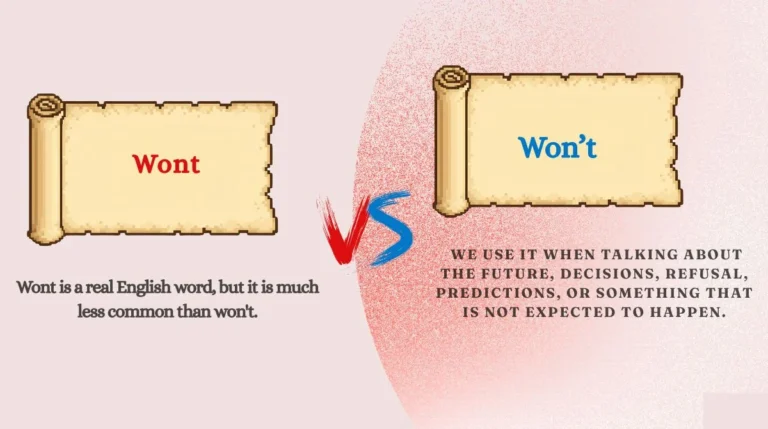
Wont is a real English word, but it is much less common than won’t.
As a noun, wont means a person’s usual habit, custom, or typical way of behaving. It often describes something someone regularly does.
For example:
It was his wont to arrive early.
This means that arriving early was his usual habit.
The word wont is often found in formal, old-fashioned, literary, or traditional writing. You may see it in books, biographies, historical writing, or formal descriptions. It is not normally used in casual conversation.
Wont as a Noun
When wont is used as a noun, it refers to a usual habit or practice.
Consider this sentence:
As was her wont, she brought a cup of tea to the meeting.
The meaning is:
As was her usual habit, she brought a cup of tea to the meeting.
Another example:
He went for a walk after dinner, as was his wont.
Again, wont means his normal habit.
Wont as an Adjective
Wont can also be used as an adjective. In this use, it is usually followed by to + verb and means “accustomed” or “used to doing something.”
For example:
She was wont to complain about the weather.
This means she was accustomed to complaining about the weather.
Another example:
The old man was wont to sit by the window every evening.
The sentence tells us that sitting by the window was his usual behavior.
This adjective use is quite formal and may sound old-fashioned in modern everyday English.
When Should You Use “Wont”?
Use wont when you are talking about a regular habit, custom, or characteristic behavior, especially in formal or literary writing.
Here are some examples:
- As was his wont, he checked the door twice before leaving.
- She was wont to read before going to bed.
- He followed his usual wont and arrived before everyone else.
- As was her wont, Maria stayed quiet during the argument.
- The king was wont to travel without a large group of guards.
- He was wont to tell the same story at family gatherings.
- As was their wont, the children played outside after school.
- The writer was wont to work late into the night.
Common Learner Confusion
Many students see wont and automatically think it is a spelling mistake for won’t. That is not always true.
For example:
He won’t come today.
This means:
He will not come today.
But:
He was wont to come early.
This means:
He was accustomed to coming early.
The first sentence talks about the future or refusal. The second talks about a habit.
A good clue is the apostrophe. When you see won’t, think will not. When you see wont, think habit or custom.
What Does “Won’t” Mean?
Won’t is the contraction of will not.
It is one of the most common negative forms used in English. We use it when talking about the future, decisions, refusal, predictions, or something that is not expected to happen.
For example:
I won’t call him tonight.
This means:
I will not call him tonight.
The apostrophe in won’t is important because it shows that letters have been left out in the contraction.
Unlike wont, won’t is extremely common in everyday English.
When Do We Use “Won’t”?
We use won’t in several common situations.
First, we use it for a future action that someone says will not happen.
I won’t be late.
Second, it can show refusal or unwillingness.
My little brother won’t eat vegetables.
This may mean that he refuses to eat them.
Third, we can use it when something does not work or refuses to behave as expected.
My phone won’t turn on.
The phone is not turning on.
We also use won’t in predictions:
It won’t rain tomorrow.
The speaker believes rain will not happen.
Grammar Rule for “Won’t”
Won’t + base form of the verb
The structure is:
Subject + won’t + base verb
Examples:
- I won’t go.
- She won’t help.
- They won’t agree.
- We won’t wait.
- He won’t come.
Notice that we do not add -s, -ed, or -ing directly after won’t.
Incorrect:
She won’t goes.
Correct:
She won’t go.
Example Sentences with “Won’t”
- I won’t forget your birthday.
- She won’t come to the party tonight.
- We won’t stay here for long.
- He won’t answer my question.
- They won’t agree with the new plan.
- My car won’t start this morning.
- The children won’t go to bed.
- It won’t take more than ten minutes.
Common Learner Confusion
A common mistake is writing wont when the writer actually means will not.
For example:
I wont go there again.
This should be:
I won’t go there again.
The apostrophe matters.
Another mistake is thinking that won’t always means simple future. It can also express refusal.
Compare:
The door won’t open.
This does not necessarily mean the door is making a decision. It simply means the door refuses to open or cannot be opened.
Difference Between Wont and Won’t
The most important difference is simple:
Wont = a usual habit, custom, or accustomed behavior.
Won’t = will not.
The apostrophe is not just decoration. It changes the word and its grammatical role.
Comparison Table
| Feature | Wont | Won’t |
|---|---|---|
| Apostrophe | No | Yes |
| Meaning | Habit, custom, usual behavior | Will not |
| Grammar | Noun or adjective | Contraction |
| Frequency | Uncommon | Very common |
| Style | Formal or literary | Everyday English |
| Future meaning | No | Yes |
| Shows refusal | No | Often |
| Example | He was wont to complain. | He won’t complain. |
Usage Difference
Look at these two sentences:
He was wont to arrive early.
This means arriving early was his usual habit.
Now compare:
He won’t arrive early.
This means he will not arrive early.
The meanings are very different even though the spelling is almost the same.
Grammar Logic
Wont functions as an independent English word. Depending on its use, it can mean a habit or describe someone as being accustomed to doing something.
Won’t, on the other hand, is a contraction. It combines:
will + not = won’t
The apostrophe replaces letters that have been omitted.
This is why won’t behaves like the negative form of will.
For example:
I will go.
Negative:
I won’t go.
Similarly:
She will help.
Negative:
She won’t help.
Sentence Structure Difference
With won’t, we normally use:
Subject + won’t + base verb
Examples:
He won’t come.
They won’t wait.
I won’t forget.
With wont, common structures include:
Subject + be + wont + to + verb
For example:
She was wont to smile.
Or:
as was/were someone’s wont
For example:
As was his wont, he left early.
This structure is uncommon in casual spoken English.
Meaning Comparison
Consider these examples:
John won’t talk to me.
John will not talk to me.
John was wont to talk to everyone.
John usually talked to everyone.
The first sentence describes a future or current refusal. The second describes a repeated habit.
Grammar Rules You Must Remember
Rule 1: “Won’t” Means “Will Not”
Whenever you can replace the word with will not, use won’t.
Example:
I won’t be late.
Expanded form:
I will not be late.
If the expanded sentence makes sense, won’t is the correct choice.
This is the easiest test for most learners.
Rule 2: Use a Base Verb After “Won’t”
After won’t, use the base form of the verb.
Correct:
She won’t come.
Correct:
He won’t help us.
Incorrect:
She won’t comes.
Incorrect:
He won’t helping us.
The rule is:
won’t + base verb
So remember:
- won’t go
- won’t eat
- won’t sleep
- won’t work
- won’t happen
- won’t change
Rule 3: “Wont” Is Usually About Habit
When wont appears without an apostrophe, look for a meaning connected to habit, custom, or usual behavior.
Example:
He was wont to complain about small problems.
The sentence describes a repeated behavior.
Another common expression is:
As was her wont, she arrived early.
This means:
As was her usual habit, she arrived early.
Rule 4: The Apostrophe Changes the Meaning
Do not ignore the apostrophe.
Compare:
I won’t call him.
= I will not call him.
And:
He was wont to call every morning.
= It was his usual habit to call every morning.
One tiny mark creates a major difference.
This is true with many contractions in English. Compare can’t with cant, it’s with its, and you’re with your. Apostrophes can carry important grammatical information.
Common Mistakes Students Make
Mistake 1: Leaving Out the Apostrophe
Incorrect:
I wont go tomorrow.
Correct:
I won’t go tomorrow.
Why does this happen? Usually because people type quickly or do not know that won’t is a contraction.
Mistake 2: Adding an Apostrophe to the Noun “Wont”
The word wont does exist without an apostrophe.
For example:
As was his wont, he arrived early.
Adding an apostrophe here would change the word into won’t, creating a completely different meaning.
Mistake 3: Using “Wont” Before a Normal Verb When You Mean “Will Not”
Incorrect:
She wont attend the meeting.
Correct:
She won’t attend the meeting.
The clue is the meaning. If you mean will not, use won’t.
Mistake 4: Using the Wrong Verb After “Won’t”
Incorrect:
They won’t goes there.
Correct:
They won’t go there.
Remember that modal verbs such as will use the base form of the following verb.
Because won’t contains will, the same rule applies.
Mistake 5: Thinking “Wont” Is a Common Everyday Alternative
Some learners believe they can use wont as a shorter spelling of won’t.
They cannot.
For example:
I wont eat that.
is not standard spelling for:
I won’t eat that.
In normal English writing, the apostrophe must be included.
Easy Trick to Remember the Difference
Here is a simple classroom trick:
Think: “Apostrophe = Not”
When you see:
won’t
immediately think:
will not
The apostrophe is your signal that the word is a contraction.
Now think of:
wont
without the apostrophe.
Think:
habit
So you can remember:
won’t → will not
wont → usual habit
Here is another useful trick.
Ask yourself:
“Can I replace this word with will not?”
If the answer is yes, use won’t.
Example:
We won’t leave yet.
Replace it:
We will not leave yet.
Perfect. So won’t is correct.
Now try:
As was her wont, she checked the door twice.
Replace wont with will not:
As was her will not, she checked the door twice.
That makes no sense. So wont is the correct word.
In everyday English, you will almost always need won’t, not wont. The word without the apostrophe is real, but it is relatively uncommon.
Daily Life Examples
Let’s look at natural examples that you might actually hear or use.
Example 1
A: Are you coming to dinner?
B: Sorry, I won’t be able to come.
Here, won’t means will not.
Example 2
A: Why isn’t the computer working?
B: It won’t turn on.
The computer refuses or fails to turn on.
Example 3
A: Will Sarah join us?
B: No, she won’t come tonight.
Again, won’t means she will not come.
Example 4
A: Are you going to tell him?
B: No, I won’t tell him anything.
The speaker has decided not to tell him.
Example 5
A: Why are the kids still awake?
B: They won’t go to sleep.
Here, won’t can express refusal or unwillingness.
Example 6
A: Will you forget about this?
B: No, I won’t forget.
The speaker promises that forgetting will not happen.
Example 7
A historical-style sentence might say:
As was his wont, he walked through the garden every morning.
Here, wont means his usual habit.
Example 8
Another formal example:
She was wont to write letters by hand.
This means she was accustomed to writing letters by hand.
Example 9
The old teacher was wont to arrive before sunrise.
This describes a regular habit.
Example 10
My printer won’t print this document.
This is very natural modern English. The printer is not working as expected.
Practice Section
Choose wont or won’t in each sentence.
1. I ___ be at home tonight.
A. wont
B. won’t
2. As was his ___, he arrived before everyone else.
A. wont
B. won’t
3. She ___ answer my messages.
A. wont
B. won’t
4. He was ___ to take a short walk after dinner.
A. wont
B. won’t
5. The car ___ start this morning.
A. wont
B. won’t
Answers
1. B — won’t
“I won’t be at home tonight” means “I will not be at home tonight.”
2. A — wont
“As was his wont” means “as was his usual habit.”
3. B — won’t
“She won’t answer” means “she will not answer.”
4. A — wont
“He was wont to take a short walk” means taking a walk was his usual practice.
5. B — won’t
“The car won’t start” means the car will not start or is refusing to start.
FAQs
What is the difference between wont and won’t?
Wont is a word related to a usual habit, custom, or typical behavior. Won’t is the contraction of will not. The apostrophe is important because it completely changes the meaning and grammar of the word.
Is “wont” a correct English word?
Yes, wont is a correct English word. However, it is much less common in modern everyday English. It usually appears in formal, literary, or traditional writing and refers to a habit or something someone is accustomed to doing.
Is “won’t” short for “will not”?
Yes. Won’t is the standard contraction of will not. For example, “I won’t go” means “I will not go.” It is very common in both spoken and written English, especially in informal and everyday communication.
Can we use “won’t” in questions?
Yes, won’t can appear in questions. For example, “Won’t you come with us?” can be used as an invitation or suggestion. You may also hear questions such as “Won’t it be difficult?” depending on the context.
Is “wont” formal or informal?
Wont is generally associated with formal, literary, or old-fashioned English. It is not a common choice in casual conversation. In everyday speech, people usually use simpler expressions such as usually, normally, or be accustomed to.
Why does “won’t” have such an unusual spelling?
The spelling of won’t comes from the historical development of the contraction of will not. Modern contractions do not always follow a simple letter-by-letter shortening pattern. Although the spelling is unusual, won’t is now a standard form that all English learners should recognize.
Conclusion
The difference between wont and won’t is much easier once you focus on the apostrophe and the meaning.
Won’t is the common word. It is a contraction of will not, and we use it for future actions, predictions, decisions, refusal, and things that do not work as expected. Its normal structure is subject + won’t + base verb, as in “She won’t come.”
Wont, without the apostrophe, is a different word. It refers to a usual habit, custom, or typical behavior. It is much less common and is often found in formal or literary writing. Expressions such as “as was his wont” describe something someone usually did.
When you are unsure, use the will not test. If you can replace the word with “will not,” choose won’t. If you are talking about a person’s usual habit, wont may be correct.
A little attention to that tiny apostrophe can make your English writing much clearer. Practice these two forms in real sentences, and the difference will soon feel natural.

Evan Rellmont is a writer who turns thoughtful ideas into meaningful words, creating stories and reflections that connect, inspire, and leave a lasting impression.