
Many English learners stop when they come across “sitted” and “seated.” Both words seem possible at first.
After all, English has many verbs that form their past tense by adding -ed, so it feels natural to think that sit might become sitted. But English does not always follow that pattern.
The verb sit is an irregular verb. Its main forms are sit, sat, sat, not sit, sitted, sitted.
Major dictionaries list sat as both the past tense and past participle of sit.
So where does seated come from? It comes from the verb seat, which has a different meaning and a different grammar pattern.
Seat can mean to put someone in a seat, while seated is also commonly used as an adjective meaning “sitting.” Cambridge, for example, defines seated as “sitting” and gives expressions such as remain seated and please be seated.
This difference matters in everyday English. You may need to say that someone sat down, that they were seated at a table, or that a receptionist seated the guests.
By the end of this guide, you will know exactly when to use sat, seated, and sit, why sitted is usually incorrect in standard English, and how to avoid this mistake in speaking speaking and writing.
What Does “Sitted” Mean?
Is “Sitted” a Correct English Word?
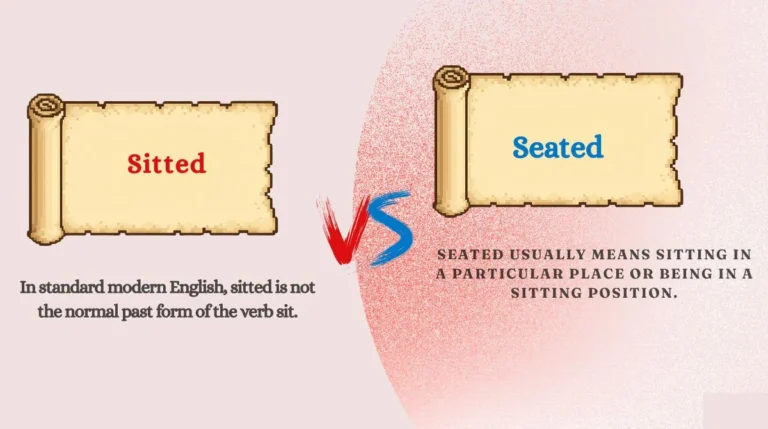
In standard modern English, sitted is not the normal past form of the verb sit.
This is one of the most common mistakes made by English learners. They see a verb such as walk becoming walked and assume that sit should become sitted. That looks logical, but sit is an irregular verb.
The standard forms are:
- Present: sit
- Past: sat
- Past participle: sat
- -ing form: sitting
Oxford lists the verb forms as sit, sat, sat, sitting, while Merriam-Webster also gives sat as the past form and sitting as the -ing form.
The Language Portal of Canada specifically uses sitted as an example of a nonstandard verb form and explains that the correct form is sat.
Why Do People Write “Sitted”?
The mistake usually happens because learners apply a regular verb rule to an irregular verb.
For example:
- talk → talked
- clean → cleaned
- open → opened
- work → worked
A learner may then think:
- sit → sitted ❌
But English does not work that way with every verb.
Some common irregular verbs change completely:
- go → went
- eat → ate
- take → took
- come → came
- sit → sat
The safest rule is simple: Do not use “sitted” as the normal past form of “sit.” Use “sat.”
Examples of the Correct Form
Here are some examples that show how sat should be used:
- She sat beside her brother.
- I sat on the sofa after dinner.
- We sat in the waiting room for an hour.
- He sat near the window.
- They sat at the table and talked.
- The children sat quietly during the lesson.
- I sat down when the teacher arrived.
- She sat next to me on the bus.
Notice that we do not need sitted in any of these sentences.
When Should You Use “Sit”?
Use sit for the present tense, especially after words such as will, can, should, may, and to.
Examples:
- Please sit here.
- I usually sit near the front.
- You can sit with us.
- We will sit outside.
- She wants to sit by the door.
- You should sit down.
So remember:
sit = present
sat = past
A Common Learner Confusion
A learner might write:
Yesterday, I sitted in the park. ❌
The correct sentence is:
Yesterday, I sat in the park. ✅
Another common error is:
He sitted next to me. ❌
Correct:
He sat next to me. ✅
The problem is not pronunciation or meaning. The problem is the verb form.
What Does “Seated” Mean?
Seated usually means sitting in a particular place or being in a sitting position.
Cambridge defines seated as an adjective meaning “sitting.” It gives examples such as “The woman seated opposite him” and “You are requested to remain seated.”
This means that seated and sitting can sometimes describe the same physical situation, but they are used differently in sentences.
For example:
- She is sitting by the window.
- She is seated by the window.
Both can describe a woman who is in a chair by the window. The second sentence sounds a little more formal.
“Seated” Comes From “Seat”
This is the part that often causes confusion.
Sit and seat are related in meaning, but they are not the same verb.
- sit = to be in a sitting position
- seat = to put someone in a seat or help someone find a seat
Merriam-Webster defines seat as a transitive verb meaning, among other things, to cause someone to sit, assist someone in finding a seat, or put someone in a sitting position.
That is why seated is not simply the past tense of sit.
Compare:
- I sat in the chair.
- The host seated me in the front row.
In the first sentence, I performed the action of sitting.
In the second sentence, the host caused or helped me to sit in a particular place.
Examples of “Seated”
Here are some natural examples:
- The guests were seated at the dinner table.
- She was seated near the entrance.
- Everyone remained seated during the speech.
- The students were seated in rows.
- Please remain seated until the bus stops.
- The waiter seated us near the window.
- He was seated beside his parents.
- The audience was already seated when the show began.
The phrase be seated is especially common in formal situations.
For example:
- Please be seated.
- All passengers must remain seated.
- The guests were seated before dinner was served.
Cambridge specifically labels “please be seated” as formal.
Is “Seated” Formal?
Often, yes.
Seated is completely correct in everyday English, but it can sound more formal than sitting or sat.
Compare:
- She is sitting in the waiting room. — natural and conversational
- She is seated in the waiting room. — correct, slightly more formal
That is why you often hear seated in announcements, restaurants, offices, theaters, ceremonies, and formal instructions.
Difference Between “Sitted” and “Seated”
The biggest point is this:
“Sitted” is generally not the correct standard form of “sit.” “Seated” is a correct word, but it comes from “seat,” not from the past tense of “sit.”
Here is a clear comparison:
| Word | Correct? | Source Verb | Main Use | Example |
|---|---|---|---|---|
| sitted | ❌ Usually nonstandard | sit | Avoid in standard English | She sitted here. ❌ |
| sat | ✅ Yes | sit | Past tense of sit | She sat here. ✅ |
| seated | ✅ Yes | seat | Being in a seat / placed in a seat | She was seated here. ✅ |
| sitting | ✅ Yes | sit | Present participle / continuous form | She is sitting here. ✅ |
| sit | ✅ Yes | sit | Present/base form | Please sit here. ✅ |
“Sat” vs. “Seated”
This is actually the more useful comparison for learners.
Look at these sentences:
She sat by the window.
This tells us that she took or occupied that position.
She was seated by the window.
This describes her position. It can also suggest that someone placed her there.
Another pair:
We sat at table 4.
This is simple and conversational.
We were seated at table 4.
This sounds more formal and focuses on the arrangement or assigned location.
Grammar Logic
The key is to identify the verb.
With “sit”
The forms are:
sit → sat → sat
Examples:
- I sit here every day.
- I sat here yesterday.
- I have sat here before.
With “seat”
The forms are:
seat → seated → seated
Examples:
- The waiter seats the guests.
- The waiter seated the guests.
- The waiter has seated the guests.
This is a completely different verb pattern.
Sentence Structure Difference
Sit is commonly used without a direct object:
She sat on the chair.
We do not normally say:
She sat the chair. ❌
Seat, on the other hand, is normally transitive when it means “put someone in a seat”:
The waiter seated the guests. ✅
Here, the guests receive the action.
You can also use:
She seated herself near the window.
This means she placed herself in that seat.
Grammar Rules You Must Remember
Rule 1: The past tense of “sit” is “sat,” not “sitted.”
This is the most important rule.
Correct:
I sat on the bench yesterday.
Incorrect:
I sitted on the bench yesterday.
Oxford and Cambridge both list sat as the past tense of sit.
Rule 2: Use “seated” when describing someone who is sitting or has been placed in a seat.
Correct:
The guests were seated at the table.
Correct:
She remained seated during the meeting.
The word seated often describes a person’s position rather than simply stating the action of sitting.
Rule 3: “Seat” and “sit” are different verbs.
Use sit when a person is taking or occupying a sitting position.
Use seat when someone puts a person in a seat or helps them find a seat.
Compare:
I sat near the door.
The receptionist seated me near the door.
This small change in the verb changes the sentence structure and meaning.
Rule 4: “Be seated” is a common fixed expression.
You will often hear:
- Please be seated.
- Remain seated.
- Everyone was seated.
- The audience was seated before the show started.
These are completely natural forms in standard English. Cambridge also gives “please be seated” as a formal expression meaning please sit down.
Common Mistakes Students Make
Mistake 1: Using “Sitted” as the Past Tense
Incorrect:
She sitted on the sofa.
Correct:
She sat on the sofa.
Why does this mistake happen? Because learners expect a regular -ed ending.
Easy tip: learn sit as a three-part irregular verb:
sit – sat – sat
Mistake 2: Thinking “Seated” Is the Past Tense of “Sit”
This is also incorrect.
You may see:
She seated in the room. ❌
The sentence is missing the correct structure.
You can say:
She sat in the room. ✅
or:
She was seated in the room. ✅
The difference is that sat is the past tense of sit, while was seated uses seated as an adjective/past-participial form connected to seat.
Mistake 3: Using “Seated” Without a Needed Form of “Be”
Incorrect:
He seated in the classroom. ❌
Correct:
He was seated in the classroom. ✅
Or:
He sat in the classroom. ✅
When seated describes a person’s state or position, forms such as is seated, was seated, were seated, remained seated are common.
Mistake 4: Saying “I Seated There”
Incorrect:
I seated near the window. ❌
Better:
I sat near the window. ✅
Or:
I was seated near the window. ✅
Remember that seat usually needs an object when it means “put someone in a seat.”
For example:
The receptionist seated me near the window.
Here, me is the object.
Mistake 5: Confusing “Sitting” and “Seated”
Both can be correct:
She is sitting in the office.
She is seated in the office.
The first sounds more natural in many casual conversations. The second can sound more formal or can focus more strongly on the person’s position.
So the words are not always direct substitutes in every sentence, even though their meanings can overlap.
Easy Trick to Remember the Difference
Here is a simple classroom trick:
Think: “SIT = SAT”
When you talk about what a person did, remember:
sit → sat
For example:
- Today I sit here.
- Yesterday I sat here.
Never change sit into sitted in standard English.
Think: “SEAT = PLACE”
The verb seat is connected to the idea of a seat or placing someone in a seat.
For example:
The usher seated us.
The usher helped put us in our seats.
Then:
We were seated in the front row.
That sentence describes where we ended up.
A useful memory line is:
Sit = your position.
Seat = place someone in a position.
There are exceptions and special uses in English, but this simple distinction will help in most everyday situations.
Daily Life Examples
Understanding grammar becomes much easier when you hear it in real situations.
1. At a Restaurant
Waiter: Your table is ready.
You: Great, thank you.
Waiter: Please be seated.
Here, be seated is a polite and somewhat formal way to tell someone to sit down. Cambridge gives this as a standard formal expression.
2. At School
Teacher: Where did you sit yesterday?
Student: I sat in the second row.
Notice sat, not sitted.
3. On a Bus
Driver: Please remain seated while the bus is moving.
Seated works well because it describes the passengers’ position.
4. At a Wedding
Host: The guests were seated before the ceremony began.
This sounds natural because the sentence describes how the guests were arranged.
5. At Home
Mom: Where is your brother?
You: He is sitting in his room.
This is casual, everyday English.
6. At a Theater
Usher: Your seats are over there.
Guest: Thank you.
Usher: Please be seated before the show starts.
Again, be seated is a natural formal expression.
7. At the Office
Manager: Where did you sit during the meeting?
Employee: I sat beside Sarah.
The action happened in the past, so sat is correct.
8. At a Doctor’s Office
Receptionist: Please have a seat.
Patient: Thank you.
Later, someone might say:
The patient was seated in the waiting area.
9. On an Airplane
Flight attendant: Please remain seated until the seat belt sign is turned off.
Here, seated describes the required position.
10. At a Formal Event
Host: Once everyone was seated, the speaker began the presentation.
This is a very common pattern in formal writing and speech.
Practice Section
Choose the correct word or phrase in each sentence.
1. Yesterday, I ___ beside my friend.
- A) sitted
- B) sat
- C) seated
Answer: B) sat
The sentence talks about the past action of sit, so sat is correct.
2. Please remain ___ until the plane stops.
- A) sitted
- B) sat
- C) seated
Answer: C) seated
The expression remain seated means continue sitting.
3. The waiter ___ us near the window.
- A) sat
- B) seated
- C) sitted
Answer: B) seated
The waiter placed or helped the guests into their seats, so the verb is seat → seated.
4. She ___ down when the teacher entered.
- A) sat
- B) sitted
- C) seated
Answer: A) sat
The past form of sit is sat.
5. He was ___ at the front of the room.
- A) sitted
- B) sat
- C) seated
Answer: C) seated
The natural structure is was seated.
FAQs
1. What is the difference between sitted and seated?
Sitted is generally not a standard modern English form for the verb sit. The normal past tense is sat. Seated is a correct word related to the verb seat and commonly means being in a sitting position or being placed in a seat.
2. Is “sitted” correct English?
In standard English, sitted should normally be avoided. Major grammar and dictionary sources give sat as the past form of sit. For example, “I sat on the chair” is correct, while “I sitted on the chair” is not standard usage.
3. Is “seated” the past tense of “sit”?
No. The past tense of sit is sat. Seated comes from the verb seat. Seat can mean to put someone in a seat, and seated is also used as an adjective meaning “sitting.”
4. Can I say “I was seated”?
Yes. I was seated is correct. It means that you were in a sitting position or had been placed in a seat. For example: I was seated near the front of the room. This form is common, especially in formal or descriptive English.
5. Is “Please be seated” formal or informal?
Please be seated is correct and is generally considered formal. It is common in ceremonies, meetings, theaters, classrooms, official announcements, and other organized settings. Cambridge specifically marks this expression as formal.
6. Which is correct: “I sat” or “I was seated”?
Both can be correct, but they are used differently. I sat is the simple past of sit and focuses on the action. I was seated focuses more on your position or on the fact that you had been placed in a seat. In casual conversation, I sat is often the simpler choice.
Conclusion
The easiest way to solve the sitted or seated confusion is to remember that sit and seat are two different verbs.
The verb sit is irregular:
sit → sat → sat
So when you talk about the past, say sat, not sitted. Major dictionaries such as Oxford, Cambridge, and Merriam-Webster list sat as the past form of sit.
The word seated comes from seat. It can mean that someone is sitting in a particular place or has been placed in a seat. Expressions such as was seated, remain seated, and please be seated are all correct.
A simple rule can save you every time:
Sit → Sat
Seat → Seated
Once you start noticing these forms in conversations, movies, classrooms, restaurants, and signs, the difference will feel much more natural. Keep practicing with short sentences, and this common grammar mistake will quickly become easy to avoid.

Evan Rellmont is a writer who turns thoughtful ideas into meaningful words, creating stories and reflections that connect, inspire, and leave a lasting impression.