
English has many words that sound exactly the same but have different meanings and spellings. Stake and steak are two common examples.
When you hear either word in a conversation, you hear the same sound: /steɪk/. The problem starts when you need to write the word. Which spelling should you choose?
The answer depends completely on the meaning.
Steak is usually connected with food. It means a slice or piece of meat, often beef, that is cooked by grilling, frying, broiling, or another method. Stake, on the other hand, has several meanings.
It can mean a strong post or stick placed in the ground, money or something valuable put at risk, a share or interest in something, or the possible consequences of an action.
It can also be used as a verb, such as in “stake money” or “stake a claim.”
These words are especially confusing because their pronunciation gives you no spelling clue. You have to understand the sentence and its meaning.
Once you learn the basic idea, the difference becomes easy. Think about the situation first: Are you talking about food? Use steak. Are you talking about risk, a share, a post, or something important that can be lost? Use stake.
4. What Does “Stake” Mean?
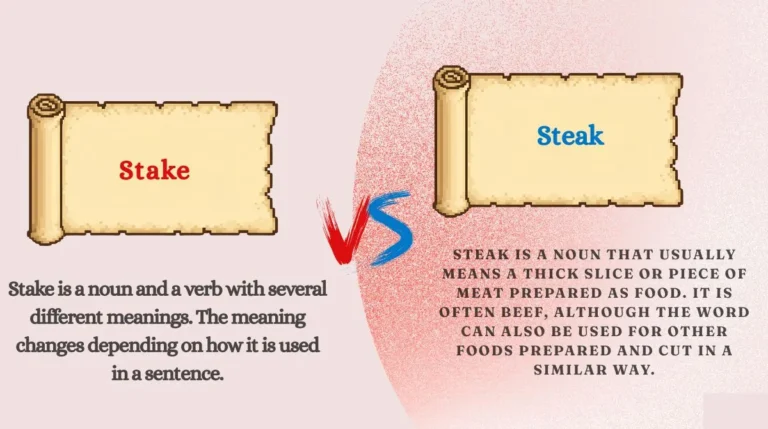
Stake is a noun and a verb with several different meanings. The meaning changes depending on how it is used in a sentence.
The easiest way to understand stake is to remember its main ideas: a post, money at risk, an interest or share, or something that matters in a result.
Stake as a noun
One meaning of stake is a pointed piece of wood or metal that is driven into the ground. It can be used to support something, mark a place, hold an object in position, or keep an animal in one area.
For example:
- The gardener placed a stake next to the young tree.
- Tie the plant to a stake so it does not fall.
- The tent was held down with wooden stakes.
- He drove a stake into the ground to mark the corner.
- The farmer used a stake to keep the gate in place.
- We used two metal stakes to secure the sign.
Here, stake refers to a physical object.
Stake as money or something valuable at risk
Another common meaning is money or something valuable that you risk in a game, bet, competition, or uncertain situation.
For example:
- He put $20 at stake in the game.
- The players knew there was a lot at stake.
- She had a personal stake in the decision.
- They were unwilling to put their savings at stake.
- His reputation was at stake after the mistake.
The expression “at stake” is very common in English. It means that something important may be lost, damaged, or affected.
For example:
Her future is at stake.
This means her future could be seriously affected by what happens.
Stake as a share or interest
Stake can also mean a share, financial interest, or level of involvement in a business, project, or situation.
For example:
- Maria owns a stake in the company.
- He bought a small stake in the business.
- The investors want a larger stake in the project.
- She has a personal stake in the outcome.
- Several companies have a financial stake in the deal.
In this meaning, stake is not a physical object. It refers to a share or interest that connects someone to something.
Stake as a verb
Stake is also used as a verb. It can mean to risk something valuable, place something as a bet, or make a firm claim.
For example:
- I would not stake my savings on that plan.
- He staked his reputation on the result.
- She staked all her money on the business idea.
- They staked a claim to the land.
- The company staked its future on the new product.
The phrase “stake a claim” means to say or show that you have a right to something.
Common learner confusion with “stake”
The biggest problem is that stake sounds exactly like steak. A learner may hear:
“We need a stake.”
and think about meat because the sound is identical.
The best solution is to focus on meaning, not pronunciation.
When the sentence is about food, cooking, grilling, meat, or dinner, the word is usually steak.
When the sentence is about risk, money, ownership, claims, support, or something important that could be lost, the word is likely stake.
5. What Does “Steak” Mean?
Steak is a noun that usually means a thick slice or piece of meat prepared as food. It is often beef, although the word can also be used for other foods prepared and cut in a similar way.
The most common use is in phrases such as beef steak, grilled steak, steak dinner, and steak sandwich.
Steak as food
For example:
- I ordered a steak for dinner.
- The restaurant serves excellent steak.
- She cooked a steak on the grill.
- We had steak and vegetables last night.
- He likes his steak medium rare.
- The chef prepared a juicy steak.
- They shared a large steak.
- I bought two steaks from the butcher.
When you are talking about a particular piece, a steak is common.
For example:
I ordered a steak.
When you are talking about steak as food in general, the noun can also be used without an article.
For example:
We had steak for dinner.
Steak can be countable or uncountable
This is a useful grammar point for learners.
When steak means an individual piece of meat, it is often countable:
- one steak
- two steaks
- three steaks
Example:
We ordered two steaks.
But when you are talking about the food generally, steak may be treated as an uncountable food noun.
Example:
We had steak for lunch.
Both uses are natural, but the sentence structure changes according to the meaning.
Common types and phrases
You may see steak in many food-related expressions:
- grilled steak
- fried steak
- beef steak
- steak sandwich
- steak dinner
- steak knife
- steak sauce
- steakhouse
Examples:
- The steakhouse was crowded tonight.
- Please pass the steak sauce.
- This steak knife is very sharp.
- We had a wonderful steak dinner.
Common learner confusion with “steak”
Because steak sounds like stake, learners sometimes write the wrong spelling.
A sentence such as:
I had a delicious stake for dinner.
is incorrect when the writer means meat.
The correct sentence is:
I had a delicious steak for dinner.
A simple clue is this: if you can reasonably replace the word with “meat” or “piece of meat,” you probably need steak.
6. Difference Between Stake and Steak
The most important thing to remember is that stake and steak are homophones. Homophones are words that have the same pronunciation but different meanings and spellings.
Both words are pronounced /steɪk/.
However, their meanings are completely different.
| Word | Pronunciation | Part of Speech | Main Meaning | Example |
|---|---|---|---|---|
| Stake | /steɪk/ | Noun, Verb | A post, risk, share, interest, or something valuable involved in an outcome | Her reputation is at stake. |
| Steak | /steɪk/ | Noun | A piece of meat used as food | We cooked a steak for dinner. |
Usage difference
Use steak when the topic is food.
The steak was tender and juicy.
Use stake when the topic is risk.
A lot is at stake.
Use stake when the topic is ownership or interest.
He owns a stake in the company.
Use stake when the word means a post or support.
The plant needs a stake.
Grammar logic
There is an important grammar difference as well.
Stake can be both a noun and a verb:
- Noun: She has a stake in the business.
- Verb: He staked his money on the result.
Steak is normally a noun:
- We ordered steak.
- She cooked two steaks.
So if the word appears as a verb meaning “risk” or “claim,” it must be stake, not steak.
Sentence structure difference
Look at these patterns:
Stake + in
He has a stake in the company.
This means he has an interest or share in the company.
At stake
Her job is at stake.
This means her job may be lost or affected.
Stake + object + on
He staked his savings on the new business.
This means he risked his savings.
A steak + food verb
She grilled a steak.
We ordered steak.
The surrounding words usually make the intended meaning clear.
Meaning comparison
Consider these two sentences:
The stake was buried in the garden.
The steak was served with potatoes.
They sound similar when spoken, but their meanings have nothing to do with each other. One is an object used in the ground, while the other is food.
That is why spelling matters so much with homophones.
7. Grammar Rules You Must Remember
Rule 1: Use “steak” for meat or food
Whenever the word refers to a piece of meat prepared for eating, use steak.
Examples:
I ordered a steak at the restaurant.
She cooked two steaks for the guests.
A quick check is to ask yourself, “Can I eat it?” If the answer is yes and the word refers to the meat, steak is the correct spelling.
Rule 2: Use “stake” for risk, interest, or something important
Use stake for an amount or interest that can be risked, lost, or involved.
Examples:
His career is at stake.
She has a financial stake in the company.
The common phrase “at stake” is especially useful to remember.
Rule 3: Use “stake” for a post or support
A stake can be a stick or post pushed into the ground.
Examples:
The gardener tied the tree to a stake.
The tent was secured with four stakes.
This meaning has nothing to do with food.
Rule 4: “Stake” can be a verb, but “steak” normally cannot
Use stake as a verb when you mean to risk something or make a claim.
Examples:
They staked their savings on the idea.
She staked her reputation on his success.
The company staked a claim to the property.
Do not use steak in these verb patterns.
8. Common Mistakes Students Make
The main reason students make mistakes with these words is simple: they sound identical.
When English learners hear a sentence, they cannot see the spelling. Later, when they write it, they may choose the wrong word.
Mistake 1: Using “stake” for food
Incorrect:
We ate stake for dinner.
Correct:
We ate steak for dinner.
Why? Because the sentence is about meat.
Mistake 2: Using “steak” for risk
Incorrect:
His job is at steak.
Correct:
His job is at stake.
Why? Because at stake is an established expression meaning that something important may be lost or affected.
Mistake 3: Mixing up “stake” and “steak” in business
Incorrect:
She owns a small steak in the company.
Correct:
She owns a small stake in the company.
Here, stake means a share or financial interest.
Mistake 4: Using “steak” as a verb
Incorrect:
He steaked all his savings on the project.
Correct:
He staked all his savings on the project.
Stake is the verb meaning “risk.”
Easy correction tips
Before choosing the spelling, ask:
Is it food?
Use steak.
Is it a risk, share, post, claim, or something important that may be lost?
Use stake.
You can also look at nearby words. Words such as grill, cook, eat, restaurant, meat, dinner, sauce, knife, and potatoes strongly suggest steak.
Words such as risk, money, company, claim, reputation, interest, future, and at often suggest stake.
9. Easy Trick to Remember the Difference
Here is a simple memory trick:
Steak = food
Think of the “ea” in steak as being connected with eating.
You do not need this as a real spelling rule. It is simply a memory trick to help you remember:
Steak → eat → food
Now remember:
Stake = risk, share, or post
Think about a wooden stake standing in the ground. A stake can be a strong post.
Then connect the word to the phrase:
“Something is at stake.”
That phrase means something important could be lost.
You can also remember:
Steak goes on your plate. Stake goes in the ground or into a risk.
For example:
- A steak goes on your plate.
- A stake may go in the ground.
- Your money may be at stake.
- You may have a stake in a business.
This mental picture makes the spelling easier to recall.
10. Daily Life Examples
These examples show how the two words appear naturally in everyday English.
Example 1: At a restaurant
Customer: What do you recommend?
Waiter: Our grilled steak is very popular.
Here, the meaning is food, so the spelling is steak.
Example 2: Talking about dinner
We are having steak and salad tonight.
The speaker is talking about a meal.
Example 3: Gardening
The tree is leaning, so I need a stake to support it.
This is the post/support meaning.
Example 4: Business
My brother has a stake in the family business.
This means he has an ownership or financial interest.
Example 5: A serious situation
There is a lot at stake in tomorrow’s meeting.
Something important may be gained or lost.
Example 6: Taking a risk
I would never stake my savings on something I do not understand.
Here, stake is a verb meaning to risk.
Example 7: Dinner with friends
Friend: What did you order?
You: I ordered a grilled steak with vegetables.
The word clearly refers to food.
Example 8: Marking a place
They put a wooden stake in the ground to mark the boundary.
Again, this is the post meaning.
Example 9: Reputation
She staked her reputation on the new design.
She took a serious risk involving her reputation.
Example 10: An important decision
Our future is at stake, so we need to think carefully.
The phrase tells us that something important may be affected.
11. Practice Section
Choose the correct word: stake or steak.
1. We ordered a large ______ for dinner.
a) stake
b) steak
2. His reputation is at ______.
a) stake
b) steak
3. She owns a small ______ in the company.
a) stake
b) steak
4. The farmer used a wooden ______ to support the young tree.
a) stake
b) steak
5. He ______ all his savings on the new business.
a) steaked
b) staked
Answers
1. steak — It refers to food.
2. stake — The correct expression is at stake.
3. stake — Here, it means a share or financial interest.
4. stake — It is a post used to support something.
5. staked — Stake can be used as a verb meaning to risk something.
12. FAQs About Stake and Steak
What is the difference between stake and steak?
Stake has several meanings. It can mean a post, a risk, a share, an interest, or the amount of something important that may be lost.
Steak usually means a piece of meat prepared as food. The two words sound the same but have different spellings and meanings.
Are stake and steak pronounced the same?
Yes. Stake and steak are homophones, which means they have the same pronunciation but different spellings and meanings.
Both are normally pronounced /steɪk/. You must use the context to understand which word is intended.
Can “stake” be used as a verb?
Yes. Stake can be a verb meaning to risk something valuable or make a claim.
For example, “He staked his reputation on the plan” means he risked his reputation. “They staked a claim” means they claimed a right to something.
Is “steak” only used for beef?
Not always. Steak is commonly associated with beef, but the word can be used for other foods or cuts prepared in a steak-like way.
However, in everyday English, when people simply say steak, they are very often talking about beef steak.
Is “at stake” correct grammar?
Yes. At stake is a very common English expression.
It means that something important is in danger of being lost, damaged, or affected. For example, “Her job is at stake” means her job may be lost depending on what happens.
How can I remember stake vs steak?
Use the simple idea “steak = eat.” When you are talking about food or meat, choose steak.
Use stake for a post, risk, share, claim, or something important that can be lost. The phrase “at stake” is a useful clue.
Conclusion
The difference between stake and steak becomes much easier when you stop relying on sound and start looking at meaning. Both words are pronounced the same, but they are used in very different situations.
Steak is mainly a food word. You eat it, cook it, grill it, order it, or serve it. Stake has several meanings. It can be a post in the ground, a share or interest in something, something valuable at risk, or a verb meaning to risk or claim something.
Remember the simple classroom trick: steak is for eating, while stake is connected with risk, shares, posts, and claims.
The phrase “at stake” is especially important because it appears often in everyday and written English. A little practice with real sentences will help the correct spelling become automatic. The next time you hear /steɪk/, pause for a second and ask yourself what the speaker means. That one habit can prevent many spelling mistakes.

Evan Rellmont is a writer who turns thoughtful ideas into meaningful words, creating stories and reflections that connect, inspire, and leave a lasting impression.